Create my document
Login

Choose country

FranceBelgiqueEspañaUnited StatesUnited KingdomالمغربDeutschlandItalia
Employment

Paid & Unpaid Internship Agreement Template (Word, PDF)

Lawyer-drafted internship agreement for paid and unpaid roles. Reduce labor law risk, set clear terms, stay FLSA-compliant in all 50 states. Word & PDF.
4.8/532 reviews50 000+ downloadsInstant download
Share

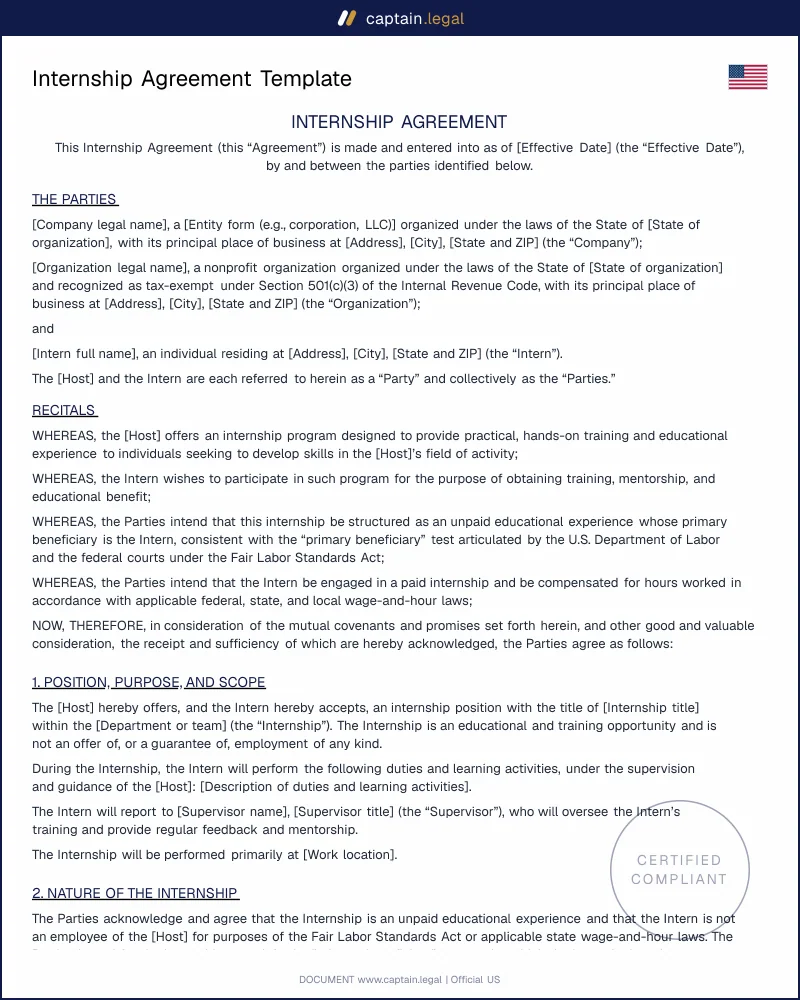
An internship agreement is the written contract that defines the relationship between an intern and the company, nonprofit, or startup that hosts them. It fixes the dates, the duties, the supervision, and above all whether the position is paid or unpaid, which is the single decision that creates the most legal exposure in the United States. For a for-profit employer, getting the paid-versus-unpaid classification wrong is not a paperwork slip; it can trigger back wages, overtime, and penalties under the Fair Labor Standards Act. A well-drafted internship agreement documents the educational purpose of the role, sets expectations on both sides, and gives you a clean record if a regulator or a former intern ever asks who really benefited from the arrangement. This template works for paid and unpaid programs alike and adjusts to the federal and state rules that apply to your situation.

Compliant

2026 Legislation

50,000+ clients

trust us

Affordable

From $4.90 / doc

Secure payment

Instant download

Paid & Unpaid Internship Agreement Template (Word, PDF)

Secure payment · No subscription

Fill in the template

What is an internship agreement?

An internship agreement is a fixed-term contract between a host organization and an individual who joins primarily to learn, observe, and develop skills in a real work setting. It is not the same thing as an employment contract, even when the intern is paid. An employment contract assumes an ongoing economic exchange of labor for wages; an internship agreement frames the relationship around training and education, with compensation treated as a separate, deliberate choice rather than an automatic entitlement. That framing matters because it shapes how courts and the Department of Labor later characterize the role.

People also confuse an internship agreement with an independent contractor agreement. A contractor runs their own business and delivers a defined result; an intern is supervised, follows the host's schedule, and is there mainly to gain experience. Calling someone an "intern contractor" to dodge both wage law and payroll taxes is the kind of shortcut that collapses under scrutiny. The cleanest programs pick one lane and document it. If you want to compare the contractor route for genuinely independent talent, our independent contractor and freelancer agreement options sit in the business catalog. Choose the wrong document type and the label on the page will not save you, because US agencies look at the actual economic reality of the relationship, not the title you typed at the top.

2

When do you need this document?

The most common trigger is launching a summer or semester internship program at a startup or growing company, where founders want eager talent but have not thought through whether the FLSA requires pay. A written agreement forces that decision early, before the intern has worked three weeks and a wage claim is already taking shape. The second frequent scenario is a for-profit business taking on a student for academic credit. Credit alone does not make an internship lawfully unpaid, but a role genuinely integrated with a degree program scores well on the primary beneficiary test, and the agreement is where you record that integration.

Nonprofits and charities reach for this document when they want to distinguish a true learning placement from ordinary volunteer help or from a paid junior role. The line is real, and the paperwork keeps it visible. Companies also use an internship agreement when an intern will touch sensitive material, since confidentiality and invention-assignment language belongs in the contract from day one, not in an afterthought email.

Two edge cases legitimize careful drafting. First, the intern who quietly becomes indispensable: once a so-called intern is covering a vacant role, answering customer tickets, or hitting revenue targets, the displacement factor flips against you and the position has effectively become paid employment. Second, the international intern on a J-1, F-1 CPT, or OPT status, where immigration rules layer on top of wage law and the agreement has to satisfy both. Treat the agreement as the moment you classify the role, not as a formality you sign after the fact.

3

Key clauses included in our template

  • The parties and program identification names the host organization and the intern in full and states plainly whether the internship is paid or unpaid. This single line anchors every other clause, because the entire FLSA analysis flows from the compensation decision recorded here.
  • The educational purpose and supervision clause describes the learning objectives, the skills the intern will develop, and the named supervisor responsible for mentoring. This is the heart of the primary beneficiary case: it shows the program was designed around training rather than around getting unpaid labor.
  • The term and schedule clause fixes start and end dates and weekly hours, tying the duration to the period of meaningful learning. A definite, limited term reads far better under Fact Sheet #71 than an open-ended arrangement that drifts into ordinary employment.
  • The compensation or stipend clause sets out pay, overtime treatment, and any stipend for a paid program, or expressly confirms the absence of pay and the shared understanding behind it for an unpaid one. Getting this language to match reality is what keeps you off the wrong side of a minimum wage claim.
  • The confidentiality and invention assignment clause protects trade secrets, customer data, and any work product the intern creates, and it requires the return of company property at the end. For startups whose value sits in code and ideas, this clause is not optional.
  • The no-guarantee-of-employment and at-will clause confirms the internship does not promise a job and, if the role is paid, that any resulting employment is at-will. Our at-will employment agreement template handles the conversion when an intern is later hired on.
4

State-specific considerations

State law frequently raises the bar above the federal floor, and a handful of jurisdictions deserve particular attention before you run an unpaid program.

California is the strictest environment in the country for unpaid internships. The state generally follows the federal primary beneficiary test, but California's Division of Labor Standards Enforcement applies it skeptically, and the state minimum wage sits well above the federal one, so a misclassified intern in California accrues larger back-wage liability. Programs that displace regular staff or run without genuine academic structure are the ones that draw claims. If your "intern" looks like a junior employee, treat them as one and use our employee offer letter template instead.

New York layers extra obligations on top of the FLSA factors. The state has long applied an expanded set of criteria for unpaid interns, and recent guidance has tightened the expectation that interns receive a genuine evaluation and structured learning rather than routine work. New York's higher minimum wage compounds the cost of getting it wrong, and the state Department of Labor has been active in this area. Document the educational component carefully and keep written proof of the supervision and feedback the intern actually received.

Texas is more permissive and tracks the federal standard closely without adding its own intern-specific overlay, which makes the FLSA primary beneficiary analysis the controlling test. That is not a license to relax: the federal seven factors still apply with full force, and a Texas intern doing displacing work is just as entitled to wages as one anywhere else. Florida likewise follows the federal framework without a separate state intern statute, so the same primary beneficiary analysis governs, and the practical risk again concentrates in roles where the intern's work substitutes for paid headcount rather than supplementing it.

5

How to fill out this internship agreement

You start by choosing whether the internship is paid or unpaid, because that answer drives the rest of the form. From there you enter the host organization and intern details, then select the state where the internship takes place so the template can flag the local wage rules that apply. Next you describe the program itself: the learning objectives, the supervisor's name, the start and end dates, and the weekly hours, which together build the educational record that the primary beneficiary test rewards.

If you selected a paid program, you fill in the rate and confirm how overtime is handled; if unpaid, you confirm the shared understanding that there is no compensation and no promise of a job. You then set the confidentiality and invention-assignment terms to match how much sensitive material the intern will see. The form lets you add academic-credit details when the placement is tied to a degree program, which strengthens the unpaid classification. Once you have reviewed the summary, you download the finished agreement in Word and PDF and route it for signature. For related hiring paperwork once an intern converts, browse the full US legal documents catalog.

6

Common mistakes to avoid

The mistake that produces the most claims is labeling a position "unpaid internship" while assigning it the work of a paid employee. The label carries no weight on its own. If the intern answers customer tickets, closes sales, or covers a vacant seat, the displacement factor turns against the employer and the FLSA treats the role as employment regardless of what the agreement says. A close second is assuming that offering academic credit automatically makes an internship lawfully unpaid. Credit is one factor among seven, and a poorly structured program with credit attached still fails if the company is the real beneficiary.

Employers also stumble on state law by drafting to the federal floor and forgetting that California or New York demand more. Another recurring error is leaving compensation language vague, so the document neither confirms a clear "no pay" understanding nor sets a defensible rate, which is precisely the ambiguity that wage disputes feed on. Finally, many programs skip confidentiality and invention-assignment terms entirely, then discover an intern walked out with code or client data and no contractual obligation to return it. Decide the classification honestly at the start, draft to the stricter of federal and state law, and keep written proof of the training the intern actually received.

Key takeaways

Paid vs. Unpaid

Misclassification can trigger back pay liability

For a for-profit host, the paid-versus-unpaid call is where most legal exposure sits. If an “unpaid intern” is later treated as an employee under the Fair Labor Standards Act (FLSA), the company can face claims for back wages, overtime, and penalties. The agreement should state clearly whether the role is paid or unpaid and document the educational purpose behind the setup.

FLSA Standard

Use the primary beneficiary test

Since 2018, the Department of Labor applies the seven-factor primary beneficiary test to unpaid internships, as described in Fact Sheet #71. No single factor controls, and the outcome depends on the real facts, not a checklist. Your agreement should align with that framework by reflecting training similar to school, limited duration tied to learning, and an understanding there is no promise of pay.

Document Choice

Labels do not beat economic reality

Do not try to split the difference with made-up categories like an “intern contractor.” Agencies and courts look at the economic reality: contractors run their own business and deliver a defined result, while interns are supervised, follow the host’s schedule, and are there mainly to learn. If you pick the wrong document type, the title on the page will not protect you.

Frequently Asked Questions

Yes. An internship agreement is a contract, and once both parties sign it, the duties, dates, confidentiality terms, and compensation provisions are enforceable like any other agreement. What it cannot do is override wage law. If the facts show an unpaid intern was really an employee under the FLSA primary beneficiary test, a signed "unpaid" clause will not defeat a claim for minimum wage and overtime. The agreement is binding on the things parties can freely decide, and it is strong evidence of the program's educational intent, but it sits underneath the statutory rules a private contract cannot waive.

Sometimes, but only if the intern is genuinely the primary beneficiary of the relationship. The Department of Labor applies a flexible seven-factor test that weighs whether the experience resembles classroom training, ties to formal education, runs for a limited learning period, and avoids displacing paid staff. A for-profit business can host a lawful unpaid internship when those factors point toward education over labor. The moment the intern's work mainly benefits the company, the role becomes employment and federal law requires pay. Nonprofits have somewhat more room, but the volunteer exemption is narrow and fact-specific.

There is no fixed legal limit, but duration is one of the seven factors courts weigh. The internship should run only as long as it provides meaningful learning, which is why most programs align with a semester or a summer rather than stretching indefinitely. An open-ended placement that continues past any genuine educational purpose starts to look like ordinary employment, weakening an unpaid classification. A defined term with clear start and end dates, recorded in the agreement, reads far better under Fact Sheet #71 than an arrangement that quietly rolls on month after month.

The template downloads in both Word and PDF. The Word file lets you edit clauses, adjust the schedule, and tailor the confidentiality language to your organization, with tracked changes if several people review it. The PDF gives you a clean, fixed version to circulate for signature and to store once executed. Keeping both is good practice: you edit in Word during drafting and archive the signed PDF as your record. Having a dated, signed copy on file is exactly the documentation you want if the classification of the role is ever questioned.

If the intern qualifies as an employee, which any paid intern at a for-profit employer generally does, then yes, overtime rules under the FLSA apply unless a genuine exemption fits. Most interns do not meet the duties tests for the executive, administrative, or professional exemptions, so they are non-exempt and earn time-and-a-half beyond forty hours in a workweek. Calling the role an "internship" does not change that. Track hours accurately and budget for overtime, because a job title never substitutes for the duties-and-salary analysis the law requires.

No. This is one of the most common misconceptions. Academic credit is helpful evidence under the primary beneficiary test because it ties the internship to a formal education program, but it is only one of seven factors and never decisive on its own. A company that hands an intern employee-level work cannot rely on credit to avoid paying wages. Credit strengthens an unpaid classification when the rest of the program is genuinely educational; it cannot rescue a placement that is really a job in everything but name.

It can, and many do, but the agreement should make clear that the internship itself carries no promise of future employment. That no-guarantee language is one of the seven factors supporting a lawful unpaid program, since an internship offered as a guaranteed path to a paid role looks more like a trial employment period. When you do decide to hire an intern afterward, you move them onto standard hiring paperwork and treat the new role as at-will in most states. The internship and the eventual job are two separate relationships, documented by two separate agreements.

The exposure is significant. If the Department of Labor or a court finds that an "unpaid intern" was actually an employee, the worker is entitled to back pay at minimum wage plus unpaid overtime, often with liquidated damages that can double the amount, and in some cases attorney's fees. State agencies in places like California and New York add their own penalties on top, and a single misclassified intern can prompt scrutiny of an entire program. The cost of running the seven-factor analysis honestly at the outset is trivial next to the cost of getting it wrong.

4.8/5

32 verified reviews · 50 000+ downloads

Paid & Unpaid Internship Agreement Template (Word, PDF)
  • Immediate access to the document
  • PDF + Word download
  • Compliant with 2026 legislation
  • Reviewed by lawyers
Fill in the template
Secure payment · No subscription
Updated on May 29, 2026

You might also like

Workplace Harassment Complaint Form
Remote Work Agreement Template