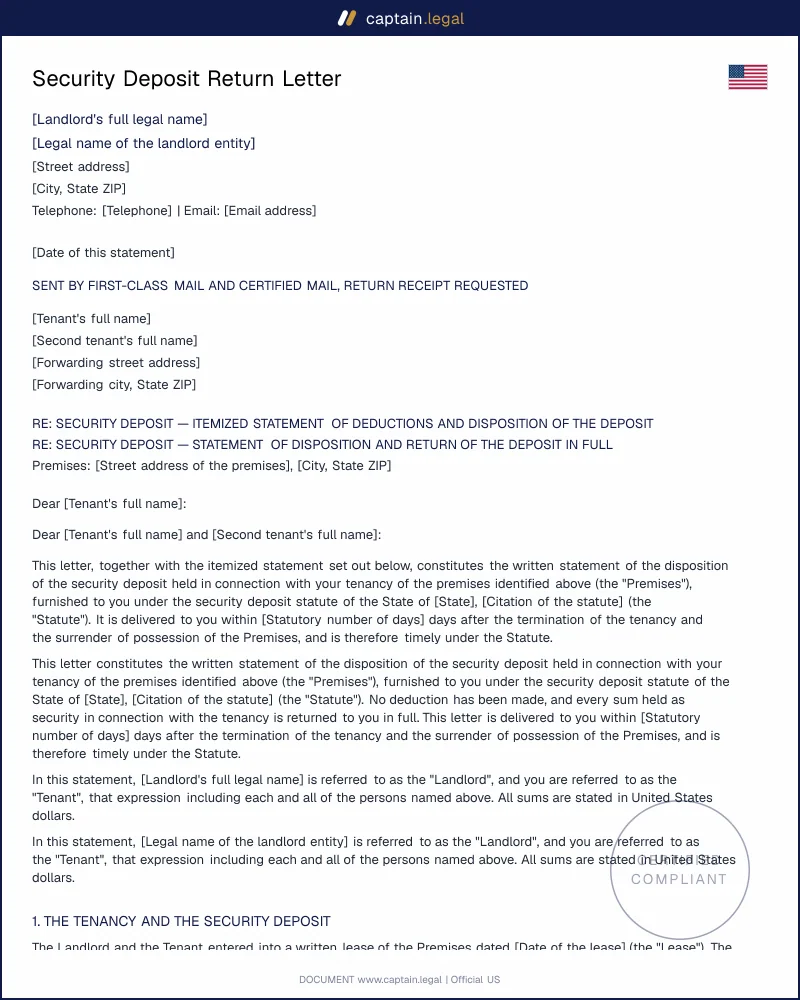
California allows twenty-one calendar days from the date the tenant vacates to deliver the itemized statement and the balance, under §1950.5 of the Civil Code. Receipts must accompany any deduction above the statutory threshold, and where the work is unfinished inside the window the landlord sends a good faith estimate first and the final documentation within fourteen days of completion. The photographic requirements added by AB 2801 now form part of the same obligation, and a statement arriving without them hands the tenant a ready-made challenge. Bad faith retention exposes the landlord to statutory damages of up to twice the deposit. Tenants also hold a pre-move-out right to request an initial inspection so they can cure defects first, and denying it weakens every deduction that follows.
Texas gives thirty days from surrender, but §92.107 of the Property Code conditions the obligation on the tenant delivering a written forwarding address, and courts read that requirement generously in the tenant's favor when the address arrives late. Missing day thirty creates a rebuttable presumption of bad faith under §92.109(d), and the consequences are the harshest in the country: a flat penalty, treble the wrongfully withheld amount, attorney fees, and forfeiture of the right to sue the tenant for the damage at all. A nonrefundable cleaning fee collected at signing is usually treated as deposit money anyway.
Florida runs a two-track procedure that catches out-of-state owners. Claim nothing and the full deposit goes back within fifteen days. Claim anything and you have thirty days to send a notice of intention to impose a claim containing the wording set out in §83.49(3)(a), historically by certified mail and now, since §83.505 took effect, by email where both parties signed the statutory addendum. The tenant then has fifteen days to object in writing. Missing the thirty-day notice waives the claim completely, regardless of how much damage the tenant caused.
New York sets the tightest deadline in the country at fourteen days after the tenant vacates, under §7-108(1-a)(e) of the General Obligations Law. Fail to provide both the statement and the balance inside those fourteen days and the right to retain any portion is forfeited by operation of law, without regard to the merits of the deduction. Landlords must also offer a walk-through inspection before move-out and give the tenant an itemized list of proposed repairs so the tenant can fix the problem first.
Elsewhere the deadlines stretch. Maryland allows forty-five days under §8-203 of the Real Property Code and adds an interest calculation. Massachusetts and Washington work on thirty days, Oregon on thirty-one, Arizona on fourteen business days.