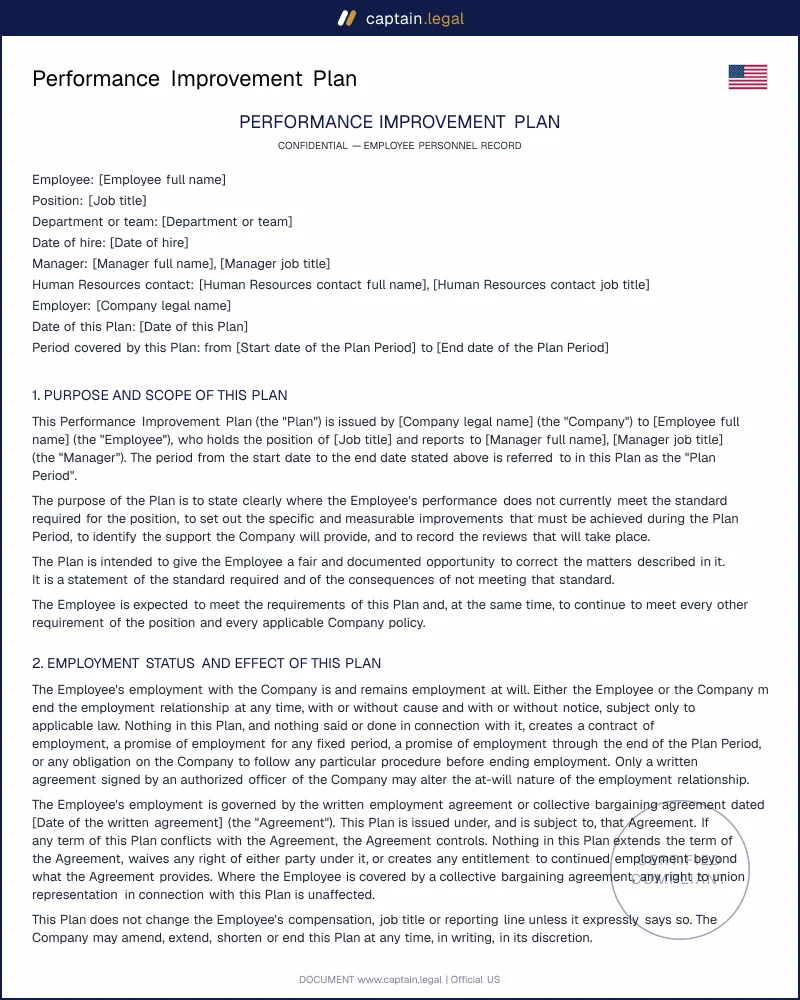
No US statute obliges an employer to issue a plan before terminating an at-will employee. The obligations attach to how it is written and administered. Employment in forty-nine states is at will by default; Montana is the exception, where the Wrongful Discharge from Employment Act, Mont. Code Ann. §39-2-901 and following, requires good cause once the probationary period ends. Everywhere else the plan works as evidence. Under McDonnell Douglas Corp. v. Green, 411 U.S. 792 (1973), an employer defending a discrimination claim must produce a legitimate, non-discriminatory reason for the termination, and a specific, contemporaneous, consistently applied plan is the strongest form of that proof. A vague one invites a pretext argument.
The exposure has widened. In Muldrow v. City of St. Louis, 601 U.S. 346 (2024), the Supreme Court dropped the requirement that a plaintiff show significant harm to establish an adverse action under Title VII, leaving a threshold of some harm that leaves the employee worse off. The First Circuit rejected the argument that every plan clears that bar, holding in Walsh v. HNTB Corp., 169 F.4th 330 (1st Cir. 2026), that the inquiry is fact-specific. The line is worth memorizing: a plan that warns or develops is not an adverse action, while one that assigns new duties, alters pay or closes off advancement may be.
Three federal rules shape the drafting. The Americans with Disabilities Act opens the interactive process once an employer learns a disability may be driving the gap, and the EEOC enforcement guidance on applying performance and conduct standards to employees with disabilities is the working reference, which is why a plan belongs in the same file as an ADA reasonable accommodation request form. 29 C.F.R. §825.220(c) bars using FMLA leave as a negative factor, so protected absences never feed the metrics. And under Stericycle, Inc., 372 NLRB No. 113 (2023), telling an employee not to discuss the plan with coworkers can violate section 7 of the National Labor Relations Act.