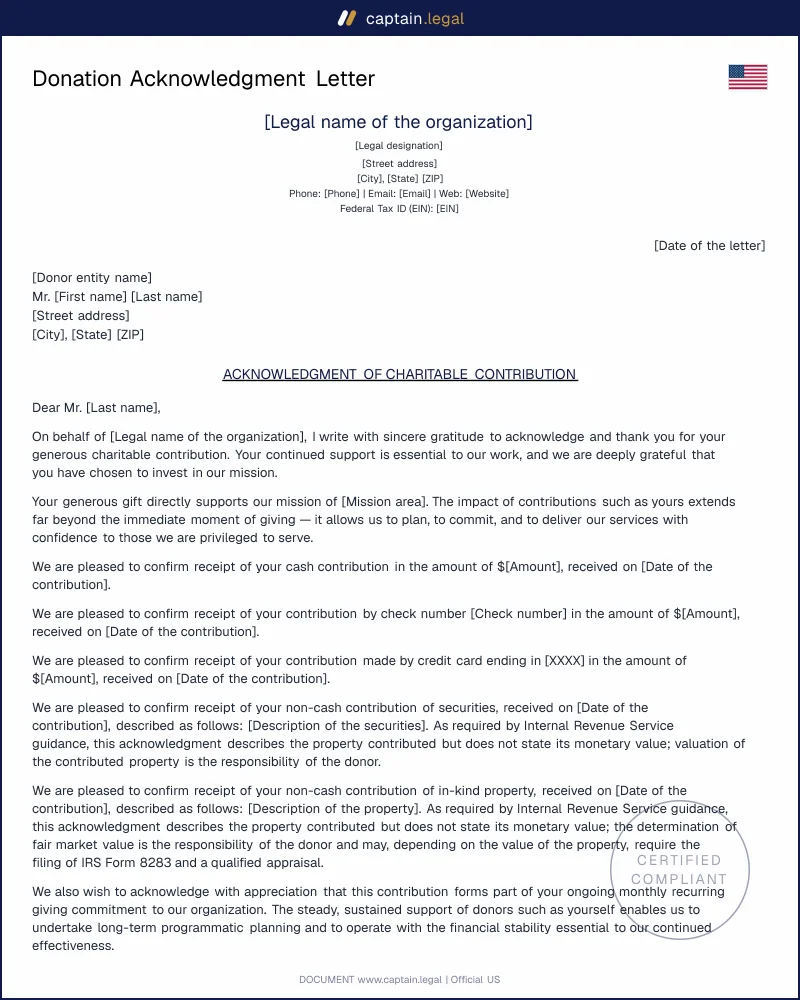
A donation acknowledgment letter is the written receipt a US charitable organization sends to a donor to confirm that a gift was received and to give the donor the paperwork required to claim a federal income tax deduction. For any single contribution of $250 or more, the Internal Revenue Code makes that letter the donor's only path to a deduction : without it, the gift is legally unsupported, even if the check cleared and the bank statement is in hand. The document is sometimes called a donor receipt, a charitable contribution acknowledgment, or a gift substantiation letter. They are the same thing, and they are governed by the same federal rules issued by the IRS.
Captain.Legal's template is built for 501(c)(3) public charities, private foundations, churches, schools, and fiscal sponsors that need to issue compliant receipts year-round or after a year-end campaign. It produces both single-gift letters and end-of-year annual summaries, and it adjusts the disclosure language depending on whether the donor received goods or services in return.
Compliant
2026 Legislation
50,000+ clients
trust us
Affordable
From $4.90 / doc
Secure payment
Instant download
Donation Acknowledgment Letter Template — Word & PDF for Nonprofits
Secure payment
What is a donation acknowledgment letter?
A donation acknowledgment letter is a contemporaneous written acknowledgment (CWA) under Internal Revenue Code §170(f)(8). The phrase matters. The IRS does not just want a receipt ; it wants a receipt that contains specific statements and that reaches the donor before the donor files the return claiming the deduction. A thank-you note that says "we received your generous gift, thank you so much" is not a CWA. It is a courtesy letter that exposes the donor to denial of the deduction on audit.
The letter does two jobs at once. First, it documents the donee charity (legal name, federal tax-exempt status under §501(c)(3)), the date of the contribution, the amount of cash or a description of any non-cash property given. Second, and this is where most templates fail, it makes an explicit statement about whether the donor received any goods or services in exchange for the gift. If the charity provided nothing of value, the letter must say so in plain language. If the charity provided a benefit (a gala dinner, a tote bag above token value, a sponsorship perk), the letter must describe it and give a good-faith estimate of its value, so the donor knows the deductible amount is the gift minus that value.
A donation acknowledgment letter is not the same as a pledge card, which is a promise to give, or a donation receipt under $250, which can simply be a bank record on the donor's side. It is also not the same as a nonprofit governance document like bylaws or a board resolution. The acknowledgment exists for one regulated purpose : to substantiate a deduction the donor will claim on Form 1040, Schedule A.
Legal framework
The federal anchor is Internal Revenue Code §170(f)(8), which states that no deduction is allowed for any contribution of $250 or more unless the donor obtains a contemporaneous written acknowledgment from the donee organization. The IRS implements this rule through Treasury Regulations §1.170A-13(f) and explains it in the IRS Publication 1771 on charitable contribution substantiation and disclosure requirements, which every nonprofit finance officer should have on file. The threshold applies to each single contribution, not to the donor's annual total : ten separate $40 weekly church offerings do not trigger §170(f)(8), but a single $250 check does.
The acknowledgment must contain four elements to qualify as a CWA. It must identify the amount of cash contributed and describe (but not value) any non-cash property given. It must state whether the charity provided any goods or services in consideration for the contribution. If goods or services were provided, it must include a description and a good-faith estimate of value, except where the benefit consists solely of intangible religious benefits provided by an organization operated exclusively for religious purposes, in which case the letter says exactly that. The acknowledgment must be in the donor's hands before the earlier of the date the return is filed or its due date including extensions : a letter mailed in April for a gift received in January is fine, but a letter issued in response to an IRS audit two years later is not.
A second federal rule sits next to §170(f)(8) and is often forgotten. §6115 requires charities to provide a written disclosure to any donor making a quid pro quo contribution in excess of $75, telling the donor that only the portion exceeding the value of goods or services received is deductible. §6714 imposes a penalty of $10 per contribution, capped at $5,000 per fundraising event or mailing, on charities that fail to make this disclosure. The two rules interact constantly during galas, auctions, and benefit concerts : the same letter often serves both as a §170(f)(8) acknowledgment and a §6115 disclosure. The state layer is lighter at the federal-tax level, but most states with charitable solicitation registration (the Articles of Incorporation Template — Word & PDF you filed at formation will reference the registered name) expect that public-facing donor receipts match the legal name on file with the state attorney general or secretary of state.
When do you need this document?
The textbook trigger is a single cash contribution of $250 or more, whether received by check, credit card, ACH, payroll deduction, or a peer-to-peer fundraising platform that names the donor. The moment that gift hits the books, the clock starts on issuing a compliant acknowledgment. Most well-run charities send the letter within 72 hours of receipt for major gifts and batch year-end letters in early January for recurring donors, so every donor has the paperwork well before the Form 1040 filing season opens. Waiting until the donor calls to ask for the receipt is a sign of trouble, not service.
The second common scenario is a non-cash contribution valued at $250 or more : donated stock, used vehicles, equipment, real estate, art. The letter describes the property without assigning a value (valuation is the donor's job and may require Form 8283) and confirms whether anything was given in return. Vehicle donations have their own regime under §170(f)(12) and require Form 1098-C in addition to or instead of the standard acknowledgment. A separate dedicated letter is typically used for those gifts.
A third scenario is the quid pro quo contribution over $75, where the donor pays more than the value of what is received : a $200 ticket to a gala that includes a $60 dinner, a $500 sponsorship that includes signage worth $100. The acknowledgment must spell out the deductible portion in plain numbers. This is the area where IRS penalties under §6714 actually get assessed, usually after a routine examination of Form 990 picks up large event revenue without matching disclosures.
The fourth scenario is the annual summary sent to recurring donors. A church receiving weekly offerings can aggregate the year's gifts into a single January letter, as long as it lists every contribution date and amount of $250 or more. The fifth, easy to miss : gifts received through a donor-advised fund at Fidelity Charitable, Vanguard Charitable, or a community foundation. Those gifts do not need a tax-deductibility statement because the DAF already issued one to the donor, but a thank-you acknowledging the grant is still expected as a matter of donor stewardship. The same is true for employment-related payroll-deduction giving programs, where the employer handles substantiation jointly with the charity.
Key clauses included in our template
- The organization identification block lists the charity's exact legal name as registered with the state and the IRS, its Employer Identification Number (EIN), the address used on Form 990, and a statement that the organization is recognized as tax-exempt under §501(c)(3). This block is what an IRS examiner reads first ; a mismatch between the letter and the Determination Letter on file is the most common cause of denied deductions on audit.
- The contribution details section records the date of the gift, the amount in dollars for cash contributions, and a clear description of any non-cash property (no estimated value, by design). For annual summaries, the template generates a dated line item for each gift, with subtotals broken out by month or by single-gift threshold so the donor can match the letter to bank records without manual reconciliation.
- The goods-or-services statement is the clause that turns a thank-you note into a CWA. The template produces one of three variants depending on the answer: "No goods or services were provided in exchange for this contribution" ; or a description plus good-faith estimate of value with the deductible amount calculated for the donor ; or, for religious organizations, a statement that the only benefit provided was an intangible religious benefit. Choosing the wrong variant invalidates the acknowledgment for the donor, even if the numbers are correct.
- The §6115 quid pro quo disclosure block activates automatically when the contribution exceeds $75 and goods or services were provided. It uses the IRS-recommended formula stating that only the amount exceeding the value of benefits is deductible, with the deductible portion shown as a separate line so the donor's accountant can transcribe it directly onto Schedule A.
- The signature and date block is signed by an authorized officer of the charity. The template pulls authority levels from the Corporate Bylaws Template — Word & PDF so that only an officer with delegated signature power (typically the Executive Director, Treasurer, or Development Director) appears as the signatory.
- The delivery and retention footer confirms how the letter was sent (mail, email, donor portal) and reminds the donor to retain it with their tax records. The IRS accepts electronic acknowledgments, so a properly formatted email or PDF download counts as a CWA without a wet signature.
Special situations to watch
Non-cash property over $500. Once a non-cash gift is valued by the donor at over $500, the donor must file Form 8283 with their return. The acknowledgment letter does not estimate value, but it should describe the property with enough detail (year, make, model, VIN for a vehicle ; CUSIP and share count for securities ; physical description and condition for tangible items) that the donor can complete Form 8283 accurately. Gifts valued over $5,000 generally require a qualified appraisal, and items over $500,000 may require the appraisal itself to be attached to the return.
Donor-advised funds and matching gifts. When a donor recommends a grant from a DAF, the charity has not received a deductible contribution from the individual : the DAF received it months or years earlier. The acknowledgment thanks the donor for recommending the grant and confirms no goods or services were provided, but it omits the tax-deductibility statement to avoid creating a false impression of a deductible payment. Employer matching gifts follow the same pattern : the match is the employer's contribution, not the employee's.
Religious organizations and intangible religious benefits. A §170(f)(8)(B)(iii) exception lets churches and synagogues acknowledge gifts that produced only intangible religious benefits (pew assignments, prayers, religious instruction not sold commercially) without estimating value. The letter must say that the only consideration provided was an intangible religious benefit. Material benefits (a parish dinner, a religious-school tuition discount) fall outside the exception and require a standard §6115 disclosure.
Auctions and raffles. Auction winners only deduct the amount paid above the fair-market value of the item won, which means the charity must publish FMV before the bidding starts and confirm it on the acknowledgment. Raffle tickets are not deductible at all : their cost is treated as gambling, not as a charitable contribution. The acknowledgment for raffle revenue should not use deduction language, and most state gaming regulators publish their own disclosure requirements that override the IRS template.
How to fill out this donation acknowledgment letter
You start by selecting the type of gift : single cash contribution, single non-cash contribution, year-end annual summary, quid pro quo with benefits, or DAF/matching grant. The form adjusts every downstream field based on that selection, so the goods-or-services clause and the §6115 disclosure appear only when they should. From there, the wizard pulls the charity's identification block from the profile you set up once (legal name, EIN, address, Determination Letter date), so you never retype it. New users who have not set up a profile can paste this information directly from their IRS Determination Letter.
You then enter the donor's full legal name and mailing address as they want it to appear on their tax records ; for joint donors, both spouses are listed if the gift came from a joint account. The amount and date fields accept multiple line items for annual summaries, with the template aggregating totals automatically and flagging any single gift of $250 or more for individual disclosure. For non-cash gifts, you describe the property in the property description field and the template suppresses the value field entirely, so you cannot accidentally assign a dollar value the IRS would reject.
The last screen handles goods and services. You answer a yes/no question, and if yes, you describe what was provided and enter the good-faith fair-market value. The template calculates and displays the deductible amount as a separate, prominent line. You sign electronically, the document generates in both Word and PDF, and you can email it directly to the donor or download both files for batch processing in your CRM. The full nonprofit document library on Captain.Legal sits at the US legal document catalog if you need surrounding paperwork like board resolutions or gift acceptance policies.
Common mistakes to avoid
The single most damaging mistake is issuing a thank-you note instead of a CWA. A warm letter that confirms the gift but omits the goods-or-services statement is not a CWA, and the donor's deduction can be denied on audit even years later, with no opportunity to cure once the return has been filed. The second is late delivery. The acknowledgment must be in the donor's hands before the earlier of their filing date or the return's due date with extensions ; charities that batch letters in mid-February will satisfy almost all donors but will miss the small group of early filers, who lose their deduction. Most well-run development offices send acknowledgments within 48 to 72 hours for gifts over $1,000 and finish bulk year-end letters before January 15.
The third recurring mistake is misstating goods-or-services value, particularly at galas and benefit auctions. A charity that prints "No goods or services were provided" on a $500 gala ticket where dinner was served has invalidated every CWA at that event and exposed itself to §6714 penalties on top of donor complaints. The fourth is assigning a dollar value to donated property. The acknowledgment describes ; the donor values. A letter that says "thank you for your contribution of a 2018 Honda Civic, fair market value $12,000" is not just unhelpful, it can be used against the donor if the IRS disagrees with the number. The fifth, frequent in small organizations : using a defunct legal name on the letter because the charity rebranded but never updated the Determination Letter with the IRS. The legal name on the receipt must match the §501(c)(3) file, not the marketing name on the website.
Frequently Asked Questions
19 verified reviews · 50 000+ downloads
- Immediate access to the document
- PDF + Word download
- Compliant with 2026 legislation
- Reviewed by lawyers
You might also like