Create my document
Login

Choose country

United StatesUnited StatesChoose country
Business

Trademark License Agreement | Lanham Act 15 U.S.C. 1127

Trademark license drafted to the Lanham Act and its quality-control rules. Royalty, territory and reversion clauses keep your mark enforceable. Word & PDF.
4.8/517 reviews50 000+ downloadsInstant download
Share

A Trademark License Agreement is the contract that lets another party use your brand name, logo, or slogan while you keep ownership of the mark. It is the instrument brand owners reach for when a manufacturer wants to put their name on a product line, a franchisee opens a location, or a merchandising partner prints a logo on apparel. The document defines what can be used, where, for how long, on what terms, and above all how quality stays under the owner's control. That last point is not optional decoration. Under U.S. trademark law, a license that omits real quality-control obligations can quietly destroy the very mark it was meant to monetize, and most business owners never see the risk coming until an opponent raises it in court.

This template is built for licensors and licensees who need enforceable brand and logo use terms with the royalty, territory, and quality-control clauses that protect a mark from abandonment, in either exclusive or non-exclusive form.

Compliant

2026 Legislation

50,000+ clients

trust us

Affordable

From $4.90 / doc

Secure payment

Instant download

Trademark License Agreement | Lanham Act 15 U.S.C. 1127

Secure payment · No subscription

Fill in the template

What is a trademark license agreement?

A trademark license agreement is a written grant of permission. The licensor owns a registered or common-law mark and allows the licensee to use it on defined goods or services, in a defined territory, for a defined term, while retaining title to the mark itself. This is the feature that separates a license from an assignment. An assignment transfers ownership outright, usually together with the goodwill of the business symbolized by the mark. A license transfers nothing but a controlled right to use. When the term ends, the right ends, and the licensee must stop using the mark entirely.

The distinction matters because it dictates who controls quality and who benefits from the goodwill that use generates. In a license, every bit of goodwill the licensee builds flows back to the licensor, which is exactly why the licensor must be entitled to police how the mark appears. Owners sometimes confuse a trademark license with a broader intellectual property arrangement, but they are not the same. Licensing a logo is narrower than licensing patents or copyrighted work, and mixing them in one loose document creates ambiguity that surfaces at the worst possible moment. If your brand strategy also involves confidential materials, pair this agreement with a proper non-disclosure agreement covering confidential brand information rather than trying to bolt secrecy language onto the license.

2

When do you need this document?

The most frequent trigger is merchandising, where a brand owner lets a third party manufacture and sell apparel, accessories, or consumer goods bearing the logo. Whenever your name goes on a product you do not make yourself, you need a license that fixes quality standards before the first unit ships. The second common scenario is franchising and multi-location expansion, where operators use your brand identity across sites you do not directly run. A franchise relationship layers additional regulation on top, but the trademark license sits at its foundation, and getting that base wrong undermines everything above it.

Distribution and co-branding arrangements form the next tier. A distributor who markets under your mark, or a partner who combines their brand with yours on a joint product, is using the mark in commerce and therefore needs written permission with defined limits. Manufacturers who private-label goods for a brand owner fall in the same bucket. One edge case that trips people up is the intra-group license between a holding company that owns the marks and the operating subsidiaries that actually trade. Owners assume family ties make paperwork unnecessary, but courts have found abandonment even inside corporate groups when no control mechanism existed on paper. Another edge case is the informal, unwritten permission a founder gives a friend or early partner. Verbal trademark licenses are enforceable in theory but nearly impossible to defend, because you cannot prove the quality control the law demands. If you are structuring these relationships as part of a wider venture, align the license with your co-founder agreement covering IP assignment and equity so ownership of the mark is never in doubt.

3

Key clauses included in our template

  • The grant of license defines the exact mark, the goods or services it may cover, the territory, and whether the grant is exclusive or non-exclusive. An exclusive license bars even the licensor from using the mark in that field, while a non-exclusive license lets the owner license others in parallel, so the choice carries real commercial weight and must be stated without ambiguity.
  • The quality-control provisions are the doctrinal heart of the document. They give the licensor the right to approve the licensee's use of the mark before launch, to inspect goods or services, and to review marketing materials, with a right to require periodic samples. This is the clause that answers the naked-licensing problem, and Barcamerica is the reason it can never be treated as boilerplate.
  • The royalty and compensation terms set the financial structure, whether a flat fee, a percentage royalty on net sales, minimum guaranteed payments, or milestone-based amounts. These terms are contractual rather than federally regulated, so the parties are free to design them around the deal, including audit rights to verify reported sales.
  • The territory and field-of-use limits confine the license to a geographic area and a product category, preventing a licensee from expanding the mark into markets the owner intends to keep or license elsewhere.
  • The term, renewal, and termination language fixes duration, sets grounds for termination such as breach, bankruptcy, or failure to meet quality standards, and dictates what happens to inventory and goodwill when the relationship ends. It should require the licensee to cease all use on termination and confirm that goodwill reverts to the owner.
  • The ownership and goodwill acknowledgment has the licensee expressly recognize that the licensor owns the mark and that all goodwill from use inures to the licensor, a clause that heads off later disputes about who built the brand's value.
4

State-specific considerations

While trademark rights flow primarily from federal law, the contract that carries them is governed by state law, and the governing-law clause matters. California courts, sitting within the Ninth Circuit that decided Barcamerica, apply the naked-licensing doctrine rigorously, so a license destined for California operations should document actual, ongoing quality control and not merely reserve the right on paper. California also maintains its own state trademark registration system under the California Business and Professions Code §14200 and following, which can supplement federal rights for marks used only within the state.

New York frequently serves as the chosen governing law for merchandising and entertainment licenses because of its developed body of commercial contract law. Parties licensing fashion, media, or consumer brands often select New York courts for predictability, and the state's approach to contract interpretation rewards precise drafting of royalty and audit provisions. Texas has become a common seat for franchise and multi-location brand licensing, and Texas courts enforce clear termination and reversion language strictly, so vague exit provisions tend to be read against the party that drafted them.

Delaware is the default choice when the licensor is a holding company, since so many brand-owning entities are Delaware corporations or LLCs. Intra-group licenses between a Delaware holding company and its operating affiliates still require genuine quality-control mechanics, because incorporation does not immunize a mark from abandonment. Florida rounds out the common set, particularly for hospitality and consumer brands, where licensors should confirm the mark is properly identified and that the agreement addresses use in advertising across the licensee's locations. Across all five, the federal quality-control requirement is constant; only the contract's interpretive backdrop changes.

5

How to fill out this trademark license agreement

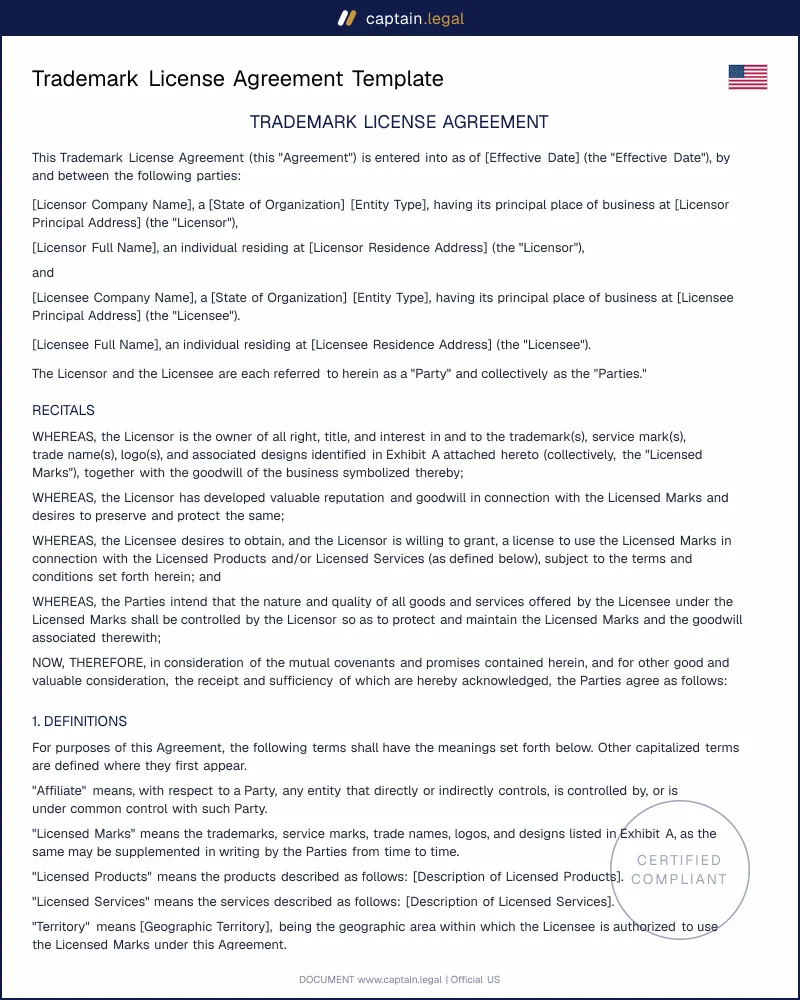
You start by identifying the two parties and the exact mark being licensed, entering the registration number if the mark is federally registered or describing the common-law mark and its first use if it is not. From there, the form asks you to define the scope, meaning the specific goods or services, the territory, and the field of use, so the grant stays as narrow or as broad as your deal requires. The next step is the exclusivity selector, where choosing exclusive or non-exclusive adjusts the downstream language automatically so the licensor's own rights are correctly reserved or surrendered.

The document then walks you through the quality-control mechanics, prompting you to set approval rights, inspection frequency, and sample requirements calibrated to your product. You enter the royalty structure, whether a flat fee or a percentage with minimums, along with any audit rights. Finally, you set the term, renewal conditions, and termination triggers, then confirm the ownership and goodwill acknowledgments. When you are done, the completed agreement downloads in editable Word and signed PDF, ready for signature. If the licensing sits inside a broader commercial relationship, you may also want a master services agreement for the underlying commercial terms.

6

Common mistakes to avoid

The single most damaging error is treating quality control as a formality. Owners copy a clause that reserves the right to inspect, then never inspect, and a court reading the license years later finds the reserved right was window dressing. The doctrine punishes the gap between what the paper says and what the owner actually did, so the safer practice is to set inspection and approval obligations you will genuinely perform, then perform them. A related mistake is confusing a license with an assignment. Founders who mean to keep their brand sometimes sign language that transfers ownership, or license the mark so loosely that a later buyer questions whether title ever stayed put. If you are also protecting the people side of the business, a confidentiality and invention assignment agreement keeps employee-created brand assets clearly owned by the company.

The other recurring failures cluster around scope and exit. Leaving the territory or field of use undefined invites the licensee to push the mark into markets you wanted to keep, and there is no easy way to claw back a right you granted in vague terms. Skipping the reversion language means that when the license ends, inventory bearing your mark keeps circulating and goodwill sits in limbo. Finally, many owners forget the ownership acknowledgment entirely, then face a licensee who argues, sometimes credibly, that its own efforts built the brand's value and that it deserves a share of the mark. Naming ownership expressly, and confirming that goodwill inures to the licensor, closes that door before it opens.

Key takeaways

Ownership

A license grants use, not ownership

A trademark license lets someone use your name, logo, or slogan, but you still own the mark. The agreement must spell out what can be used, on which goods or services, in what territory, and for how long. When the term ends, the right to use ends too and the licensee must stop entirely. This is different from an assignment, which transfers the mark and its goodwill.

Quality control

No quality controls can kill the mark

Under the Lanham Act, the real danger is a license with no real quality-control obligations. Courts treat that as naked licensing and as evidence of abandonment under 15 U.S.C. §1127. If the mark is deemed abandoned, it becomes unenforceable and the federal registration can be canceled. Cases like Barcamerica and Eva's Bridal show licensors can lose a mark simply by failing to monitor licensee quality.

Business terms

Royalty, territory, and end-of-term reversion

The deal economics and scope should be tight: royalty terms, exclusive or non-exclusive status, and a clear territory. These clauses are not filler; they define the value being sold and prevent disputes about where the licensee can operate or expand. Include a clean end-of-term handoff so rights revert to the owner and the licensee cannot keep using the brand after expiration or termination.

Frequently Asked Questions

Yes, a trademark license agreement is a binding contract as soon as both parties sign, provided it contains the essential terms of offer, acceptance, consideration, and a lawful subject. Beyond ordinary contract validity, its enforceability as a trademark instrument depends on the presence and exercise of quality-control provisions. Under 15 U.S.C. §1127, a license that gives the licensor no control over the quality of goods or services is treated as a naked license and can render the mark abandoned. So the agreement binds the parties contractually the moment it is executed, but to protect the underlying mark you must both include and actually use the quality-control rights the template provides.

An exclusive license grants the licensee the sole right to use the mark within the defined field and territory, and in a fully exclusive grant even the licensor cannot use it there. A non-exclusive license lets the licensor grant the same rights to multiple licensees at once and keep using the mark itself. Exclusivity usually commands higher royalties because the licensee gains market protection, while non-exclusive terms suit merchandising programs with many partners. Our template lets you select either option, and the downstream language adjusts automatically so the licensor's reserved rights are stated correctly for the choice you make.

The term is whatever the parties agree, since federal law sets no maximum or minimum duration for a license. Merchandising deals often run one to three years with renewal options, while franchise-related licenses can extend far longer. What matters legally is not the length but the continuity of control throughout the term. A long license with no active quality supervision is more dangerous than a short one, because the abandonment risk compounds over time. The template lets you set a fixed term, automatic or optional renewals, and clear termination triggers, so the relationship never drifts into an uncontrolled arrangement by default.

The completed trademark license agreement downloads in both editable Microsoft Word format and a clean, signature-ready PDF. The Word version lets you negotiate and adjust specific terms with the other party without retyping the whole document, which matters when royalty numbers or territory definitions change during discussions. The PDF gives you a final version suitable for signing and record-keeping. Having both means you can circulate a draft for markup and then lock the final terms, keeping a clean copy for your files and for any future due diligence a buyer or investor might request.

No, you can license a common-law mark that is used in commerce but not federally registered. Registration is not a precondition to granting a valid license. That said, federal registration strengthens your position considerably, because it provides public notice, supports enforcement, and makes ownership easier to prove if the licensee later disputes it. Registration alone does not protect against naked licensing, so a registered mark still needs the quality-control clauses this template supplies. The practical answer is that you may license without registering, but registering first gives the license a firmer foundation and reduces argument about who owns what.

Yes, and doing so is often the smart approach. A license can be limited to specific goods or services, to a defined geographic territory, and to a particular field of use, leaving you free to exploit or license the rest elsewhere. This is exactly why the template asks you to define scope, territory, and field precisely. Granting narrow, well-bounded rights protects your ability to expand the brand into new categories or regions later. The risk runs the other way: an undefined grant can be read broadly against you, so the discipline of naming limits works entirely in the licensor's favor.

That depends on the assignment and change-of-control language in the agreement. Many trademark licenses restrict the licensee from assigning its rights without consent, and a well-drafted license also addresses what happens if the licensor transfers ownership of the mark. Because the goodwill in the mark is a business asset, a buyer will scrutinize your licenses during due diligence, and gaps in control or ownership language can reduce value or delay a sale. Setting clear assignment, consent, and reversion terms up front keeps the mark cleanly transferable and preserves the value you built.

There is no bright-line rule, and courts have openly acknowledged the difficulty of defining a precise threshold. What the law requires is control sufficient to ensure the licensee's goods or services meet the expectations the mark creates in consumers. In practice, courts look at whether you retained contractual control rights, whether you actually exercised them, and whether any reliance on the licensee was reasonable given a close relationship. Approval of proposed uses, periodic inspection, and sample review are the standard mechanisms. The safe course is to build realistic controls into the agreement and then follow them, because the exercise of control, not just its reservation, is what defends the mark.

4.8/5

17 verified reviews · 50 000+ downloads

Trademark License Agreement | Lanham Act 15 U.S.C. 1127
  • Immediate access to the document
  • PDF + Word download
  • Compliant with 2026 legislation
  • Reviewed by lawyers
Fill in the template
Secure payment · No subscription
Updated on July 1, 2026

You might also like

Terms of Service Template
Freelance Contractor Agreement