Create my document
Login

Choose country

United StatesUnited StatesChoose country
Business

Demand Letter for Payment | FDCPA & Interest-Aware

Demand letter drafted to breach-of-contract elements, FDCPA rules and statutory prejudgment interest such as Cal. Civ. Code 3289(b). Word & PDF download.
4.7/523 reviews50 000+ downloadsInstant download
Share

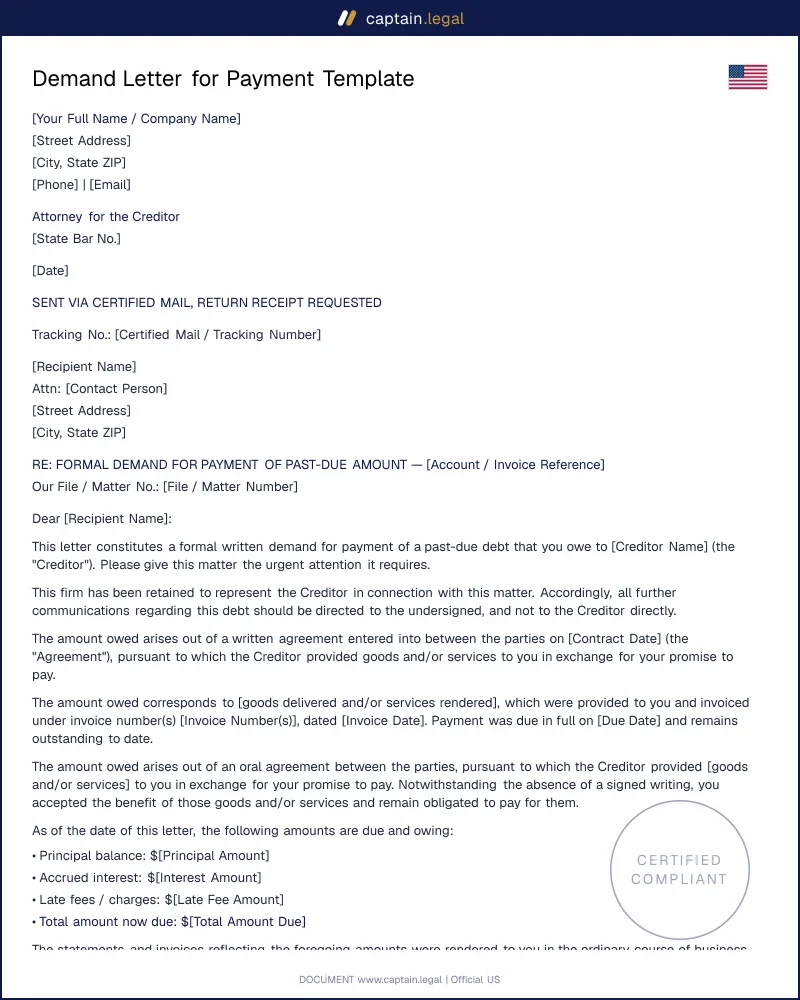
A demand letter for payment is the formal written notice a creditor sends to recover a past-due invoice before filing suit. It states the amount owed, references the contract or invoice that created the obligation, adds any interest and permitted late charges, and sets a firm deadline to pay. For a small business chasing an unpaid balance, this letter is the pivot point between informal follow-up and litigation. Done right, it recovers the money without a courthouse. Done poorly, it can hand the other side a defense or, if you fall under federal collection rules, expose you to liability. This template gives you a collection demand letter built to the standards a commercial litigator would recognize, with state-aware interest language and a clean pre-litigation record.

Most invoices get paid after a firm letter, not a lawsuit. The letter works because it signals that the informal phase is over and that you have organized your facts, your numbers, and your legal grounds in one place. That signal only lands when the letter is precise. A vague reminder that "your account is overdue" reads as another email. A letter that names the invoice, the contract clause, the accrued interest under a cited statute, and the exact date payment is due reads as the last step before a complaint.

Compliant

2026 Legislation

50,000+ clients

trust us

Affordable

From $4.90 / doc

Secure payment

Instant download

Demand Letter for Payment | FDCPA & Interest-Aware

Secure payment · No subscription

Fill in the template

What is a demand letter for payment?

A demand letter for payment is a written pre-suit communication in which a creditor formally demands that a debtor pay a sum already due under a contract, invoice, or account. In commercial practice it is also called a collection letter, a past-due notice, or a pre-litigation demand. Its legal function is twofold. First, it puts the debtor on notice of the claim and the consequences of non-payment, which matters because many contracts require written notice of breach before a party can sue, and some states impose statutory pre-suit demand steps for particular claims. Second, it creates a documented record that a court and, later, a judge will read as evidence that you acted reasonably and gave the debtor a fair chance to cure.

The letter is not the same thing as an invoice, and the difference is legal, not stylistic. An invoice requests payment in the ordinary course of business. A demand letter asserts that payment is overdue, that a breach has occurred, and that you are prepared to enforce your rights. It typically identifies the parties, the underlying agreement, the invoice number and date, the principal balance, any contractual or statutory interest, and a payment deadline, and it closes by reserving the right to pursue all available remedies. One distinction controls everything else: whether you are the original creditor collecting your own debt or a third party collecting someone else's. That single fact decides which federal rules apply, and it is covered in the next section. If you also need to protect the underlying transaction going forward, our independent contractor agreement with IRS-compliant 1099 terms sets clear payment terms before a dispute ever starts.

2

When do you need this document?

The most common trigger is a straightforward unpaid invoice past its net terms, where informal reminders have gone unanswered and the balance is large enough to justify escalation. A business that lets an invoice drift ninety or a hundred and twenty days without a formal demand weakens its position: the account looks tolerated, and a debtor's lawyer will argue you sat on the claim. Sending a firm letter at thirty to sixty days past due resets that dynamic and starts the interest clock in writing. The second frequent scenario is a client who disputes part of a bill and simply stops paying the whole thing, using the disagreement as cover to hold the entire balance. A demand letter isolates the undisputed portion and demands it now, separating the real dispute from the stalling.

You also need this letter when a contract requires written notice of breach before you can sue or terminate. Many service agreements and master services agreements contain a notice-and-cure clause, and skipping it can sink an otherwise valid claim. The letter satisfies that condition and preserves your right to move forward. It is equally the right tool when you are preparing for small claims or civil court and want a clean exhibit showing you demanded payment and gave a deadline before filing.

Two edge cases justify extra care. If the debt might be time-barred, sending a demand and, worse, accepting a partial payment can restart the statute of limitations, which cuts both ways depending on whether you are the creditor or the debtor. And if you are collecting on behalf of another business, or the debtor is an individual consumer, you may cross into FDCPA territory and must add the validation language before you send anything. When the underlying relationship involves confidential information you also want protected during a payment fight, pair the demand with the terms in a non-disclosure agreement covering permitted disclosures.

3

Key clauses included in our template

  • The identification of the parties and the account names the creditor, the debtor, and every invoice at issue by number and date, so there is no ambiguity about what is owed. Vague references to "your outstanding balance" invite disputes; a precise ledger of invoice 1043 dated March 3 for a stated principal does not.
  • The statement of the obligation and breach ties the debt to the contract or purchase order that created it, confirms your performance, and states plainly that payment was due and was not made. This paragraph is drafted to the breach of contract elements a court will look for, so the letter doubles as a future exhibit.
  • The itemized amount due separates principal from interest and any contractually permitted late charge, and states the interest rate and its basis. Blending everything into one lump sum is a recurring drafting error; itemizing protects you if the debtor challenges the math and keeps a consumer-facing letter compliant if the FDCPA applies.
  • The interest and late-charge provision applies your contractual rate where one exists or the state statutory rate where it does not, with room to cite the governing statute such as Civil Code §3289(b) in California. It states that interest continues to accrue until payment, which incentivizes prompt resolution.
  • The payment deadline and instructions set a firm date, typically ten to thirty days out, and tell the debtor exactly how to pay. A default of thirty calendar days is standard; where a statute sets a specific pre-suit period, the template adjusts to match it.
  • The reservation of rights and next steps states that if payment is not received by the deadline you will pursue available remedies, without naming a forum that conflicts with an arbitration clause and without threatening action you will not take.
4

State-specific considerations

California treats interest on unpaid invoices for goods and services as outside its usury limits, because a credit sale is not a loan under Southwest Concrete Products v. Gosh Construction Corp. A creditor may charge a reasonable contractual rate, and where the contract is silent the prejudgment rate for a liquidated debt is 10 percent per year under Civil Code §3289(b). Late charges, by contrast, are disfavored and must be reasonably related to actual damages rather than functioning as a penalty. California also runs prompt-payment statutes for private construction under Civil Code §8800 et seq., so construction invoices carry their own timing rules. Keep any stated interest reasonable; an 18 percent rate has survived challenge but is not automatically safe.

New York permits interest on commercial past-due accounts and applies a statutory framework through its general obligations and finance provisions, with the rate depending on whether a written agreement fixes it. When no contract rate is specified, prejudgment interest on a breach-of-contract claim is set by statute and runs from the date performance was due. A written late-fee clause is strongly advisable, because without one you are limited to the statutory default rather than a higher custom figure.

Texas allows businesses to charge late fees and interest, with the enforceable rate depending on whether a written agreement fixes it, under the Texas Finance Code. Where the contract is silent, statutory interest applies, and Texas caps most contractual commercial interest to guard against usury. A demand letter that cites a rate the contract never authorized invites a challenge, so the template ties the number to your signed terms or falls back to the statutory rate.

Florida permits late fees and interest on commercial invoices but measures them against the state usury statutes that define the maximum lawful rate. There is no mandated grace period for business invoices, though a short courtesy buffer is common practice. As in the other states, a written interest clause in the underlying contract is what lets you claim more than the statutory default, so the demand letter reads best when it points to that clause.

5

How to fill out this demand letter for payment

You start by selecting the state whose law governs the underlying contract, which sets the applicable interest rate and any pre-suit notice rules the form should reflect. From there you enter the creditor and debtor details, then list each unpaid invoice by number, date, and amount so the letter builds an itemized ledger rather than a single lump sum. The form then asks whether your contract specifies a late-payment interest rate; if it does, you enter that rate, and if it does not, the template applies your state's statutory prejudgment rate and cites the governing provision.

Next you set the payment deadline, with a thirty-day default that adjusts if a statute imposes a specific period, and you choose the delivery method, with certified mail and return receipt recommended so you can prove the letter was received. You then indicate whether you are the original creditor or a third-party collector, because that answer decides whether the document adds the FDCPA validation language required for consumer debts. The finished letter downloads in editable Word and signed PDF, so you can adjust wording and keep a clean copy for your file. If your dispute also touches an equity or ownership question, the shareholder agreement covering buy-sell and dispute mechanics handles that separate layer.

6

Common mistakes to avoid

The error that causes the most trouble is misstating the amount owed. If you overstate the balance, add unauthorized fees, or claim an interest rate your contract never granted, the debtor gains a credible reason to refuse the whole demand, and under the FDCPA an inaccurate figure in a consumer-debt letter can itself be a violation. Always itemize principal, interest, and any permitted late charge separately, and tie the interest rate to your signed terms or the correct statutory default. A second frequent mistake is threatening action you have no intention of taking or naming the wrong forum. Threatening to sue in court when your contract compels arbitration undercuts your credibility and can violate collection rules; the letter should reserve remedies without bluffing.

A third mistake is treating a business collection letter as if the FDCPA never applies, or conversely bolting consumer validation language onto a straightforward B2B demand where it does not belong. Get the sender's status right first, then draft to it. Sending by ordinary email with no proof of receipt is another avoidable error, since a debtor who later claims never to have received notice can complicate a notice-and-cure requirement; certified mail with a return receipt fixes that. Finally, do not let the tone slide into harassment or exaggeration. A calm, factual, well-documented letter is more persuasive to the debtor and reads far better as an exhibit than an angry one, and it protects the payment terms you can lock down in advance with an at-will employment agreement setting clear compensation terms.

Key takeaways

Purpose

A demand letter is not an invoice

An invoice is routine billing; a demand letter is a pre-suit notice that the payment is already overdue and a breach has occurred. It should name the parties, the contract or invoice that created the obligation, the exact amount due, and a firm pay-by date. Written notice can be a contract requirement before you can sue, and it also builds a record a judge will later read.

Proof

Track breach-of-contract elements in writing

Treat the letter like a mini case file. Spell out the agreement, confirm you performed (delivered goods or services), state the debtor failed to pay by the due date, and quantify damages as unpaid principal plus any interest and permitted late charges. Precision matters: citing the invoice number and date and tying the numbers to the legal theory makes the letter land as the last step before a complaint, not another reminder.

Compliance

Sender status changes the rules entirely

One fact controls the drafting risk: are you the original creditor collecting your own receivable, or a third party collecting for someone else? That distinction determines whether federal debt-collection rules may apply and what language is safe to use. If you get it wrong, a sloppy letter can hand the debtor a defense or expose you to liability, even before you file suit.

Frequently Asked Questions

The letter itself does not create a new obligation; it enforces one that already exists under your contract or invoice. Its legal weight comes from three functions. It satisfies any notice-of-breach requirement in your agreement, it starts or documents the accrual of interest, and it becomes evidence a court will read as proof you demanded payment and gave a fair deadline before suing. To carry that weight the letter must be accurate: name the correct parties, cite the real invoice, and state a defensible amount. An accurate, properly served demand is one of the strongest pre-suit documents you can hold, even though it is not a judgment.

A deadline of thirty calendar days is the standard default for a commercial past-due invoice, long enough to be reasonable and short enough to signal urgency. You can go shorter, to ten or fourteen days, when the situation is time-sensitive, but a very short window can read as pressure rather than a genuine chance to cure. Where a statute sets a specific pre-suit period, that period controls and the letter should match it exactly. Under the FDCPA, a consumer-debt validation notice must give the debtor thirty days to dispute, so if federal collection rules apply you cannot demand payment inside that window without preserving those rights.

Yes, on two possible bases. If your contract or invoice specifies a late-payment rate, that contractual rate applies, subject to your state's usury ceiling. If your documents are silent, your state's statutory prejudgment interest rate applies from the date the amount became certain; in California that default is 10 percent per year under Civil Code §3289(b). Interest on commercial credit sales is generally not treated as a usurious loan, though the rate must stay reasonable. Itemize the interest separately from principal and state the rate and its basis in the letter, because a blended or unexplained figure is easy for a debtor to challenge.

Only in specific situations. The Fair Debt Collection Practices Act governs third-party debt collectors and applies mainly to consumer debts, not to a business collecting its own commercial account from another business. If you are the original creditor chasing a B2B invoice, you generally sit outside the FDCPA. If you are collecting someone else's debt, or the debtor is an individual consumer, you must include the §1692g validation notice and avoid the false or misleading statements barred by §1692e. When you are unsure which side of the line you fall on, the conservative course is to state the amount accurately and skip any threat you will not carry out.

A demand letter is the step before litigation, not litigation itself. It asks the debtor to pay voluntarily and warns that legal action may follow, but it files nothing with a court and costs far less than a suit. Most disputes resolve at this stage because the letter shows the creditor is organized and serious. A lawsuit begins only if the deadline passes without payment or a workable arrangement. The letter's value is precisely that it often makes the lawsuit unnecessary while building the record you would need if you did file.

The demand letter downloads in editable Word format and as a signed PDF. The Word file lets you adjust the parties, invoice details, interest figures, and deadline to fit your specific account, and the PDF gives you a clean, professional copy to send and to keep for your records. Because a demand letter often becomes an exhibit later, keeping the final PDF alongside your proof of mailing is good practice.

Certified mail with a return receipt is strongly recommended for any demand you might have to prove was delivered. It gives you dated evidence that the debtor received the notice, which matters when your contract has a notice-and-cure clause or when you later need to show a court that you demanded payment before filing. Ordinary email or regular mail can work for an informal reminder, but for the formal demand that precedes possible litigation, the return receipt is worth the small extra cost and effort.

4.7/5

23 verified reviews · 50 000+ downloads

Demand Letter for Payment | FDCPA & Interest-Aware
  • Immediate access to the document
  • PDF + Word download
  • Compliant with 2026 legislation
  • Reviewed by lawyers
Fill in the template
Secure payment · No subscription
Updated on July 1, 2026

You might also like

Master Services Agreement Template
Non-Disclosure Agreement (NDA) Template | PDF & Word