Create my document
Login

Choose country

FranceBelgiqueEspañaUnited StatesUnited KingdomMarocDeutschlandItaliaSchweiz
Real Estate

Right to Rent Pack UK | Immigration Act 2014 Compliant

Lawyer-grade tenant referencing and Right to Rent check pack under the Immigration Act 2014. Avoid penalties up to £20,000 per occupier. England, Word & PDF.
4.7/533 reviews50 000+ downloadsInstant download
Share

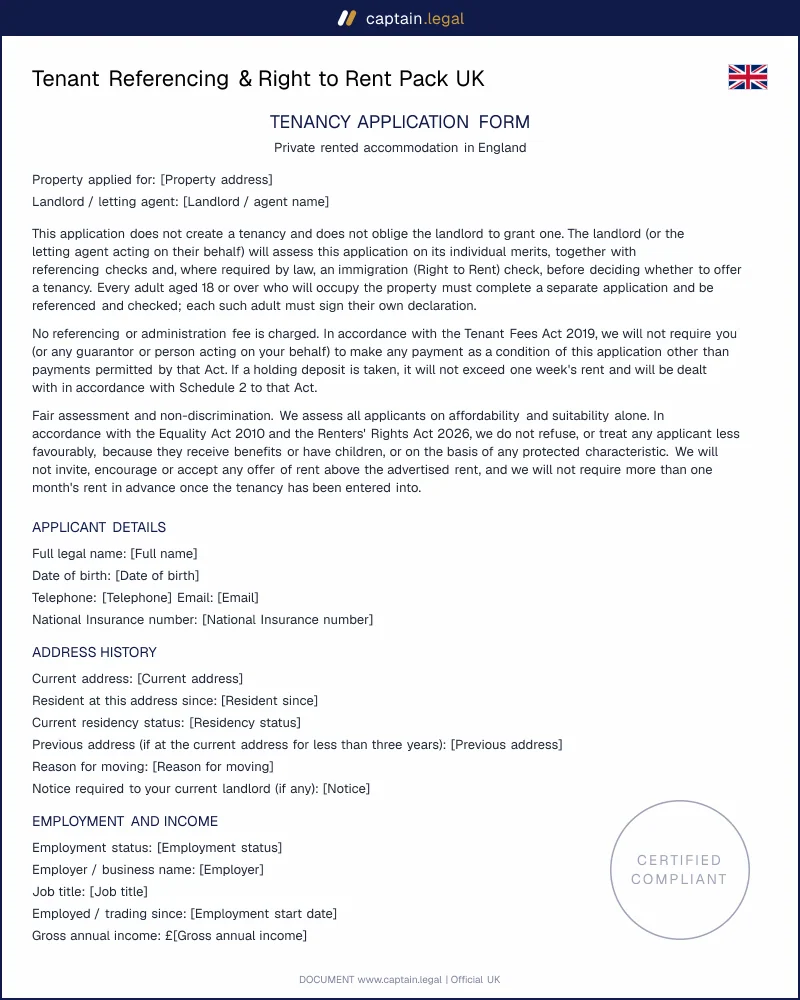
A tenant referencing and Right to Rent pack is the bundle of paperwork a residential landlord in England completes before handing over the keys: an application and consent form, a documented Right to Rent immigration check, and a structured request for a reference from the applicant's previous landlord. Vetting a tenant is not an optional courtesy. The Right to Rent check is a statutory duty under the Immigration Act 2014, and the referencing element is what stands between you and a tenant who looked perfect on paper but stops paying in month three. This pack gives private landlords and letting agents a GDPR-aware, lawyer-grade way to screen applicants properly, build a defensible file, and start the tenancy on a clean footing.

The three documents work as one process. You collect the applicant's data lawfully, you verify their right to occupy, and you ask the right questions of the people who let to them before you. Each piece is downloadable in Word and PDF, ready to complete, sign and store.

Compliant

2026 Legislation

50,000+ clients

trust us

Affordable

From $4.90 / doc

Secure payment

Instant download

Right to Rent Pack UK | Immigration Act 2014 Compliant

Secure payment · No subscription

Fill in the template

What is a tenant referencing and Right to Rent pack?

The phrase covers two distinct legal exercises that landlords tend to run together at the same point in the letting. Tenant referencing is the commercial due diligence: confirming identity, employment, affordability, rent history and any adverse credit, usually through an application form, employer or accountant confirmation, and a previous-landlord reference. It protects your income. The Right to Rent check is something else entirely. It is a legal obligation imposed on landlords in England to confirm that every adult who will occupy the property as their only or main home has a lawful immigration status that entitles them to rent.

People conflate the two because they happen in the same window, but they answer different questions. Referencing asks "will this person pay and look after my property?" The Right to Rent check asks "am I allowed to let to this person at all?" A tenant can sail through referencing with a glowing employer letter and still be disqualified from renting on immigration grounds, and a tenant with a perfect right to rent can be a serious arrears risk. You need both, and you must keep the records separate but consistent. Our pack splits them deliberately: a referencing application and consent form, a dedicated Right to Rent check record sheet, and a previous-landlord reference request, so that the immigration evidence sits in its own auditable place. That separation is precisely what the deposit receipt and prescribed information template does for the deposit side of the file.

2

When do you need this document?

The clearest trigger is a new letting to a tenant you have never housed before. Before a single key changes hands, you run the Right to Rent check and the referencing in parallel, because the check must be completed before the tenancy begins to give you the statutory excuse. Most landlords use the pack at the offer-accepted stage, once an applicant has expressed serious interest but before any money or commitment passes. Run it too late and you are exposed; run it too early on a casual enquiry and you are processing personal data you have no settled reason to hold.

You also reach for it when adding an adult occupier mid-tenancy. A partner moving in, an adult child returning home, a replacement flatmate on a joint tenancy: each new adult occupying as their main home needs their own Right to Rent check, even if they will never appear on the agreement. This is one of the most commonly missed obligations in the sector. Time-limited cases form the next category. Where an applicant has leave to remain that expires, you establish a time-limited statutory excuse and must diarise a follow-up check before that leave runs out, then report to the Home Office if the right has lapsed.

The pack is equally useful for lodger arrangements in your own home, which carry the lower per-lodger penalty but the same checking duty, and which pair naturally with a lodger agreement for excluded occupiers. One edge case worth flagging: company lets, where a business rather than an individual is the tenant, sit outside the Right to Rent scheme entirely, but you will still want full referencing on the corporate covenant. Never assume a tenancy is exempt because of its label; the substance of who occupies as their main home is what controls.

3

Key clauses included in our template

  • The applicant data consent and privacy notice sets out, in plain GDPR-aware language, what personal data you collect, your lawful basis for processing it, who you share it with such as a referencing agency or guarantor, and how long you retain it. This is what makes the whole exercise lawful under the UK GDPR, and without it your file is built on data you had no clear right to hold.
  • The Right to Rent check record captures the prescribed detail in one place: which List A or List B documents were seen or which share code was used, the date the check was carried out, who conducted it, and confirmation that you saw originals or a live online record rather than a copy. This is the single sheet that evidences your statutory excuse, so it is drafted to mirror the Home Office's own checking sequence.
  • The previous-landlord reference request asks the questions that actually predict tenant behaviour: rent paid on time, arrears history, condition of the property at check-out, any deposit deductions, and whether the landlord would let to them again. It is structured so the answers are comparable across applicants and usable as evidence later.
  • The affordability and employment confirmation section records income, employment status and any guarantor arrangement, giving you a documented basis for the affordability decision rather than a gut feeling you cannot defend if challenged.
  • The follow-up check reminder field flags any time-limited right to rent and the date the repeat check falls due, so a lapsing visa does not quietly become a £10,000 problem.
4

Regional considerations

Right to Rent is the rare housing duty that does not apply across the whole of the United Kingdom, and getting the geography wrong cuts both ways. In England, the full scheme under the Immigration Act 2014 applies to every private residential letting where an adult occupies as their only or main home, from a single room to a large HMO, and the civil and criminal liabilities above all bite. This pack is built for England first.

In Wales, the position is different and frequently misunderstood. The Right to Rent immigration-checking duty under the 2014 Act has never been commenced in Wales, so a Welsh landlord is not obliged to perform it, though all the Renting Homes (Wales) Act 2016 requirements around occupation contracts and written statements apply instead. In Scotland, the scheme likewise does not apply; the Private Housing (Tenancies) (Scotland) Act 2016 governs the private rented sector through the private residential tenancy, and immigration checking forms no part of a Scottish landlord's letting duties. Northern Ireland sits outside the scheme as well.

The practical trap is the cross-border portfolio. A landlord who lets in both Manchester and Cardiff must run Right to Rent on the English property and must not mechanically apply it to the Welsh one, where over-zealous immigration checking can stray into unlawful discrimination under the Equality Act 2010. The safe rule is to check identity and right to rent on every English applicant without exception, so that no one is singled out by nationality or appearance, while applying the correct devolved regime elsewhere. If you are unsure which nation's rules govern a let, resolve it before you start collecting data, not after. For the employment-style referencing logic that sits alongside this, our employee handbook aligned to the ACAS Code shows the same evidence-first discipline applied to staff.

5

How to fill out this tenant referencing pack

You start with the applicant's consent. Before collecting anything, you hand over or send the privacy notice and have the applicant sign the consent section, which fixes your lawful basis and lets you approach third parties such as a previous landlord or employer. From there you complete the Right to Rent check record. You decide which route fits the applicant: a manual check of original List A or List B documents, an IDVT check through a certified provider for British and Irish passport holders, or the GOV.UK online service using the applicant's share code and date of birth for anyone with an eVisa. You record what you saw, the date, and confirm originals or a live record, then save the portal outcome rather than a screenshot.

The referencing request goes out next. You send the previous-landlord reference form, chase the employer or guarantor confirmation, and log the affordability outcome on the form. Finally you diarise any follow-up check for time-limited leave. Throughout, the document keeps the immigration evidence and the commercial referencing in separate sections so the file reads cleanly if a deposit scheme, court or the Home Office ever asks to see it. Once the tenant passes, you move straight to the assured shorthold tenancy agreement template.

6

Common mistakes to avoid

The most expensive error is accepting a photocopy or a screenshot. The Home Office requires you to see original documents in person, conduct a video check while holding the originals, or use the online service that produces a live record; a scanned passport emailed by the applicant establishes no statutory excuse at all. Closely behind it sits the missed mid-tenancy occupier. Landlords check the named tenant religiously and then let an unchecked partner or adult child move in months later, which is a fresh breach carrying its own penalty. Another recurring failure is forgetting the follow-up on time-limited leave: the initial check protects you only until the leave expires, and a diary that does not flag the renewal turns a compliant landlord into a liable one overnight.

On the referencing side, the classic mistake is collecting far more data than you need and keeping it forever, which breaches the UK GDPR data-minimisation and storage-limitation principles. Resist the urge to demand bank statements covering two years when three months answers the affordability question. Finally, landlords with mixed portfolios sometimes apply Right to Rent in Wales or Scotland out of habit, or worse, check only applicants who "look foreign", both of which expose them under the Equality Act 2010. Check everyone the same way, or check no one differently. Consistency is your protection against both an immigration penalty and a discrimination claim. The same documentary discipline underpins our Section 8 notice for seeking possession when a tenancy has to end.

Key takeaways

RIGHT TO RENT

You must check every adult occupier

In England, a Right to Rent check is a legal duty, not a courtesy. Before you hand over the keys, you must confirm that every adult who will live in the property as their only or main home is not disqualified by immigration status. Under the Immigration Act 2014 (including section 22), you must not authorise occupation if the person cannot lawfully rent.

PENALTIES

Fines can hit £20,000 per person

The cost of getting this wrong is now steep. From February 2024, a first breach can trigger a civil penalty of up to £10,000 per occupier (or £5,000 per lodger), and repeat breaches can reach £20,000 per occupier (£10,000 per lodger). The Immigration Act 2016 also adds potential criminal liability where you knew, or had reason to believe, someone lacked the right to rent.

PAPER TRAIL

Keep a clean, auditable file

Your protection is the statutory excuse: carry out the prescribed check properly and retain the evidence. Enforcement has focused on landlords who kept no records or relied on photocopies, so documentation matters as much as the check itself. Run referencing and Right to Rent as one joined-up process, but keep the records separate and consistent so the immigration evidence sits in its own clear, reviewable place.

Frequently Asked Questions

The pack is a compliance and evidence tool rather than a contract, so "binding" is the wrong frame for most of it. The Right to Rent check record is the document that establishes your statutory excuse under the Immigration Act 2014, which is a genuine legal protection against a civil penalty, provided you complete it correctly using one of the three prescribed methods and retain the evidence. The applicant consent and privacy notice creates real obligations on you under the UK GDPR. The previous-landlord reference and affordability sections are evidential records. None of them grants tenancy rights; those come from the tenancy agreement you sign afterwards. What the pack does is make every later step defensible.

Acceptable documents fall into List A, which shows an unlimited right to rent such as a British passport, and List B, which shows a time-limited right requiring a follow-up check. For most non-British and non-Irish nationals you will no longer see a physical document at all; you verify their status online using the GOV.UK share code service against their eVisa. For British and Irish passport holders you can use a certified IDVT provider. A photocopy or emailed scan is never sufficient on its own. You must see originals in person, conduct a compliant video check while holding the originals, or rely on a live online record, and you must save the official portal outcome as your evidence.

For Right to Rent, retain a clear copy of the check evidence for the full duration of the tenancy and for at least one year after it ends, which is what the Home Office expects when assessing a statutory excuse. For the referencing data governed by the UK GDPR, the principle is the opposite of "keep everything": you hold personal data only as long as your lawful basis justifies. In practice that means keeping affordability and reference material for the tenancy plus a short defined period to handle disputes, then deleting it. Set the retention period in the privacy notice so the applicant knows, and stick to it.

Yes. Every document in the pack is available in both Microsoft Word and PDF. The Word version lets you adapt fields to your portfolio, add your letterhead, and tailor the referencing questions before you send anything out, while the PDF gives you a clean, fixed copy to sign, store and share with a guarantor or agent. Most landlords keep the editable Word file as their working master and archive a signed PDF as the record. Both formats download instantly and are built to read cleanly if a court, council or deposit scheme later asks to inspect your file.

The check must be carried out before the tenancy begins, meaning before the adult takes up occupation as their only or main home. There is a narrow window: the check is valid if completed in the 28 days immediately before the tenancy start date. Complete it earlier than that and it may no longer be current; complete it after the tenant moves in and you have lost the statutory excuse for the gap, leaving you exposed to the full civil penalty. For applicants with time-limited leave, you also schedule a follow-up check before that leave expires, because the initial excuse only runs for the period of the leave you verified.

No. The Right to Rent scheme under the Immigration Act 2014 applies only in England. Landlords in Wales, Scotland and Northern Ireland have no immigration-checking duty, and applying it where it does not belong risks a discrimination claim under the Equality Act 2010. If you hold a cross-border portfolio, run Right to Rent on your English properties only, and follow the relevant devolved regime, the Renting Homes (Wales) Act 2016 in Wales or the Private Housing (Tenancies) (Scotland) Act 2016 in Scotland, for the rest. Within England, the safeguard against discrimination is uniformity: check every applicant by the same method regardless of nationality or appearance.

If a follow-up check shows an occupier no longer has the right to rent, you must report it to the Home Office promptly, which preserves your position. Under the Renters' Rights Act 2025, a Home Office notice confirming the loss now triggers Ground 7B, a mandatory possession ground that lets you seek to recover the property through a Section 8 process. Acting on that notice is not optional: continuing to let after you know the occupier is disqualified removes your statutory excuse and reopens the criminal exposure under section 33A. This is exactly why the follow-up reminder field in the pack matters, and why your referencing file and your possession strategy belong in the same place.

4.7/5

33 verified reviews · 50 000+ downloads

Right to Rent Pack UK | Immigration Act 2014 Compliant
  • Immediate access to the document
  • PDF + Word download
  • Compliant with 2026 legislation
  • Reviewed by lawyers
Fill in the template
Secure payment · No subscription
Updated on June 7, 2026

You might also like

Lodger Agreement UK Template
Assured Shorthold Tenancy Agreement