Create my document
Login

Choose country

FranceBelgiqueEspañaUnited StatesUnited KingdomالمغربDeutschlandItalia
Leave Request

UK Study Leave Request Form | Fees & Repayment Clause

Confirm approved study leave dates in writing for payroll and handovers. Repayment-clause ready, Cavendish-proof template. Download in Word and PDF.
4.7/519 reviews50 000+ downloadsInstant download
Share

A Study/Training Leave Request Form is the document a UK employee uses to ask for paid or unpaid time away from work to attend a course, sit an exam, or complete professional qualifications, and that the employer uses to record the decision with conditions attached. It captures the requested dates, the nature of the training, who pays the course fees, and whether the employee must repay those fees if they leave shortly after qualifying. Aimed at HR teams, line managers, and small-business owners, it turns a casual conversation about development into a written record that payroll, handover planning, and any future dispute can rely on. Get the training agreement terms down on paper and the "we agreed it in the corridor" argument disappears.

Compliant

2026 Legislation

50,000+ clients

trust us

Affordable

From $4.90 / doc

Secure payment

Instant download

UK Study Leave Request Form | Fees & Repayment Clause

Secure payment · No subscription

Fill in the template

What is a study/training leave request form?

A study/training leave request form is a hybrid document. One half is the employee's formal request to be released from normal duties for education or training; the other half is the employer's written response, setting out approved dates and any financial conditions that come with the release. In UK practice it usually sits alongside, or feeds into, a separate training cost agreement or study agreement where larger sums are involved.

The form is not the same thing as a statutory request to do "time to train". A handful of employees have a narrow statutory right under sections 63D to 63K of the Employment Rights Act 1996 to request time to undertake study or training, but that right only obliges the employer to consider the request properly, not to pay for it or grant it. Most workplace study leave is contractual or discretionary, not statutory, which is precisely why the written conditions matter so much. A good form records whether the leave is paid, part-paid, or unpaid, whether attendance is compulsory, and what happens to the repayment clause if the employee resigns before an agreed period has passed. Without that clarity, an employer who has funded a costly qualification has little realistic way of recovering the spend, and an employee can find themselves chased for money they never expected to owe.

2

When do you need this form?

The everyday trigger is an employee asking to attend a course that falls partly or wholly within working hours. A trainee accountant needs three days for an ACCA exam sitting, a junior solicitor needs release for the SQE, or a warehouse supervisor wants to take a forklift instructor qualification the company is happy to sponsor. In each case you need the dates fixed in writing so the rota, the handover, and payroll all reflect the same reality. The form is also the natural home for the fee and repayment terms when the employer is footing the bill, because development conversations rarely get the paperwork they deserve until something goes wrong.

It earns its keep just as much when the answer is a qualified yes. Perhaps you can release the employee for the exam but not for the full revision week, or you can fund the course this year but need a two-year repayment commitment in return. Recording a conditional approval cleanly is far better than a vague nod that both sides later remember differently. The same applies to refusals: a statutory time-to-train request must be answered on proper grounds, and a written decision protects you if the employee challenges it.

One edge case worth flagging is the apprenticeship. Apprentices have a contractual and funding-linked entitlement to off-the-job training, and study leave for them is governed by the apprenticeship agreement rather than ordinary discretionary leave, so the standard form should be adapted rather than used blind. A second edge case is the employee who is also on long-term sickness or a phased return; here study leave can interact awkwardly with fit note restrictions, and the request should be checked against the Equality Act 2010 duty to make reasonable adjustments before being approved.

3

Key clauses included in our template

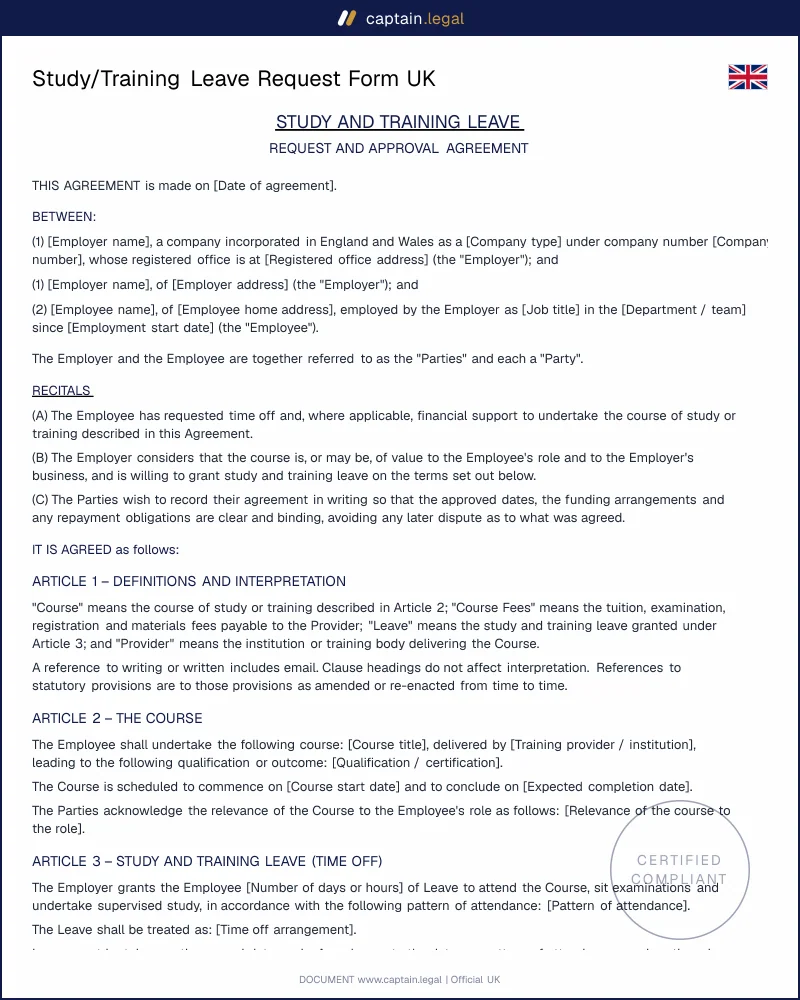
  • The request and approval block captures the course title, provider, dates, daily hours, and whether the time counts as working time. It forces both parties to commit to specifics rather than the loose "a few days in spring" that derails planning later.
  • The funding and fee statement sets out exactly what the employer is paying, whether that covers tuition only or also exam entry, travel, and materials, and the total committed figure. Naming the components stops the familiar argument about whether the resit fee was ever included.
  • The repayment clause is the commercially important term. It ties any obligation to repay funded fees to a tapering schedule keyed to length of service after qualification, drafted to survive the Cavendish penalty test rather than functioning as a flat clawback that a tribunal might strike out.
  • The deduction authorisation is a short but vital paragraph in which the employee agrees in writing that any repayable sum may be deducted from final pay, satisfying section 13 ERA 1996 and saving the employer from chasing a debt through the small claims track.
  • The conditions of attendance record whether attendance and passing the assessment are compulsory, what happens if the employee fails, and whether continued sponsorship depends on results. This mirrors the discipline you will already recognise from a properly drafted full-time UK employment contract.
  • The confidentiality and handover note flags who covers the role during absence and confirms that any knowledge or qualification gained remains usable by the business, a sensible addition when the training is bespoke or expensive.
4

How to fill out this study/training leave request form

You begin with the employee details and the proposed course, entering the provider, the qualification, and the exact dates and hours of release so there is no later argument about how much time was actually agreed. From there the form moves to the funding question, where you state whether the leave is paid, part-paid, or unpaid and itemise which costs the employer is covering, which is the point at which most informal arrangements quietly fall apart if left unwritten. Next you set the repayment terms, choosing a tapering schedule that reflects how long the employee should stay to make the investment worthwhile, and the template prompts you to keep the figures proportionate rather than punitive. You then complete the deduction authorisation, which the employee signs before the course begins so that any clawback is lawful under the wage-deduction rules. Finally the manager records the decision, whether a clean approval, a conditional yes with alternative dates, or a refusal on stated grounds, and both parties sign and date the form. The completed document can be saved for payroll and kept on the personnel file, the same record-keeping habit that underpins the wider UK business and company templates used across growing teams.

5

Common mistakes to avoid

The most expensive error is funding a qualification with no written repayment clause, or a clause drafted as a flat penalty. Employers regularly discover, only when an employee resigns the week after passing, that a "repay the full fee on leaving" term is unenforceable because it bears no relation to actual loss, leaving them with nothing recoverable. A tapering schedule tied to a legitimate retention interest is the fix, and it needs to be signed before, not after, the spend is committed. The second frequent slip is forgetting the written deduction authorisation: even a watertight repayment clause cannot be enforced by docking final wages unless the employee agreed to the deduction in advance and in writing, so the money has to be pursued separately, often for sums too small to justify the effort.

Beyond the financial terms, managers often treat a statutory time-to-train request as an informal chat and skip the proper procedure, which exposes the business if the employee later complains the request was not handled correctly. Others approve leave verbally and forget to confirm the dates, so payroll pays a normal week while the employee is absent on what was meant to be unpaid study. A handful of employers also ask for far more detail than they need, recording health information or personal circumstances that have no bearing on the decision and create data-protection risk. Keep the form proportionate, confirm everything in writing, and the document you tuck onto the personnel file alongside your UK personal and family document templates will do exactly the job it was built for.

Key takeaways

Written record

Turn study leave into clear approvals

This form captures both sides: the employee’s request and the employer’s decision. It pins down the exact dates, whether the leave is paid, part-paid or unpaid, and any conditions attached. That written confirmation feeds payroll, handover planning and staffing cover, and it stops the later “we agreed it in the corridor” dispute when memories differ.

Statutory v contractual

A request right is not paid leave

Do not confuse this with the statutory “time to train” process. Sections 63D to 63K of the Employment Rights Act 1996 can give some employees a right to ask for study or training, but it only forces the employer to consider the request properly. Most study leave is contractual or discretionary, so your form needs to state the deal plainly.

Fees repayment

Make repayment terms fair and enforceable

If the employer pays course fees, the repayment clause is what protects that spend when someone leaves soon after qualifying. Courts are more likely to uphold a tapered schedule than a blunt “repay everything” term, especially after Cavendish Square Holding BV v Makdessi [2015] UKSC 67 on penalties. If you want to deduct from final pay, get written agreement first to avoid section 13 Employment Rights Act 1996 issues.

Frequently Asked Questions

Yes, once both parties have signed it the form becomes a binding variation of, or supplement to, the employment contract. The approval of dates, the funding commitment, and the repayment clause are all enforceable as contractual terms, provided the repayment figure is a proportionate protection of the employer's interest rather than a penalty under the Cavendish test. The written deduction authorisation makes any clawback lawful under section 13 of the Employment Rights Act 1996. What the form cannot do is override statutory rights, so it sits on top of the law rather than displacing it. Treat it as the contractual record of an agreement both sides have genuinely reached.

Statutory time to train is a narrow procedural right under sections 63D to 63K of the Employment Rights Act 1996, available to qualifying employees in larger organisations, that obliges the employer to consider a request to undertake study or training and respond properly. It does not require the employer to pay for the training or grant paid leave. Discretionary study leave, by contrast, is whatever the employer chooses to offer under the contract, and that is where funding, paid time off, and repayment terms live. Most workplace study leave in the UK is discretionary, which is exactly why putting the conditions in writing matters so much.

You can, but only if the repayment clause is drafted carefully. English courts will enforce a clause requiring repayment of funded fees on early departure when it protects a legitimate business interest in a proportionate way, following Cavendish Square Holding BV v Talal El Makdessi. A tapering schedule, full fees within twelve months, reducing to nothing after a defined period, is far safer than a flat demand to repay everything. You also need the employee's written agreement that the sum can be deducted from final pay, signed before the course starts, otherwise you are limited to recovering the debt separately.

The template is delivered as an editable Microsoft Word file and a clean PDF. The Word version lets you adjust the funding figures, the repayment taper, and the attendance conditions to fit the specific course, while the PDF gives you a tidy version to sign, file, and hand to payroll. You can complete it once and reuse the structure across the business for future training requests, which keeps your approach consistent and defensible if two employees ever compare how their requests were handled.

There is no fixed statutory notice period for discretionary study leave, so the timescale is whatever your contract or policy sets, and the form prompts you to record it. For a statutory time-to-train request, the employer must follow the procedure in the Employment Rights Act 1996, holding a meeting and giving a decision within the regulated timescales rather than to a notice period set by the employee. As a practical matter, the more lead time you have, the easier the handover and rota cover become, so a sensible policy asks for several weeks' notice for anything involving more than a day or two away from the role.

Not automatically. Paid study leave is a matter of contract and discretion, not a statutory entitlement, so the form requires you to state plainly whether the leave is paid, part-paid, or unpaid before anyone signs. Many employers pay for the exam day itself but treat revision time as unpaid, or fund the course while keeping the time off unpaid. The key is to record the position clearly so payroll processes the absence correctly and the employee is not surprised by a lighter pay packet. You can review related approval and refusal wording across the UK leave request templates when setting your standard approach.

Only if the employee has given written authorisation in advance. Section 13 of the Employment Rights Act 1996 prohibits an employer from making deductions from wages unless the worker has agreed in writing before the deduction is made, so the form includes a specific authorisation paragraph the employee signs at the outset. Without it, even a valid repayment clause cannot be enforced by docking the final payslip, and the employer is left pursuing the money as an ordinary debt. Getting that signature before the course begins is the single most useful protective step, and the full set of templates is available in the complete UK document library.

4.7/5

19 verified reviews · 50 000+ downloads

UK Study Leave Request Form | Fees & Repayment Clause
  • Immediate access to the document
  • PDF + Word download
  • Compliant with 2026 legislation
  • Reviewed by lawyers
Fill in the template
Secure payment · No subscription
Updated on May 30, 2026

You might also like

Adoption Leave Request Form UK
Shared Parental Leave Notice Pack UK