Create my document
Login

Choose country

FranceBelgiqueEspañaUnited StatesUnited KingdomMarocDeutschlandItaliaSchweizSingapore
Real Estate & Rental

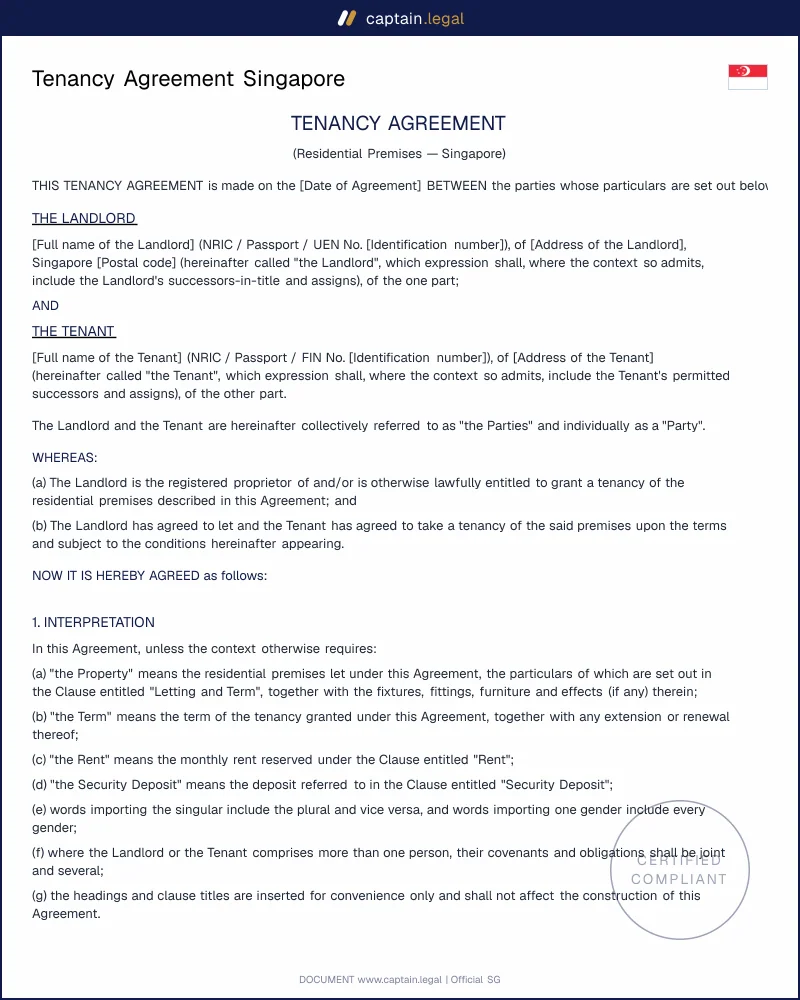
Tenancy Agreement Singapore: IRAS-Ready Lease

Tenancy agreement drafted for Singapore property practice under the Stamp Duties Act. IRAS-ready, HDB and condo clauses. Instant PDF and Word.
4.9/537 reviews50 000+ downloadsInstant download
Share

A residential tenancy agreement in Singapore is the written contract that lets a landlord rent out an HDB flat, a private condominium or a landed home to a tenant on agreed terms. It fixes the rent, the security deposit, the term, the maintenance split and the grounds for ending the relationship early. Most expat lets and local rentals run on a one or two year term, and the agreement is the document IRAS expects to see when you stamp it. A clean, lawyer-drafted tenancy agreement keeps the deposit refund, the diplomatic clause and the minor-repair threshold out of dispute, because those three clauses are where Singapore tenancies actually break down.

This template is built for Singapore residential practice and downloads instantly as PDF and Word, ready for the IRAS e-Stamping portal.

Compliant

2026 Legislation

50,000+ clients

trust us

Affordable

From $4.90 / doc

Secure payment

Instant download

Tenancy Agreement Singapore: IRAS-Ready Lease

Secure payment · No subscription

Fill in the template

What is a residential tenancy agreement in Singapore?

A residential tenancy agreement is a contract granting a tenant the right to occupy a dwelling for a fixed term in exchange for rent. In Singapore the words tenancy agreement, lease agreement and rental agreement are used interchangeably in the residential market, though practitioners tend to reserve "lease" for longer terms and "tenancy" for the one to two year arrangements that dominate the rental scene. The substance is identical: a landlord (the lessor) gives a tenant (the lessee) exclusive possession, and the tenant pays an agreed sum on agreed dates.

What sets the Singapore version apart is the property type driving the clauses. An HDB tenancy sits under the public-housing rulebook, where the flat owner needs HDB approval before subletting the whole unit and the tenant must hold a valid pass. A private condominium tenancy is governed by ordinary contract and common law, with the management corporation's by-laws layered on top. A landed property adds its own maintenance and grounds obligations. The same template skeleton serves all three, but the eligibility, approval and occupancy clauses change depending on whether you are renting a Toa Payoh flat or a District 10 condo. Using a generic foreign template that ignores HDB approval or the diplomatic clause is the single most common drafting error in this market. Our Singapore lease and rental agreement templates are structured around these distinctions from the first field.

2

When do you need this document?

The everyday trigger is renting out a flat or condo for income. A landlord who has cleared the HDB Minimum Occupation Period and wants to sublet the whole unit needs a written tenancy agreement before HDB will register the arrangement, and the registration must be filed within seven days of the tenancy starting. The same need arises for a private condo owner letting to an expat family on a two-year posting, where the diplomatic clause becomes the centre of gravity for the whole deal.

Room rentals are the next most frequent scenario. An owner subletting individual bedrooms while still living in the flat faces fewer restrictions than whole-flat subletting, but still needs a clear written agreement covering shared utilities, occupancy caps and house rules. Tenants taking a room in a shared flat want the same protection: a written record of what they pay, what they can use and when they can leave.

Two edge cases legitimise careful drafting. The first is the early-departure expat: a tenant on an employment pass who is transferred abroad mid-term relies on the diplomatic clause, and a missing or badly worded clause traps them in rent they cannot escape. The second is the handover dispute: without a signed inventory and condition report, deposit deductions for "damage" become a he-said-she-said that the Small Claims Tribunals struggle to resolve. A landlord renewing an existing tenant should also re-paper the term rather than letting it drift into an unstamped month-to-month arrangement, which is exactly the situation our property handover and condition report documents are designed to prevent.

3

Key clauses included in our template

  • The parties and property clause names the landlord, every adult tenant in possession and the exact address, and records the property type. For an HDB flat it confirms that HDB subletting approval has been obtained, since renting out without approval is an offence that can cost the owner the flat.
  • The rent and security deposit clause sets the monthly figure, the payment date and the deposit, which the market sets at one month's rent for a one-year term and two months' rent for a two-year term. It states the conditions for refund and the deductions the landlord may make, so the end-of-tenancy return is governed by the contract rather than by argument.
  • The diplomatic clause lets a foreign tenant terminate after a minimum of 12 months by giving two months' written notice if their employment in Singapore ends or they are posted abroad, on production of proof. This is the clause expats negotiate hardest, and the template fixes the qualifying period and notice precisely so neither side can stretch it later.
  • The minor repairs clause splits maintenance by setting a threshold figure below which the tenant absorbs small repair costs and above which the landlord steps in. It also allocates aircon servicing, which is the most litigated upkeep item in Singapore condos.
  • The reinstatement and inventory clause ties the deposit to the condition report taken at move-in, so the tenant returns the premises in the recorded state allowing for fair wear and tear, and the landlord cannot claim for pre-existing marks.
  • The stamp duty clause records that the tenant bears the duty and must e-stamp within the statutory window, closing off the joint-liability risk for the landlord.
4

Regional and property-type considerations

HDB flats carry the heaviest overlay. Only Singapore citizens who have met the five-year Minimum Occupation Period may sublet a whole flat, and HDB approval must be obtained before the tenancy starts. Permanent residents generally cannot sublet a whole flat, though they may take in authorised occupiers, and the lease term for foreign tenants is capped at two years against three for citizens and PRs. Occupancy caps apply by flat size, and the landlord must report the subletting to HDB within seven days. A tenancy agreement for an HDB flat that omits the approval confirmation or breaches the occupancy cap exposes the owner to fines and possible compulsory acquisition. The agreement should always recite that approval is in place.

Private condominiums are lighter on prior approval but heavier on by-laws. There is no HDB-style pre-approval; instead the landlord notifies the relevant authority of occupancy and must comply with the management corporation's rules under the Building Maintenance and Strata Management Act. The diplomatic clause, aircon servicing split and pet policy do most of the work here, since the strata setting makes nuisance and shared-facility disputes common.

Landed property sits closest to pure common-law contract, with foreign acquisition restricted under the Residential Property Act. The clauses that matter shift toward grounds maintenance, structural upkeep and the larger deposits these properties attract. Across all three types, disputes that cannot be settled privately go to Community Mediation or the Small Claims Tribunals for claims within the statutory ceiling, so a clear written agreement is the landlord's first line of defence. A landlord who also runs a business from a property should look at our commercial and business agreement templates for the separate framework that governs non-residential lets.

5

How to fill out this tenancy agreement

You start by choosing the property type, because HDB, private condominium and landed each unlock a different set of clauses. From there you enter the parties, naming every adult tenant who will occupy the unit rather than only the person signing, and confirm for an HDB flat that subletting approval is in hand. You then set the financial terms: the monthly rent, the deposit calibrated to the term length, and the payment dates. The form prompts you to fix the term, the diplomatic clause qualifying period and the notice required, and to set the minor-repair threshold that decides who pays for small fixes.

The template then guides you through the inventory and reinstatement terms, where you attach or reference the condition report, and through the stamp duty clause that records the tenant's obligation to e-stamp within 14 days. Once the fields are complete you download the agreement as PDF and Word, sign it, and log in to the IRAS e-Stamping portal to stamp it. If you need to verify identity documents or status before signing, our personal and family legal documents cover the statutory declarations sometimes requested at this stage.

6

Common mistakes to avoid

The costliest mistake is treating stamp duty as optional. Many first-time landlords sign, hand over keys and forget IRAS entirely, only to find the agreement inadmissible when a deposit dispute lands at the Small Claims Tribunals. The duty is small, the penalty for missing the 14-day window is not, and an unstamped agreement undermines the very protection the document was meant to give. The second frequent error is reusing a foreign template that has no diplomatic clause or an unworkable one, which either traps a transferred expat or hands the tenant an escape the landlord never intended. A diplomatic clause needs a clear minimum period, a defined notice and a proof requirement, and a vague version is worse than none.

On the HDB side, landlords routinely forget that whole-flat subletting needs prior approval and seven-day registration, and that occupancy caps are enforced. Skipping the inventory and condition report is the other recurring trap: without dated photographs and a signed list, deposit deductions collapse the moment the tenant disputes them. Finally, owners often leave the security deposit terms vague, failing to state what counts as fair wear and tear, which turns a routine move-out into a contested claim. A short, properly drafted agreement that addresses each of these closes the gaps before they open. For employment-pass holders renting while on assignment, our Singapore employment contract templates sit alongside the tenancy as part of the same relocation file.

Key takeaways

Stamp duty

E-stamp on time or it bites

A tenancy of one year or more must be e-stamped with IRAS under the Stamp Duties Act. The deadline is 14 days after signing in Singapore, or 30 days if signed overseas. If you miss it, the lease is not admissible in evidence until duty and any penalty are paid, and penalties can climb as the delay grows. State clearly who pays.

Key terms

Lock down rent, deposit and exits

In Singapore, residential rentals rely on contract and common law, so the written tenancy agreement carries most of the weight. Make sure the rent amount and payment dates, security deposit and refund conditions, the term, maintenance split, and early-termination grounds are spelt out. Disputes often centre on the deposit refund, any diplomatic clause, and the minor-repair threshold.

Property type

HDB, condo and landed are different

Do not use a generic foreign lease. The clauses change depending on whether you are renting an HDB flat, a private condominium, or a landed home. HDB subletting requires HDB approval before the whole unit is rented out, and the tenant must hold a valid pass. For condos, the management corporation’s by-laws can add extra rules on occupancy and use.

Frequently Asked Questions

Yes. A residential tenancy agreement is enforceable as an ordinary contract under Singapore law once both parties sign and there is rent and an agreed term. There is no requirement for a lawyer or a notary to validate a residential tenancy. The one formal step that affects enforceability is stamping: under the Stamp Duties Act, an unstamped agreement of one year or more is not admissible in evidence until the duty and any penalty are paid. So the template is binding on signing, but you should e-stamp it through IRAS to be able to rely on it in any dispute. Filling in the parties, rent, deposit and term accurately is what makes it hold up.

For a residential tenancy of up to four years, IRAS charges 0.4% of the total rent payable over the term, based on the higher of the contractual or market rent. A tenancy with an Average Annual Rent of S$1,000 or less is exempt. On a S$3,000 monthly rent over 12 months, the total rent is S$36,000 and the duty is S$144. You must e-stamp within 14 days of signing in Singapore, or 30 days if signed overseas, through the IRAS e-Stamping portal. By convention the tenant pays, though both parties are jointly liable, so the agreement should say so expressly.

Yes. The agreement is generated in both PDF and editable Word format. The PDF is print-ready for signing and for uploading when you e-stamp through IRAS. The Word version lets you adjust wording before signing if your situation needs a tweak, such as a specific aircon-servicing arrangement or a pet clause. Both versions carry the same Singapore-specific clauses, including the diplomatic clause, the minor-repair threshold and the HDB approval confirmation where relevant. You can fill it in, preview the full document, and download immediately.

A diplomatic clause lets a foreign tenant end the tenancy early if their employment in Singapore ceases or they are posted abroad. The market standard allows termination after a minimum of 12 months on two months' written notice, with proof of transfer or cessation of employment. You need one whenever your tenant is an expat on an employment or dependant pass, because without it a transferred tenant stays liable for the full remaining rent. Landlords often pair it with a reimbursement clause for any unamortised agent commission. For a local tenant on a long-term basis the clause is usually unnecessary.

Yes, for a whole-flat sublet. Only Singapore citizens who have completed the five-year Minimum Occupation Period may sublet an entire HDB flat, and you must obtain HDB approval before the tenancy begins, then register the subletting within seven days of it starting. Renting out rooms while you still live in the flat carries fewer restrictions but still requires you to keep within occupancy caps and to verify each tenant's pass and eligibility. Subletting without approval is an offence that can lead to fines or, in serious cases, loss of the flat, so the agreement should confirm approval is in place.

There is no statutory cap on residential deposits in Singapore, so the figure is set by the market and the contract. The convention is one month's rent for a one-year tenancy and two months' rent for a two-year tenancy, paid on signing and held against damage and unpaid rent. The deposit is normally returned without interest at the end of the term after deductions agreed in the tenancy agreement. This is why the inventory and condition report matter: deductions are far easier to justify when the move-in state is documented. The agreement should set out exactly what the deposit secures and the timeline for its return.

Most Singapore residential tenancies run for one or two years, which is the market norm for both HDB and private property. For HDB flats the term for foreign tenants is capped at two years, against three years for Singapore citizens and PRs, and a minimum of six months applies to whole-flat subletting. Private property terms are more flexible and can run longer, though a lease beyond four years changes how stamp duty is calculated and how the interest is treated. The full Singapore legal document catalogue includes renewal and notice templates for when the term ends.

An unstamped tenancy agreement is still a valid contract between you and the other party, but it cannot be used as evidence in court or before the Small Claims Tribunals until the stamp duty and any penalty are paid. In practice this means that if a deposit, damage or early-termination dispute arises, you cannot rely on the document to prove your terms until you regularise it. Late stamping also attracts a penalty that escalates with the delay, starting nominal and rising to several times the duty. The fix is simple: e-stamp through IRAS within 14 days of signing and keep the stamp certificate with the agreement.

4.9/5

37 verified reviews · 50 000+ downloads

Tenancy Agreement Singapore: IRAS-Ready Lease
  • Immediate access to the document
  • PDF + Word download
  • Compliant with 2026 legislation
  • Reviewed by lawyers
Fill in the template
Secure payment · No subscription
Updated on June 15, 2026

You might also like

Letter of Intent to Rent Property Singapore
Tenancy Agreement Stamp Duty Singapore