Create my document
Login

Choose country

FranceBelgiqueEspañaUnited StatesUnited KingdomMarocDeutschlandItaliaSchweizSingapore
Business & Incorporation

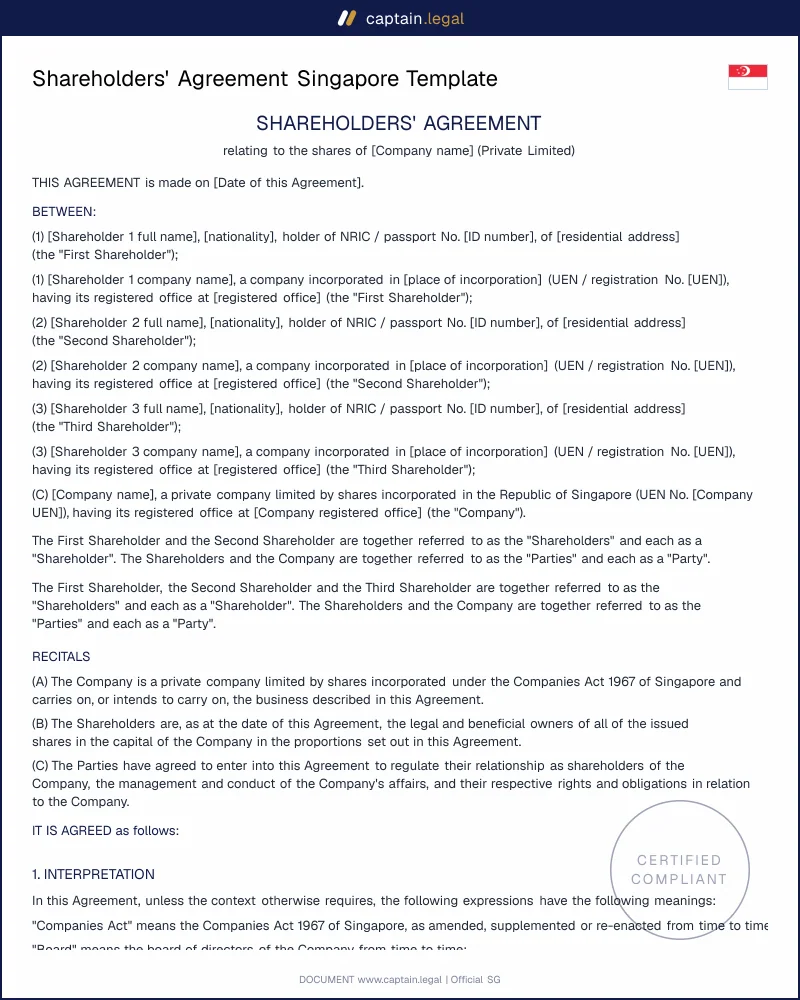
Shareholders' Agreement Singapore: Companies Act 1967

Pte Ltd shareholders' agreement drafted to the Companies Act 1967, with section 216 and 254 protections, drag-along, tag-along and founder vesting clauses.
4.6/521 reviews50 000+ downloadsInstant download
Share

A shareholders' agreement is the private contract that decides how a Singapore Pte Ltd is actually run when its owners stop agreeing. It binds the shareholders to each other on the things the Companies Act 1967 and a standard constitution leave open: who controls major decisions, how shares change hands, what a founder keeps if they walk away, and how a 50/50 split gets broken before it kills the company. Lawyers in Singapore treat it as the document that does the heavy lifting on control and exit, sitting alongside the company Constitution rather than replacing it. This template is drafted for Pte Ltd companies registered with ACRA and built around the reserved matters, drag-along and tag-along, founder vesting, leaver and deadlock provisions that local practice expects.

Most founders sign one too late, usually after the first serious disagreement, when leverage has already shifted. The point of putting it in place at incorporation is that everyone agrees the rules while they still like each other.

Compliant

2026 Legislation

50,000+ clients

trust us

Affordable

From $4.90 / doc

Secure payment

Instant download

Shareholders' Agreement Singapore: Companies Act 1967

Secure payment · No subscription

Fill in the template

What is a shareholders' agreement in Singapore?

A shareholders' agreement (often abbreviated SHA) is a contract between some or all of the members of a company that governs their rights and obligations as owners. It is a creature of contract law, enforceable between the parties who sign it, and it is private: unlike the Constitution, it is not filed with ACRA and does not appear on a BizFile+ search. That privacy is exactly why investors and founders prefer to keep sensitive commercial terms, valuation formulas and veto rights inside the SHA rather than in the public constitutional document.

The distinction that trips people up is SHA versus Constitution. The Constitution is the company's statutory rulebook, binding the company and every member under section 39 of the Companies Act 1967, and third parties such as banks and regulators rely on it. The SHA binds only its signatories and can go further, granting personal rights that never appear in the Constitution at all. Where the two documents conflict, Singapore courts generally give precedence to the Constitution on matters of corporate governance, which is why a well-drafted SHA is always checked for consistency against the constitutional document before signing. Our template is designed to work in tandem with a Singapore Pte Ltd company constitution, not against it, so reserved matters and transfer rules line up across both instruments.

2

When do you need a shareholders' agreement?

The clearest trigger is more than one founder. The moment a Pte Ltd has two or more shareholders, the absence of an SHA means the default position governs every fallout, and the default position is rarely what either party would have chosen. A second common scenario is bringing in outside investment: angel investors and venture funds expect an SHA as a condition of putting money in, and they will want anti-dilution protection, information rights and a veto over reserved matters before they wire a cent. Without one, the round usually stalls.

Founder departures are the third trigger, and the one founders most underestimate. When a co-founder leaves after eighteen months with a quarter of the equity and no vesting clause, the remaining team is stuck working to enrich someone who has gone. Vesting and good leaver / bad leaver mechanics exist precisely for that moment. A fourth situation is the 50/50 split, the structure that feels fair at the start and becomes a trap the day the two owners disagree, because neither can outvote the other and the company simply freezes.

Two edge cases are worth flagging. The first is a joint venture between two corporate shareholders, where the SHA effectively becomes the operating constitution of the venture and the reserved matters list does most of the work. The second is a family company bringing in the next generation: succession, share transfer on death and the treatment of inherited shares all belong in the SHA rather than left to intestacy. If your structure also needs aligned employment terms for founder-directors, pair the SHA with a Singapore employment contract for directors and key staff.

3

Key clauses included in our template

  • The reserved matters schedule lists the decisions that cannot be taken without a defined supermajority or the consent of named shareholders. Typical entries are issuing new shares, taking on substantial debt, changing the business, approving the annual budget and selling the company. This is the single most important minority protection in the document, because it stops a majority owner from acting unilaterally on matters that reshape the investment.
  • The drag-along right lets a defined majority compel the minority to sell on the same terms when a genuine third-party buyer wants 100 percent of the company. Without it, a single small holder can block an otherwise clean exit. The clause is drafted with price and process safeguards so the minority sells on equal terms, not worse ones.
  • The tag-along right is the mirror protection for the minority. If a majority shareholder sells, the minority can require the buyer to take their shares too, on the same price and terms, so they are never left stranded as a powerless co-owner alongside a new controller they never chose.
  • The founder vesting schedule ties each founder's equity to time served, commonly over three to four years with a one-year cliff, so a founder who leaves early forfeits the unvested portion. This keeps equity in the hands of the people still building the company.
  • The good leaver / bad leaver provisions set the price a departing shareholder receives. A good leaver, who leaves through ill health or by agreement, is typically bought out at fair value; a bad leaver, who is dismissed for cause or breaches the agreement, receives a lower formula price. The distinction protects the company from rewarding bad conduct.
  • The deadlock clause provides the escalation path when the owners cannot agree: structured negotiation, then mediation, then a buy-sell mechanism such as a shotgun or Russian roulette clause, before anyone reaches for section 254. It is the contractual alternative to a court-ordered winding up.
4

Regional considerations

Singapore is a single unified jurisdiction, so there is no state-by-state variation in the way a federal system produces. The Companies Act 1967 applies islandwide and the Accounting and Corporate Regulatory Authority (ACRA) is the sole companies registrar, which simplifies drafting considerably compared with multi-state markets. What varies instead is the regulatory overlay depending on the company's activity. A business holding a Monetary Authority of Singapore (MAS) licence, such as a payment institution or fund manager, faces ownership and control restrictions that must be carried into the reserved matters and transfer provisions, because a transfer that breaches a licensing condition can put the licence itself at risk.

Dispute resolution choice is the other practical decision. Many Singapore SHAs route disputes to the Singapore International Arbitration Centre (SIAC), valued for confidentiality and the enforceability of awards under the New York Convention, which matters when one shareholder is based overseas. Domestic, lower-value disputes are often sent to the Singapore Mediation Centre first. The governing law and jurisdiction clause should be deliberate, not boilerplate, because a foreign shareholder may otherwise assume a different forum applies. For companies limited by guarantee or non-profit structures the analysis differs entirely, and those are better served by a dedicated Singapore CLG constitution under the Companies Act 1967 rather than a shareholders' agreement.

5

How to complete this shareholders' agreement

You begin by entering the company's details and the names and shareholdings of every party, which fixes who is bound and in what proportion. From there the template moves through the commercial sections in the order a practitioner would negotiate them. You set the reserved matters, choosing which decisions need a supermajority and which need unanimous consent, then define the board composition and how directors are appointed and removed. The transfer section comes next, where you switch the pre-emption rights, drag-along and tag-along thresholds on and configure the percentages that trigger each one.

The founder protection block follows, where you set the vesting period, the cliff and the good leaver and bad leaver price formulas. You then choose your deadlock mechanism and your dispute resolution forum, typically SIAC arbitration or court litigation in Singapore. Once the fields are complete, the document assembles into a coherent agreement that you download as Word and PDF, ready to review against your Constitution and circulate for signature. If you have not yet incorporated, you can prepare the founding documents alongside the SHA from the Singapore business and incorporation templates.

6

Common mistakes to avoid

The most damaging mistake is signing an SHA that contradicts the Constitution. When the reserved matters in the agreement do not match the directors' powers in the Constitution, officers receive conflicting instructions and a court asked to resolve the clash will usually side with the constitutional document, defeating the protection the SHA was meant to give. The fix is mundane but essential: reconcile the two documents clause by clause before signing, and amend the Constitution where the SHA grants rights it cannot deliver alone. A close second is leaving out vesting on the assumption that co-founders will stay, which is the single error that produces the most founder disputes, because a departing founder with fully vested equity has no incentive to leave cleanly.

Vague reserved matters cause the next tier of problems. A clause that simply says "major decisions require consent" invites argument over what counts as major, so each reserved item should be specific and, where it involves a number, quantified. Founders also routinely skip the deadlock mechanism in 50/50 companies, which is precisely the structure most likely to freeze, leaving the only exit a section 254 winding up petition that destroys value for everyone. Finally, many agreements are never updated when a new shareholder joins or a funding round closes, so the live cap table no longer matches the document the parties actually signed. An SHA is reviewed and amended by written consent of all parties whenever ownership changes.

Key takeaways

ROLE

The SHA runs the company when you disagree

A shareholders' agreement (SHA) is a private contract between shareholders that fills the gaps the Companies Act 1967 and a standard Constitution leave open: control over major decisions, how shares can be transferred, founder vesting and what happens when a 50/50 split turns into deadlock. It sits alongside the Constitution and does the practical “control and exit” work founders and investors expect in a Singapore Pte Ltd.

PRIORITY

Constitution can override a conflicting SHA

The Constitution is the company’s statutory rulebook and binds the company and every member under section 39 of the Companies Act 1967. The SHA binds only the signatories. If the two conflict on corporate governance, Singapore courts generally give precedence to the Constitution, which can leave a carefully negotiated SHA clause hard to enforce. Align reserved matters and share transfer rules across both documents before signing.

DISPUTES

Draft to avoid section 216 and 254 fights

Deadlock and exit clauses are shaped by what happens if matters end up in court. Under section 216, a minority shareholder can seek relief for oppression or unfair prejudice, including a court-ordered buy-out at fair value. Under section 254(1)(i), the company can be wound up on the just and equitable ground when trust breaks down. A well-drafted SHA aims to keep disputes out of these routes.

Frequently Asked Questions

Yes. A shareholders' agreement is a contract and binds everyone who signs it under Singapore's common law of contract, provided the usual requirements of offer, acceptance, consideration and intention to create legal relations are met. It does not need to be filed with ACRA or registered anywhere to be enforceable between the parties. The one important limit is its relationship with the Constitution: where the two conflict on a matter of corporate governance, courts generally give the Constitution precedence, which is why our template is drafted to sit consistently alongside your constitutional document rather than override it. Properly executed, including by electronic signature under the Electronic Transactions Act 2010, it is fully binding.

You download the completed shareholders' agreement in both Word and PDF. The Word version lets your lawyer or company secretary make final adjustments, insert party-specific schedules or align defined terms with your existing Constitution before signing. The PDF is the clean execution copy you circulate for signature and keep on file. Singapore practice is to retain a signed original with the company secretary and provide each shareholder with a copy, so the agreement can be produced if a transfer, dispute or investor due diligence ever requires it.

In most cases, yes, because the two documents do different jobs. The Constitution is the public, statutory rulebook that satisfies the Companies Act 1967 and that banks and regulators rely on. The shareholders' agreement is the private contract that handles the commercial relationship between owners: reserved matters, vesting, drag-along and tag-along, leaver terms and deadlock resolution, much of which founders prefer to keep out of the public document. A standard constitution rarely addresses any of these in the detail a real dispute demands, so relying on it alone leaves the most contentious situations governed only by statutory defaults.

Reserved matters give a minority holder a veto over a defined list of significant decisions, even though they cannot outvote the majority on ordinary business. By requiring a supermajority or specific consent for actions such as issuing new shares, taking on major debt or selling the company, the clause stops the majority from diluting or restructuring the minority's position unilaterally. This is the contractual front line against the kind of commercial unfairness that would otherwise push a minority shareholder toward a section 216 oppression claim, which is slow, costly and damaging to the business for everyone involved.

They protect opposite parties in a sale. A drag-along right lets a defined majority force the minority to sell when a buyer wants the whole company, so a single small holder cannot block a clean exit; the minority sells on the same terms as the majority. A tag-along right protects the minority instead: if the majority sells, the minority can require the buyer to take their shares too, on identical price and terms, so they are never left as a powerless co-owner beside a new controller. A well-drafted agreement includes both, balancing the majority's freedom to exit against the minority's right not to be stranded.

Founder vesting ties each founder's equity to continued involvement, usually over three to four years with a one-year cliff. Before the cliff, a founder who leaves takes no equity; after it, shares vest gradually, often monthly or quarterly, until fully earned. If a founder departs early, the unvested portion is bought back, commonly at a nominal or cost price, so it returns to the company and stays available for the people still building it. Vesting is the mechanism that prevents the classic problem of a co-founder walking away after a few months while retaining a large, permanent slice of the business.

The agreement provides a contractual escalation path so the dispute does not go straight to court. It typically starts with structured negotiation between the principals, then mediation, often through the Singapore Mediation Centre, and only then a buy-sell mechanism such as a shotgun clause, where one shareholder names a price at which they will either buy or sell. The aim is to resolve the impasse internally and avoid a section 254(1)(i) just and equitable winding up petition, which Singapore courts treat as a last resort and which destroys value for every party. A clear deadlock clause is what keeps a 50/50 disagreement from becoming a terminal one.

Yes. The Electronic Transactions Act 2010 recognises electronic signatures as valid for commercial agreements of this type, so a shareholders' agreement executed electronically is binding in Singapore. This is useful when shareholders are in different countries, a common situation given how many Pte Ltd companies have overseas investors or founders. Many parties still keep a signed PDF original with the company secretary as the definitive record. For related personal documents such as a will or power of attorney, where stricter execution formalities apply, see the Singapore wills and personal legal templates instead.

4.6/5

21 verified reviews · 50 000+ downloads

Shareholders' Agreement Singapore: Companies Act 1967
  • Immediate access to the document
  • PDF + Word download
  • Compliant with 2026 legislation
  • Reviewed by lawyers
Fill in the template
Secure payment · No subscription
Updated on June 17, 2026

You might also like

NDA Singapore Template
First Board Resolutions Singapore