Create my document
Login

Choose country

SingaporeSingaporeChoose country
Employment & HR

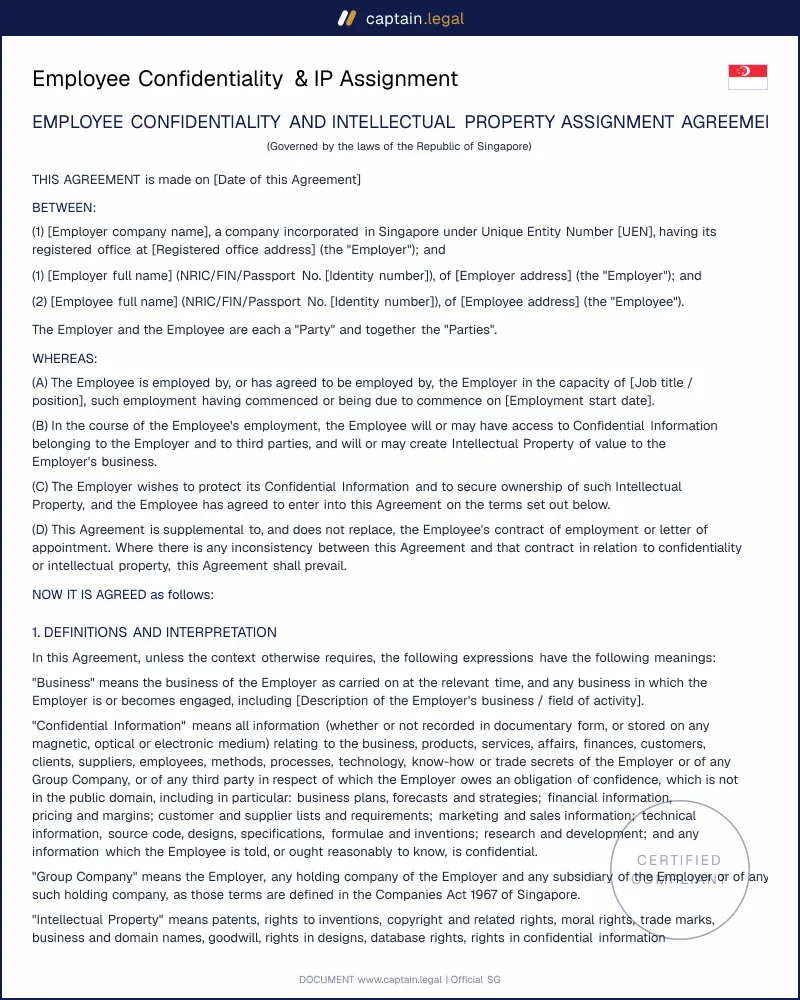
Employee IP Assignment Agreement Singapore (s.138 CA)

Confidentiality and IP assignment drafted to the Copyright Act 2021 and Patents Act 1994. Valid written assignment, ready in Word and PDF.
4.5/519 reviews50 000+ downloadsInstant download
Share

An Employee Confidentiality and Intellectual Property Assignment Agreement keeps the value your staff create inside the company. It binds the employee to protect trade secrets, client data and know-how during and after the engagement, and assigns to the employer every piece of intellectual property the employee produces on the job. In Singapore, where the Copyright Act 2021 and the Patents Act 1994 already vest much employee-created IP in the employer by default, a well-drafted agreement closes the gaps those statutes leave open and gives you clean, provable title. It is drafted for Singapore practice and downloads instantly as editable Word and PDF.

Compliant

2026 Legislation

50,000+ clients

trust us

Affordable

From $4.90 / doc

Secure payment

Instant download

Employee IP Assignment Agreement Singapore (s.138 CA)

Secure payment

Fill in the template

What is an employee confidentiality and IP assignment agreement?

An Employee Confidentiality and IP Assignment Agreement is a single document, or a schedule to the employment contract, combining two promises. The first is a duty of confidence: the employee agrees not to use or disclose the employer's confidential information except for the employer's benefit, both while employed and after leaving. The second is an assignment of intellectual property: the employee assigns to the employer all rights in the works, inventions, designs and other IP created in connection with the employment, and agrees to sign whatever further documents perfect that transfer.

People often confuse this agreement with a plain non-disclosure agreement, but the two are not the same. A standard NDA governs a two-way exchange of information between businesses considering a deal, and Captain.Legal offers a dedicated one for that purpose in its Singapore NDA templates for mutual and one-way disclosure. An employee agreement is narrower and deeper: it sits inside an ongoing employment relationship and does the heavy lifting of transferring ownership of everything the employee makes. It is what lets a Singapore employer treat source code, product designs and customer lists as company assets rather than the personal property of whoever happened to create them.

2

When do you need this agreement?

The clearest trigger is any new hire who will touch something the business wants to keep. Engineers writing code, designers producing brand assets, salespeople building a client book: each generates value you want to own outright and keep from a competitor. Because the statutory defaults cover only part of the picture, a Singapore employer signs this at the start so ownership is settled before the first line of code exists. It belongs alongside the full-time employment contract drafted to the Employment Act 1968, not as an afterthought once a dispute has surfaced.

The second scenario is a change in role. An employee promoted into a research or product function, or moved onto a project outside their original duties, may create inventions that section 49 does not automatically assign, so refreshing the agreement then prevents a nasty surprise. A third is exposure to third-party confidential information, such as a client's data under a services contract, where the employer must flow its own obligations down to the individual handling the material. Founders present a related edge case: a startup that never had its first developers sign can find, during due diligence for a funding round, that it does not clearly own its own product. Investors treat missing IP assignments as a deal-breaking defect, and retrofitting signatures after someone has left is difficult and sometimes impossible.

3

Key clauses included in our template

  • The definition of confidential information is drafted broadly but precisely, covering technical data, business plans, customer and supplier information, pricing and unpublished IP, while carving out what is already public or independently known. A vague definition invites argument about what was actually protected, so the clause anchors each category to the employer's real business.
  • The present assignment of intellectual property transfers, in writing and signed as section 138 of the Copyright Act 2021 requires, all rights in works and inventions created in connection with the employment, including future rights. It pairs with a further-assurance covenant obliging the employee to execute any further documents IPOS or a foreign registry may need.
  • The waiver of the right to be identified addresses the attribution right introduced by the Copyright Act 2021, so the employer can use and adapt works without a later claim that the creator should have been named.
  • The post-employment confidentiality obligation survives termination indefinitely for genuine trade secrets, tracking the common law of confidence rather than an arbitrary end date a court might read as the true limit of protection.
  • The return-of-materials clause requires the employee to hand back or delete all confidential material and devices on leaving, often the practical difference between a clean exit and a leak.
4

Sector considerations

Confidentiality and IP assignment is national law in Singapore, so the same framework applies whether the employer sits in the CBD, Jurong or one-north. The variation is by sector and seniority. In technology and life sciences, where patentable inventions and copyright-heavy code dominate, the assignment and further-assurance clauses carry the most weight, and employers should describe the inventive elements of a role explicitly in the job scope so section 49 of the Patents Act 1994 bites cleanly. A generic job title weakens the statutory default and throws the burden onto the contract. For managers and executives earning above the Employment Act salary threshold, much of the relationship is governed by the contract rather than by statute, which makes careful drafting even more important. Financial and fund management firms layer regulatory secrecy duties on top, so the confidentiality definition should be wide enough to capture client information caught by those rules, and where an employee handles personal data the agreement should dovetail with the employer's Personal Data Protection Act 2012 obligations. One point holds across every sector: a restraint that merely repeats the confidentiality promise adds nothing, because a Singapore court looks for a legitimate proprietary interest over and above confidential information already protected elsewhere in the contract.

5

How to fill out this agreement

You begin by identifying the parties and the employment the agreement attaches to, since it works best as a companion to the main contract. You then set the scope of confidential information, tailoring the categories to what the business actually holds, whether source code, formulations, client lists or pricing models. Next you confirm the IP assignment and, where the role involves invention or authorship, describe those duties clearly so the statutory defaults and the contractual assignment reinforce each other. The template guides you through the confidentiality survival period, the return-of-materials mechanics and the waiver of the identification right. Because section 138 of the Copyright Act 2021 requires an assignment to be signed by the assignor, the employee must sign for the transfer to take effect. You then download in Word to adapt further or in PDF to sign as is. If you are still assembling the hiring pack, the KETs statement required within 14 days of starting work is the natural companion to prepare alongside it.

6

Common mistakes to avoid

The most frequent error is treating the statutory defaults as complete protection. Section 134 of the Copyright Act 2021 and section 49 of the Patents Act 1994 give a strong starting position, but they leave gaps around works made outside normal duties, future rights and the writing requirement for assignments, and an employer relying on the defaults alone often discovers the gap only in litigation. A close cousin is the agreement that assigns existing IP but forgets future rights, so everything created after signing slips through. Equally common is the recycled foreign template: US and European precedents assume ownership and moral-rights rules that do not map onto Singapore, and a clause drafted for another country can be worse than none.

The other cluster concerns restraints. Employers routinely bolt an aggressive non-compete onto the confidentiality clause and assume both will hold. Singapore courts start from the position that any post-employment restraint is void unless it protects a legitimate proprietary interest and is reasonable in scope, duration and geography, and recent High Court decisions have struck down restraints precisely because the employer could show no interest beyond confidential information a separate clause already covered. A blanket ban on competing, with no geographic or temporal limit, is the least enforceable clause you can draft. The fix is to protect confidentiality and client connections through targeted clauses and reserve any non-compete for the narrow case where a genuine, separate interest justifies it. Founders make a final classic error by never having early hires sign at all, then scrambling during a funding round, an issue that also surfaces when reviewing a company's shareholders' agreement drafted to the Companies Act 1967.

Key takeaways

OWNERSHIP

Get clean title, not assumptions

Even though the Copyright Act 2021 (s.134) and Patents Act 1994 (s.49) often place employee-created works and certain inventions with the employer by default, those rules have limits. This agreement closes the gaps for borderline cases, like work done just outside normal duties. It lets you treat source code, product designs and customer lists as company assets with provable ownership.

IN WRITING

Copyright assignment must be signed

If you want a valid transfer of copyright beyond the statutory default, the Copyright Act 2021 requires the assignment to be in writing and signed by the assignor (s.138). That means a verbal understanding or a clause buried without proper execution can fail when you try to enforce rights or sell the IP. The agreement also anticipates follow-up signatures to perfect the transfer.

CONFIDENTIALITY

Duty of confidence continues after exit

The confidentiality promise is broader than a typical NDA and is tied to the employment relationship. It restricts using or disclosing trade secrets, client data and internal know-how during employment and after the employee leaves. Misuse of confidential material can be actionable under the common law of confidence, as highlighted in I-Admin (Singapore) Pte Ltd v Nice Payroll Pte Ltd, and handling personal data must also comply with the PDPA.

Frequently Asked Questions

Yes. Once both parties sign, the agreement is a binding contract under Singapore law, and the IP assignment satisfies the writing-and-signature requirement in section 138 of the Copyright Act 2021. Its practical strength depends on tailoring: a broad but precise confidentiality definition and a clear present assignment of current and future IP will hold up, while vague or overreaching clauses invite challenge. The confidentiality duties rest on the common law of confidence and the contract itself, both of which Singapore courts enforce through injunctions and damages. For the assignment to bite on inventions, the employee's duties should be described accurately, so the Patents Act 1994 default and the contractual transfer support each other.

Partly, and that is the trap. Under section 134 of the Copyright Act 2021 your company is the first owner of copyright in works an employee creates in the course of employment, and under section 49 of the Patents Act 1994 you own inventions made in the course of normal duties where an invention might reasonably be expected. Those defaults are real but incomplete: they do not cleanly capture work made just outside normal duties, future creations, or contributions where the job scope is written too loosely. The agreement converts those partial defaults into a single, provable transfer, which matters during due diligence or any ownership dispute.

For ordinary confidential information the duty typically runs for the employment and a defined period afterwards, while for genuine trade secrets it can survive indefinitely, because the common law protects a secret for as long as it stays secret. The template distinguishes the two so a court does not read a fixed end date as the outer limit of all protection. What you cannot do is use the confidentiality clause as a disguised non-compete: keeping information secret is legitimate, but preventing an ex-employee from working is a restraint of trade that must independently satisfy the reasonableness test.

You can, but treat it with caution. In Singapore a post-employment non-compete is presumptively void and enforceable only if it protects a legitimate proprietary interest and is reasonable in scope, duration and geography. Where confidentiality and client connections are already protected by other clauses, recent High Court decisions have refused to enforce a non-compete that adds nothing beyond that. Keep it narrow, tie it to a specific interest, and rely mainly on the confidentiality and non-solicitation provisions, which courts enforce far more readily.

A standard NDA governs information shared between two businesses weighing a transaction and is usually mutual. This agreement lives inside the employment relationship, imposes ongoing duties on one individual, and additionally assigns intellectual property to the employer, which a plain NDA does not do. If you need a straightforward disclosure agreement for a commercial discussion rather than a hire, the mutual and one-way NDA template for Singapore is the right instrument instead.

You can download it as an editable Microsoft Word file or as a ready-to-sign PDF. The Word version lets you adjust the confidentiality definition, the IP scope and any restraint to fit the specific role, which is worth doing rather than signing a generic draft. The PDF suits settled terms where you need a clean copy to execute. Either way, the employee must sign for the IP assignment to take legal effect. For related individual paperwork within the business, the Singapore personal and estate document templates cover adjacent ground.

4.5/5

19 verified reviews · 50 000+ downloads

Employee IP Assignment Agreement Singapore (s.138 CA)
  • Immediate access to the document
  • PDF + Word download
  • Compliant with 2026 legislation
  • Reviewed by lawyers
Fill in the template
Secure payment
Updated on July 10, 2026

You might also like

Mutual Separation Agreement Singapore
KETs Statement Singapore