Create my document
Login

Choose country

SingaporeSingaporeChoose country
Business

SAFE & Note Term Sheet Template, Word and PDF

Build a SAFE or convertible note term sheet with a guided wizard, then download it in Word and PDF, ready to send to your early-stage investors.
4.8/517 reviews50 000+ downloadsInstant download
Share

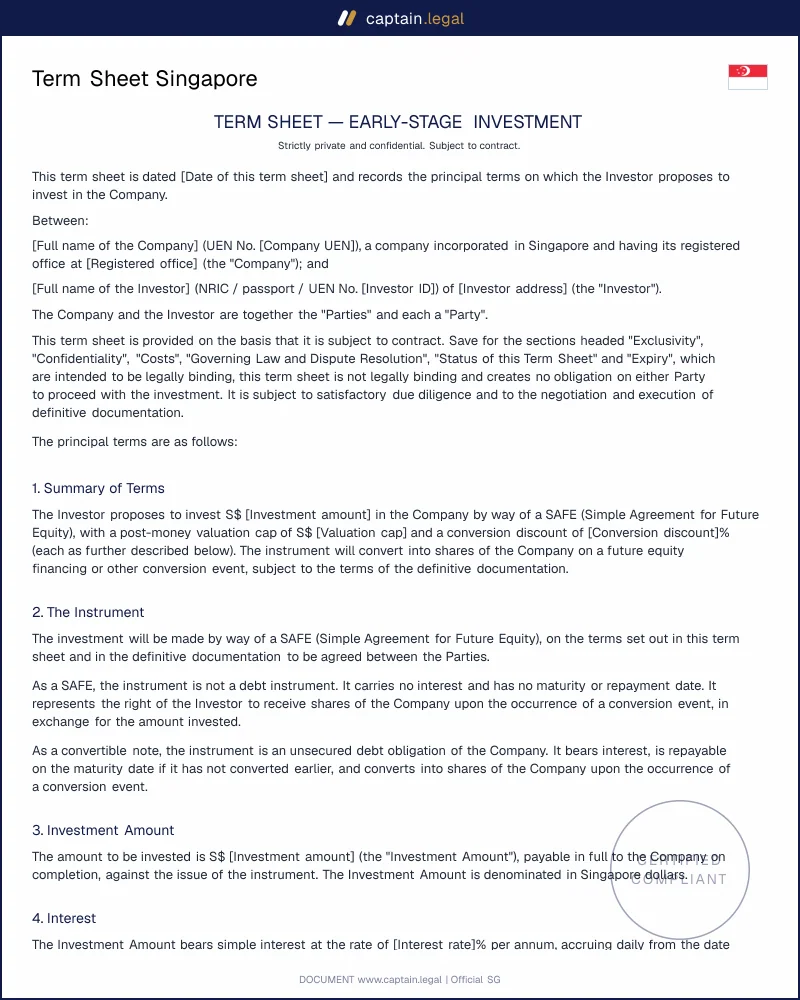
A term sheet is the one-page summary of the deal a founder and an early investor shake hands on, before any lawyer drafts the binding paperwork. This template produces a Singapore heads of terms for an early-stage investment made either as a SAFE, a simple agreement for future equity, or as a convertible note. You choose the instrument and the key financial terms, and the document assembles the rest. Founders get a clean, investor-ready offer to circulate; investors get the commercial points fixed before diligence begins. Most of it is deliberately non-binding, which is how a term sheet should read.

Compliant

2026 Legislation

50,000+ clients

trust us

Affordable

From $4.90 / doc

Secure payment

Instant download

SAFE & Note Term Sheet Template, Word and PDF

Secure payment

Fill in the template

What is a SAFE or convertible note term sheet?

A term sheet records the principal commercial terms of a proposed investment: how much money goes in, what it buys, and what a later conversion into shares depends on. It is not the investment itself. The binding instrument, the SAFE or the convertible note, is signed afterwards, once diligence and the definitive documentation are done.

The choice between the two instruments drives everything below it. A SAFE is not debt: it carries no interest and no maturity date, and gives the investor shares when the company next raises an equity round, or a payout of equivalent value if it is sold first. A convertible note is an unsecured loan that bears interest and falls due on a maturity date, converting into shares if a qualifying round happens first. Both use a valuation cap and a conversion discount to reward the early investor for backing the company before it has a price. The definitive convertible loan and SAFE agreement for Singapore startups is what this offer leads into once both sides agree.

2

When do you need this document?

The commonest trigger is the first real cheque. A founder promised money by an angel or a micro-VC needs something concrete to move from conversation to commitment, and a term sheet does that without full documentation up front. Accelerator and pre-seed rounds run the same way: the lead investor issues terms, the founder counter-signs, and the SAFE or note follows. Bridge rounds are another classic, where existing investors top a company up on convertible terms.

It also earns its place whenever several investors come in on the same terms, because circulating one clean offer keeps every party on the same valuation cap and discount instead of negotiating each cheque separately. Founders still sorting out equity between themselves usually settle the founders' agreement between co-founders first, then use this document to bring outside money in. If an investor asks for a board seat or warranties now, the deal has outgrown a simple convertible.

3

Key clauses included in our template

The template runs from a short summary of terms to the signature block, and adapts as you answer. The clauses that carry the weight are these:

  • The instrument choice sits at the top and reshapes the rest of the document. Pick a SAFE and the interest and maturity sections disappear; pick a convertible note and they appear.
  • The investment amount and valuation cap fix how much goes in and the ceiling valuation at which it converts, so a later up-round does not erode the investor's entry price.
  • The conversion discount gives the investor a percentage reduction on the price the next round's investors pay, and the document applies whichever of the cap or the discount yields the better price.
  • The interest and maturity clauses, present only for a note, set a simple annual rate and the date by which the note converts or is repaid, with accrued interest rolling into the conversion rather than paid in cash.
  • The conversion clause defines the qualifying financing that triggers automatic conversion, and handles a trade sale or a winding up before conversion.
  • The optional pro-rata and most-favoured-nation rights let the investor keep its percentage in later rounds and pick up better terms granted to a later convertible holder.
  • The binding exclusivity, confidentiality and expiry clauses stop the company shopping the deal, protect each side's information, and lapse the offer if it is not signed in time.

This pairs naturally with a shareholders' agreement for a Singapore company when the round ends in a governance arrangement.

4

SAFE or convertible note: what changes

The instrument you pick changes the risk on both sides. A SAFE keeps things simple: no interest to track and no maturity date to miss, so nothing forces a conversion or a repayment if the next round is slow to arrive. That simplicity is why the SAFE has spread through Singapore's seed stage. The trade-off is that a pure SAFE gives the investor no scheduled way to recover the money if the company simply drifts.

A convertible note answers that by being debt. It accrues interest, usually at a modest simple rate, and carries a maturity date. If no qualifying round happens before that date, the investor can demand repayment or convert on the spot, which is real leverage a SAFE lacks. The note also ranks ahead of shareholders on a winding up, a meaningful difference if the company fails. Lending to a company also sits near the Moneylenders Act 2008, but that Act excludes anyone who lends only to corporations, so a convertible note into a Singapore company stays outside its licensing regime.

Between the two, the valuation cap and the discount behave identically, so the negotiation turns on interest, maturity and the downside. A founder confident of raising soon leans toward the SAFE; an investor who wants a floor leans toward the note. This document writes either cleanly, so you can send the same offer both ways.

5

How to fill out this term sheet

You start by naming the company and the investor, then choose the instrument, and the form adjusts at once. Select the SAFE and the interest rate and maturity date fields drop away; select the convertible note and they appear, because those terms only make sense for debt. From there you enter the investment amount, the valuation cap and the conversion discount, and set the qualifying financing threshold. Two switches add pro-rata rights and a most-favoured-nation clause if the investor asked for them, and a final step sets the exclusivity period and the expiry date.

The preview updates beside the form as you answer, and the section numbering re-flows when the note-only or optional clauses come in and out, so what you read is always the exact offer you will sign. When it is done, download it, sign it, and circulate it. The same guided wizard powers the full catalogue of Singapore legal documents, so you can move straight to the definitive instrument.

6

Common mistakes to avoid

The most common error is misreading what binds. Founders sometimes celebrate a signed term sheet as a closed deal and stop talking to other investors, when only a short administrative set of clauses, exclusivity, confidentiality, costs, governing law and expiry, actually binds; the money is not committed until the definitive instrument is signed. The mirror mistake is an investor treating the commercial terms as final and skipping the diligence the document makes a condition.

The next trap is the exemption. A raise that slips past the private placement headcount, or past the small offers ceiling, loses its prospectus exemption under the Securities and Futures Act 2001, and the fallout is regulatory, not merely contractual. Founders also forget the conversion plumbing: without the section 161 allotment authority in place, a note that matures cannot be turned into shares. Leaving the valuation cap and the discount half-understood invites an argument at conversion about which applies, and leaving out an expiry date lets a stale offer hang over the company for months. Businesses that run their fundraising on proper paper, from this offer through to the rest of their company and business templates for Singapore, spend their energy building rather than renegotiating.

Key takeaways

Document role

Term sheet fixes terms, not the investment

This is a Singapore heads of terms: a one-page deal summary used to align founder and early investor before lawyers draft the SAFE or convertible note. It records the money in, what conversion depends on, and headline economics, but the actual binding instrument is signed later after diligence and definitive documentation. Treat it as the handshake paper, not the closing.

Instrument choice

SAFE is not debt; note is

Choosing SAFE versus convertible note drives the rest of the term sheet. A SAFE is not a loan: no interest and no maturity date, and it converts in the next equity round or pays out an equivalent value on a sale first. A convertible note is an unsecured loan with interest and a maturity date, converting if a qualifying round happens before it falls due. Both commonly use a valuation cap and conversion discount.

Regulatory & approvals

Stay within SFA exemptions and prepare conversion

A convertible instrument is treated as an offer of securities under the Securities and Futures Act 2001, so a prospectus would be required unless you structure the raise within an exemption (for example small offers, private placement, or offers only to accredited or institutional investors). On conversion, Companies Act 1967 mechanics matter: directors need authority to allot shares (commonly via shareholders’ resolution under section 161) and any constitution pre-emption waivers, or the conversion can get stuck.

Frequently Asked Questions

Mostly no, and that is deliberate. A Singapore court reads a term sheet as subject to contract, so the commercial paragraphs, the amount, the valuation cap and the conversion terms, create no obligation to proceed. What does bind is a short, clearly marked set of clauses: exclusivity, confidentiality, costs, governing law and expiry. The template states this split expressly, so neither side can later argue the whole thing was, or was not, a contract. The binding commitment to invest arises only when the SAFE or the convertible note itself is signed, which stops a friendly heads of terms turning into an accidental contract.

It depends on who needs protection. A SAFE suits a founder raising quickly from angels or an accelerator, where speed matters and nobody wants a loan on the books. A convertible note suits an investor who wants a maturity date and interest as a floor, plus a repayment right if the round never comes. The valuation cap and discount work the same either way, so the real question is whether the investor needs the downside protection debt gives. Many Singapore rounds default to the SAFE for a small cheque and the note for a larger one.

Usually not, provided the raise fits an exemption under the Securities and Futures Act 2001. Most seed rounds rely on the small offers exemption, the private placement exemption for offers to no more than fifty persons in twelve months, or an offer restricted to accredited and institutional investors. Stay inside one of those and no prospectus is lodged with the Monetary Authority of Singapore. The offer makes compliance with the Act a condition of completion, so both sides confirm the exemption before money moves. If a raise is large or widely marketed, take advice, because breaching an exemption is a regulatory matter.

Both reward the investor for coming in before the company has a price. The valuation cap sets a maximum valuation at which the money converts into shares, so if the next round prices the company higher, the early investor still converts at the lower capped figure and receives more shares. The conversion discount gives a straight percentage off the price the next round's investors pay. When both apply, the template gives the investor whichever produces the lower price per share. A convertible note behaves like a short-term private loan agreement between individuals that can turn into equity instead of being repaid.

You set the exclusivity period yourself, and most Singapore early-stage deals run it for a few weeks to a couple of months, long enough to finish diligence and definitive papers. The offer also carries an expiry date, so it lapses cleanly if the other side does not sign in time. Producing the document itself takes minutes: you answer the guided questions and download a signable file at the end. That speed is the point, it turns a verbal understanding into a circulated offer the same day.

Yes, the finished document downloads in both Word and PDF. The PDF is ready to print and sign; the Word version stays editable if the two sides agree a last adjustment before signing. Because a term sheet is usually circulated by email and counter-signed quickly, most people send the PDF for signature and keep the Word file as the working copy. Save a signed copy for each party and keep it with the eventual SAFE or convertible note.

4.8/5

17 verified reviews · 50 000+ downloads

SAFE & Note Term Sheet Template, Word and PDF
  • Immediate access to the document
  • PDF + Word download
  • Compliant with 2026 legislation
  • Reviewed by lawyers
Fill in the template
Secure payment
Updated on July 12, 2026

You might also like

Convertible Loan Agreement Singapore
Statutory Demand Singapore