Create my document
Login

Choose country

SingaporeSingaporeChoose country
Real Estate

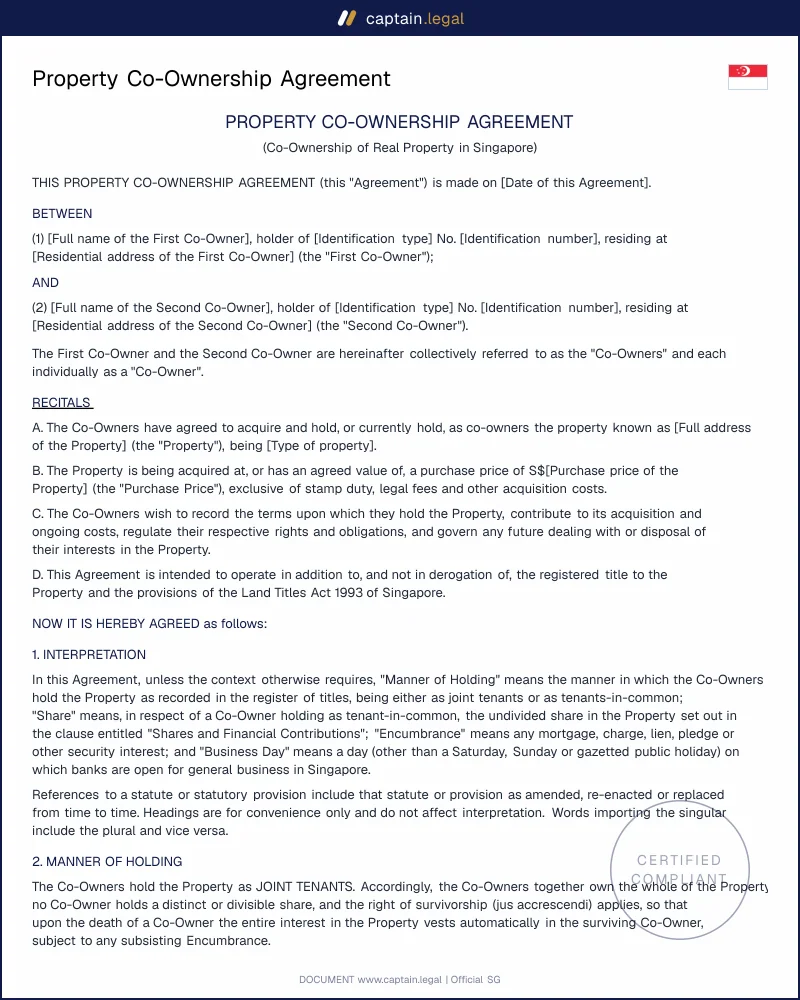
Property Co-Ownership Agreement Singapore | LTA s.53

Co-ownership agreement drafted to the Land Titles Act 1993 and SLA practice: joint tenancy vs tenancy-in-common, shares, severance and exit. Word and PDF.
4.7/514 reviews50 000+ downloadsInstant download
Share

A property co-ownership agreement is the private contract that governs how two or more people hold, pay for, and eventually exit a Singapore property they own together. It sits alongside the title registered with the Singapore Land Authority and does the work the title deed cannot: it records the exact manner of holding, fixes each owner's share of the purchase price and the mortgage, and sets out what happens when one co-owner wants out, dies, or stops paying. Siblings buying an investment condo, unmarried partners taking an HDB flat, friends pooling funds for a first property, business associates holding commercial premises: all of them benefit from a tenancy-in-common structure and a written agreement that turns an informal understanding into an enforceable one. This template is drafted for Singapore conveyancing practice and downloads as Word and PDF.

Compliant

2026 Legislation

50,000+ clients

trust us

Affordable

From $4.90 / doc

Secure payment

Instant download

Property Co-Ownership Agreement Singapore | LTA s.53

Secure payment

Fill in the template

What is a property co-ownership agreement in Singapore?

A property co-ownership agreement is a binding contract between co-owners that regulates their internal relationship as owners of the same land. It is separate from the instrument that vests title, and separate again from any tenancy agreement with an outside tenant. The document you register at SLA tells the world who owns the property and in what manner. The co-ownership agreement, by contrast, stays private between the parties and covers the questions the register is silent on: who paid what, who pays the outgoings, how decisions are made, and how someone leaves.

The critical drafting decision is the manner of holding, because Singapore recognises two very different structures. Under a joint tenancy, co-owners hold the whole property together with no distinct shares, and the right of survivorship means that when one owner dies the survivors automatically take the deceased's interest regardless of any will. Under a tenancy-in-common, each owner holds a defined and separate share, equal or unequal, and that share passes under the owner's will or the Intestate Succession Act 1967 rather than to the co-owners. If you are co-buying to protect a financial contribution rather than to leave everything to the other owner, tenancy-in-common with a co-ownership agreement is almost always the correct structure. Business partners and investors default to it for exactly this reason, while married couples buying a family home often prefer joint tenancy for the clean automatic transfer.

2

When do you need this document?

The most common trigger is co-buying with unequal financial contributions. Two siblings who put in 70 and 30 percent, or a couple splitting 60-40, need the agreement to record those figures and to hold the property as tenants-in-common in matching shares, because the register alone will not remember who paid what. Without it, the higher contributor is left arguing resulting trust years later, on incomplete bank records. Investment purchases are the next frequent scenario: friends or business associates buying a rental unit want the rent, the outgoings, and the eventual sale proceeds divided by a formula everyone signed up to, not left to memory. A related use is holding commercial premises as tenants-in-common, where partners expect to bequeath their share to their own families rather than to each other.

Estate planning drives a large share of these agreements. A co-owner who wants their stake to pass under a will rather than by survivorship needs a tenancy-in-common and a co-ownership agreement that dovetails with their estate documents, and this is worth coordinating when you prepare a Singapore will under the Wills Act. Two edge cases legitimise careful drafting. First, HDB flats follow their own rulebook under the HDB eligibility scheme, so the manner of holding and any later change is effected through HDB rather than ordinary conveyancing, and the agreement must not contradict HDB's conditions. Second, decoupling and 99-to-1 arrangements have drawn IRAS scrutiny; a co-ownership agreement should reflect the genuine beneficial split, because artificial ratios designed only to reduce duty carry real Stamp Duties Act 1929 risk.

3

Key clauses included in our template

  • The manner of holding and shares clause is the spine of the document. It states expressly whether the parties hold as joint tenants or tenants-in-common, and for a tenancy-in-common it fixes each owner's percentage share. Getting this to match the SLA transfer is what prevents a later resulting-trust fight.
  • The contribution and financing schedule records the deposit, the balance, and each owner's portion of the mortgage and CPF monies applied. Because Singapore equity reads unequal contributions as evidence of beneficial shares, this schedule is often the single most valuable page in a dispute.
  • The expense and outgoings clause ties property tax, maintenance, insurance, and mortgage instalments to ownership percentages by default, and sets a mechanism for chasing a co-owner who falls behind. A 30 percent owner paying half the carrying costs is subsidising the other, and the clause stops that drift.
  • The right of first refusal requires any owner who wants to sell their share to offer it to the co-owners first, on stated terms and within a workable window, before any outside buyer is approached. A 30 to 60 day period is more enforceable than the 5 or 10 days people often insert.
  • The buyout and exit mechanism sets a valuation method, whether an independent appraisal or a shotgun clause, so a departing owner can be bought out cleanly. Without it, the only exit is a court-ordered sale of the whole property, often at a poor price.
  • The deadlock and default clause governs what happens when owners cannot agree on a sale or when one stops paying, including a forced-sale trigger, so the arrangement does not simply freeze.
4

Regional and property-type considerations

HDB flats are governed by the HDB eligibility framework rather than ordinary conveyancing, and the vast majority are held by spouses as joint tenants. Changing the manner of holding, or the proportion of shares in a tenancy-in-common, is done by applying directly to HDB on its change-of-holding form rather than by lodging an instrument at SLA. A co-ownership agreement over an HDB flat must sit within the flat's occupancy and eligibility conditions, and any exit provision has to respect the Minimum Occupation Period and HDB's consent requirements. Where a bank loan is outstanding, the lender's consent is needed before any change to the holding.

Private residential property, including condominium units, follows the SLA route. A change of holding is effected by lodging and registering the relevant instrument of declaration with the Singapore Land Authority, and an outstanding mortgage means the bank's consent must be obtained first. This is the natural home for unequal-share investment structures, and the co-ownership agreement should be prepared alongside the conveyancing so the registered shares and the agreed shares are identical.

Foreign ownership adds a layer. The Residential Property Act 1976 restricts foreign persons from acquiring landed residential property and vacant land without approval, so a co-ownership arrangement involving a foreign co-owner should confirm eligibility before committing. Additional Buyer's Stamp Duty under the Stamp Duties Act 1929 also turns on each buyer's profile and property count, which is one more reason to record the true beneficial shares in writing rather than to invent a ratio for duty purposes.

5

How to fill out this co-ownership agreement

You start by choosing the manner of holding, and the template guides you toward a tenancy-in-common where the parties intend distinct shares. From there you enter each co-owner's full name and identification, then the property details as they appear on the title, so the agreement and the register speak the same language. The form then asks for the contribution figures: the deposit each owner paid, their portion of the balance and the mortgage, and any CPF monies applied, all of which populate the contribution schedule. You set the percentage shares, and the template checks that they add to one hundred. Next you configure the exit machinery by selecting a right-of-first-refusal window and a buyout valuation method, and by choosing a deadlock trigger for the case where owners cannot agree. Finally you settle the day-to-day terms on expenses and decision-making, and the document assembles as Word and PDF ready for signature. If you also need to regulate an outside tenancy, you can pair it with a Singapore tenancy agreement drafted for HDB and condominium lettings.

6

Common mistakes to avoid

The costliest error is buying with unequal money but taking title as joint tenants, or as tenants-in-common in equal shares, because the higher contributor then loses the very protection they thought they had. Survivorship or an equal split overrides the real contribution unless a trust can be proved, and proving it after the fact is slow and expensive. A closely related mistake is signing an instrument of declaration to sever a joint tenancy and never registering it at SLA, which after Chan Lung Kien leaves the severance ineffective and the survivorship rule fully alive. People also forget the lender: changing the holding or transferring a share while a mortgage is outstanding needs the bank's consent, and skipping it breaches the loan.

Owners frequently omit any exit mechanism, then discover that a co-owner who wants to leave, or who stops paying, can only be dealt with by an application to the General Division of the High Court for a sale of the whole property. Tying expense sharing loosely, or not at all, to the ownership percentages is another slow-burning fault that lets one owner subsidise the other for years. Finally, treating a 99-to-1 ratio as a pure duty-saving device rather than a genuine reflection of beneficial ownership invites Stamp Duties Act 1929 scrutiny, so record shares that are real. Where the co-owners are unmarried partners, aligning the agreement with a Singapore deed of cohabitation avoids gaps between the property terms and the wider relationship.

Key takeaways

Manner of holding

Choose joint tenancy or tenancy-in-common upfront

Your manner of holding drives what you actually own. Joint tenancy means no defined shares and the right of survivorship applies, so a co-owner’s interest passes automatically to the surviving owners regardless of any will. Tenancy-in-common gives each owner a defined share (equal or unequal) that passes under a will or the Intestate Succession Act 1967, which better protects unequal financial contributions.

Land Titles Act

SLA register can override your intent

For registered land, section 53(1) of the Land Titles Act 1993 presumes co-owners are joint tenants unless the transfer instrument states otherwise. If you are buying in unequal proportions, you must elect tenancy-in-common on the instrument lodged with Singapore Land Authority, not just “agree” privately later. A private co-ownership agreement helps, but it cannot fix a wrong manner of holding on the register.

Disputes and exit

Record contributions and set an exit plan

This agreement fills the gaps the SLA register does not cover: who paid the purchase price, who services the mortgage, who pays outgoings, and how decisions are made. If contributions do not match the registered shares, disputes often turn on resulting trust principles, so written records of contributions become key evidence. It should also spell out what happens if a co-owner stops paying, wants to sell, or dies.

Frequently Asked Questions

Yes. A co-ownership agreement is an ordinary contract and binds the parties who sign it, provided the usual requirements of offer, acceptance and consideration are met. It does not need to be registered to be enforceable between the co-owners, though the underlying manner of holding and any later change to it must be reflected on the title through the Singapore Land Authority. The agreement is the document a court turns to when a dispute over shares, expenses or exit arises, and it carries particular weight as contemporaneous evidence of each owner's financial contribution. To govern who may live in the property, many owners pair it with a room rental agreement for HDB and condo lettings.

Under a joint tenancy, co-owners hold the whole property together with no separate shares, and the right of survivorship passes a deceased owner's interest automatically to the survivors, overriding any will. Under a tenancy-in-common, each owner holds a distinct share, equal or unequal, which passes under their will or the Intestate Succession Act 1967. Joint tenancy suits couples wanting a seamless transfer of the family home; tenancy-in-common suits investors, siblings and business partners who contribute unequally or want to control who inherits their stake. The choice is made at purchase and recorded on the title, so decide before you complete.

Yes, but only as tenants-in-common. A tenancy-in-common lets owners hold defined shares such as 70-30 or 60-40, matching their financial contributions. A joint tenancy cannot carry unequal shares because it treats owners as holding the whole together. If you contribute unequally, you must elect a tenancy-in-common on the transfer and record the split in the agreement, because section 53(1) of the Land Titles Act 1993 otherwise presumes a joint tenancy. Where money and registered shares diverge, equity may impose a resulting trust in proportion to contributions, but relying on that after a dispute is far riskier than documenting the shares upfront.

If your agreement contains a buyout or right-of-first-refusal clause, you follow that process: serve the transfer notice, allow the stated window, and complete the buyout at the agreed valuation without court involvement. If there is no such mechanism and the co-owner will not cooperate, your remaining route is an application to the General Division of the High Court for an order of sale, supported by evidence of your ownership and contributions. That process is slower and costlier than a contractual exit, which is precisely why the template builds in a valuation method and a deadlock trigger. A well-drafted exit clause is the difference between a clean departure and litigation.

It depends on the manner of holding. Under a joint tenancy, the deceased's interest passes automatically to the surviving co-owners by survivorship, regardless of what any will says. Under a tenancy-in-common, the deceased's share forms part of their estate and passes under their will, or under the Intestate Succession Act 1967 if there is no will. This distinction is the main reason estate-focused owners choose tenancy-in-common, and it is why the co-ownership agreement should be coordinated with each owner's will so the two documents do not pull in different directions.

The template downloads as both Word and PDF. The Word version lets you adjust names, shares, contribution figures and exit terms before signing, while the PDF gives you a clean copy ready to print and execute. You can complete the guided fields, download immediately, and have co-owners sign without waiting on a law firm's drafting time. Both formats are yours to keep and reuse if your circumstances change.

No. Severance by an instrument of declaration under section 53(5) of the Land Titles Act 1993 only takes effect once the instrument is registered with the Singapore Land Authority. The Court of Appeal in Chan Lung Kien v Chan Shwe Ching [2018] SGCA 24 confirmed that service alone is not enough and that improper service, such as ordinary post or a newspaper notice, is ineffective. Until registration is complete, the joint tenancy subsists and the right of survivorship continues to operate, so a signed but unregistered declaration achieves nothing. For business co-owners, a Singapore shareholders' agreement can carry similar exit and deadlock protections for jointly held companies.

For private property, changing the holding is done by lodging and registering an instrument of declaration with the Singapore Land Authority, and a conveyancing lawyer usually handles the registration, though the co-ownership agreement itself can be prepared in advance. For HDB flats, you apply directly to HDB on its change-of-holding form and may use HDB's own lawyers or appoint your own. In either case, if there is an outstanding loan, the bank's consent is required first. Having the co-ownership agreement drafted early means the registered shares and the agreed shares line up when the change is made.

4.7/5

14 verified reviews · 50 000+ downloads

Property Co-Ownership Agreement Singapore | LTA s.53
  • Immediate access to the document
  • PDF + Word download
  • Compliant with 2026 legislation
  • Reviewed by lawyers
Fill in the template
Secure payment
Updated on July 9, 2026

You might also like

Deed of Assignment or Novation of Lease
Commercial Lease Agreement Singapore