Create my document
Login

Choose country

SingaporeSingaporeChoose country
Employment & HR

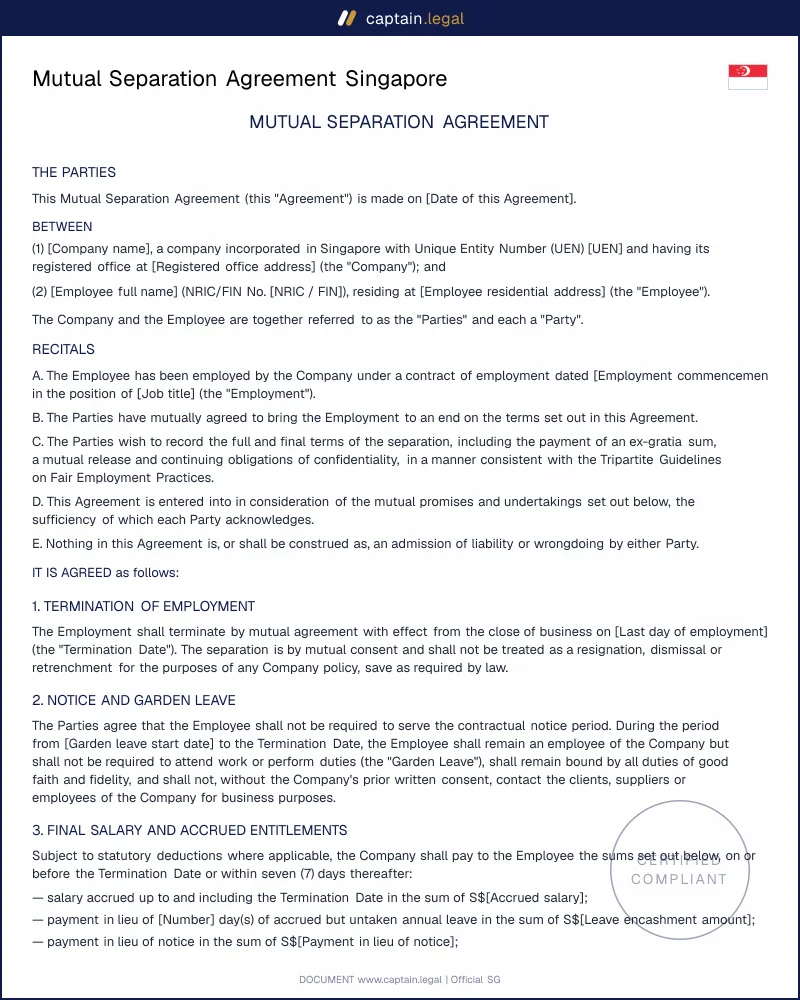
Mutual Separation Agreement Singapore: EA 1968

Separation deed drafted to the Employment Act 1968 and Tripartite Guidelines: ex-gratia, release and waiver, CPF and IR21 handled right.
4.7/518 reviews50 000+ downloadsInstant download
Share

A mutual separation agreement is the document two parties sign when an employer and an employee decide, by consent, to end the employment relationship on agreed terms rather than through a unilateral dismissal or resignation. In Singapore it typically packages an agreed last day of service, an ex-gratia or separation sum, a full and final release and waiver of claims, and post-employment obligations on confidentiality, non-solicitation and the return of company property. Used well, it converts a potentially contested exit into a clean, documented parting that both sides can rely on. This template is drafted to Singapore employment practice, the Employment Act 1968 and the applicable Tripartite Guidelines, and downloads as an editable Word file and a ready-to-sign PDF.

Compliant

2026 Legislation

50,000+ clients

trust us

Affordable

From $4.90 / doc

Secure payment

Instant download

Mutual Separation Agreement Singapore: EA 1968

Secure payment

Fill in the template

What is a mutual separation agreement in Singapore?

A mutual separation agreement, sometimes called a separation deed or settlement agreement, is a contract that records the consensual end of employment and settles what each side owes the other. It differs from an ordinary termination letter, which is a unilateral notice served by the employer, and from a resignation acceptance, which acknowledges an exit the employee initiated. Here both parties negotiate and sign, so neither is dismissing nor resigning in the strict sense; the departure is by agreement, which is precisely what removes the ground for a later wrongful dismissal claim.

The commercial logic is straightforward. The employer wants certainty that the departing employee will not later file a claim at the Tripartite Alliance for Dispute Management or the Employment Claims Tribunals, and wants trade secrets and client relationships protected after exit. The employee wants a defined payout, a clean reference where offered, and clarity on final salary, leave encashment and CPF. A well-drafted agreement gives both. It names the parties, fixes the separation date, sets out every payment and its character, records the mutual release, and restates the continuing duties that survive employment. When these elements sit in one signed instrument, the exit is enforceable and far harder to unpick. For the negotiation phase, many employers pair this document with a properly scoped Singapore NDA template built on the common law of confidence so that discussions themselves stay protected.

2

When do you need this document?

The most common trigger is a negotiated exit at senior level, where a manager or executive and the company agree that the relationship has run its course and both prefer a clean break to a contested notice period. Rather than serve a bare termination, the employer offers an ex-gratia sum in exchange for a waiver, and the parting is documented. The second frequent scenario is a performance or fit issue that neither side wants aired through a formal section 14 due inquiry; a mutual separation lets the employee leave with dignity and the employer avoid a drawn-out process. Restructuring sits close behind. Where a role is genuinely redundant, some employers prefer a bespoke separation agreement over a standard retrenchment letter because it wraps the retrenchment benefit, the release and the post-exit covenants into one signed instrument, which pairs naturally with the wider Employment and HR templates drafted for the Employment Act 1968.

Two edge cases legitimise careful drafting. First, an employee raising a grievance or threatening a claim: here the separation agreement functions as a settlement, and the ex-gratia payment buys peace, but the release must be watertight or the money is spent without closing the risk. Second, a departing founder or director whose exit touches shareholding, board resignation and confidential information at once; the separation document then has to dovetail with corporate steps rather than stand alone. In both, the agreement is doing more than recording a last day, and getting the ground for termination and the waiver right is where the value lives.

3

Key clauses included in our template

  • The parties and recitals identify the employer and employee precisely and record that the separation is by mutual agreement, which anchors the whole instrument and closes off any later argument that the exit was a unilateral dismissal or resignation.
  • The last day of service and notice treatment fixes the separation date and states whether the employee works out notice, is placed on garden leave, or receives salary in lieu of notice, with the calculation basis set out so the final figure is not disputed after signing.
  • The separation payment and its character breaks the money into components and labels each: contractual dues, any ex-gratia sum, and, where applicable, compensation for loss of office. Because IRAS assesses taxability by nature and not by label, the drafting here directly affects whether CPF and tax bite, so each line is described for what it actually is.
  • The release and waiver is the operative clause: a full and final settlement of all claims arising from the employment and its termination, given in consideration of the payment, with carve-outs for accrued CPF and any claim that cannot be waived at law.
  • The restrictive covenants restate confidentiality, non-solicitation of clients and staff, and any non-compete, each scoped to a legitimate business interest. A blanket bar on competing is likely to be struck down, so the template keeps duration and scope reasonable.
  • The return of property, references and mutual non-disparagement close the loop on company assets, records and reputation, and set out what reference, if any, the employer will provide.
4

Regional considerations

Singapore is a single unified jurisdiction, so unlike a federal system there are no state or provincial variations to reconcile; the Employment Act 1968, the CPF regime and MOM practice apply island-wide. That said, several practical distinctions still shape a separation agreement, and treating them as if they did not exist is where drafting goes wrong.

The coverage question matters first. Most employees are now within the Employment Act, but certain protections still turn on whether a person is a workman or a non-workman and on salary level, which affects what statutory floor the parties are settling against. For a foreign employee on an Employment Pass, S Pass or Work Permit, the exit triggers pass cancellation and, critically, tax clearance: the employer must file Form IR21 and may need to withhold monies until IRAS clears the account, so the separation agreement should preserve the employer's right to hold back the final sum pending clearance. For a unionised employee, any collective agreement negotiated under the Industrial Relations Act 1960 governs the floor for retrenchment benefit and may prescribe the calculation, so the negotiated ex-gratia cannot fall below it. Where the separation follows a genuine redundancy, the Tripartite Advisory on Managing Excess Manpower and Responsible Retrenchment and its checklist steer good practice, and employers with at least ten staff must notify MOM of retrenchments within the prescribed window. Directors and shareholder-employees add a corporate layer, and their separation should be sequenced with board and register steps rather than signed in isolation, much as a Singapore share transfer instrument is handled as part of a wider exit.

5

How to fill out this mutual separation agreement

You start by identifying the two parties and confirming that the exit is genuinely consensual, because that single fact underpins the enforceability of everything that follows. From there you enter the separation date and choose how notice is treated, whether the employee works it, takes garden leave, or is paid in lieu, and the form prompts for the calculation basis so the final figure is transparent. Next you set out the money, and this is the step that rewards care: you break the total into contractual dues, ex-gratia sum and, where the facts support it, compensation for loss of office, describing each for its true nature so the tax and CPF treatment follows correctly. You then tailor the release, confirming the claims being settled and any that must be carved out, and adjust the restrictive covenants to a scope that reflects a real business interest rather than a reflexive maximum. Finally you address property return, references and non-disparagement, review the whole against the employee's actual contract, and sign. The output downloads in Word so you can adapt any clause before execution, and in PDF for immediate signing. Where the underlying contract or its confidentiality terms need refreshing first, the Key Employment Terms statement built to MOM requirements is a useful companion.

6

Common mistakes to avoid

The costliest error is a release that is too vague to bind. A clause that waives "all claims" without consideration passing, or without naming the categories settled, can be read down, and the employer discovers the ex-gratia payment bought nothing. Just as damaging is mislabelling the payments: calling a sum "compensation for loss of office" when it is really gratuity for past service does not make it tax-free, because IRAS looks to substance, and a careless breakdown can expose both sides to a clearance dispute long after signing. Employers also stumble on the restrictive covenants, importing a sweeping non-compete that a court will refuse to enforce, which leaves the genuine interest, confidential information and client connections, less protected than a narrower clause would have been.

On the process side, the frequent misstep is using a mutual separation to disguise a dismissal that is really discriminatory or retaliatory, which the Tripartite Guidelines do not permit and which can still be pursued despite a signed release. For foreign employees, forgetting the IR21 tax clearance obligation and paying out the final sum in full can leave the employer chasing money it should have withheld. And across the board, signing without checking the agreement against the employee's own contract, its notice clause, its existing covenants and any collective agreement, produces internal contradictions that undermine the very certainty the document is meant to deliver. A short exit process, such as the one that accompanies a resignation acceptance and clearance letter, is worth mirroring here so nothing is missed.

Key takeaways

Exit terms

Fix the last day and all payments

A mutual separation agreement turns an exit into a dated, signed deal: it should state the last day of service, list every sum due (final salary, leave encashment, any ex-gratia), and clarify how notice is handled. Under the Employment Act 1968, final payments and salary in lieu of notice must be calculated properly and paid within the statutory window for final dues, not left vague.

Waiver

A release works only with real consideration

The release and waiver is what gives the employer certainty against later claims at TADM or the Employment Claims Tribunals. In Singapore, a waiver of statutory and contractual claims is far easier to enforce when it is specific about what is being surrendered and is supported by consideration. A genuine ex-gratia payment is the usual consideration; a loose release or a token payout invites challenge.

Compliance

You cannot contract around unfair dismissal

Even if both sides sign, the agreement is not a shield for conduct that would breach the Tripartite Guidelines, especially around wrongful dismissal and discrimination. The document should reflect a consensual exit, not an attempt to re-label a problematic termination. MOM can act on guideline breaches, so the narrative, process, and settlement terms must line up with fair employment practices.

Frequently Asked Questions

Yes. A mutual separation agreement is a contract, and once both parties sign it with the intention to be bound and with consideration passing, usually the ex-gratia or separation payment, it is enforceable like any other agreement. Its strength as a defence against future claims depends on the drafting of the release and waiver: the more specific the claims settled and the clearer the consideration, the harder it is to challenge. A waiver of statutory rights is effective when set out in a properly drafted contract, though a handful of claims cannot be contracted out of at law, which is why the template carves those out rather than pretending to waive everything. Signing voluntarily, with a real opportunity to consider the terms, also strengthens enforceability.

Both. The mutual separation agreement downloads as an editable Microsoft Word file and as a ready-to-sign PDF. The Word version lets you adjust the separation date, tailor the payment breakdown, narrow the restrictive covenants and add any bespoke terms before execution, which matters because separations are rarely identical. The PDF is formatted for immediate signature once the terms are settled. You can keep the Word file as your internal working draft and issue the PDF as the executed version for both parties' records.

There is no statutory figure for a consensual separation, so the amount is negotiated. As a reference point, the Tripartite Advisory on Managing Excess Manpower and Responsible Retrenchment suggests a norm of two weeks' to one month's salary per year of service for retrenchment benefit, with those under two years' service sometimes given an ex-gratia sum out of goodwill. Separation packages often borrow that benchmark, then adjust for seniority, the strength of any threatened claim and the value of the covenants sought. The right number is the one that makes the waiver worth signing for the employee and worth paying for the employer.

Not necessarily. The whole point of a consensual separation is that the parties agree how notice is treated. You can mutually waive the notice period, agree that the employee works it out, place the employee on garden leave, or pay salary in lieu of notice. Whatever you choose, record it clearly and set out the calculation, because notice and its pay are a common source of post-exit dispute. If the contract specifies a notice period, the agreement should expressly vary it so there is no argument later that the contractual notice still applied.

It depends on the nature of each component. Genuine compensation for loss of office is treated by IRAS as a capital receipt and is not taxable, and CPF is not payable on payments made for loss of employment. By contrast, salary in lieu of notice, gratuity for past services and ex-gratia sums for work done are taxable, and CPF may apply. IRAS assesses by substance, not by the label in the agreement, so the payment breakdown must describe each sum honestly. Neither party should treat the agreement's wording as a final ruling on tax; the employee should confirm their own position, and for foreign employees the employer must handle IR21 clearance before releasing the final sum.

Generally no, which is the employer's reason for paying. A properly drafted release settles the claims arising from the employment and its ending, so once you sign for consideration you give up the right to pursue those matters at the Tripartite Alliance for Dispute Management or the Employment Claims Tribunals. The exceptions are narrow: claims that cannot be waived at law, matters the release did not cover, and situations where the agreement itself is challenged for something like duress or misrepresentation. A separation used to mask a discriminatory dismissal also remains exposed under the Tripartite Guidelines, so the release protects a genuine parting, not a disguised wrong.

The names sound alike but the documents are unrelated. A mutual separation agreement ends an employment relationship. A deed of separation under the Women's Charter is a family law instrument that records the terms on which spouses live apart. If you are ending a job, this employment template is the right one; if you are separating from a spouse, that family document is what you need. They share only the word "separation" and nothing of their legal content.

4.7/5

18 verified reviews · 50 000+ downloads

Mutual Separation Agreement Singapore: EA 1968
  • Immediate access to the document
  • PDF + Word download
  • Compliant with 2026 legislation
  • Reviewed by lawyers
Fill in the template
Secure payment
Updated on July 11, 2026

You might also like

Warning & Show-Cause Letter Singapore
Fixed-Term Employment Contract Singapore