A Memorandum of Understanding (MOU) is the document Singapore non-profits reach for when a society, charity or company limited by guarantee wants to formalise a partnership before anyone commits to a binding contract. It records shared objectives, the roles each side will play and the resources each brings, whether the counterparty is another association, a corporate sponsor or a government agency running a joint programme. For committees that collaborate constantly (shared events, pooled grant applications, co-branded fundraising, secondment of volunteers) the MOU is the workhorse that sets expectations without exposing the organisation to the full weight of a service contract. This template is drafted in Singapore English, to the register a local practitioner would expect, and it is deliberately reusable across sponsors and partner bodies.
Most non-profit collaborations in Singapore never need a heavier instrument than a well-drafted MOU. It signals seriousness to donors and funders, gives the management committee a written mandate to point to, and keeps a partnership from drifting into misunderstanding once the founding enthusiasm fades.
Compliant
2026 Legislation
50,000+ clients
trust us
Affordable
From $4.90 / doc
Secure payment
Instant download
Memorandum of Understanding | Singapore Non-Profit Law
Secure payment
What is a memorandum of understanding for a non-profit?
An MOU is a written statement of mutual understanding between two or more parties who intend to work together but have not yet concluded, or may never conclude, a formal contract. In the non-profit context it typically sits between two associations pooling effort on a project, or between a charity and a corporate sponsor funding a programme. The document names the parties, states the shared purpose, allocates responsibilities and contributions, fixes a duration, and sets out how the relationship ends. It is broader and softer than a partnership agreement or a joint venture agreement, which are built to be fully enforceable from the first signature.
The label matters less than the drafting. Singapore lawyers distinguish an MOU from a letter of intent (more common in property and acquisition contexts) and from a term sheet (which concentrates on financial terms), though the three overlap and courts treat them by substance, not name. For a non-profit, the practical difference is intent: an MOU usually says the parties will cooperate in good faith and negotiate specifics later, whereas a sponsorship contract says the sponsor shall pay a defined sum on defined dates. Getting that distinction wrong is the single most expensive mistake a committee can make, because a document titled "MOU" can still bind you if its wording and your conduct point that way.
Legal framework
Singapore has no statute that defines or governs the MOU. Its legal effect flows entirely from the common law of contract, which Singapore inherited from English law and which requires offer, acceptance, consideration, certainty of terms and an intention to create legal relations before any promise becomes enforceable. Whether an MOU is binding is decided by the courts on an objective test: what would a reasonable person, reading the document in its context, understand the parties to have intended. The Court of Appeal set the governing approach to contractual interpretation in Zurich Insurance (Singapore) Pte Ltd v B-Gold Interior Design & Construction Pte Ltd [2008] 3 SLR(R) 1029, directing courts to look at the language and the relevant background rather than a party's private, subjective intentions.
The case law is a warning to anyone who assumes the "MOU" label is a shield. In Cendekia Candranegara Tjiang v Yin Kum Choy [2002] 2 SLR(R) 283 the High Court treated an arrangement whose material terms were "to be agreed upon at a later date" as an unenforceable agreement to agree, precisely because the parties still meant to negotiate. But Singapore courts have also held an MOU to be a binding contract where the language was detailed and the parties acted on it as though it were operative. The title on the cover page does not decide the question; the words inside and the parties' subsequent conduct do. For a full statement of the interpretive principles applied to such documents, the Singapore Academy of Law's reasoning on contractual interpretation in Zurich Insurance v B-Gold remains the reference point practitioners cite.
Two further points recur for non-profits. First, even a broadly non-binding MOU can contain individually binding clauses: confidentiality, exclusivity, governing law and dispute resolution are routinely enforced on their own terms. Second, any MOU under which a charity or society collects members' or donors' personal data engages the Personal Data Protection Act 2012, so a data-handling clause belongs in the drafting rather than an afterthought once information starts flowing between partners.
When do you need this document?
The most common trigger is a partnership between two associations sharing effort on a project neither could run alone, a joint fundraising drive, a co-hosted community event, a shared grant application where each body contributes a defined slice of the work. An MOU records who does what and who owns the outputs before either committee spends volunteer hours it cannot recover. The second frequent scenario is corporate sponsorship: a company agrees to fund or supply a programme, and both sides want the goals, the acknowledgement rights and the reporting expectations written down while the sponsorship contract is still being negotiated. Committees also use an MOU to open dialogue with a government agency on a co-delivered scheme, where a written framework is often a precondition to any funding conversation.
Beyond these, an MOU earns its place whenever a collaboration involves reputational exposure. A charity lending its name to a partner's campaign wants confidentiality and good-faith obligations locked in early, and those clauses can bind even if the wider project never proceeds, as Singapore courts have enforced exclusivity and confidentiality terms in otherwise preliminary documents. One edge case worth flagging: where an Institution of a Public Character (IPC) collaborates on a fundraising appeal, the MOU should address how tax-deductible receipting and donor data are handled, because getting that wrong touches charity governance obligations under the Code of Governance rather than mere partnership etiquette. Another: a collaboration that will eventually incorporate a separate vehicle should say so, so the MOU reads as a step toward a company limited by guarantee constitution, not as the final deal itself.
Key clauses included in our template
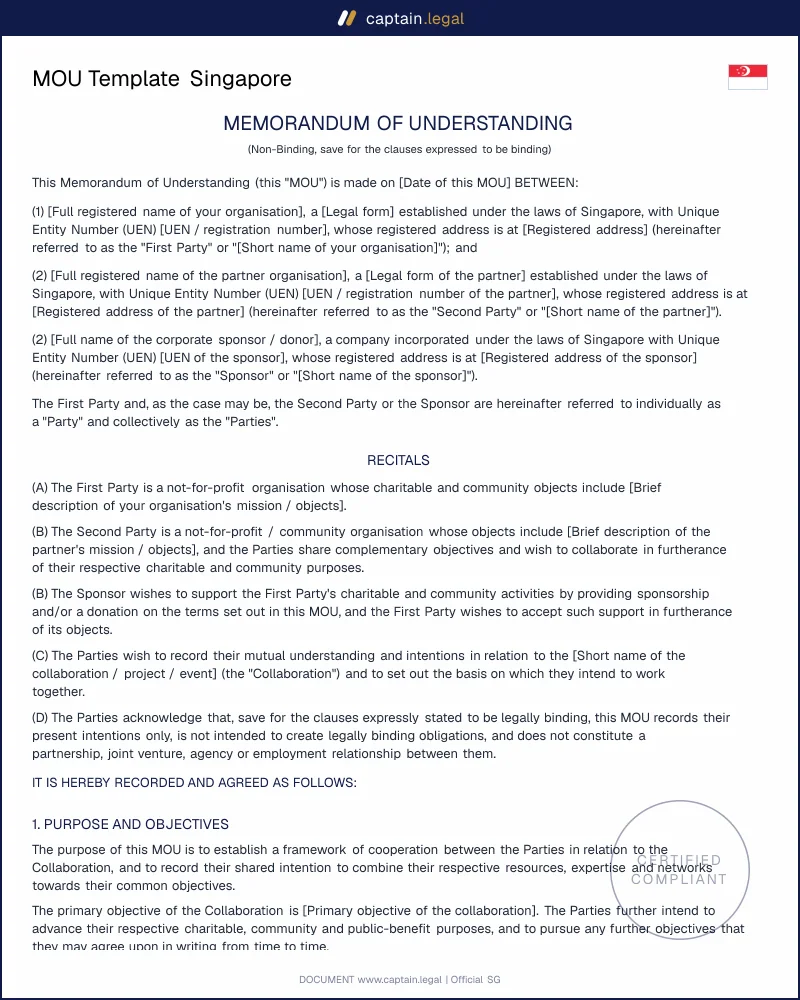
- The identification of the parties sets out the full registered name of each society, charity or CLG, its registration number with the Registrar of Societies, the Commissioner of Charities or ACRA as applicable, and the registered address. Naming the entity correctly matters because a society is not a separate legal person in the way a company is, so the template makes clear whether the committee signs on the organisation's behalf or in a representative capacity.
- The statement of purpose and scope describes the collaboration in plain terms: the shared objective, the programme or event, and the boundaries of what each party is and is not agreeing to do. This is the clause that keeps a partnership from expanding by assumption, and it is drafted to state expressly whether the overall understanding is binding or a framework for later agreement.
- The roles, contributions and resources clause allocates responsibility with enough specificity to be useful but without turning the MOU into a service contract. It records what each side supplies, whether funds, venues, staff, volunteers or intellectual property, and on what timeline.
- The binding-clauses carve-out is the part most home-made MOUs miss. It states which provisions the parties do intend to be legally enforceable, typically confidentiality, exclusivity, governing law and dispute resolution, while leaving the operational understanding non-binding. This mirrors how Singapore courts actually treat these documents.
- The confidentiality and data-protection clause protects information shared during the collaboration and addresses obligations under the Personal Data Protection Act 2012 where members' or donors' data changes hands.
- The term, review and termination clause fixes how long the understanding runs, how either party exits, and what happens to jointly created materials, funds or goodwill on termination. The governing law and dispute resolution clause names Singapore law and specifies whether disputes go to the courts or to mediation.
Regional considerations
Singapore is a single unified jurisdiction, so there is no state-by-state variation of the kind found in federal systems. What changes the analysis instead is the legal form of each party to the MOU, and a well-drafted document adapts to it. A partner that is a society registered under the Societies Act 1966 is not a separate legal entity, which means the individuals on its management committee can carry personal exposure; the MOU should therefore make clear that the committee contracts for the society and that authority to sign has been minuted. A partner that is a company limited by guarantee under the Companies Act 1967 is a separate legal person with limited liability, so signature by an authorised director binds the company directly, and the MOU can be drafted with the certainty that a corporate counterparty allows.
Charity and IPC status adds a further layer. A partner registered as a charity under the Charities Act 1994 owes governance duties under the Commissioner of Charities' Code of Governance, and a collaboration that touches fundraising or public appeals must be drafted with those duties in view. Where the counterparty is a corporate sponsor rather than another non-profit, the balance of the MOU shifts toward acknowledgement rights, brand use and reporting, and away from mutual programme delivery. Committees running recurring partnerships often keep a master MOU and vary only the schedule, which is why this template is built to be reused across sponsors; where a partnership hardens into an ongoing operational relationship, the natural next step is a board resolution recording the committee's approval before signature.
How to fill out this memorandum of understanding
You start by identifying the parties, entering each organisation's registered name, its regulator and registration number, and the name and office of the person authorised to sign. The template then asks you to state the shared purpose in your own words and to set the scope, so the collaboration is described the way your committee actually discussed it rather than in generic boilerplate. From there you allocate roles and contributions, and the document prompts you to say plainly what each side provides and by when. The critical step follows: you choose which clauses are binding and which are not, and the template frames the confidentiality, governing-law and dispute-resolution provisions as enforceable while keeping the operational understanding as a good-faith framework. You then set the term, the review points and the exit mechanism, confirm Singapore law as the governing law, and generate the document in Word and PDF. Before signature, route the draft through your committee and, where the constitution requires it, minute the approval so the signatory's authority is on record. Societies adopting or amending their governing documents alongside a partnership can pair this with a society constitution built to Registry of Societies requirements.
Common mistakes to avoid
The mistake that generates the most disputes is treating the "MOU" label as a guarantee of non-enforceability. Singapore courts read substance over form, and a detailed document that the parties then act on can bind them regardless of its title, so a committee that wants a genuine framework must say so expressly and avoid the mandatory language ("shall pay", "will deliver by") that reads as a contract. The opposite error is just as common: parties who actually want firm commitments hide behind an MOU, then discover the operational terms are an unenforceable agreement to agree because the material terms were left "to be agreed later". If the deal is real, the confidentiality, exclusivity and payment obligations need to be drafted as binding, or moved into a proper contract.
Two further slips recur in non-profit practice. Committees forget to confirm signing authority, and a signature by someone the constitution never empowered can leave the organisation, or the individual, exposed. And partnerships that move members' or donors' data between organisations routinely omit any Personal Data Protection Act 2012 clause, which is both a compliance gap and a reputational risk once a donor complains. A collaboration that will eventually need a separate corporate vehicle should also flag that intention rather than let the MOU masquerade as the final arrangement, since converting an informal understanding into an incorporated body later is far cleaner when the non-profit and association document suite has been used consistently from the start.
Frequently Asked Questions
16 verified reviews · 50 000+ downloads
- Immediate access to the document
- PDF + Word download
- Compliant with 2026 legislation
- Reviewed by lawyers
You might also like