Create my document
Login

Choose country

FranceBelgiqueEspañaUnited StatesUnited KingdomMarocDeutschlandItaliaSchweizSingapore
Real Estate & Rental

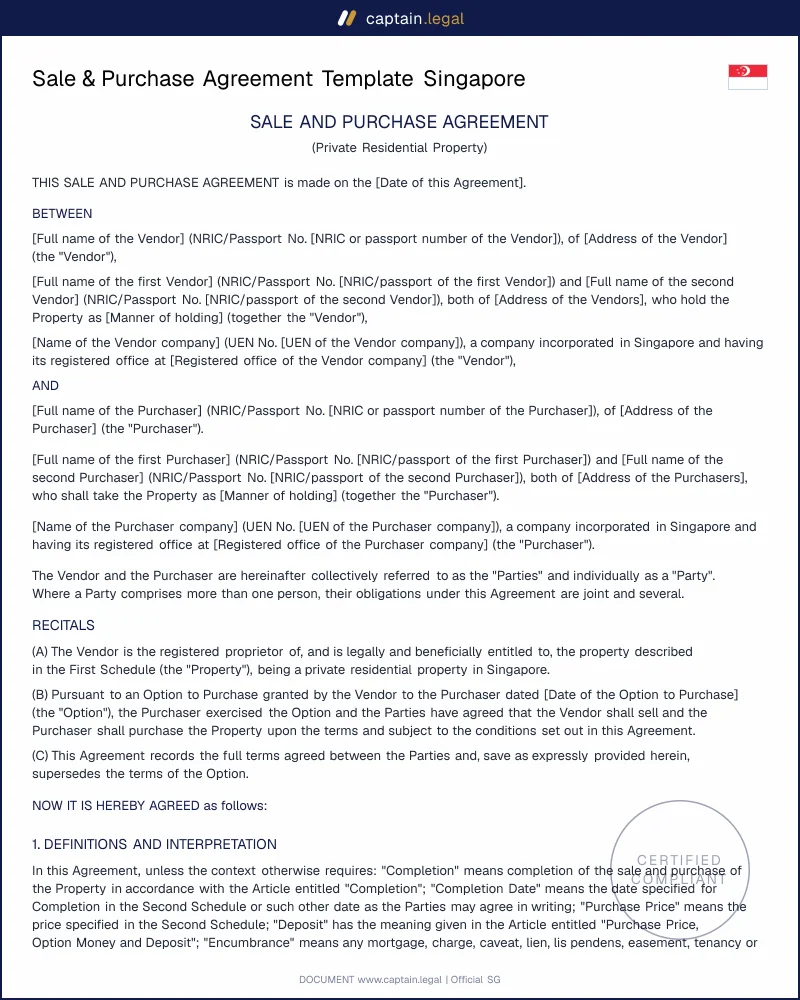
Sale & Purchase Agreement Singapore (COS 2020 Drafted)

Private property sale and purchase agreement built on the Law Society Conditions of Sale 2020 and the Conveyancing and Law of Property Act 1886.
4.8/527 reviews50 000+ downloadsInstant download
Share

A Sale and Purchase Agreement is the contract that records the agreed terms on which a vendor sells, and a purchaser buys, a private residential property in Singapore: the price, the deposit, the completion date and the warranties of title that survive to closing. For most private deals it sits behind an Option to Purchase (OTP), the instrument the seller grants first and the buyer exercises to form a binding contract. This page is written for individual sellers and buyers of condominiums, apartments and approved landed homes who want a solicitor-grade sale and purchase agreement that reflects current conveyancing practice, the Law Society's Conditions of Sale 2020, and the stamping deadlines IRAS enforces to the day.

Compliant

2026 Legislation

50,000+ clients

trust us

Affordable

From $4.90 / doc

Secure payment

Instant download

Sale & Purchase Agreement Singapore (COS 2020 Drafted)

Secure payment · No subscription

Fill in the template

What is a sale and purchase agreement in Singapore?

A sale and purchase agreement is the principal contract for the disposal of an interest in land. It fixes the bargain: parties, property, price, the deposit already paid, the balance due on completion, and the date legal title passes. In a private residential deal the document rarely stands alone. The transaction almost always opens with an Option to Purchase, a short instrument the vendor grants in exchange for an option fee, giving the purchaser an exclusive window to commit. When the purchaser pays the option exercise fee and signs within that window, the OTP becomes the binding contract and performs the same function as a full S&P agreement.

The distinction matters in practice. For HDB flats the parties must use the HDB-prescribed OTP, and any substitute is not valid under the Housing and Development Act 1959. For private property there is no mandatory form, so a vendor may grant an OTP or enter a fuller negotiated S&P agreement, both typically incorporating the Law Society of Singapore's Conditions of Sale 2020 by reference. The fuller agreement earns its place on higher-value, sub-sale or company-to-individual deals where bespoke warranties, conditions precedent or leaseback terms are needed. Whichever route you take, the document only binds once signed and, for the OTP, properly exercised. A heads-of-terms or a letter of intent records intention, not obligation.

2

When do you need this document?

The clearest trigger is a straightforward private resale where you have agreed a price and want the bargain locked before either side has second thoughts. Here the vendor usually grants an OTP, the purchaser pays the option fee, and the document hardens into a binding contract on exercise. The second common scenario is a higher-value or non-standard deal, a luxury condominium, a landed home, or a sub-sale, where the parties want negotiated warranties, conditions precedent on financing or planning approval, or a tailored completion timetable that a stock option cannot carry. A fuller sale and purchase agreement is the right vehicle there.

You also need a properly drafted S&P when a company sells to an individual or vice versa, because the title chain, the ABSD exposure for entities, and the board authority to sell all have to be addressed on the face of the contract. Estate and family transfers are another frequent use: a sale between related parties still needs an arm's-length record of price and completion to satisfy a future buyer's solicitor and IRAS. One edge case worth flagging is the deal involving a foreign purchaser of landed property, which is restricted under the Residential Property Act 1976 and may require government approval before the contract can complete. A second is the property sold subject to an existing tenancy, where the S&P must square with the lease and, if you are using one of our property notice and termination letter templates, with any notice already served. Sign nothing before you have confirmed eligibility and the property type.

3

Key clauses included in our template

  • The parties and property clause identifies the vendor and purchaser by their full legal names and NRIC, FIN or company registration numbers, and describes the property by its address, lot and, where titled, its strata or land lot reference. Getting this exact matters because the transfer instrument and the IRAS stamping both pull from it.
  • The price, deposit and balance clause records the agreed purchase price, the option fee and exercise fee already paid, and the balance payable on completion. It states plainly how the deposit is held and what happens to it if the purchaser defaults, which is where most forfeiture disputes are decided.
  • The incorporation of the Conditions of Sale brings in the Law Society's Conditions of Sale 2020 as the general conditions, then lets the special conditions vary them for the specific deal, so you inherit a tested framework without redrafting standard mechanics.
  • The title and completion clause sets the scheduled completion date, the vendor's obligation to deliver clean title free of encumbrances save those disclosed, and the conveyancing steps that move the price through the prescribed conveyancing account.
  • The warranties clause captures the vendor's representations on title, vacant possession or tenancy, and the insolvency warranty aligned to the Insolvency, Restructuring and Dissolution Act 2018.
  • The conditions precedent and default clause ties completion to financing, approvals or eligibility where relevant, and sets out the remedies, including notice to complete and forfeiture of deposit, when a party fails to perform. Our Singapore commercial contract templates follow the same default-and-remedy discipline.
4

Regional and transaction-specific considerations

Private condominiums and apartments are the most common subject of a private S&P and carry the fewest ownership restrictions: foreigners may buy them, subject only to the heavy ABSD charge at the foreign rate. The agreement should address the management corporation, outstanding maintenance contributions and any sinking-fund levies, since the Conditions of Sale 2020 allocate liability for levies by reference to the completion date. Confirm the share value and any pending special levy before you commit.

Landed residential property is a different animal. Under the Residential Property Act 1976, a foreign person generally cannot acquire landed homes or vacant residential land without approval from the Land Dealings Approval Unit, and Sentosa Cove operates under a distinct approval track. A landed S&P signed by an ineligible foreign buyer risks being unenforceable. Verify eligibility and, where needed, make government approval a condition precedent on the face of the contract.

HDB flats sit outside ordinary private conveyancing altogether. They are governed by the Housing and Development Act 1959 and HDB's eligibility rules, the OTP must be the HDB-prescribed form, and resale completes through HDB rather than a private conveyancing account. If your transaction touches an HDB flat, the private S&P template is not the right document. Executive condominiums add their own minimum occupation period and resale restrictions during the early years, which a private S&P must respect. For ancillary paperwork supporting any of these, our Singapore inventory and handover document templates record the state of the premises on completion.

5

How to fill out this sale and purchase agreement

You start by identifying the transaction type, since the form adapts to whether you are granting an Option to Purchase or entering a fuller negotiated agreement, and whether the property is a condominium, an apartment or approved landed property. From there you enter the parties' full legal details and identification numbers, then the property description exactly as it appears on the title, because the stamping and the eventual transfer both rely on that wording. The template then prompts you for the agreed price, the option fee and exercise fee, and the balance, and it sets the deposit-holding and forfeiture terms automatically.

Next you fix the completion date and choose whether to incorporate the Conditions of Sale 2020 as your general conditions, which most private deals do, before adding any special conditions for financing, approvals or tenancy. The guided fields flag where a condition precedent is sensible, such as a foreign buyer's eligibility or mortgage approval. Once the fields are complete you generate the document in Word and PDF, ready to sign and, critically, to stamp through IRAS within the statutory window. If you are also documenting the underlying entity or its authority to sell, pair it with our Singapore board resolution and corporate document templates.

6

Common mistakes to avoid

The error solicitors see most often is treating the Option to Purchase as a draft rather than a binding contract. Once a private OTP is granted and exercised it locks both parties in, so a purchaser who exercises before financing is confirmed, or a vendor who grants an OTP while still negotiating with another buyer, has created obligations they cannot easily escape. A close second is missing the 14-day stamping deadline: late stamping draws a penalty and, until paid, the instrument cannot be used in evidence, which can stall a completion that depends on producing a stamped contract.

Buyers also misjudge their ABSD position, signing before confirming whether the foreign rate or a second-property surcharge applies, only to face a duty bill that dwarfs what they budgeted. On landed property, the recurring failure is overlooking the Residential Property Act 1976 eligibility rule and signing an unenforceable contract. Vendors, for their part, too often leave the deposit forfeiture terms vague, then find the clause unenforceable when the buyer walks. Finally, parties incorporate the Conditions of Sale but never read which edition they have adopted, missing that the 2020 set changed the insolvency warranty and added a mediation step. Read the general conditions you are signing up to. When the same parties handle their personal affairs, our Singapore wills and statutory declaration templates keep the rest of their paperwork consistent.

Key takeaways

BINDING DEAL

OTP or S&P only binds when exercised

In most private residential sales, the deal starts with an Option to Purchase (OTP). The seller grants it for an option fee, and it only becomes a binding contract when the buyer signs and pays the exercise fee within the option window. A heads-of-terms or letter of intent is not enforceable. For HDB flats, you must use the HDB-prescribed OTP under the Housing and Development Act 1959.

FRAMEWORK

Conditions of Sale 2020 set the baseline

Private property agreements commonly incorporate the Law Society of Singapore’s Conditions of Sale 2020, then add special conditions for the specific transaction. This matters because there is no mandatory private-form contract, so unclear drafting can push parties into disputes over completion, title warranties, or bespoke terms like leasebacks. The 2020 Conditions also align the vendor’s insolvency warranty with the Insolvency, Restructuring and Dissolution Act 2018.

STAMP DUTY

Budget for BSD and ABSD early

Stamp duty can make or break affordability. Under the Stamp Duties Act 1929, Buyer’s Stamp Duty applies to every acquisition, with a top marginal rate of 6% on the value above S$3 million. Additional Buyer’s Stamp Duty may apply on top depending on the buyer’s profile, and can reach 60% for foreign purchasers. Treat stamping as a day-sensitive obligation and plan cashflow before committing.

Frequently Asked Questions

Yes. A sale and purchase agreement signed by both parties, or an Option to Purchase that has been properly granted and exercised, forms a binding contract for the sale of land in Singapore, enforceable under ordinary contract and conveyancing law. The template is drafted to incorporate the Law Society's Conditions of Sale 2020 and to satisfy the formal requirements of the Conveyancing and Law of Property Act 1886. What gives it full effect in practice is correct execution by the parties and, just as importantly, stamping through IRAS within the statutory window, because an unstamped instrument is inadmissible in evidence until the duty is paid.

An Option to Purchase is the instrument a vendor grants first, in return for an option fee, giving the buyer an exclusive period to decide. It becomes a binding contract when the buyer pays the exercise fee and signs within that period. A fuller sale and purchase agreement is a single negotiated contract used mainly on higher-value, sub-sale or company deals where bespoke warranties or conditions precedent are needed. Both perform the same legal function once formed, and both usually incorporate the Conditions of Sale 2020. For most private resales the OTP route is standard; the fuller agreement is reserved for transactions that need tailoring.

Stamp duty is due within 14 days of signing the sale and purchase agreement, or within 14 days of exercising the Option to Purchase for a resale property. Buyer's Stamp Duty applies to every purchaser, with a top marginal rate of 6% on value above S$3 million, and Additional Buyer's Stamp Duty is added depending on your buyer profile, reaching 60% for foreign purchasers. The duty is computed on the higher of the purchase price or the market value. Miss the deadline and you face a penalty, and the instrument stays inadmissible in evidence until everything is paid.

It depends on the property type. A foreign person may buy a private condominium or apartment using this agreement, subject to Additional Buyer's Stamp Duty at the foreign rate. Landed residential property and vacant residential land are restricted under the Residential Property Act 1976, and a foreign buyer usually needs approval from the Land Dealings Approval Unit before completing. Where approval is required, the sensible course is to make it a condition precedent in the contract so the deal does not collapse if approval is refused. HDB flats are not open to foreign ownership at all.

Yes. The agreement is generated in both Word and PDF format. The Word file lets your solicitor or you adapt special conditions, party details and completion terms to the specific deal, while the PDF gives you a clean version ready to sign. Because Singapore conveyancing often calls for tailoring, the editable Word format is genuinely useful: you can adjust the conditions precedent, the deposit terms or the warranties before execution. Once finalised, you sign and then stamp the document through IRAS within the 14-day window.

You can prepare and sign the agreement yourself, and the template is built to a solicitor's standard so the structure and the Conditions of Sale 2020 incorporation are sound. That said, the actual conveyancing in Singapore, the movement of purchase moneys through the prescribed conveyancing account, the legal requisitions and the transfer of title, is handled by solicitors under the Conveyancing Money Rules 2011. For a standard private resale the template covers the contractual stage well; for landed property, company sales or anything with eligibility or approval complications, having a conveyancing solicitor review the special conditions is the prudent step.

The contract sets the consequences, which is exactly why drafting matters. If a purchaser defaults after exercising, the vendor can typically forfeit the deposit and, under the Conditions of Sale 2020, serve a notice to complete before pursuing further remedies. If a vendor defaults, the purchaser may seek specific performance to force the sale through or claim damages. The deposit and forfeiture clause, and the incorporated general conditions, govern who keeps what and on what timeline, so a clearly drafted agreement is the difference between a clean exit and a drawn-out dispute.

4.8/5

27 verified reviews · 50 000+ downloads

Sale & Purchase Agreement Singapore (COS 2020 Drafted)
  • Immediate access to the document
  • PDF + Word download
  • Compliant with 2026 legislation
  • Reviewed by lawyers
Fill in the template
Secure payment · No subscription
Updated on June 15, 2026

You might also like

Tenancy Agreement Stamp Duty Singapore
Tenancy Agreement Singapore