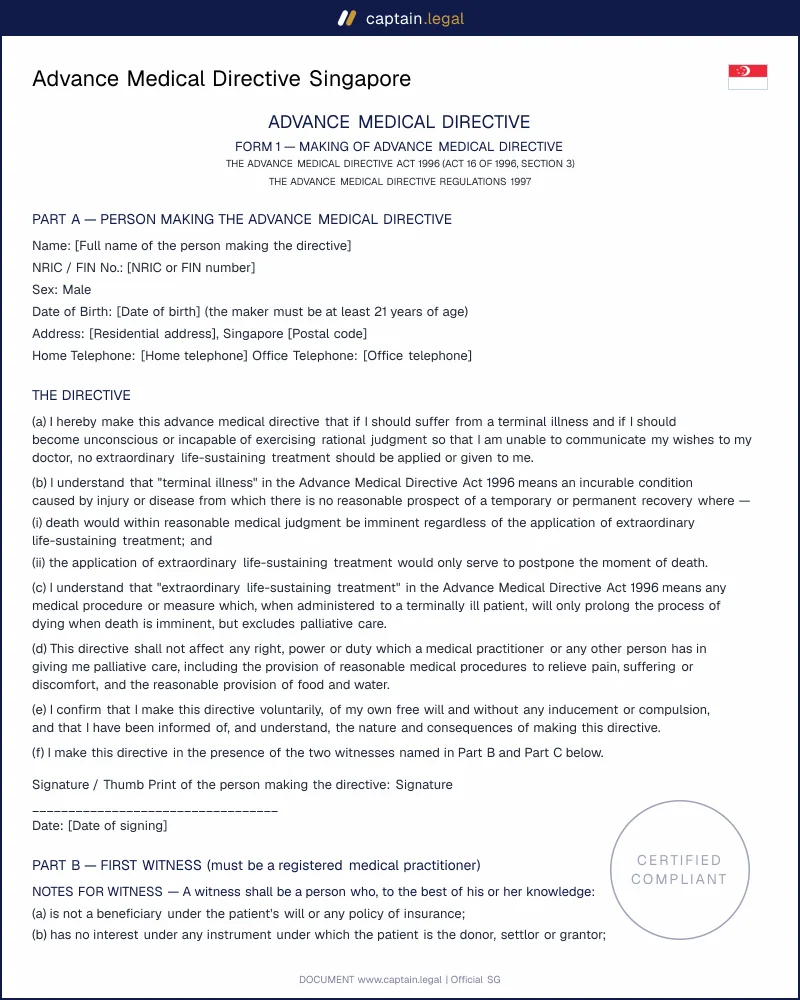
The Advance Medical Directive Act 1996 is a national statute, so the substantive rules are uniform across Singapore regardless of where you live or are treated. There is no state-by-state variation of the kind seen in federal jurisdictions, and the Registrar of Advance Medical Directives sits centrally within the Ministry of Health at the College of Medicine Building. What varies in practice is access to a willing medical witness and the certification pathway once a directive is invoked.
Public hospitals and polyclinics hold your medical records, which makes the medical witness's job straightforward, so many people sign their AMD where they are already a patient. A doctor at a polyclinic or restructured hospital can witness without the records gap that often stops a walk-in clinic doctor from agreeing.
Private clinics can also witness, and the prescribed form is freely available there, but a doctor with no prior relationship to you may be cautious, since section 4 puts the burden of confirming your soundness of mind on that practitioner. Bringing your usual general practitioner into the process avoids most friction.
Muslim makers should note that the AMD operates entirely within secular medical law and does not engage the Administration of Muslim Law Act; the directive concerns the withdrawal of futile treatment, not inheritance, so the two regimes do not collide. The certification step is also uniform nationwide: once a directive is in play, the treating doctor must obtain the agreement of two other medical practitioners that the illness is terminal, and a Committee of three Specialists resolves any disagreement.