Create my document
Login

Choose country

FranceBelgiqueEspañaUnited StatesUnited KingdomMarocDeutschlandItaliaSchweizSingapore
Employment & HR

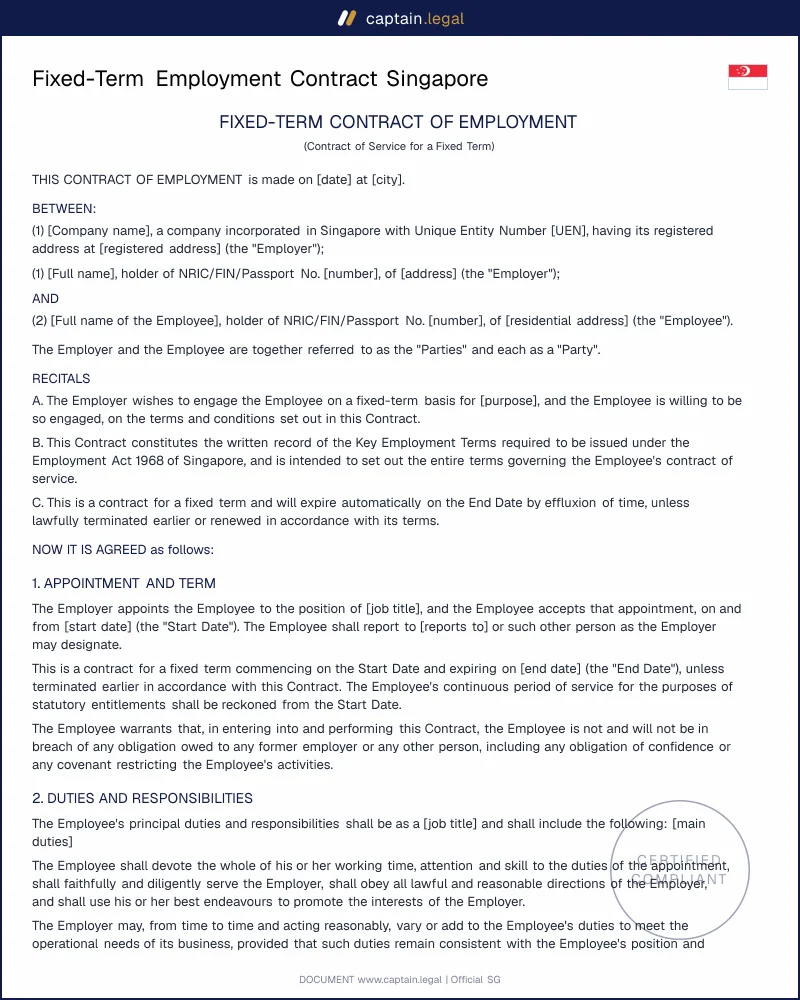
Fixed-Term Employment Contract Singapore: EA 1968

Term contract drafted to the Employment Act 1968, KET Regulations 2016 and MOM Tripartite Advisory. Covers term, renewal, CPF and section 10 notice.
4.7/536 reviews50 000+ downloadsInstant download
Share

A fixed-term employment contract in Singapore is a written contract of service that runs from a stated commencement date to a defined expiry date, after which it ends automatically unless the parties agree to renew. Employers reach for it when the work has a natural horizon: a six-month project hire, a twelve-month maternity cover, a seasonal retail push, or a role tied to a grant or a work pass cycle. The instrument is governed by the Employment Act 1968 and shaped by the Tripartite Advisory on the Employment of Term Contract Employees, and a well-drafted version sets out the term, the renewal mechanism, the early termination notice and the statutory Key Employment Terms in one place.

Get the drafting right and a term hire is clean and predictable. Get it wrong, with a missing expiry date or a renewal pattern that looks like disguised permanence, and you invite a dispute you did not budget for.

Compliant

2026 Legislation

50,000+ clients

trust us

Affordable

From $4.90 / doc

Secure payment

Instant download

Fixed-Term Employment Contract Singapore: EA 1968

Secure payment · No subscription

Fill in the template

What is a fixed-term employment contract in Singapore?

A fixed-term contract, often called a term contract, is an employment agreement with a built-in end date rather than an open-ended duration. It is still a contract of service under the Employment Act 1968, which means the term employee enjoys the same statutory floor as a permanent colleague: itemised payslips, CPF contributions, salary paid on time, and leave entitlements once the qualifying service is met. The defining feature is the expiry date. When that date arrives the engagement terminates by its own terms, and no further notice of termination is needed because the contract has simply run its course.

This is where the document differs from a permanent appointment letter. A permanent contract continues indefinitely until one party serves notice; a term contract carries its own self-executing end. It also differs from a casual or part-time arrangement, which is defined by weekly hours below the statutory threshold rather than by a fixed duration. The single most important clause is the one that states the purpose of the fixed term, because that purpose is what distinguishes a genuine project hire from a permanent role dressed up as temporary. Captain.Legal builds the term, the purpose and the renewal logic into the form so the finished agreement reads like a contract a Singapore HR practitioner would actually issue, not a generic template stretched to fit. For the open-ended alternative, our Singapore employment and HR template library sits one click away.

2

When do you need this document?

The clearest case is project-based hiring, where a company brings in a developer, consultant or site engineer for the life of a defined deliverable and wants the engagement to end cleanly when the project closes. Maternity and medical cover is the next most common trigger: a term contract lets you bring in a replacement for the period a permanent employee is on maternity leave under the Child Development Co-Savings Act, with an expiry date that tracks the expected return. Seasonal demand drives a third wave, from F&B and retail hires over festive peaks to event staff engaged for a single conference cycle.

Grant-funded and research roles form a distinct category. A university or institute funded for a fixed grant period needs the employment term to mirror the funding window, and the contract should say so explicitly. Work pass alignment is the quieter edge case worth flagging: where a foreign hire's Employment Pass or S Pass runs for a defined validity, a term contract that matches the pass duration keeps the paperwork coherent and avoids a permanent commitment the pass may not support. The trickier scenario is serial renewal. An employer who renews a six-month term four times in a row, with no break and identical duties, risks the arrangement being read as effectively permanent, which exposes the company to expectations of continuity it never intended. When the work is genuinely ongoing, a permanent appointment is the honest instrument, and our broader HR and personnel document suite for Singapore covers that path.

3

Key clauses included in our template

  • The appointment and duration clause names the position, the commencement date and the termination date, and it states the purpose of the fixed term in plain words, whether that is project work, maternity cover, seasonal demand or grant funding. MOM's Tripartite Advisory treats this statement of purpose as the dividing line between a legitimate term hire and a disguised permanent role, so it is drafted to do real work rather than sit as boilerplate.
  • The renewal clause sets out whether the contract is renewable, any cap on the number of renewals, and the process, typically written notice by a specified date before expiry. It also addresses what happens on conversion to permanent status, so neither side is left guessing once the term lapses.
  • The early termination clause gives a notice period for ending the contract before its expiry, expressed as a fixed period or aligned to the section 10 statutory tiers, with salary in lieu available under section 11. Both sides carry the same notice obligation, which the Act requires.
  • The remuneration and CPF clause records the gross salary, payment frequency and the employer's CPF obligations for citizens and permanent residents, alongside any allowances or bonuses tied to completing the term.
  • The Key Employment Terms and leave clause captures the items the KET Regulations 2016 require in writing, including annual leave, sick leave and rest days, accrued on the cumulative term where earlier renewed contracts count as continuous service.
  • The confidentiality and restraint clause protects trade secrets and client connections, drafted narrowly so any post-employment restriction stays defensible under Singapore restraint-of-trade principles.
4

Regional considerations

Singapore is a single unified jurisdiction, so unlike federal systems there are no state-by-state variations to map. The Employment Act 1968 applies islandwide and MOM is the single regulator, which simplifies drafting considerably. The variation that matters here is by worker category and salary, not by geography. Part IV of the Act, covering hours of work, rest days and overtime, applies only to workmen earning up to a stated monthly cap and to non-workmen earning below a separate threshold, so a term contract for a junior operations hire engages obligations that a contract for a senior manager does not.

Foreign-worker status is the other axis to watch. A term hire on an Employment Pass or S Pass is subject to MOM pass conditions on top of the Act, and the contract duration should sit comfortably within the pass validity. Work Permit holders attract sector-specific levy and quota rules that a domestic hire never touches. CPF is a further dividing line: contributions are mandatory for citizens and permanent residents but not for foreign pass holders, so the remuneration clause must reflect the employee's status rather than apply a single default. Sector practice also shapes expectations, with construction, marine and process roles carrying their own safety and Work Injury Compensation considerations under the Work Injury Compensation Act 2019. For company-side documents that often accompany a hire, such as board approvals and director consents, the Singapore business and incorporation templates cover the corporate paperwork, while confidentiality and intellectual property protection sits within the Singapore commercial and contract templates.

5

How to fill out this fixed-term employment contract

You begin by choosing whether the hire is for a project, a cover arrangement, a seasonal role or a grant-funded position, because that choice drives the wording of the purpose clause. From there you enter the parties, the position and the commencement and expiry dates, written in the local format such as 15 January 2026, and the form calculates the term so the duration reads consistently throughout. Next you set the salary, the payment cycle and the CPF position, with the form adjusting for whether the employee is a citizen, permanent resident or foreign pass holder.

The notice section lets you specify an early termination period or default to the statutory section 10 tiers, and the renewal section captures whether and how the contract can be extended. You then complete the Key Employment Terms, leave entitlements and any confidentiality or restraint provisions, with optional probation if the term is long enough to warrant one. Once the fields are complete the document assembles into a clean agreement you can download in Word and PDF, ready to sign or to adapt for a specific hire. If you need to record the resignation or release at the end of the term, the Singapore HR letters and notices collection provides the matching documents.

6

Common mistakes to avoid

The most frequent error is leaving out the expiry date or stating it loosely, which defeats the entire point of a term contract and can convert it, by default, into an open-ended engagement an employer cannot easily end. Close behind is the serial-renewal trap, where the same short term is rolled over repeatedly with identical duties and no genuine break, until the relationship looks permanent and the employee can reasonably claim the protections and expectations of a permanent hire. Employers also frequently miscalculate continuous service, forgetting that contracts renewed within one month count cumulatively for leave and notice, which understates what the employee is owed and surfaces as a dispute at exit.

A second cluster of mistakes sits around termination and restraint. Drafting different notice periods for employer and employee breaches the Employment Act requirement of symmetry, and an early termination clause that is silent simply imports the section 10 defaults, often to the employer's surprise. Overreaching confidentiality and non-compete clauses are the classic own-goal: a restraint that bans all competition, with no link to a legitimate interest and no reasonable limit on scope or geography, is likely to be struck down entirely, leaving the business with no protection at all. Finally, employers sometimes treat a foreign hire's contract as identical to a local one, ignoring the CPF distinction and the pass-validity ceiling that should bound the term.

Key takeaways

TERM DATES

Expiry date ends the contract automatically

A fixed-term contract must state a clear commencement date and a defined expiry date. When the expiry date arrives, the employment ends by operation of the contract, so no separate termination notice is needed for that ending. If the end date is missing or ambiguous, you risk arguments that the arrangement was not genuinely time-limited, especially where the role looks ongoing.

EA COVERAGE

Employment Act floor still applies

A term contract is still a contract of service under the Employment Act 1968, so the employee gets the same baseline protections during the period worked. That includes itemised payslips, salary paid on time, CPF contributions (where applicable), and leave entitlements once qualifying service is met. The contract being “temporary” does not reduce statutory minimum standards.

RENEWALS

Renewals can count as continuous service

Renewal mechanics matter. Where a term contract is renewed within one month of the previous one, the periods are treated as continuous service, which affects leave accrual and notice calculation. The Tripartite Advisory on the Employment of Term Contract Employees also pushes employers to treat benefits fairly across cumulative terms. Repeated back-to-back renewals without a clear purpose invite disputes.

Frequently Asked Questions

Yes. A fixed-term contract is a contract of service under the Employment Act 1968 and is fully enforceable once both parties sign and consideration passes, which here is the salary in exchange for work. The term employee is entitled to the same statutory protections as a permanent employee, applied to the period worked, including CPF contributions for citizens and permanent residents and leave benefits once the qualifying service is met. The contract binds both sides for its duration, and the early termination clause, or the section 10 statutory notice where the contract is silent, governs how either party may end it before the expiry date. A clear, well-drafted version is exactly what MOM expects an employer to be able to produce.

Singapore law sets no statutory ceiling on either the duration of a fixed-term contract or the number of times it can be renewed. You can structure a three-month seasonal hire or a two-year project engagement, and you can renew as business needs dictate. The practical limit is one of substance rather than statute: where a short term is renewed repeatedly with the same duties and no real break, the arrangement risks being treated as effectively permanent, with the continuity expectations that follow. The Tripartite Advisory encourages employers to count cumulative service across renewals for leave and notice, and to give advance warning of any decision not to renew, so the employee can plan.

If the contract specifies an early termination notice period, that figure applies, and it must be identical for employer and employee under the Employment Act. If the contract is silent, section 10 supplies the default, which scales with length of service: one day for under twenty-six weeks, one week from twenty-six weeks to two years, two weeks from two to five years, and four weeks at five years or more. Either party may pay salary in lieu of serving notice under section 11. If the contract simply runs to its expiry date, no termination notice is required at all, because the agreement ends by its own terms.

Yes. Every Captain.Legal fixed-term contract is generated in both Microsoft Word and PDF. The Word file lets you fine-tune wording for a specific hire, add a clause your sector needs, or adjust the renewal mechanism, while the PDF gives you a clean, fixed version ready for signing and for your records. Both download the moment the document is assembled, so you can issue the contract the same day you decide to hire.

CPF contributions are mandatory for Singapore citizens and permanent residents for the duration of the engagement, regardless of whether the contract is term or permanent, so a term hire who is a citizen or PR accrues CPF from day one. Foreign pass holders are not subject to CPF. Leave follows service: a term employee covered by the Employment Act who completes three months of continuous service is entitled to annual leave and paid sick leave, and where earlier renewed contracts count as continuous service, that earlier time is included in the calculation. The Child Development Co-Savings Act governs maternity and childcare leave where the qualifying conditions are met.

The protection lies in drafting and in practice. State the purpose of the fixed term explicitly, whether project, cover, seasonal or grant-funded, so the contract shows a genuine reason for the end date rather than an arbitrary one. Keep the duties consistent with that stated purpose, and avoid an unbroken chain of identical renewals where the work is plainly continuing indefinitely. Where you do renew, follow the Tripartite Advisory by treating continuous service cumulatively and giving advance notice of non-renewal. When the role is genuinely ongoing with no foreseeable end, the candid choice is a permanent appointment, which protects both the business and the relationship.

When a term contract runs to its stated expiry without renewal, it terminates automatically, and neither party needs to serve a separate notice of termination, because the end date built into the contract does that work. The employer should settle any final salary, accrued but unused leave and outstanding CPF promptly. Good practice, reinforced by the Tripartite Advisory, is to tell the employee well before expiry whether the contract will be renewed, so they have time to arrange their next role. Issuing a short letter of release or a certificate of employment at the close is a clean way to document the end and the final settlement.

4.7/5

36 verified reviews · 50 000+ downloads

Fixed-Term Employment Contract Singapore: EA 1968
  • Immediate access to the document
  • PDF + Word download
  • Compliant with 2026 legislation
  • Reviewed by lawyers
Fill in the template
Secure payment · No subscription
Updated on June 16, 2026

You might also like

Part-Time Employment Contract Singapore
Resignation Acceptance Letter Singapore