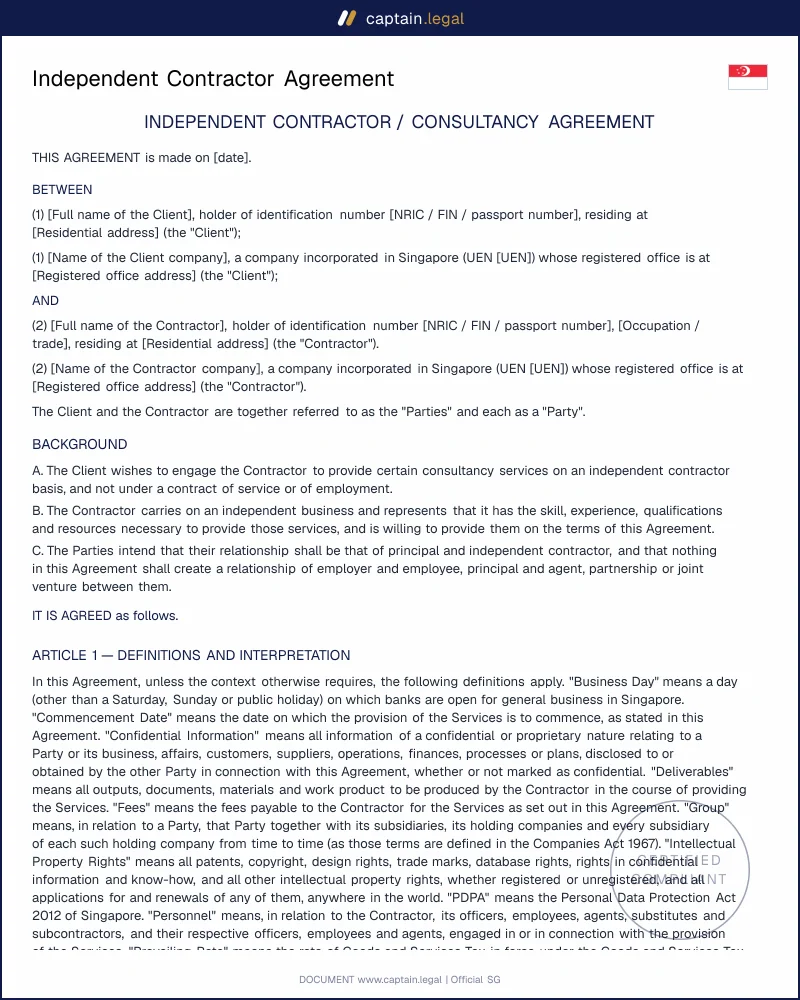
Singapore has no single statute that defines an independent contractor. Classification rests on the common law multi-factor test, applied by the courts and adopted in practice by the Ministry of Manpower and the CPF Board. The starting point is the control test: the more a hiring party dictates what work is done, how it is done, when and where, the more the relationship looks like employment. Control is necessary but rarely sufficient on its own, so the courts weigh it alongside who provides the tools and equipment, whether the worker bears financial risk and can profit from sound management, whether the engagement is exclusive, how remuneration is calculated, and whether the individual is integrated into the organisation or genuinely runs their own business.
The leading authority is Public Prosecutor v Jurong Country Club [2018], where the Court of Appeal considered whether a long-serving fitness instructor was an employee owed CPF contributions. The Court held he was an independent contractor, weighing his autonomy over methods, the absence of employee benefits such as annual and sick leave, and the way he carried on his own account. The case confirms the Singapore approach: the totality of the relationship governs, and the contract label is only one factor among many. A document that recites independence but is contradicted by exclusive, closely supervised, salaried work will fail.
The financial stakes of getting this wrong are severe. If a contractor is later reclassified as an employee, the Central Provident Fund Act exposes the company to back-contributions with no statutory limitation period, meaning liability can run from the very first day of the engagement, plus interest and possible penalties. The Employment Act 1968 protections may also apply retroactively. Note too the Platform Workers Act 2024, in force from 2025, which created a distinct category for ride-hailing and delivery platform workers with CPF and injury-insurance entitlements; it does not convert ordinary consultants or freelancers into employees, but it signals a firm regulatory direction on worker protection. For the current statutory text, the Ministry of Manpower and the Central Provident Fund Act are available through the Singapore Statutes Online portal maintained by the Attorney-General's Chambers. Because the burden generally falls on the worker to prove employment, a carefully drafted contract for services remains a company's first and best line of defence, and it pairs well with the confidentiality protections in our employee IP assignment and confidentiality template.