Create my document
Login

Choose country

FranceBelgiqueEspañaUnited StatesUnited KingdomMarocDeutschlandItaliaSchweizSingapore
Business

Singapore First Board Resolutions: Companies Act 1967

First directors' resolutions and Section 145 consent to act, drafted to the Companies Act 1967 and ACRA practice. Appointment, registered office, allotment.
4.7/521 reviews50 000+ downloadsInstant download
Share

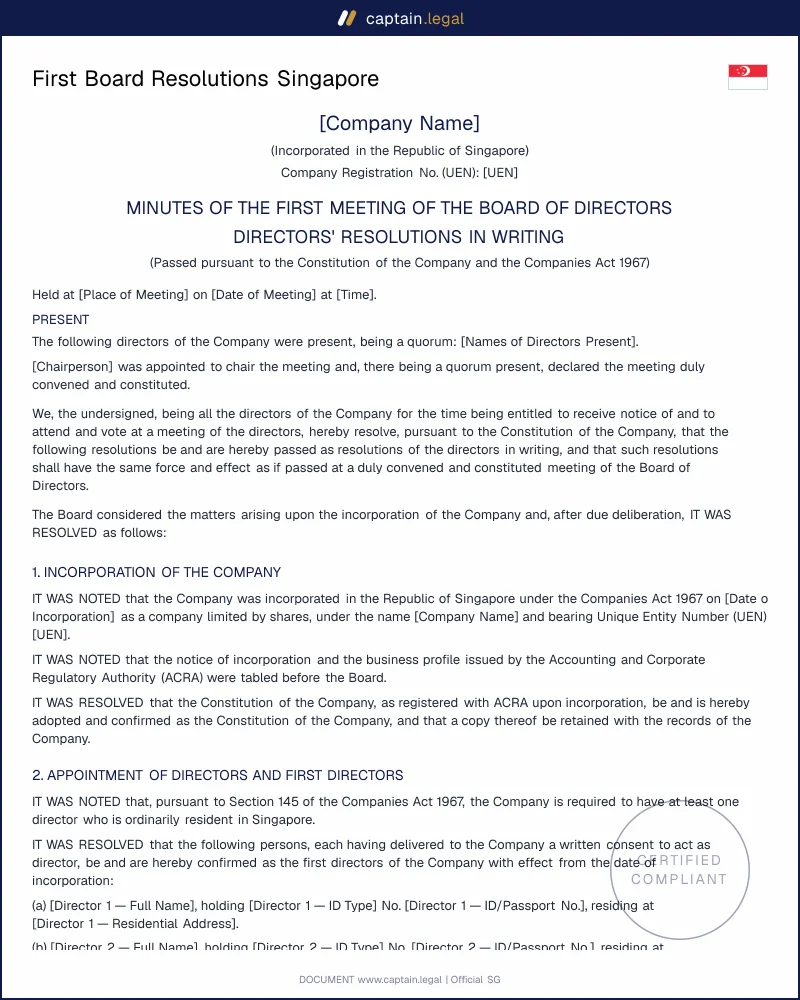
First board resolutions are the founding minutes of a Singapore Pte Ltd: the written record of the first decisions a board takes once the company exists on the ACRA register but before it can actually trade. They confirm the appointment of directors, fix the registered office, allot the founders' shares, open the bank account and put the company secretary in place. This first board resolutions and directors' consent pack also includes the Section 145 consent to act as director, the single piece of paper without which a Singapore incorporation is incomplete. Drafted to the Companies Act 1967, ready as PDF and Word.

A clean set of founding minutes is what a bank, an auditor or an incoming investor asks for first. Get it wrong at incorporation and you pay a corporate secretary to rectify it later, often under deadline pressure during a financing round or an account-opening review.

Compliant

2026 Legislation

50,000+ clients

trust us

Affordable

From $4.90 / doc

Secure payment

Instant download

Singapore First Board Resolutions: Companies Act 1967

Secure payment · No subscription

Fill in the template
2

When do you need this document?

The clearest trigger is the first week after BizFile+ confirms incorporation, when the company has a number but no functioning board record. Before the directors can sign anything binding on behalf of the company, they should pass resolutions adopting the constitution as filed, noting their own appointments, fixing the registered office address and approving the first business year. Most founders reach for this pack precisely because a bank has asked for it. Singapore banks will not open a corporate account without a board resolution that names the authorised signatories and sets the mandate, and the relationship manager will usually want to see the directors' and secretary's appointments recorded in the same set of minutes.

The allotment of founders' shares is the next common reason. The subscriber shares noted at incorporation still need a formal allotment resolution, an updated register of members and the issue of share certificates, and an investor doing diligence later will check that this paper trail exists. A further scenario is the appointment of the company secretary itself: the board resolution making that appointment, paired with the secretary's Form 45B consent, is what the secretary's own firm will expect on day one. One edge case worth flagging is the Employment Pass holder acting as resident director, where the appointment should not be treated as effective until the Ministry of Manpower's Letter of Consent is in hand; a resolution that records the appointment as live before that point overstates the position. A second is the single-director, single-shareholder company, which still cannot use the same person as company secretary and must record a separate appointment, a constraint that also surfaces when founders adapt a Singapore private limited company constitution.

3

Key clauses included in our template

  • The adoption of the constitution and noting of incorporation records the ACRA unique entity number, the date of incorporation and confirmation that the constitution on file governs the company. This anchors every later resolution to the founding document and gives auditors a clean starting reference.
  • The appointment of first directors and the Section 145 consent records each director's acceptance of office and attaches the signed written consent and declaration of non-disqualification. The resolution and the individual consent are kept together because Section 173C requires the consents to be retained at the registered office and produced to ACRA on request.
  • The appointment of the company secretary names the qualified secretary, references the Form 45B consent to act and confirms the appointment falls within the six-month window set by Section 171. For a sole-director company the minute makes clear that a separate person holds the secretary role.
  • The fixing of the registered office states the Singapore address at which the company keeps its registers and receives official correspondence, and authorises the secretary to notify ACRA of any later change within the statutory period.
  • The allotment of shares sets out the number, class and consideration for the founders' shares, directs the update of the register of members and authorises issue of the share certificates, drafted to stay within the allotment power the constitution grants the board.
  • The opening of the bank account and signatory mandate approves the chosen bank, names the authorised signatories and sets the operating instructions, which is the clause banks read most closely when reviewing the account-opening file.
4

Regional and sectoral considerations

Singapore is a single jurisdiction, so the founding resolutions do not vary canton by canton or state by state the way they would in a federal system. The variation that matters is by company type and ownership structure, and the template is built to flex across the common cases. A wholly foreign-owned Pte Ltd must satisfy the resident director requirement of Section 145, which in practice means appointing a Singapore citizen, permanent resident or eligible pass holder, and the resolutions should record that appointment carefully because the company is in breach of the Act if it ever lacks a resident director. Where the resident director is an Employment Pass or EntrePass holder, the minutes should reflect that directorship is permitted under the relevant pass conditions, and an Employment Pass appointment may require the Ministry of Manpower's prior consent.

The single-shareholder, single-director company is the most frequent SME structure and carries its own drafting points: the sole director may also be the sole member, but cannot be the company secretary, so the appointment minute must name a second person. Companies that expect to cross the GST registration threshold quickly under the Goods and Services Tax Act often use the same first board meeting to authorise the registration application, which keeps the compliance timeline tidy. A company carrying a charitable or non-profit purpose, by contrast, sits under a different governance overlay and is usually structured as a company limited by guarantee rather than a Pte Ltd, which changes the founding documents substantially; founders in that position should start from the company limited by guarantee and non-profit governance templates instead. Where the founders are also entering employment with the company, the first resolutions can note the approval of directors' service terms, which dovetails with the Singapore employment contract and appointment letter templates.

5

How to fill out these first board resolutions

You start by entering the company's particulars as they appear on the BizFile+ business profile: the full name, the unique entity number and the date of incorporation. From there the form asks who the first directors are and prompts each of them through the Section 145 consent and declaration, so the resolution and the individual consents come out of the same pass. The next step records the company secretary, where you confirm the appointee is ordinarily resident in Singapore and, for a sole-director company, that the secretary is a different person, the constraint the form flags automatically. You then fix the registered office address and the first financial year end, which the secretary will need for the annual return cycle.

The share allotment step asks for the class, number and consideration of the founders' shares, and the form keeps the figures consistent with the register of members it generates alongside the minute. For the bank account, you name the chosen bank and the authorised signatories and set the mandate, which is the clause the bank's onboarding team checks. Finally you choose your output, and the pack downloads in both Word and PDF so you can circulate it for signature or hand it straight to your corporate secretary, in the same way the rest of the Singapore business and commercial document library produces ready-to-file paper.

6

Common mistakes to avoid

The most damaging error is treating the resolution and the consent as interchangeable. Founders often pass a tidy minute appointing three directors and never collect the signed Section 145 consents, which means the appointments are not valid in law and the company has failed its duty under Section 173C to keep those consents. A close second is letting the company secretary deadline slip: the six-month window under Section 171 feels generous until the company hits its first filing and discovers no one is authorised to lodge it, and a sole director who quietly treats himself as secretary has breached the separation rule outright. Allotment is the third recurring trap, where founders note shares informally, never pass the allotment resolution, never update the register of members and never issue certificates, leaving a gap that surfaces awkwardly during investor diligence.

Two further mistakes are quieter but just as costly. Recording a foreign director's appointment as effective before the Ministry of Manpower's Letter of Consent is granted overstates the board's composition and can taint resolutions passed in the interim. And backdating the first board meeting to predate incorporation produces minutes that are facially impossible, since the company did not exist to hold a meeting; the resolutions must be dated on or after the date ACRA issued the entity number. Each of these is straightforward to avoid with a structured pack and far more expensive to rectify once a bank or auditor has flagged it.

Key takeaways

Section 145

No consent, no valid director appointment

A first board resolution can record appointments, but a director’s appointment does not take effect unless the individual signs a written consent to act and declares they are not disqualified under Section 145 of the Companies Act 1967. This is separate from the board’s minute. If a consent is missing or defective, the person is not validly appointed in law, even if the resolution says otherwise.

Founding actions

These resolutions let the company start operating

Once ACRA issues the UEN, the Pte Ltd exists but cannot practically run without the inaugural decisions on file. The first board resolutions typically fix the registered office, confirm directors, allot founders’ shares in line with the constitution, appoint a company secretary, and approve opening the bank account and bank mandate. Treat the minute as the checklist that closes the gap between registration and day‑one operations.

Governance

Keep statutory registers and lodge particulars

The paperwork is not just for your file. Under the Companies Act 1967, the company must maintain registers of directors, secretaries and members, and it must keep directors’ and secretaries’ consents at the registered office (including Section 173C). Banks, auditors and incoming investors commonly ask for clean founding minutes early. If your records are messy, you may be forced into urgent rectification during account opening or a funding round.

Frequently Asked Questions

Yes, provided they are passed by validly appointed directors and recorded properly. Written resolutions take effect under the company's constitution, which the Companies Act 1967 makes binding on the company and its members. The decisive condition is that each director has signed a valid Section 145 consent to act before the appointment is treated as effective, because a resolution passed by a person who is not in law a director carries no authority. Once signed, dated on or after the incorporation date and entered in the minute book the company keeps under Section 188, the resolutions bind the company and can be relied on by banks, auditors and ACRA. Keeping the directors' consents at the registered office, as Section 173C requires, completes the record.

You need both, and they do different jobs. The board resolution is the company appointing the officer; the Section 145 consent is the individual personally accepting the office and declaring they are not disqualified. The Act treats the consent as a precondition to valid appointment, so a director who is named in a resolution but has never signed a consent has not been validly appointed. ACRA also requires the consent particulars to be lodged and the signed consent to be retained at the registered office. Our pack produces the resolution and each director's consent in the same flow so the two never come apart.

Within six months of incorporation, under Section 171 of the Companies Act 1967. The office cannot then remain vacant for more than six continuous months, and for a private company with a single director, that sole director cannot also be the secretary. The appointment is made by board resolution, the appointee must give written consent on Form 45B, and the company must notify ACRA. Most founders make the appointment in the same first board meeting rather than waiting, because the secretary is the officer who keeps the statutory registers and lodges filings, and the company needs those functions running from the start.

Yes. A Singapore Pte Ltd can have one director who is also the sole shareholder, and that person can pass the first resolutions as a written resolution of the sole director. The one structural limit is the company secretary: under Section 171(1E) the sole director cannot also be the company secretary, so the resolutions must appoint a separate qualified person to that role. The director must still satisfy Section 145, including the resident-director requirement, and sign the consent to act. The template recognises the single-director case and adjusts the secretary appointment clause so the separation rule is respected automatically.

The pack downloads in both Microsoft Word and PDF. The Word version lets your corporate secretary adjust names, share figures or signatory mandates before the meeting, which is how most founding packs are finalised in practice. The PDF version is the clean copy for signature and for handing to the bank or auditor. Singapore recognises electronic records and electronic signatures for most commercial dealings under the Electronic Transactions Act 2010, so the signed PDF is generally acceptable for the bank mandate and internal records, though some banks still ask for wet-ink signatures on the account-opening file.

As soon as practicable after BizFile+ confirms incorporation, and certainly before the company does anything binding such as opening a bank account or allotting shares. There is no fixed statutory deadline for the first board meeting itself, but the resolutions it passes feed obligations that do have deadlines, the six-month secretary appointment under Section 171 being the clearest. In practice founders hold or sign the first resolutions within days, because the bank, the share allotment and the registered office all wait on them. The resolutions must be dated on or after the incorporation date, never before.

Yes. The subscriber shares recorded at incorporation still require a board allotment resolution, an updated register of members and the issue of share certificates to be properly documented. The directors' power to allot is granted by the constitution, so the resolution must stay within what the constitution permits. Skipping this step is one of the most common gaps investors find during diligence, because the company's cap table on paper does not match its statutory register. The template generates the allotment minute and keeps the share figures consistent with the register of members it produces.

At the company's registered office in Singapore, alongside the statutory registers. The directors' and secretaries' consents must be retained there under Section 173C, and the minutes of the first board meeting belong in the minute book the company keeps under Section 188. The company secretary is the officer responsible for maintaining these records and for notifying ACRA of director, secretary, registered office and share allotment particulars within the prescribed periods. Keeping the founding pack complete and on file at the registered office is exactly what a bank review or an audit will test first.

4.7/5

21 verified reviews · 50 000+ downloads

Singapore First Board Resolutions: Companies Act 1967
  • Immediate access to the document
  • PDF + Word download
  • Compliant with 2026 legislation
  • Reviewed by lawyers
Fill in the template
Secure payment · No subscription
Updated on June 17, 2026

You might also like

NDA Singapore Template
Company Constitution Singapore