Singapore is a single jurisdiction, so the rules do not vary by state, but they vary sharply by the legal form your organisation has taken, and choosing the wrong template for your form is the practical equivalent of getting the region wrong.
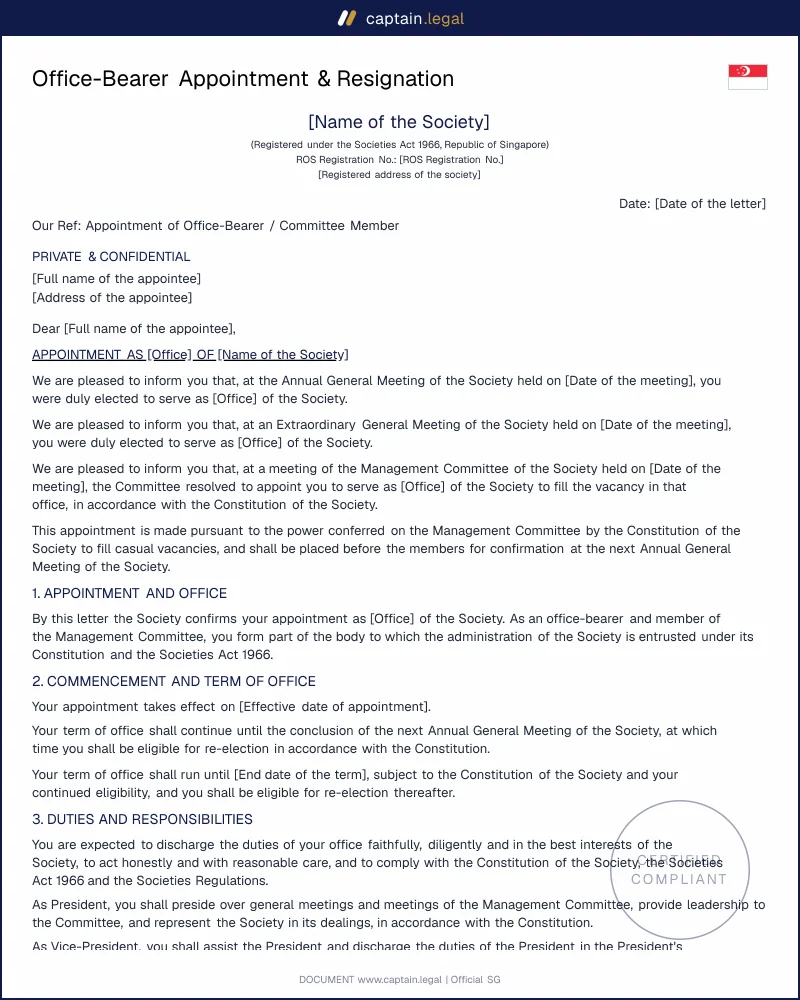
For a registered society, the Societies Act 1966 governs and the touchpoint is the Registrar of Societies. The President, Secretary and Treasurer are the office-bearers ROS treats as accountable, and a majority of committee members, together with these three key holders, must meet the citizenship or permanent-residence conditions set for certain categories of society. The appointment letter should therefore capture the individual's status where the society falls into a restricted category, and the resignation letter should trigger the constitution's notification clause to ROS.
For a charity or Institution of a Public Character, the Charities Act 1994 and the Code of Governance layer additional duties on top of the society or company rules. Board or committee changes must be kept current with the Commissioner of Charities, and an IPC's governance is examined more closely because of its power to issue tax-deductible receipts. The conflict-of-interest and eligibility declarations in the appointment letter carry extra weight here, and you should align them with your governing instrument and the data-handling duties under the Personal Data Protection Act 2012 when you record office-bearers' personal particulars.
For a company limited by guarantee, the Companies Act 1967 applies and ACRA, not ROS, is the filing destination. Director appointments and resignations are lodged with ACRA, a written consent to act as director is mandatory, and the timing rules differ from the society Annual Return cycle. If your non-profit runs as a CLG, pair these letters with the director and board paperwork in our Singapore company director and resolution templates rather than the society-style filings.