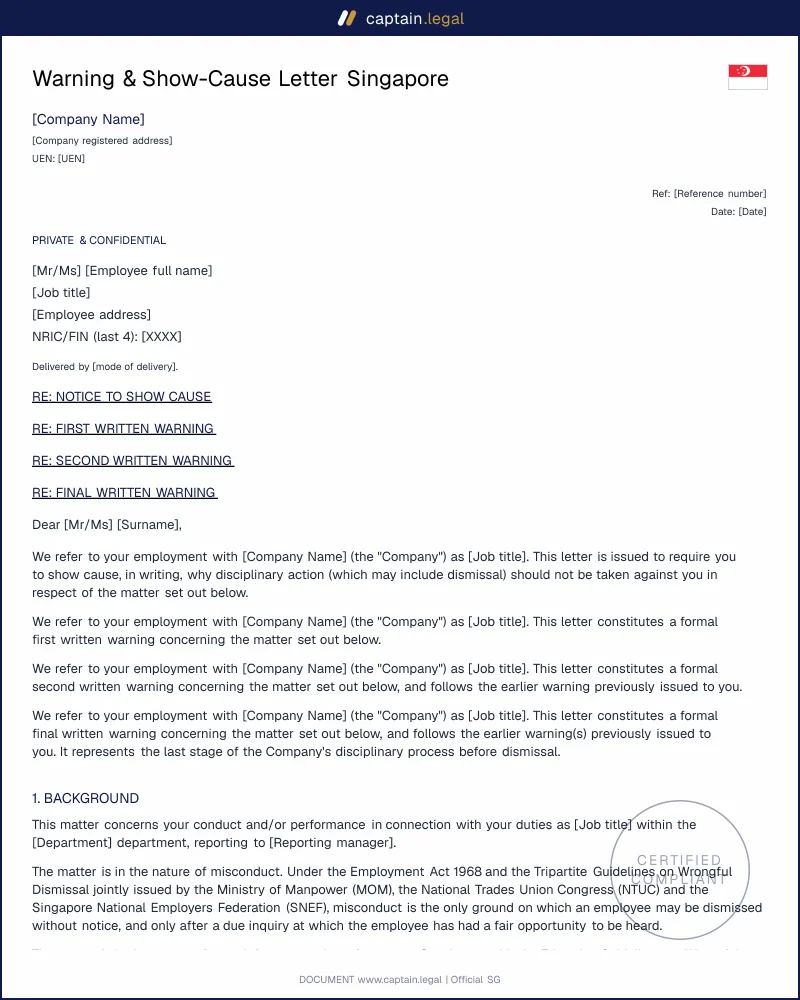
The governing statute is the Employment Act 1968, administered by the Ministry of Manpower (MOM), which since 2019 covers almost all employees including managers and executives. The provision that drives this entire document set is section 14. It allows an employer, on the ground of misconduct inconsistent with the conditions of service, to dismiss without notice, to downgrade, or to impose a lesser punishment, but only after due inquiry. The phrase "due inquiry" is the operative safeguard. The High Court in Long Kim Wing v LTX-Credence Singapore Pte Ltd [2017] SGHC 151 developed the modern standard, moving away from the looser approach in Velayutham v Port of Singapore Authority [1974-1976] SLR(R) 307, and requiring that the employee be told of the allegation and given a genuine opportunity to respond. A show-cause letter is how that opportunity is documented.
Section 14 also gives the employer interim tools. Pending the inquiry, an employee may be suspended for up to one week, paid at least half salary during that period, with any withheld pay restored in full if no misconduct is established. Suspension beyond one week requires prior approval from the Commissioner for Labour. Where dismissal is not warranted, the lesser sanctions of downgrading or suspension without wages remain available, the latter capped by statute.
Two further layers apply. The Tripartite Guidelines on Wrongful Dismissal, used as a reference by mediators at the Tripartite Alliance for Dispute Management (TADM) and adjudicators at the ECT, confirm that dismissal for genuine misconduct or poor performance is not wrongful, while dismissal that is discriminatory, retaliatory or based on a false reason is. The newer Workplace Fairness Act 2025 makes a written grievance-handling procedure a statutory expectation and strengthens protections against discrimination, which raises the bar for documented, even-handed process. For the official position on what counts as wrongful, the MOM Tripartite Guidelines on Wrongful Dismissal remain the primary reference.