Create my document
Login

Choose country

FranceBelgiqueEspañaUnited StatesUnited KingdomMarocDeutschlandItaliaSchweizSingapore
Non-Profit & Associations

Board Resolution Singapore: Companies Act 1967 Format

Written board and committee resolutions drafted for the Companies Act 1967 (s.157A, 184A) and Societies Act 1966. Section 156 disclosure ready. Word and PDF.
4.8/526 reviews50 000+ downloadsInstant download
Share

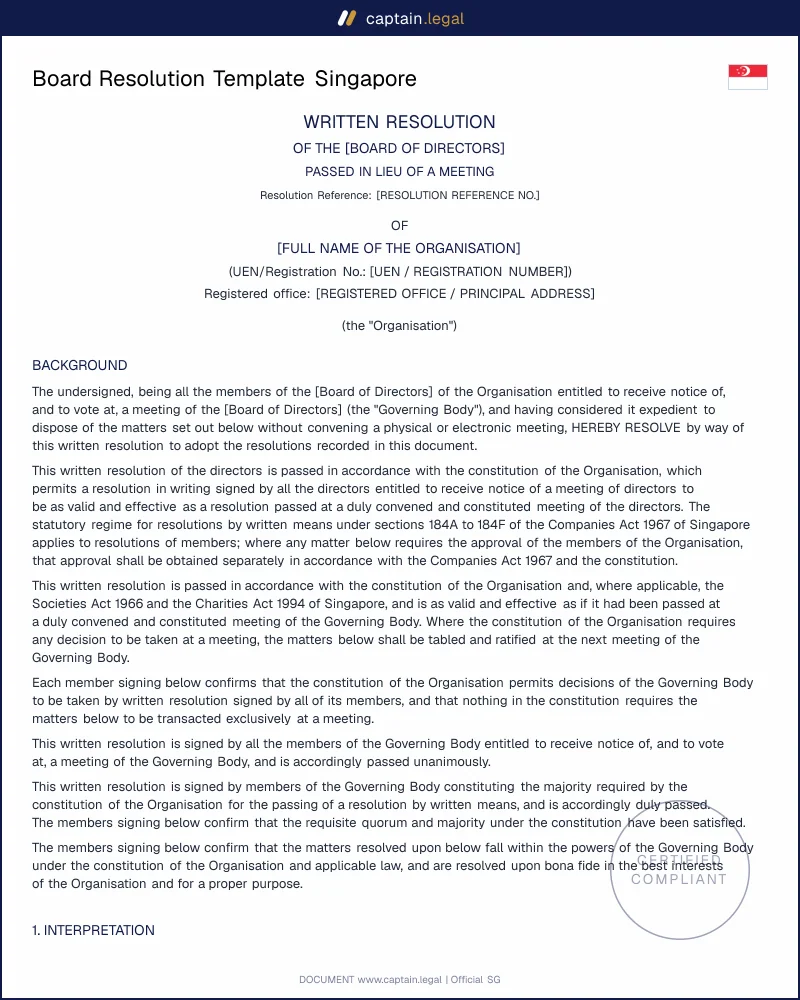
A committee or board resolution is the written record of a decision taken by the people who run an organisation: the directors of a Pte Ltd, the management committee of a society, or the board of a company limited by guarantee. A written resolution lets that body decide between formal meetings, by circulating the decision and collecting signatures instead of convening everyone in a room. This template gives you a clean, audit-ready format for resolutions passed by written means under Singapore law, covering bank mandates, appointments, the approval of contracts and the grant of delegated authority, downloadable instantly in Word and PDF.

Most decisions that bind an organisation do not need a physical meeting. What they need is a document that proves who decided what, on what date, and under what authority. That is the gap this resolution fills.

Compliant

2026 Legislation

50,000+ clients

trust us

Affordable

From $4.90 / doc

Secure payment

Instant download

Board Resolution Singapore: Companies Act 1967 Format

Secure payment · No subscription

Fill in the template

What is a committee or board resolution?

A board resolution is a formal decision of the directors of a company, recorded so that it binds the company and can be relied on by banks, auditors and counterparties. A committee resolution is the equivalent for an unincorporated body, most often the management committee of a registered society or the board of a company limited by guarantee. The substance is the same: a named decision-making body exercises a power it holds under its constitution, and the decision is minuted.

The key distinction in Singapore practice is between a resolution passed at a meeting and a resolution passed by written means, sometimes called a circular resolution. A meeting resolution is voted on by directors present in person or by video link; a written resolution is signed by the directors entitled to vote and circulated by email or in counterparts, with no meeting at all. Both are equally valid provided the organisation's constitution permits the written route. This is the point most founders get wrong: a written resolution is only effective if the constitution allows it, and a handful of older constitutions still require a physical meeting for certain matters.

Board resolutions are also distinct from shareholder resolutions, which are passed by the members of a company rather than its directors. Some decisions sit with the board, some with the members, and a few need both. Choosing the wrong organ is one of the fastest ways to have a decision challenged, which is why this template is built to make the deciding body explicit on the face of the document. If your decision belongs to the owners rather than the directors, our Singapore shareholders agreement and member resolution templates cover that side of the line.

2

When do you need this document?

The most common trigger is a bank mandate: opening an account, changing authorised signatories, or setting the threshold above which two signatures are required. Banks will not act on an informal instruction. They want a resolution naming the account, the signatories and the limits, certified by the secretary or a director. The next most frequent use is an appointment, whether of a director, a company secretary, a treasurer or an authorised representative, where the resolution is the document ACRA filings and third parties rely on to confirm the person's authority.

Approving a contract or transaction is the third recurring scenario. A resolution authorising the organisation to enter a lease, a loan facility, a service agreement or a major purchase gives the counterparty comfort that the signatory is acting with proper authority, and it protects the directors by showing the decision was taken collectively. Closely related is the grant of delegated authority, where the board empowers a named officer or sub-committee to act up to a defined limit, so day-to-day matters do not need a fresh resolution each time.

Two edge cases are worth flagging. First, a resolution approving a related-party transaction must record the interested director's disclosure under section 156 and, depending on the constitution, that director may need to abstain. Second, where directors are spread across time zones, a written resolution in counterparts is often the only practical route, and the date the resolution takes effect is the date the last required signature is given, not the date it was circulated. Get that wrong and a bank may reject the mandate.

3

Key clauses included in our template

  • The identification of the deciding body states clearly whether the resolution is of the board of directors, the management committee, or the members, and cites the constitutional power being exercised. A resolution that does not say which organ decided is the single most common reason a bank or counterparty asks for a fresh one.
  • The recitals and background set out the context in two or three lines, so anyone reading the document later understands why the decision was taken. This matters for audit and for any future dispute, where the reasoning behind a delegation or an appointment becomes the live question.
  • The operative resolutions are drafted in the conventional Singapore form, each beginning "IT WAS RESOLVED THAT", with one numbered resolution per discrete decision. Keeping bank mandates, appointments and authorisations as separate numbered items means a bank can be given a certified extract of only the resolution it needs.
  • The disclosure of interest block records any declaration made under section 156 and whether the interested director voted or abstained, putting the compliance step on the face of the document rather than leaving it to a separate note.
  • The signature and dating mechanics support both a meeting format, signed by the chair, and a written-resolution format signed by all directors entitled to vote, including signature in counterparts and by electronic means under the Electronic Transactions Act 2010.
  • The certification clause lets the secretary or a director certify the extract as a true copy, which is the form banks and registries expect for Singapore director and secretary appointment documents.
4

Regional considerations

Singapore is a single jurisdiction, so the variation here is by organisational form rather than by region, and the resolution must be matched to the right one. For a private limited company governed by the Companies Act 1967, the written-resolution route depends on what the constitution says. Companies incorporated on the standard ACRA model constitution can pass directors' written resolutions freely, but a company using a bespoke or older constitution should check whether physical meetings are required for specific matters before relying on a circular resolution. The resolution should always identify the company by its UEN and registered name exactly as they appear on ACRA records.

For a company limited by guarantee, the same Companies Act mechanics apply, but the board's powers are framed by the objects in the constitution, and a non-profit board should be careful that a resolution does not stray beyond those objects. If your organisation is still choosing its form, our Singapore CLG constitution and company-limited-by-guarantee documents set out the founding framework that any later resolution must respect.

For a registered society, the management committee acts under the Societies Act 1966 and the society's own constitution, which typically prescribes quorum, voting and how decisions are minuted. Because a society is not a separate legal entity, committee members can carry personal exposure, so recording decisions properly is a real protection, not a formality. A society's constitution and the resolution practice should be read together, and the founding rules are covered in our Singapore society constitution template under the Societies Act. For charities, a resolution should also sit comfortably within the Commissioner of Charities' Code of Governance, which expects clear records of board decisions.

5

How to fill out this resolution

You start by choosing the type of organisation, since that determines whether the document refers to a board of directors, a management committee or the members, and which statute it cites. From there you enter the organisation's full legal name and identifier, the UEN for a company or the registration details for a society, so the resolution matches the official record. The form then asks whether the decision is being taken at a meeting or by written means, and adjusts the signature block accordingly, offering a chair's signature for a meeting or a full set of director signatures in counterparts for a written resolution.

Next you draft the operative part. You select the kind of decision, a bank mandate, an appointment, a contract approval or a delegation of authority, and the template populates the conventional resolution wording for you to complete with the specific names, amounts and limits. If a director has an interest to declare, you record it in the disclosure block so the section 156 step is captured. Finally you set the effective date, which for a written resolution is the date of the last signature, and download the finished document in Word and PDF. The same flow underpins our wider set of Singapore incorporation and board document templates if you need related papers in the same session.

6

Common mistakes to avoid

The error we see most often is relying on a written resolution that the constitution does not actually permit. A circular resolution feels efficient, but if the governing document requires a physical meeting for that class of decision, the resolution is a nullity and any bank mandate or appointment built on it can be unwound. The second recurring mistake is leaving the deciding body vague. A document headed simply "Resolution" with no statement of whether the directors or the members decided invites a counterparty to refuse it, and forces a costly do-over. Equally common is dating a written resolution from the day it was circulated rather than the day the last signature arrived, which can make the resolution appear effective before it legally was.

A fourth trap is ignoring the section 156 disclosure when a director has an interest in the matter being approved. Skipping the declaration does not just create a governance problem, it exposes the director to criminal liability, and it makes the resolution vulnerable if the transaction is later challenged. Finally, many organisations pass a clean resolution and then never file it into the minute book, despite the one-month requirement in section 188. A perfectly drafted resolution that lives in someone's email is not a proper record. Treat the minute book entry as part of passing the resolution, not an afterthought, and keep the certified extract ready for the bank or auditor who will eventually ask for it.

Key takeaways

FORMAT

A written resolution can replace meetings

A written board or committee resolution records a decision without convening everyone, by circulating the text and collecting signatures (including electronic signing or counterparts). It works for practical items like bank mandates, appointments, contract approvals and delegated authority. What matters is that the document shows who decided what, the date, and the power relied on, so banks, auditors and counterparties can act on it.

CONSTITUTION

Check your constitution allows written decisions

In Singapore practice, a written resolution is only effective if your constitution permits decisions by written means. Some older constitutions still require physical meetings for certain matters, so using a circular resolution in the wrong case can leave the organisation exposed if the decision is challenged. Also be clear whether the decision belongs to the directors/committee or to members, because picking the wrong organ is a common and avoidable mistake.

COMPLIANCE

Disclose interests and file minutes properly

When a resolution approves a transaction, it should capture any director or chief executive’s declared interest under Companies Act 1967 section 156. A breach carries criminal liability, so the paper trail needs to be explicit. After passing the resolution, keep it audit-ready: Companies Act 1967 section 188 requires minutes and directors’ resolutions to be entered in the minute book within one month and signed by the chair.

Frequently Asked Questions

Yes, provided the company's constitution permits resolutions to be passed by written means. Under the Companies Act 1967, directors can pass a written resolution in lieu of a meeting, signed by all directors entitled to vote, and members can act by written resolution under section 184A. The decision binds the organisation in the same way a resolution voted at a physical meeting would. The single condition that matters is constitutional authority: if your governing document requires a physical meeting for the type of decision in question, a circular resolution will not be valid, so check the constitution before you rely on the written route for anything significant such as a bank mandate or an appointment.

Yes. The Electronic Transactions Act 2010 makes electronic signatures valid for company resolutions, so directors can sign by email, by e-signature platform, or in separate copies that together form one document. Signing in counterparts is standard practice where directors are in different countries, and the template is built to support it. The point to watch is the effective date. A written resolution signed in counterparts takes effect on the date the last required signature is given, not the date it was first circulated, so you should date the resolution accordingly and keep all signed counterparts together as a single record.

A board resolution is a decision of the directors, who manage the company's business under section 157A of the Companies Act 1967. A shareholder resolution is a decision of the members, passed in general meeting or by written resolution under section 184A. Some decisions belong to the board, such as approving a contract or a bank mandate, while others are reserved to the members, such as altering the constitution or removing a director. A few require both. Using the wrong organ is a frequent reason resolutions are rejected, so the template asks you to identify the deciding body at the outset and cites the matching authority.

You download the resolution in both Word and PDF immediately after completing the form. The Word file lets you make final adjustments, add an organisation letterhead or insert further numbered resolutions if a single meeting covered several decisions. The PDF gives you a clean, fixed version to circulate for signature or to hand to a bank, auditor or registry. Many organisations sign the PDF electronically and retain the Word version as their working copy. Both formats use the conventional Singapore resolution layout, so the document reads as a practitioner would expect rather than as a generic template.

A resolution passed at a meeting takes effect from the close of the meeting, recorded in the minutes. A written resolution takes effect on the date the last director entitled to vote signs it, which is why dating it correctly matters. There is no waiting period imposed by statute for the decision itself to be effective. Bear in mind, though, that any consequential step, such as an ACRA filing for an appointment, has its own deadline, and that under section 188 the resolution must be entered in the minute book within one month and signed by the chair to complete the record properly.

The resolution itself is usually an internal governance document and is not filed wholesale with any regulator. What gets filed is the consequence of the decision. An appointment or resignation of a director or secretary, for example, must be notified to ACRA through BizFile+ within the prescribed period, and the resolution is the internal authority for that filing. A society notifies the Registrar of Societies of certain committee changes under the Societies Act 1966. Banks and auditors will commonly ask for a certified extract of the relevant resolution rather than a filing, which is why the template includes a certification clause for the secretary or a director.

Yes. The template adapts to a registered society, in which case it refers to the management committee acting under the Societies Act 1966 and the society's own constitution rather than to directors under the Companies Act. Because a society is not a separate legal entity, properly recorded committee decisions are an important protection for the committee members personally. You should make sure the resolution respects the quorum and voting rules in your registered constitution, and if you are also setting up or revising those founding rules, the society constitution and committee framework are handled in our dedicated society documents for Singapore.

4.8/5

26 verified reviews · 50 000+ downloads

Board Resolution Singapore: Companies Act 1967 Format
  • Immediate access to the document
  • PDF + Word download
  • Compliant with 2026 legislation
  • Reviewed by lawyers
Fill in the template
Secure payment · No subscription
Updated on June 16, 2026

You might also like

Charity Governance Pack Singapore
AGM Minutes & Annual Return