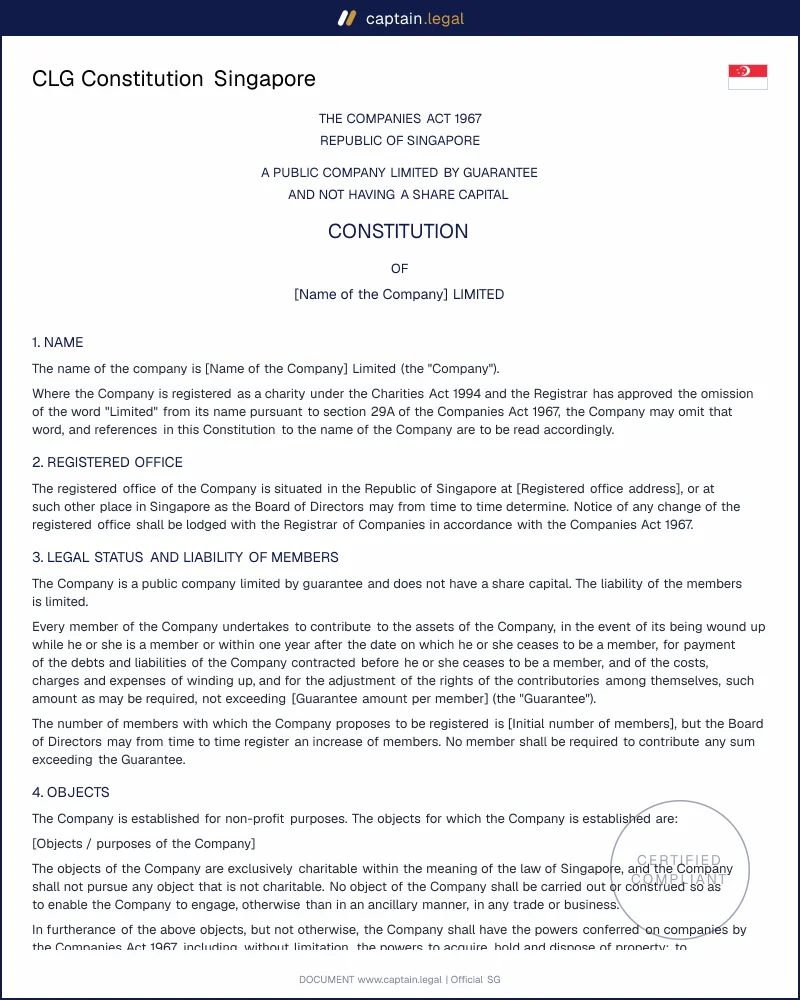
The CLG is a creature of statute. Incorporation, the members' guarantee, directors' duties and the audit regime all flow from the Companies Act 1967, administered by the Accounting and Corporate Regulatory Authority (ACRA). Because a CLG has no share capital, it is by definition a public company, which carries heavier governance and filing duties than a small private company. You need at least two directors, two members and a qualified company secretary appointed within six months of incorporation, and at least one director must be ordinarily resident in Singapore. The constitution must be submitted through BizFile, and many founders adapt a customised constitution rather than the bare model form so that the objects and reserved powers actually match the organisation.
A CLG that wants to drop the word "Limited" from its name can apply for a licence under section 29A of the Companies Act 1967, which is available only where the company is registered under the Charities Act 1994. Do not promise "Limited"-free branding before that licence is granted. Charity status is a separate layer altogether. A CLG applies to the Commissioner of Charities under the Charities Act 1994, normally within three months of incorporation, and the objects must be exclusively charitable with the organisation having at least three governing board members, of whom at least two are Singapore citizens or permanent residents. Registered charities must then follow the Code of Governance issued by the Commissioner. Charity status by itself does not make gifts tax-deductible: that requires separate approval as an Institution of a Public Character (IPC), which unlocks the enhanced donor deduction but imposes stricter reporting. A constitution that collects members' or donors' details also engages the Personal Data Protection Act 2012. The authoritative starting point is the ACRA overview of the Companies Act 1967, which links to the regime governing every CLG.