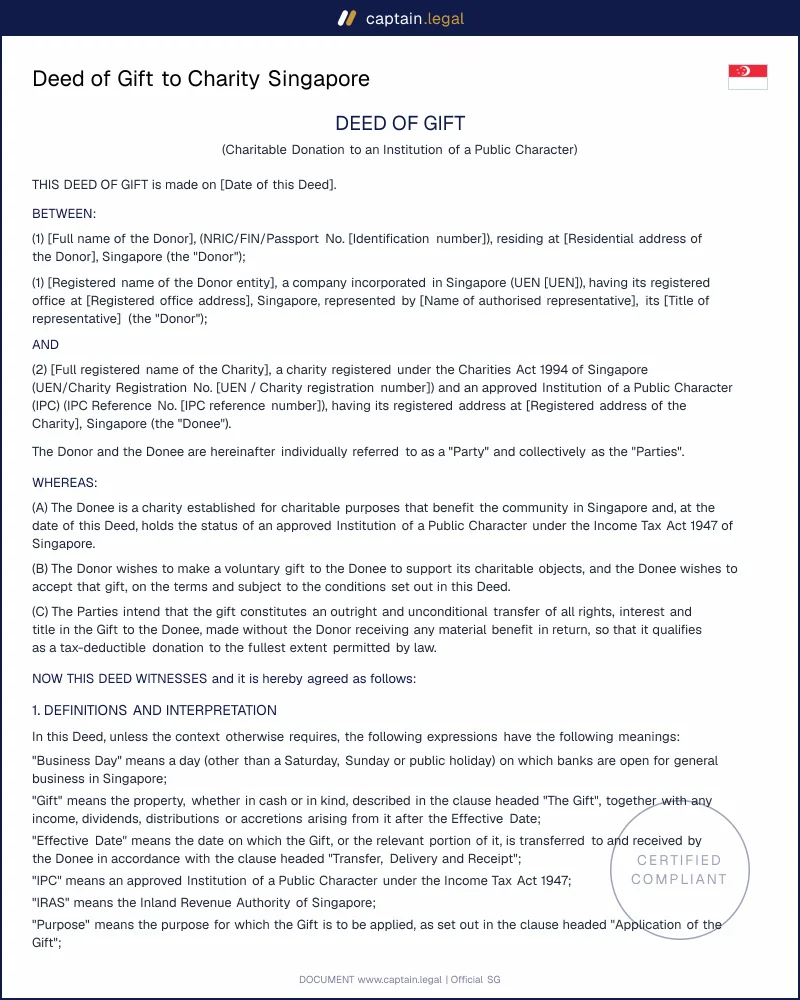
The enforceability of a charitable gift in Singapore rests on the common law of deeds, not on any single donations statute. A deed must be signed, sealed and delivered, and the Court of Appeal reaffirmed in Lim Zhipeng v Seow Suat Thin [2020] SGCA 89 that sealing remains a genuine requirement, not a formality that the words "signed, sealed and delivered" alone can satisfy. In practice the seal is now a small red wafer affixed next to the signature, and delivery refers to the donor showing an intention to be immediately and unconditionally bound rather than to any physical handover. A deed that is signed but never sealed can be struck down as unenforceable, which is why the execution block on this template carries an attestation clause and a witness line for each party.
Charitable status and tax treatment sit on top of the deed. A charity is registered with the Commissioner of Charities under the Charities Act 1994, and registered charities enjoy automatic income-tax exemption under section 13(1)(zm) of the Income Tax Act 1947. Tax deductibility for the donor is a separate question entirely. Only an approved Institution of a Public Character may issue receipts that carry the enhanced deduction, and that approval comes from the Commissioner, not from charity registration alone. The current rate is a 250% deduction, meaning every dollar of qualifying cash donation reduces the donor's assessable income by two dollars and fifty cents; this enhanced rate has been extended to 31 December 2026, after which it reverts unless renewed. The authoritative statement of what qualifies, and the pure-gift conditions behind it, is set out in the IRAS guidance on donations and tax deductions for approved IPCs.
Two drafting traps flow directly from those rules. A donation loses deductibility if the agreement contains a refund clause obliging the charity to return the money, or an exclusivity clause stopping the charity from accepting or acknowledging other donors. The gift must also confer no material benefit on the donor; naming a facility or including the donor's logo on collateral is permitted, but tickets, goods or advertising rights at commercial value are not. Where the gift is real property, a voluntary conveyance still attracts buyer's stamp duty under the Stamp Duties Act 1929 calculated on market value, and CPF monies used on the property must be refunded before the transfer.