Create my document
Login

Choose country

FranceBelgiqueEspañaUnited StatesUnited KingdomMarocDeutschlandItaliaSchweizSingapore
Non-Profit & Associations

Special Resolution Singapore: Societies Act 1966 s.11

Amend a society, charity or CLG constitution under the Societies Act 1966 and Companies Act 1967. Resolution, notice and filing pack in Word and PDF.
4.8/527 reviews50 000+ downloadsInstant download
Share

A constitution amendment is the formal mechanism by which a Singapore society, charity or company limited by guarantee changes its founding rules, and in every case the change must be carried by a special resolution of members before it can be lodged with the regulator. This page is for committee members, honorary secretaries, charity board members and company secretaries who need to alter their society constitution or governing instrument correctly, capture the vote, and file the change with the Registry of Societies or ACRA. Get the resolution wording, the notice period or the quorum wrong and the regulator will reject the application, leaving the amendment legally ineffective no matter how the meeting went.

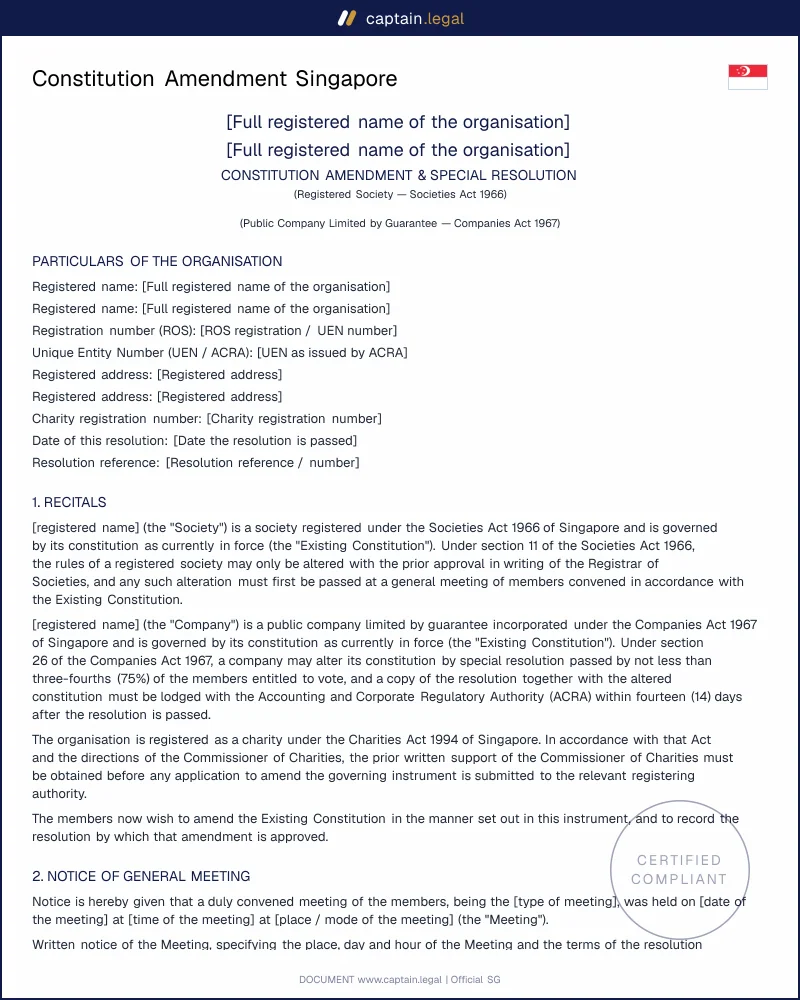
Our template gives you the special resolution wording, the member notice, the voting record and the cover note for filing, all drafted to Singapore practice and ready as Word and PDF.

Compliant

2026 Legislation

50,000+ clients

trust us

Affordable

From $4.90 / doc

Secure payment

Instant download

Special Resolution Singapore: Societies Act 1966 s.11

Secure payment · No subscription

Fill in the template

What is a constitution amendment and special resolution?

A constitution amendment is any change to the rules that govern your organisation: its objects, its membership classes, the composition and powers of the committee or board, the conduct of general meetings, the financial year, or the treatment of assets on dissolution. Under Singapore law a society's rules, a charity's governing instrument and a company's constitution are all binding internal contracts, so no change takes effect simply because members want it. It takes effect only when passed by the required majority and, where the law demands it, approved or registered by the relevant authority.

A special resolution is the elevated voting threshold reserved for these constitutional changes. For a company limited by guarantee under the Companies Act 1967, a special resolution needs at least 75% of the votes cast by members entitled to vote at a general meeting, on proper written notice. Societies set their own threshold in their existing constitution, which is frequently a two-thirds or three-quarters majority of members present at a general meeting, and that internal rule must be followed to the letter. The distinction matters because an ordinary resolution, even a unanimous one, cannot validly amend a constitution where the document or the statute calls for a special resolution. The voting record you keep is the evidence the regulator will scrutinise, so it has to show the precise figures, not just an outcome.

2

When do you need this document?

The most common trigger is a change to the objects clause, when a society or charity broadens its mission, narrows it to satisfy a funder, or rewrites its purpose to qualify for IPC status. Because the objects sit at the heart of every governing instrument, this is precisely the change regulators read most closely, and a vague new objects clause is a frequent reason an Amendment of Rules application stalls. The second recurring scenario is a governance overhaul: changing the size of the committee, the term limits of office-bearers, the quorum for general meetings, or moving from physical to electronic voting. Membership restructuring comes next, when an organisation introduces associate or life-member categories, alters subscription rules, or changes who may stand for the committee.

Two edge cases deserve flagging. First, a society that wants to update its registered name or place of business is making a constitutional change in the ROS sense and needs the same approval pathway, even though members often treat a name change as administrative. Second, a charity altering its dissolution clause must be careful: the Commissioner of Charities expects surplus assets to pass to another charitable body with similar objects, and a clause that allows distribution to members will not be supported. Never assume a routine internal vote is enough when the change touches objects, assets or name; those are the amendments that attract regulator scrutiny. When the amendment is part of a wider corporate restructuring, you may also need updated Singapore business and incorporation documents to keep the company's records consistent.

3

Key clauses included in our template

  • The special resolution wording is drafted in the formal language regulators expect, opening with "It was resolved as a special resolution that..." and setting out the exact text of the rule being added, replaced or deleted. Loose phrasing such as "the committee is authorised to update the constitution" is replaced by the precise old-and-new wording, because ROS and ACRA register the words, not the intention.
  • The meeting and notice particulars record the date, place and nature of the general meeting, confirm that members received notice of the requisite length, and reproduce the agenda item describing the proposed amendment. For a company limited by guarantee this section reflects the Companies Act 1967 notice rules; for a society it tracks the notice period in the society's own constitution.
  • The voting record captures the figures that prove the threshold was met: members present and entitled to vote, votes for, votes against, abstentions, and the resulting percentage. This is the single most-scrutinised piece of evidence, since a special resolution stands or falls on whether at least the required majority was achieved.
  • The chairperson and secretary certification confirms the minutes are a true record, signed and dated, which is what gives the document its evidential weight if the vote is ever challenged.
  • The cover note for filing is the short transmittal addressed to the Registry of Societies or ACRA, summarising what changed, referencing the resolution, and listing the enclosures so the regulator can process the application without reverting for clarification.
4

Regional considerations

Singapore is a single jurisdiction, so the meaningful distinction is by legal form rather than by region. A registered society answers to the Registry of Societies under the Home Team, and its amendment process runs entirely through the ROS e-services portal; the society must have no outstanding annual returns before an Amendment of Rules application is accepted, and a non-refundable application fee applies on submission. The Registrar approves changes in writing and may withhold approval where amended rules would be contrary to national interest or prejudicial to public peace, welfare or good order, a ground sharpened by the Societies (Amendment) Act changes that took effect in May 2024.

A company limited by guarantee answers to ACRA and files through BizFile+, a faster and more automated route, but one that demands strict adherence to the 14-day lodgement window after the special resolution. The amendment generally takes effect from the date of the resolution unless a later date is specified, and ACRA issues a notice of registration once the filing is accepted.

A charity or IPC layers the Commissioner of Charities over whichever base form it uses. The practical effect is sequencing: the charity secures the Commissioner's support first, then lodges with ROS or ACRA, never the other way round. Skipping the Commissioner's step is the classic cause of a rejected charity amendment. If your organisation also engages staff, keep your Singapore employment and HR documents aligned with any governance changes that affect how officers or employees are appointed.

5

How to fill out this constitution amendment

You begin by selecting your legal form, because that choice drives the resolution threshold, the notice rules and the filing destination throughout the document. From there the template asks for your organisation's registered name, its unique entity or society registration number, and the existing rule you intend to change, so the resolution can quote the current wording before stating the replacement. You then enter the proposed new text exactly as members will see it on the notice, and the form assembles the special resolution around it in the formal register regulators expect.

Next you record the meeting details: the date, the type of general meeting, the notice period given, and the quorum present. The voting fields capture the figures that prove the majority, and the document calculates the percentage so you can confirm the threshold was cleared before anyone signs. Finally you complete the certification block for the chairperson and secretary and generate the cover note addressed to your regulator. The output downloads in Word and PDF, so you can adjust wording, obtain wet-ink signatures, and lodge the package without rebuilding anything from scratch. For organisations handling member or donor records alongside this, the related Singapore personal and family legal documents cover adjacent paperwork you may need.

6

Common mistakes to avoid

The most damaging error is treating the vote and the filing as the same step. Passing a special resolution at a general meeting changes nothing in law until the Registry of Societies approves it in writing or ACRA registers it, and committees that act on an unfiled amendment expose every officer to risk. Closely related is the wrong threshold: applying an ordinary majority where the constitution or the Companies Act 1967 demands a special resolution, which voids the amendment even if every member present agreed. A third frequent failure is defective notice. If members did not receive notice of the correct length, with the proposed wording disclosed, the resolution is open to challenge and the regulator can reject the application on that basis alone.

The other cluster of mistakes is documentary. A voting record that states only "carried" without the actual figures gives the regulator nothing to verify, so the percentage must always appear. Charities regularly forget to secure the Commissioner of Charities support before lodging, which forces them to restart. And companies amending their objects sometimes lodge inside the 21-day window required by section 33, when only the ordinary 14-day rule was on their mind. Each of these is avoidable with a document that captures the figures, the notice and the sequence in the order the law expects.

Key takeaways

Voting threshold

Use a special resolution, not ordinary

A constitution change only takes effect if members pass it using the correct special resolution threshold. For a company limited by guarantee under the Companies Act 1967, that means at least 75% of votes cast by members entitled to vote at a general meeting, on proper written notice. For societies, follow the exact threshold stated in your existing constitution (often two-thirds or three-quarters).

Legal framework

Confirm whether you file to ROS or ACRA

Start by fixing your legal form, because the regulator and steps differ. Registered societies sit under the Societies Act 1966 and file amendments through the Registry of Societies (ROS). Companies limited by guarantee are under the Companies Act 1967 and deal with ACRA processes. Mixing up the framework leads to wrong wording, wrong meeting mechanics, and a rejection even if members voted in favour.

Approvals

No approval, no effective amendment

For societies, section 11 of the Societies Act 1966 requires the Registrar’s written approval before any change to the society’s rules. The sequence matters: pass the amendment at a general meeting in line with the current constitution, then submit the Amendment of Rules application via the ROS e-services portal. Skipping approval is not mere admin; it is an offence and can expose the society and every officer to fines.

Frequently Asked Questions

The document itself records a binding internal act once it is properly executed, but the amendment only takes legal effect after the regulator approves or registers it. For a registered society, the change to the rules is effective when the Registry of Societies grants written approval under section 11 of the Societies Act 1966. For a company limited by guarantee, the amendment binds the company and its members from the date of the special resolution, provided it is lodged with ACRA within the statutory window. The template is drafted to satisfy what each regulator looks for, but completing it does not replace the filing step, which is what gives the amendment its force in law.

It depends on your legal form. A company limited by guarantee needs at least 75% of the votes cast by members entitled to vote at a general meeting, the statutory definition of a special resolution under the Companies Act 1967. A registered society follows the threshold written into its own existing constitution, which is commonly a two-thirds or three-quarters majority of members present, and that internal rule governs because the Societies Act 1966 does not impose a single figure. The safe course is to read your current constitution before the meeting, apply the higher threshold if there is any doubt, and record the exact figures so the majority is demonstrable.

For a company limited by guarantee, a copy of the special resolution and the amended constitution must reach ACRA through BizFile+ within 14 days of the resolution being passed. Where the amendment alters the company's objects, section 33 of the Companies Act 1967 prevents lodgement until 21 days have elapsed, after which the usual window applies. A registered society has no fixed statutory countdown in the same sense, but it must obtain the Registrar's written approval before relying on the change, and outstanding annual returns must be cleared before the Registry of Societies will accept the application. Filing promptly is always the better practice.

If your organisation is a registered charity or an Institution of a Public Character, then yes. Under the Charities Act 1994, you must seek the support of the Commissioner of Charities before submitting the Amendment of Rules application to the Registry of Societies or filing with ACRA. This is a sequencing requirement, not an afterthought: the Commissioner reviews the change for consistency with the Code of Governance and with charitable purpose, particularly where objects or dissolution clauses are involved. Organisations that are neither charities nor IPCs skip this step entirely, which is one more reason to confirm your legal status before you draft.

For a company limited by guarantee, written resolutions are possible if the constitution permits them, allowing members to approve the special resolution without convening in person. Many modern constitutions also allow electronic or hybrid general meetings. For a registered society, the position is governed by your own constitution, so an amendment passed outside the meeting format your rules prescribe is vulnerable to challenge. Before relying on a written or virtual procedure, confirm that your current constitution authorises it; if it does not, that authorisation may itself be one of the amendments you need to pass first.

The template generates both Word and PDF. The Word version lets you fine-tune the resolution wording, insert your registered entity number, and adjust the notice particulars to match your meeting before printing for signature. The PDF gives you a clean, fixed copy suitable for lodging with the Registry of Societies or attaching to a BizFile+ submission to ACRA. Having both means you can edit freely and still produce a tidy final record, and you can keep the executed PDF with your statutory registers alongside your other Singapore non-profit and association documents.

For a society, the Registrar may withhold approval, for example where the amended rules would be contrary to national interest, and a person aggrieved by that refusal may appeal to the Minister within 30 days of the decision under the Societies Act 1966. In most ordinary cases, though, a rejection is a request for clarification or a drafting fix rather than an outright bar, and resubmitting with corrected wording resolves it. For a company, ACRA will not register a defective filing, so the amendment simply does not take effect until the lodgement is corrected. The practical lesson is to get the resolution wording, the voting figures and the filing sequence right the first time, which is exactly what a properly structured document is built to do.

4.8/5

27 verified reviews · 50 000+ downloads

Special Resolution Singapore: Societies Act 1966 s.11
  • Immediate access to the document
  • PDF + Word download
  • Compliant with 2026 legislation
  • Reviewed by lawyers
Fill in the template
Secure payment · No subscription
Updated on June 16, 2026

You might also like

Office-Bearer Appointment & Resignation
Society Constitution Singapore