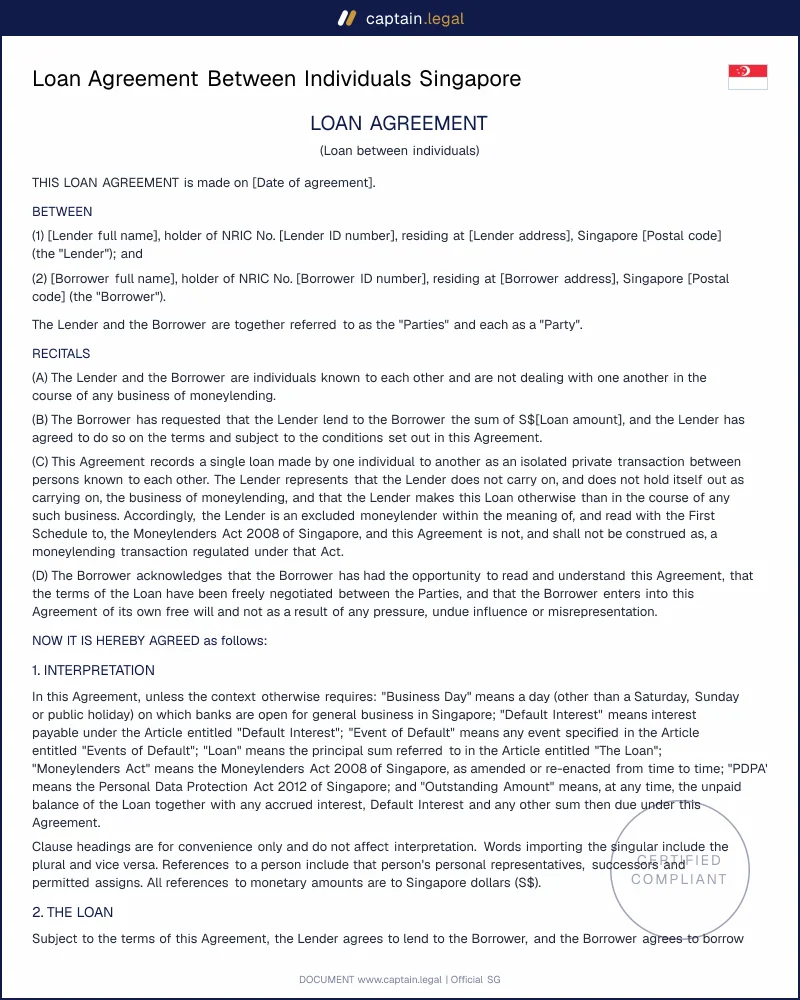
The most common scenario is the family bridging loan: a parent or sibling advances money for a property deposit, a wedding, or a business injection, and both sides want a clear record that this is a loan and not an early inheritance. Disputes here are rarely about the money itself; they are about whether it was ever a loan at all, and a signed agreement settles that question before it becomes a quarrel. The second frequent trigger is the loan between friends or business partners, where one person funds a venture or covers a shortfall and expects repayment on a schedule rather than an open-ended favour.
A third situation is the structured personal loan with interest. Once you decide to charge interest, you move squarely into section 3 territory, so the agreement should state plainly that this is a single private arrangement and not a moneylending business. Lenders advancing larger sums often add a guarantor or take security, which is when the document does its heaviest lifting. If you are lending to someone you also employ or do business with, keep the loan entirely separate from those dealings, because mixing them muddies the question of whether the advance was really commercial.
Two edge cases deserve a flag. First, repeated lending, even to a single borrower, can tip you into the business of moneylending if there is system and continuity, so a series of "friendly" loans is riskier than one. Second, loans to a company rather than a person may fall under the excluded moneylender rules for commercial borrowing, a different analysis that a private individual lending to a friend's startup should not assume applies. When the borrower runs a company, a Singapore shareholders' agreement or proper director's loan documentation may be the better instrument.