Create my document
Login

Choose country

FranceBelgiqueEspañaUnited StatesUnited KingdomMarocDeutschlandItaliaSchweizSingapore
Non-Profit & Associations

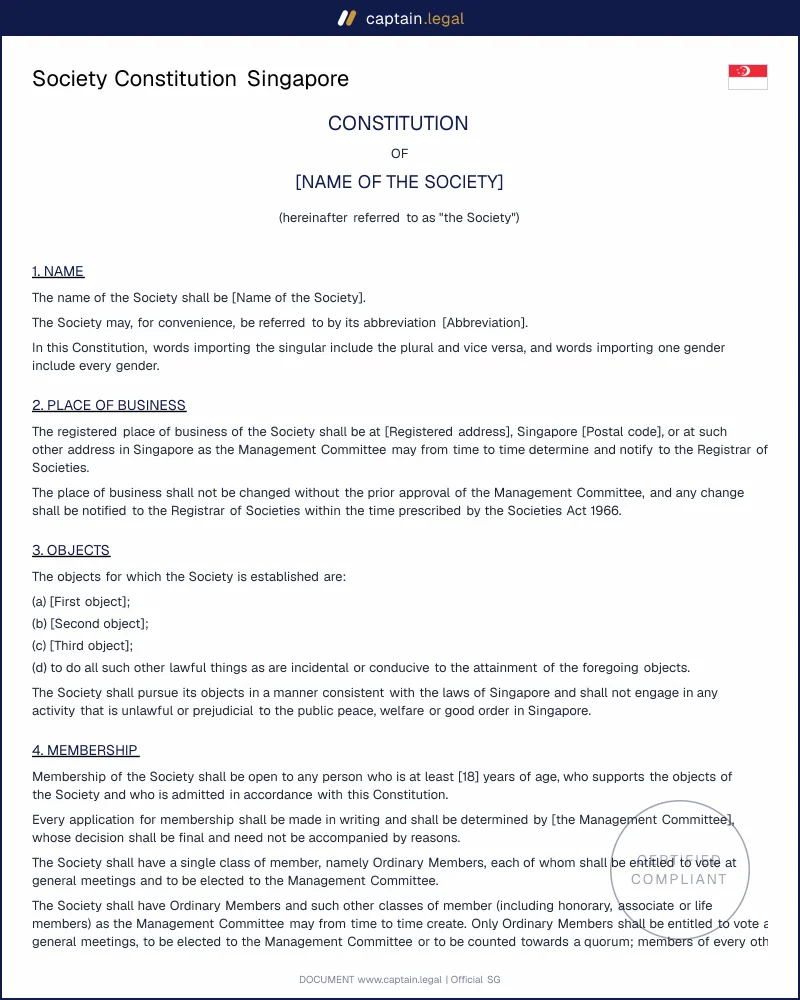
Society Constitution Singapore: Societies Act 1966

Build your society constitution to Registry of Societies requirements under the Societies Act 1966. Citizen-majority committee rules, Word format for lodging.
4.7/529 reviews50 000+ downloadsInstant download
Share

A society constitution is the founding rulebook of a membership organisation registered with the Registry of Societies (ROS) under Singapore's Societies Act 1966. It sets out the society's name and objects, who may join, how the management committee is elected, how meetings run, how money is handled and what happens to surplus assets on dissolution. Any club, association or group of ten or more persons that is not registered under another written law must register as a society, and the constitution is the central document the Registrar reviews. This template gives community groups, alumni networks, sports clubs, religious bodies and professional associations a ROS-aligned starting point they can adapt and lodge.

Compliant

2026 Legislation

50,000+ clients

trust us

Affordable

From $4.90 / doc

Secure payment

Instant download

Society Constitution Singapore: Societies Act 1966

Secure payment · No subscription

Fill in the template

What is a society constitution?

A society constitution is the written set of rules that governs a registered society and binds it to its members. Under Singapore law a society is defined as a club, company, partnership or association of ten or more persons, whatever its nature or object, that is not registered under any other written law. The constitution is not a courtesy document. It is the instrument the Registrar of Societies examines on application, and once registered it operates as a binding contract among the members and between each member and the society.

People often confuse a society with a company limited by guarantee or a charity, and the distinction matters from the first draft. A society is registered with ROS under the Societies Act 1966; a company limited by guarantee is incorporated with ACRA under the Companies Act 1967 and is a separate legal person. A society is faster and cheaper to set up, which is why most grassroots groups choose it, but committee members can carry more personal exposure because the society is not incorporated in the same way. Charity status is a separate layer that sits on top of the legal form, granted by the Commissioner of Charities under the Charities Act 1994. A society is not automatically a charity, and registration with ROS does not make donations tax-deductible. Drafting the objects and the dissolution clause with these distinctions in mind saves a great deal of correspondence with the Registrar later. If your group is leaning towards incorporation instead, the Singapore business and incorporation templates cover the company route.

2

When do you need this document?

The clearest trigger is forming a new group that crosses the ten-person threshold. Once ten or more people associate around a shared object, whether an alumni circle, a residents' network or a hobby club, the Societies Act 1966 treats the group as liable for registration, and a compliant constitution is the precondition for that application. Religious societies sit in a distinct category here: any group conducting worship or studying religious texts falls within the Schedule and must apply under Normal Registration, so its constitution faces closer scrutiny on objects, leadership and affiliations.

Existing unregistered groups also reach for this document when their informal arrangements start to fail. A committee that has been running on goodwill discovers it cannot open a proper bank account, hold property or sign contracts cleanly without a registered structure and a constitution that names authorised signatories. Sports and recreation clubs seeking to affiliate with a national association usually need ROS registration first, and the parent body will often ask to see the constitution before granting affiliation. Professional and trade associations use the constitution to fix membership classes, subscription rules and voting rights before disputes arise. One edge case worth flagging is the group considering both a society and a company limited by guarantee: drafting a society constitution clarifies the governance model and can later be migrated, though re-registration is not automatic. Mutual-benefit and cooperative bodies that would instead register under the Co-operative Societies Act should confirm their route before adopting this template.

3

Key clauses included in our template

  • The name and objects clause states the society's exact name and its purposes in clear, lawful terms. The Registrar reads the objects closely, so vague aims like "to do good in the community" are replaced with specific, achievable purposes that match the society's actual activities and do not stray into restricted political or commercial territory.
  • The membership provisions define classes of member, eligibility, the admission procedure, subscriptions and the grounds for cessation or expulsion. Because the constitution operates as a contract among members, this clause fixes who has voting rights and who does not, which prevents most internal disputes before they start.
  • The management committee clause establishes the office-bearers, beginning with the President, Secretary and Treasurer required by the Societies Act 1966, sets their terms and powers, and reflects the citizenship and eligibility restrictions the Act imposes. It also addresses casual vacancies and removal so the committee never stalls.
  • The general meetings clause governs the Annual General Meeting and Extraordinary General Meetings, prescribing notice periods, quorum, voting method and the keeping of minutes. A decision taken without the quorum or notice your constitution specifies can be challenged as invalid, so these figures are drafted deliberately rather than copied blindly.
  • The finances clause sets the financial year, regulates bank accounts and authorised signatories, caps the cash a treasurer may hold and requires audited or examined accounts. Sound money rules here are exactly what the Registrar and any future auditor look for.
  • The dissolution clause provides for winding up by member resolution and directs that any surplus assets, after debts, pass to another society or charitable body with similar objects rather than to members. This is mandatory in substance and the clause most often queried when it is missing.
4

Regional considerations

Singapore is a single jurisdiction, so the Societies Act 1966 applies uniformly across the island without the state-by-state variation seen in larger federations. The practical differences come from the type of society rather than its location. A religious society faces the Normal Registration track and a longer list of questions on its deities, texts, leadership and any overseas affiliations, all of which should be anticipated in how the objects and committee clauses are written. A society representing a particular ethnic community must expect questions about restricted membership, so the eligibility clause should be drafted candidly.

Where a society intends to pursue charity or IPC status, the Commissioner of Charities and the Code of Governance add a second layer of expectation on top of the ROS constitution, including stronger conflict-of-interest, board and financial controls. Building those governance features into the constitution from the outset avoids amending it again after registration. Societies that handle members' or donors' personal data should align their internal rules with the Personal Data Protection Act 2012, and a short data-handling provision in the constitution signals good governance to both the Registrar and prospective members. Groups weighing the society route against incorporation may find it useful to compare with the Singapore non-profit and association documents covering charities and companies limited by guarantee before committing.

5

How to fill out this society constitution

You begin by entering the proposed name of the society and, if you expect to apply under Normal Registration, the alternative names ROS will ask for, then the registered address in Singapore. From there the template guides you through the objects, where you state the society's purposes in plain, lawful language that matches what the group actually intends to do. Next you set the membership rules, choosing the classes of member, the subscription and the admission and expulsion procedures, before moving to the management committee, where you name the President, Secretary and Treasurer and confirm the eligibility and citizenship requirements the Societies Act 1966 imposes.

The meetings section then lets you fix the notice period, quorum and voting method for the AGM and any Extraordinary General Meeting, and the finances section sets the financial year, signatory rules and audit arrangements. You finish with the dissolution clause directing surplus assets to a body with similar objects. The output downloads as Microsoft Word, which is the format ROS requires for lodgement, so you can adjust wording and submit through ROS eServices without reformatting. Once your founding committee is in place, you may also want the Singapore committee and members' resolution templates to record the adoption of the constitution and the first appointments.

6

Common mistakes to avoid

The most frequent error is treating the objects clause as boilerplate. Founders copy lofty, generic aims, and the Registrar comes back with queries because the objects are too broad, stray into political activity or do not match the society's real purpose. A close second is ignoring the office-bearer rules: a committee assembled without a citizen majority, or with a non-resident as President or Treasurer, will not pass scrutiny under the Societies Act 1966, and the application stalls until the line-up is fixed. Many drafters also leave the quorum and notice figures at unrealistic levels, so a small society finds it cannot lawfully hold a valid meeting because it can never gather the quorum it wrote into its own rules.

The dissolution clause is the one people forget, and its absence is almost always queried. A constitution that says nothing about where surplus assets go, or that allows them to be distributed among members, undermines the non-profit character the Registrar expects. Weak financial provisions cause trouble later rather than at registration: no named signatories, no cap on cash held, no audit requirement, and the society is exposed the first time money goes missing. Finally, founders submit in PDF and are sent away, because ROS requires the constitution in editable Microsoft Word. Reading the Singapore personal and family legal documents for statutory declarations can also help where committee members must declare their eligibility.

Key takeaways

WHEN REQUIRED

Ten or more persons triggers ROS registration

If your club, association or group has ten or more persons and is not registered under another written law, it falls within the Societies Act 1966 framework and should register with the Registry of Societies (ROS). The constitution is not just form-filling: it is the core rulebook the Registrar reviews and, once registered, it binds the society and its members like a contract.

LEGAL FORM

A society is not a company or charity

A society registers with ROS under the Societies Act 1966. That is different from a company limited by guarantee, which is incorporated with ACRA under the Companies Act 1967 as a separate legal person. Charity status is another layer under the Charities Act 1994. ROS registration does not make donations tax-deductible, so draft your objects and dissolution clause with the right legal route in mind.

COMPLIANCE

Meet ROS filing and committee eligibility rules

ROS is strict on process and eligibility. Your constitution must be lodged in English and in Microsoft Word format, and the President, Secretary and Treasurer verify and submit via their Singpass accounts. Committee composition also matters: the majority must be Singapore citizens, and the key office-bearers (and their deputies) are expected to be citizens or permanent residents. Foreign diplomats cannot sit on the committee.

Frequently Asked Questions

Yes. Once your members adopt the constitution and the society is registered with the Registry of Societies under the Societies Act 1966, the constitution operates as a binding contract among the members and between each member and the society. It governs admission, voting, committee elections, meetings and the handling of funds, and a member who breaches it can be dealt with under its own disciplinary provisions. The template is drafted to be enforceable, but enforceability still depends on the society completing registration and on the committee actually following the rules it sets, such as holding meetings with the required notice and quorum.

You need at least ten persons before a group is liable for registration under the Societies Act 1966. Any club, company, partnership or association of ten or more persons, whatever its object, must register with ROS unless it is already registered under another written law, such as the Companies Act or the Limited Liability Partnerships Act. Beyond the headcount, the society must have a management committee with a President, Secretary and Treasurer, the majority of committee members must be Singapore citizens, and those three key office-bearers and their deputies are expected to be citizens or permanent residents. You can review the Singapore document catalogue for related founding paperwork.

You receive both Microsoft Word and PDF. The Word version matters most for registration, because ROS requires the proposed society's constitution to be submitted in Microsoft Word format, with supporting documents preferably in PDF or JPG. Having the editable Word file lets you tailor the objects, membership classes, quorum figures and signatory rules to your society before lodging through ROS eServices. The PDF is convenient for circulating a clean copy to your founding members for review and for keeping a fixed record of the version adopted at your inaugural meeting.

Timing depends on the registration track. Societies not listed in the Schedule to the Act use the Automatic Registration process and can be registered quickly once the three key office-bearers verify and submit through Singpass, while Schedule societies, including religious bodies, go through Normal Registration, which involves closer review and may take longer where the Registrar seeks further information. A non-refundable fee applies on submission, set higher for Normal Registration than for Automatic Registration. Drafting a clean, compliant constitution from the start is the single biggest factor in avoiding back-and-forth that delays approval.

Foreigners may generally be ordinary members, but office-holding is restricted. The Societies Act 1966 requires the majority of committee members to be Singapore citizens, and the President, Secretary and Treasurer, along with their deputies, are expected to be Singapore citizens or permanent residents. Foreign diplomats are not permitted to serve on the committee at all. Persons disqualified under the Act, such as undischarged bankrupts, also cannot act as officers. When you draft the management committee clause, build these requirements in directly so your proposed line-up does not fall foul of the rules and delay registration.

No. The Societies Act 1966 does not require a society constitution to be drafted or witnessed by a lawyer, and most community groups in Singapore prepare and lodge their own using a compliant model as a starting point. What matters is that the constitution covers the objects, membership, committee, meetings, finances and dissolution in terms the Registrar accepts, and that the office-bearer eligibility rules are respected. A template built to ROS expectations lets a founding committee produce a registration-ready document on its own. Complex cases, such as societies seeking charity or IPC status, may still benefit from professional advice on the additional governance obligations.

The dissolution clause should set out how the society can be wound up, usually by a resolution passed at a general meeting with a defined majority, and must direct that any assets remaining after debts and liabilities are settled are transferred to another registered society or charitable organisation with similar objects. Surplus assets cannot be distributed among the members, because that would contradict the non-profit nature the Registrar expects of a society. A missing or defective dissolution clause is one of the most common reasons constitutions are sent back, so this provision is drafted carefully in the template rather than left as an afterthought.

4.7/5

29 verified reviews · 50 000+ downloads

Society Constitution Singapore: Societies Act 1966
  • Immediate access to the document
  • PDF + Word download
  • Compliant with 2026 legislation
  • Reviewed by lawyers
Fill in the template
Secure payment · No subscription
Updated on June 16, 2026

You might also like

AGM Minutes & Annual Return
Volunteer Agreement Singapore