Create my document
Login

Choose country

FranceBelgiqueEspañaUnited StatesUnited KingdomMarocDeutschlandItaliaSchweizSingapore
Family & Divorce

Singapore Divorce Settlement: HDB, CPF & Maintenance

Record the agreed division of matrimonial assets under section 112 Women's Charter, with CPF, HDB and maintenance terms drafted to support a consent order.
4.7/521 reviews50 000+ downloadsInstant download
Share

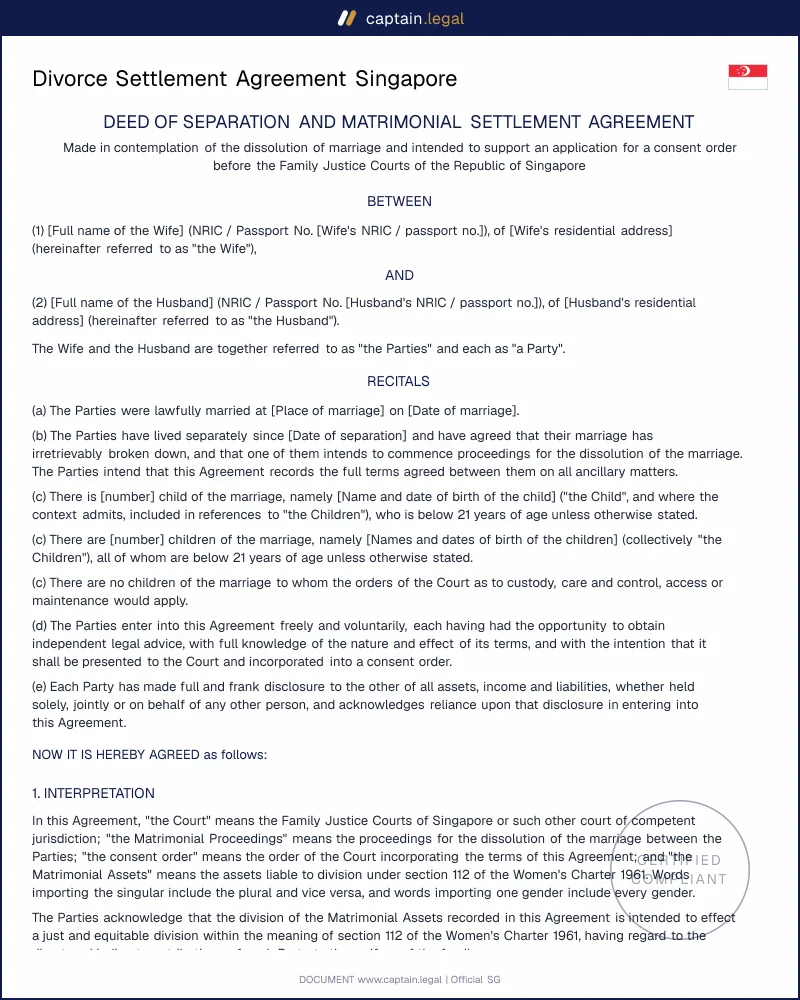
A divorce settlement agreement in Singapore is the written record of everything a separating couple has agreed on: how the matrimonial assets are split, what happens to the HDB flat, how CPF monies are refunded, the maintenance payable, and the arrangements for custody, care and control, and access to the children. It is the working document behind an uncontested divorce, the paper the Family Justice Courts read when deciding whether to grant a consent order. A clear, well-drafted matrimonial agreement turns a fragile understanding between two people into terms a court can endorse and HDB, the CPF Board, and the banks can actually act on.

This template is built for couples taking the simplified track, where both sides agree on the ground for divorce and every ancillary matter. You fill in the financial and parenting terms, both parties sign, and the agreement becomes the backbone of your draft consent order. It does not replace the court's discretion, but a sensible starting point saves weeks of back-and-forth and keeps the process amicable.

Compliant

2026 Legislation

50,000+ clients

trust us

Affordable

From $4.90 / doc

Secure payment

Instant download

Singapore Divorce Settlement: HDB, CPF & Maintenance

Secure payment · No subscription

Fill in the template

What is a divorce settlement agreement in Singapore?

A divorce settlement agreement, sometimes drafted as a matrimonial agreement or settlement deed, is a contract between spouses that sets out the agreed terms for ending their financial and parenting relationship. In Singapore practice it sits alongside the divorce application and feeds directly into the draft consent order that the Family Justice Courts are asked to make at the ancillary matters stage. The agreement covers the four pillars every uncontested divorce has to resolve: division of matrimonial assets, the matrimonial home, maintenance for the wife or ex-wife and the children, and the children's living and access arrangements.

People often confuse this document with a Deed of Separation, and the two are related but distinct. A Deed of Separation governs life while the couple is still married, recording who lives where, who pays the mortgage, and how expenses are shared during the separation period. A divorce settlement agreement looks past that moment to the final terms that will survive the marriage itself. Many couples sign a deed first to formalise their split, then convert its financial terms into a settlement agreement once they are ready to file. If you are still at the separation stage, the Singapore family and divorce document templates cover deeds of separation and parenting plans that pair naturally with this settlement.

The agreement has no automatic legal force on its own. Its weight comes from being adopted by the court as a consent order, which is why the drafting has to match what a judge will accept and what HDB and CPF will process without objection.

2

When do you need this document?

The clearest case is the uncontested divorce where both spouses have already agreed on everything and simply need the terms in writing for the court. You record the asset split, the maintenance figures, and the parenting schedule, and the document becomes the spine of your draft consent order. Couples on the simplified track use it precisely because it removes the ambiguity that turns a friendly separation into a contested fight at the ancillary matters hearing.

It is equally useful before filing, when the marriage has broken down but the paperwork has not started. Writing out the terms forces both parties to confront the awkward questions early: who keeps the HDB flat, how much CPF has to be refunded with accrued interest, whether maintenance adjusts if one parent loses a job. A second common scenario is the couple who agree on the big picture but keep stalling on detail, such as school holiday access or how enrichment fees are shared. The agreement gives those details a home.

There are two edge cases worth flagging. First, where a flat has not met its Minimum Occupation Period, a straightforward sale or transfer may need HDB's specific approval, so the agreement should record what the parties intend and leave room for HDB's decision. Second, if one spouse is a foreign national, retaining an HDB flat in sole name may not be possible under HDB eligibility rules, which the settlement should anticipate rather than assume. Couples who hold private property or business interests alongside the flat often pair this settlement with the relevant Singapore business and contract templates to document share transfers cleanly.

3

Key clauses included in our template

  • The division of matrimonial assets clause lists every asset by category: the matrimonial home, CPF balances, bank savings, insurance policies, vehicles, and any business interests. Each is identified with the agreed share or sum so HDB, the CPF Board, and the banks can act without guessing what the parties meant. Vague wording like "to be divided fairly" is replaced by concrete proportions or fixed figures.
  • The matrimonial home clause records whether the flat is sold, transferred, or retained, the party responsible for the outstanding loan, and the timeline for completion. It states explicitly that any transfer is subject to HDB approval and CPF refund of all monies used plus accrued interest at 2.5% per annum, which is the figure the CPF Board applies.
  • The maintenance clause separates spousal maintenance under section 113 from child maintenance, fixing the monthly sum, the payment date, the payment method, and the review triggers such as job loss, illness, or a child entering tertiary education. It also lists what the figure covers, so disputes over orthodontics or overseas school trips do not surface later.
  • The custody, care and control, and access clause uses the correct legal terms rather than the loose word "custody". It records the decision-making arrangement, who the child lives with day to day, and the access schedule for weekdays, weekends, and school holidays, with handover logistics spelled out.
  • The full and final settlement clause confirms that the agreed terms resolve all financial claims between the parties, subject to the court's endorsement, and that neither party will pursue further claims once the consent order is made.
4

Regional and practical considerations

Because Singapore has a single civil family jurisdiction, the variation is not by region but by the type of property and the parties' eligibility, and the settlement has to be drafted around those realities. The HDB flat is almost always the largest asset and the one most likely to derail an otherwise smooth divorce. If the flat has met its five-year Minimum Occupation Period, the parties can agree to sell on the open market or transfer it to one spouse who qualifies to keep it. The retaining party usually needs to be at least 35 years old or to have care and control of a child, and must be able to form a family nucleus and finance the loan independently. HDB does not grant new loans to fund a divorce buyout, so the settlement should be honest about how the retaining party will raise the CPF refund and the cash component.

Where the MOP has not been met, the options narrow sharply. A sale on the open market is generally disallowed, and the parties may have to surrender the flat to HDB at a valuation HDB sets, or appeal for an exemption that HDB decides case by case. The agreement should record the intended outcome while acknowledging that HDB's approval is a condition, not a formality.

The CPF dimension deserves its own attention. When a flat is transferred rather than sold, the outgoing spouse's CPF monies used for the purchase, plus accrued interest, generally must be refunded into their CPF Ordinary Account before the transfer completes. In a gift transfer with no sale proceeds, the incoming party often needs more cash upfront because there is no sale price to draw on. A settlement that ignores the CPF refund mechanics tends to stall at the conveyancing stage. Couples documenting a private property transfer alongside the flat will find the Singapore real estate and conveyancing templates useful for the sale and purchase paperwork.

5

How to fill out this divorce settlement agreement

You begin by identifying both parties and the marriage, then move through the four blocks in the order a court reads them. First you set out the division of assets, listing the matrimonial home, CPF balances, savings, and any other property with the agreed share or sum for each. From there the template prompts you for the matrimonial home decision, whether the flat is sold, transferred, or retained, and asks you to record the HDB approval condition and the CPF refund figure so the clause is conveyancing-ready.

Next you complete the maintenance terms, keeping spousal and child maintenance separate and stating the monthly amount, payment date, method, and review triggers. The parenting block follows, where you fill in the custody, care and control, and access arrangements using the precise statutory terms rather than informal language. The template then generates a full and final settlement clause and a signature page for both parties. Once signed, the agreement becomes the source document your draft consent order is built from, which you submit with the divorce application through the Family Justice Courts. You can download the finished agreement in both Word and PDF, edit it as your circumstances settle, and keep a clean signed copy for filing and safekeeping.

6

Common mistakes to avoid

The most frequent error is using "custody" as a catch-all when the parties actually mean care and control. The three concepts are distinct: custody is decision-making authority, care and control is who the child lives with, and access is the other parent's time with the child. Many families end up with joint custody but care and control to one parent, and a settlement that blurs these terms invites argument at the worst possible moment. A close second is treating maintenance as a fixed bill forever, with no review mechanism, so that when income drops or a child starts university the agreement no longer fits and one party stops paying.

On the property side, the classic mistake is drafting the HDB flat clause without checking the Minimum Occupation Period or HDB eligibility, then discovering at completion that the agreed transfer cannot happen. Just as damaging is leaving out the CPF refund and accrued interest, which the CPF Board will require regardless of what the agreement says, often leaving the retaining party short of cash. Finally, couples sometimes circulate a settlement packed with the children's addresses, school names, and medical details to unnecessary third parties; under the Personal Data Protection Act 2012, that sensitive information should be kept tightly held and the signed version stored securely. The safest agreements are specific, conveyancing-aware, and drafted to terms a Family Justice Courts judge will adopt without amendment.

Key takeaways

Court order

The agreement matters only when endorsed

A divorce settlement agreement is a working deal between spouses, not an outcome by itself. Its practical force comes only when the Family Justice Courts adopt it as a consent order at the ancillary matters stage. Draft it like a document the court, HDB, the CPF Board and banks can act on, otherwise you risk delays, objections, or a judge declining to make the order in those terms.

Asset split

Section 112 governs what gets divided

Division of property is decided under section 112 of the Women’s Charter 1961, after Interim Judgment is granted. “Matrimonial assets” are defined broadly under section 112(10): assets acquired during the marriage, and certain pre-marriage assets if improved during the marriage or used by the family (for example as the family home). Gifts and inheritances are usually excluded unless they became the home or were improved.

No 50-50

No automatic equal share in court

Do not draft on the assumption of a 50-50 split. The court looks for a just and equitable outcome and does not begin with equality as the default. The Court of Appeal approach in ANJ v ANK considers direct financial contributions and indirect contributions to the family’s welfare, averages them, then adjusts for other section 112 factors. Your settlement should reflect that logic to stay court-ready.

Frequently Asked Questions

On its own, a settlement agreement is a contract between the spouses, but its real force comes from being adopted by the court. Under section 112 of the Women's Charter, the Family Justice Courts must have regard to any agreement the parties made in contemplation of divorce, and in an uncontested case a fair, well-drafted agreement is usually endorsed as a consent order. Once it becomes a consent order it is fully enforceable like any court order. The court keeps a residual discretion to refuse terms that are unfair or not in a child's best interests, so the agreement should be drafted to what a judge will accept rather than to what one party wants.

The flat can be sold, transferred to one spouse, or retained, but every outcome depends on HDB rules layered on top of the court order. If the flat has met its five-year Minimum Occupation Period, an open-market sale or a transfer to an eligible spouse is possible. The retaining party generally must be at least 35 or have care and control of a child, must form a family nucleus, and must finance the loan and the CPF refund independently, since HDB does not lend for divorce buyouts. If the MOP is not met, a sale is usually disallowed and the flat may have to be surrendered to HDB. The settlement should record the intended outcome and treat HDB approval as a condition.

When a flat is transferred rather than sold, the outgoing spouse's CPF savings used for the purchase must generally be refunded into their CPF Ordinary Account, together with accrued interest at 2.5% per annum. This refund has to be made before the ownership transfer is finalised. In a gift transfer with no sale proceeds, the incoming party often has to fund the refund in cash, which is why the figure should be calculated and written into the agreement early. Skipping the CPF refund clause is one of the most common reasons a divorce transfer stalls at the conveyancing stage.

You can absolutely agree on maintenance between yourselves, and recording it in a settlement agreement is the sensible way to do it. Spousal maintenance under section 113 and child maintenance are both areas where the court will respect a reasonable agreement, then endorse it as part of the consent order. The figure should reflect earning capacity, the children's needs, and the standard of living during the marriage. Build in review triggers for job loss, illness, or a child entering tertiary education, because a maintenance term with no review mechanism is the clause most likely to break down later. The court retains power to vary maintenance if circumstances change materially.

The agreement itself is not filed as a standalone document; instead its terms are written into the draft consent order that accompanies your divorce application. On the simplified track, where both parties agree on the divorce and all ancillary matters, you submit the application and proposed orders, and the court can grant an Interim Judgment without the parties attending a hearing. The agreement is the source the order is built from and the evidence of what you both intended. Keeping it accurate and conveyancing-ready is what lets the court endorse your terms quickly.

For a simplified uncontested divorce where the settlement is complete, the Interim Judgment is often granted within about four to six weeks of filing, frequently without a hearing. The marriage is only finally dissolved once the Final Judgment is extracted, and that can happen no earlier than three months after the Interim Judgment, or once all ancillary matters are resolved, whichever is later. A clean settlement agreement is what keeps you on the faster end of that range, because unresolved terms push the case toward the contested track. If more than a year passes after the Interim Judgment, you need the court's permission to extract the Final Judgment.

The template downloads in both Word and PDF. The Word version lets you edit names, figures, the HDB and CPF terms, and the parenting schedule as your circumstances settle, which is useful because divorce terms often shift between first draft and final signing. The PDF gives you a clean, fixed copy for signing and for filing alongside your divorce application. Many couples keep an editable Word master and produce a final PDF once both parties have signed. You can find related family paperwork among the Singapore personal legal documents, including statutory declarations and powers of attorney that sometimes accompany a divorce.

A template gives you a sound, Singapore-specific starting point and resolves the most common drafting failures, but it does not replace advice on a complicated estate. If you hold private property, a business, overseas assets, or significant CPF and insurance balances, having the figures and the transfer mechanics checked is worth the time, since the court and the CPF Board apply their rules regardless of what you wrote. For straightforward cases with a single flat and clear parenting arrangements, a carefully completed agreement is often all the simplified track requires. Couples winding up a jointly run business at the same time may also want the Singapore non-profit and association documents if a society or charity is involved.

4.7/5

21 verified reviews · 50 000+ downloads

Singapore Divorce Settlement: HDB, CPF & Maintenance
  • Immediate access to the document
  • PDF + Word download
  • Compliant with 2026 legislation
  • Reviewed by lawyers
Fill in the template
Secure payment · No subscription
Updated on June 17, 2026

You might also like

Deed of Separation Singapore
Postnuptial Agreement Singapore