Create my document
Login

Choose country

FranceBelgiqueEspañaUnited StatesUnited KingdomMarocDeutschlandItaliaSchweizBrasilIndiaSingaporeCanada
Personal

Statutory Declaration Singapore: Oaths Act s.9-14

Statutory declaration drafted to Part 3 of the Oaths and Declarations Act 2000, prescribed First Schedule form, signed before a Commissioner for Oaths.
4.8/525 reviews50 000+ downloadsInstant download
Share

A statutory declaration is a written statement of fact that you formally declare to be true, signed before a Commissioner for Oaths or a notary public. In Singapore it is the everyday instrument for confirming something when no other proof is available: a change of name, a lost passport, a relationship, an address, or a fact a bank or government agency needs on the record. This Singapore statutory declaration template is drafted to the wording the law expects, so the declaration holds up when it lands on a registrar's, an immigration officer's, or a bank officer's desk. It comes ready to complete and sign before a Commissioner for Oaths, and downloads as both Word and PDF.

The value of a clean form is quiet but real. A declaration with the wrong attestation clause, or signed before the document is sworn, gets bounced back, and the second appointment costs you another trip and another fee. Getting the wording right the first time is the whole point.

Compliant

2026 Legislation

50,000+ clients

trust us

Affordable

From $4.90 / doc

Secure payment

Instant download

Statutory Declaration Singapore: Oaths Act s.9-14

Secure payment · No subscription

Fill in the template

What is a statutory declaration in Singapore?

A statutory declaration is a solemn written statement that the maker, the declarant, affirms to be true under the Oaths and Declarations Act 2000. It is not evidence given in a witness box and it is not a contract. It is a formal assertion of fact, given weight by the law because it is made before an authorised officer and because lying in it is a criminal offence. People reach for one when a fact needs to be put on the record but the usual paperwork is missing or insufficient, which happens far more often than most expect.

The document that trips people up most is the affidavit, and the two are close cousins rather than twins. An affidavit is sworn on oath, typically for use in active court proceedings, and follows the format set by the Rules of Court. A statutory declaration is affirmed outside the courtroom for administrative and official purposes, and follows the prescribed form in the First Schedule to the Oaths and Declarations Act 2000. In practice the line is simple. If a court file needs it, you usually want an affidavit; if the Registry of Marriages, ICA, a bank, an insurer or an employer asks you to confirm a fact, a statutory declaration is almost always the right instrument. You can compare the two side by side against our Singapore affidavit template for court and official use before you commit to a form.

2

When do you need this document?

The most common trigger is a change of personal particulars. You will be asked for a declaration when your name, date of birth or other recorded detail differs across documents and an agency needs you to confirm the correct version on the record. A deed poll for a name change is the classic pairing: the deed records the new name, and a supporting statutory declaration confirms the facts behind it, particularly where a minor is involved. If you are working through a name change, our Singapore deed poll and name change template sits naturally alongside this declaration.

Lost and damaged documents are the next big category. When a passport, a citizenship certificate or an important original goes missing, the relevant agency, often ICA, will require a written request backed by a declaration setting out how the loss happened before it will issue a replacement. Banks and insurers use them the same way, asking you to declare a fact, a relationship or an entitlement when their own records fall short. Immigration and employment matters generate a steady stream too: declarations of single status, of relationship to a sponsor, of financial standing, or of a clean record where supporting paperwork does not exist.

Two edge cases reward attention. First, anything destined for use outside Singapore: a Commissioner for Oaths cannot validate a document for foreign use, so a declaration heading overseas must be made before a notary public instead. Second, declarations tied to property and gifts, such as a declaration of solvency supporting a Singapore gift deed for transferring property without payment, carry specific factual requirements that you should pin down before you draft.

3

Key clauses included in our template

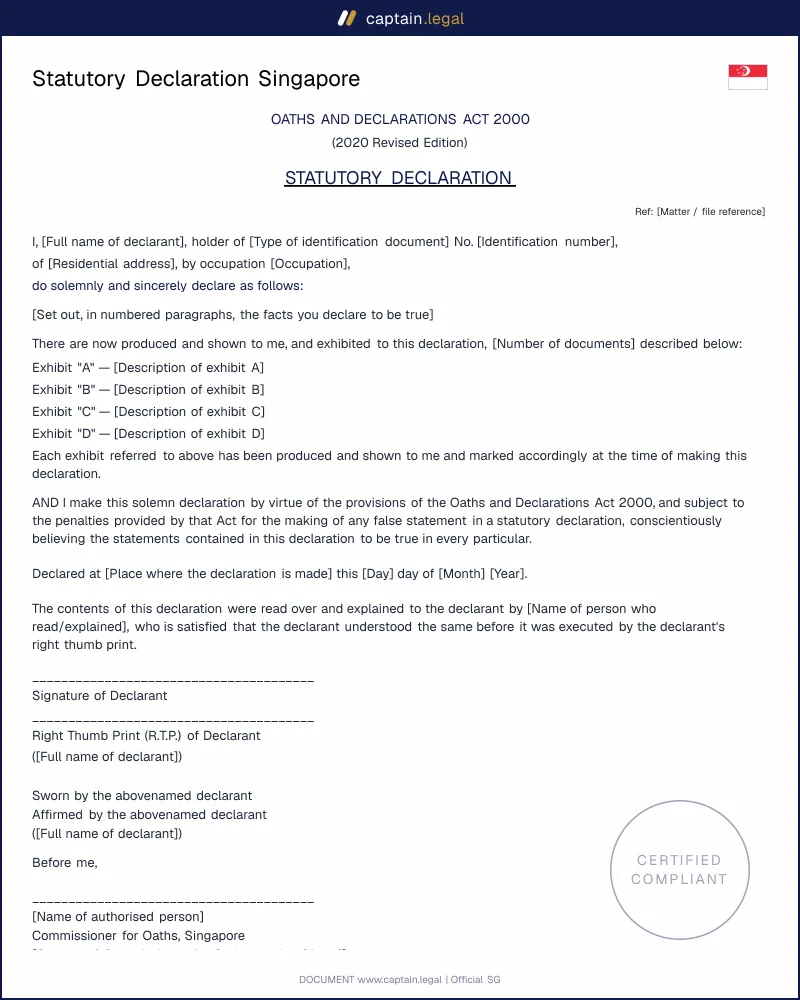
  • The declaration heading and statutory recital open the document with the maker's full name, NRIC or passport number, address and occupation, followed by the recital that the statement is made under the Oaths and Declarations Act 2000. This is the spine of the prescribed form, and an agency reading it can see at a glance that the instrument is the right one.
  • The numbered statements of fact form the substance. Each fact sits in its own paragraph, written in plain declarative sentences, because a single muddled paragraph mixing several assertions is exactly what gets a declaration questioned later. The template gives you guided fields so you set out the matter cleanly, in the order an officer expects to read it.
  • The solemn declaration clause carries the words the law turns on: the declarant makes the declaration conscientiously believing the statements to be true, by virtue of the Oaths and Declarations Act 2000 and subject to the penalties it provides for false declarations. Changing this wording is the fastest way to have a declaration rejected, so the template keeps it fixed to the statutory form.
  • The execution and attestation block is where the declarant signs and the Commissioner for Oaths endorses with signature, seal, place and date. The block is laid out so the signing order is obvious: the Commissioner first checks the document, then administers the affirmation, then both sign. It also leaves room for the notary public endorsement where the declaration is bound for use abroad.
4

Regional considerations

Singapore is a single jurisdiction, so there is no canton or state variation to track, but the purpose and the receiving authority change what a good declaration looks like. A declaration for the Registry of Marriages under the Women's Charter will state different facts from one for ICA on a lost passport, and an agency will often hand you its own form or its own list of required statements. The practical rule is to obtain the requirements from the body that asked for the declaration first, then complete the template to match, rather than guessing at the content.

Where the declaration supports a court matter, the picture shifts. For use in the courts you generally complete the form in the First Schedule to the Oaths and Declarations Act, and for affidavits in active proceedings the e-commissioning route is available: a declarant physically present in Singapore can affirm remotely before a Commissioner over video, using Singpass and a verified identity check, in place of wet-ink signing. That option is geared to court affidavits rather than every administrative declaration, so confirm with the receiving agency whether it will accept a remotely commissioned document.

The cross-border dimension is the one that catches people out. A declaration made in Singapore for a Singapore agency is straightforward, but a declaration made overseas for use in Singapore must be sworn before a notary public, a Justice of the Peace or another officer authorised under that country's law, and a declaration made in Singapore for use abroad needs a notary public rather than a court Commissioner. If your matter touches business records or a foreign subsidiary, it often runs in parallel with a corporate filing, so it can be worth reviewing our Singapore company incorporation documents for ACRA at the same time.

5

How to fill out this statutory declaration

You start by choosing the purpose of your declaration and the authority that will receive it, because that decides which facts belong in the body. From there you enter your full legal name as it appears on your NRIC or passport, your identification number, your residential address and your occupation, which together make up the opening recital. The template then opens a set of numbered fields for your statements of fact, and the guidance prompts you to keep one fact to one paragraph so the finished declaration reads cleanly to an officer. You confirm the place and leave the date open, since the date is the date of affirmation, not the date you typed the document.

Once the content is set, you download in Word or PDF and take the unsigned declaration to a Commissioner for Oaths. Do not sign it beforehand. The Commissioner checks the document, you produce your NRIC or passport, you affirm or swear that the contents are true, and you sign in the Commissioner's presence; the Commissioner then signs, seals and endorses. If the declaration is heading overseas, you bring it to a notary public instead. The whole point of starting from a correctly worded template is that the Commissioner finds nothing to fix, so the appointment is quick.

6

Common mistakes to avoid

The single most frequent error is signing the declaration at home before the appointment. A statutory declaration is only valid when the declarant signs in the presence of the Commissioner for Oaths, so a pre-signed form is worthless and the Commissioner will make you start again. Close behind is the habit of editing the document after it has been affirmed, even to correct an obvious typo. Once affirmed, the declaration is locked, and any change made outside the Commissioner's presence breaks it; the fix is a fresh affirmation, not a quiet amendment. People also tamper with the solemn declaration clause itself, trimming it or rewording it to sound less formal, which strips out the statutory language that gives the document its force.

Choosing the wrong officer is a quieter trap with the same result. A court Commissioner cannot validate a declaration for use in another country, and a lawyer acting for you in the matter cannot commission your declaration, so the appointment is wasted if you turn up at the wrong desk. Two more mistakes round out the list. Padding the body with vague or sweeping assertions invites the receiving agency to query the whole document, whereas tight, specific facts pass without comment. And treating a statutory declaration as interchangeable with an Singapore Lasting Power of Attorney under the Mental Capacity Act or any other instrument leads people to file the wrong form entirely; always confirm which document the agency actually requires before you draft.

Key takeaways

What it is

Use it to confirm facts officially

A statutory declaration is a formal written statement of fact you affirm to be true under the Oaths and Declarations Act 2000. It is commonly used when you do not have other documents, for example a lost passport, change of name, address, relationship status, or a fact a bank, ICA or ROM wants on record. It is not a contract and not courtroom testimony.

Execution

Sign only in front of Commissioner

Your declaration must be made before a Commissioner for Oaths or a notary public, and it must follow the First Schedule form (Part 3, sections 9 to 14; section 11 on how it is made). Do not sign beforehand. You sign in the Commissioner’s presence, then the Commissioner endorses it with their signature, seal and attestation. After it is affirmed, edits are not valid unless made again in front of the Commissioner.

Risk

False material statements are criminal

A statutory declaration carries weight because the law treats dishonesty seriously. If you knowingly make a false statement that is material to the declaration, you commit an offence under section 14 of the Oaths and Declarations Act 2000. This is not paperwork you “estimate” your way through. If a bank, insurer, employer or government agency relies on it, a wrong fact can trigger investigations, rejection of your application, and possible prosecution.

Frequently Asked Questions

The template itself is a correctly worded form; what gives it legal effect is the act of affirming it before a Commissioner for Oaths or a notary public under the Oaths and Declarations Act 2000. Once you have completed the content, signed it in the Commissioner's presence and had it endorsed with their signature and seal, it is a valid statutory declaration that government agencies, banks and other bodies will accept. An unsigned or self-signed form has no standing. The legal weight comes from proper execution and from section 14, which makes a knowingly false declaration a criminal offence.

Yes. The document downloads in both Microsoft Word and PDF, so you can complete it whichever way suits you. Most people fill the editable Word version on screen, check the wording, then print it for the appointment, since the declaration has to be signed on paper in front of the Commissioner. The PDF is handy when an agency asks for a clean copy or when you simply want a fixed record of the form before you sign. Keep the completed but unsigned document until you are in front of the Commissioner.

A statutory declaration must be made before a Commissioner for Oaths, who is appointed by the Board of Commissioners for Oaths and Notaries Public and is usually a practising lawyer. You can find one at law firms, the State Courts, the Supreme Court, and at various ministries and statutory boards. One rule catches people out: if a lawyer is acting for you in the same matter, neither that lawyer nor anyone from the same firm can commission your declaration. Where the declaration is intended for use outside Singapore, it must instead be made before a notary public.

The drafting takes a few minutes once you know which facts the receiving agency needs, and the affirmation itself is short, often a matter of minutes at the Commissioner's desk. The variable is booking the appointment. Many Commissioners in law firms take walk-ins, while court e-commissioning sessions for affidavits must be arranged at least 8 working days in advance. The sensible order is to confirm the agency's requirements, complete the template, then book your Commissioner, so nothing has to be redrafted on the day.

Knowingly making a false statement that is material to your declaration is a criminal offence under section 14 of the Oaths and Declarations Act 2000. For an ordinary declaration the penalty is up to 3 years' imprisonment and a fine, and where the false declaration is made or used in judicial proceedings it rises to up to 7 years and a fine. This is why the solemn declaration clause and the affirmation before a Commissioner matter so much: you are putting your name to facts under legal penalty, so every statement should be one you can stand behind.

Yes, but it must be properly executed where you are. If you are in a Commonwealth country or the United Kingdom, the declaration must be made before a notary public, a Justice of the Peace or another person authorised under that country's law. If you are in a country outside the Commonwealth, it must be made before a consul, vice consul or another authorised officer. The reverse also applies: a declaration made in Singapore for use abroad needs a notary public rather than a court Commissioner, because court Commissioners cannot validate documents for foreign use.

No. Once you have affirmed the declaration before the Commissioner for Oaths, the document is fixed, and you cannot make any amendment or deletion unless the change is made in the Commissioner's presence at the time. A correction scribbled in afterwards, however small, undermines the validity of the whole declaration. If you spot an error after affirming, the clean solution is to complete a fresh declaration and affirm it again, rather than trying to patch the existing one.

4.8/5

25 verified reviews · 50 000+ downloads

Statutory Declaration Singapore: Oaths Act s.9-14
  • Immediate access to the document
  • PDF + Word download
  • Compliant with 2026 legislation
  • Reviewed by lawyers
Fill in the template
Secure payment · No subscription
Updated on June 18, 2026

You might also like

Loan Agreement Between Individuals Singapore
Last Will and Testament Singapore
Statutory Declaration Singapore: Oaths Act 2000 Form