Create my document
Login

Choose country

FranceBelgiqueEspañaUnited StatesUnited KingdomMarocDeutschlandItaliaSchweizSingapore
Real Estate & Rental

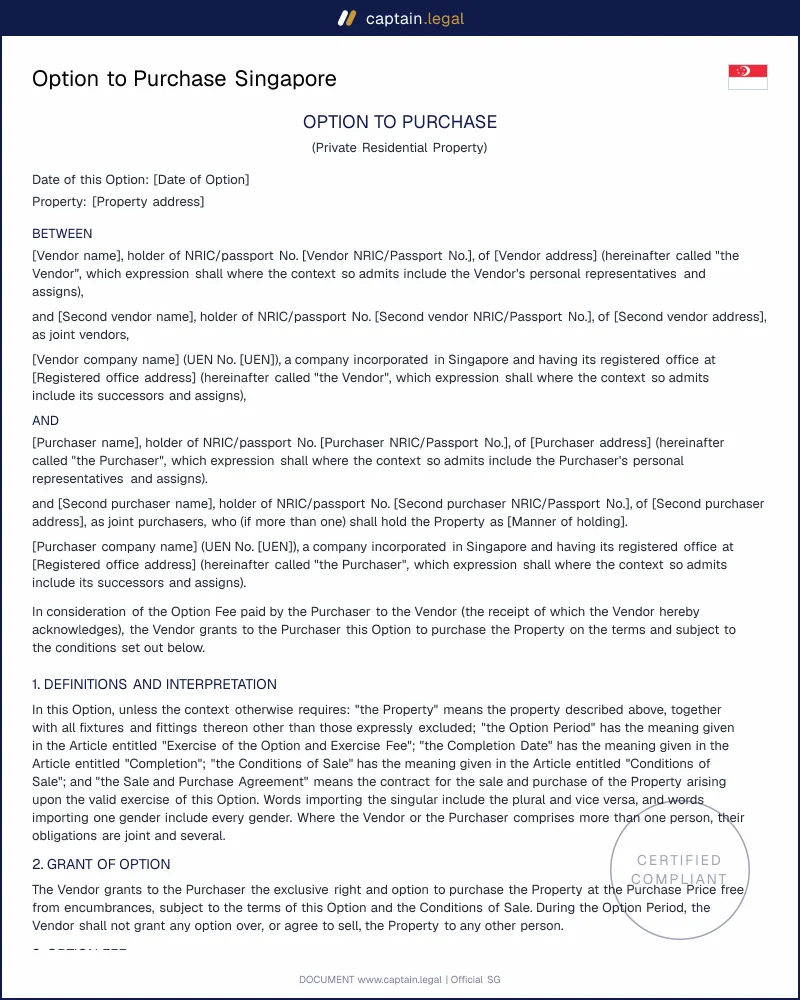
Option to Purchase Singapore | Conditions of Sale 2020

Private residential Option to Purchase drafted to Singapore conveyancing practice and the Law Society Conditions of Sale 2020. PDF and Word.
4.8/527 reviews50 000+ downloadsInstant download
Share

The Option to Purchase is the document that opens almost every private residential sale in Singapore. A vendor grants it, the buyer pays an option fee, and for a fixed window the property is taken off the market and reserved exclusively for that buyer at an agreed price. Get the exercise period, the price and the deposit mechanics right and the rest of the conveyancing runs smoothly. Get them wrong and you are arguing over a forfeited deposit or a sale that quietly lapsed. This template gives you a clean, properly structured Option to Purchase for private property, drafted to standard Singapore conveyancing practice and ready as PDF and Word.

Compliant

2026 Legislation

50,000+ clients

trust us

Affordable

From $4.90 / doc

Secure payment

Instant download

Option to Purchase Singapore | Conditions of Sale 2020

Secure payment · No subscription

Fill in the template

What is an Option to Purchase in Singapore?

An Option to Purchase is a binding contract in which the vendor, in exchange for the option fee, grants the buyer the exclusive right to buy a specified property at a fixed price within a stated period. It is not yet a completed sale. It is a standing offer the buyer alone can accept, and the buyer accepts it by exercising the option, usually by signing the acceptance copy and paying the exercise fee before the deadline.

People often confuse the OTP with the Sale and Purchase Agreement, but they sit at different stages of the same transaction. The OTP comes first and binds the vendor not to sell elsewhere; once the buyer exercises it, a full binding contract of sale crystallises and the parties move to completion. For most private resale flats and condominiums the OTP itself does the work of the sale contract, with the Law Society Conditions of Sale incorporated by reference rather than a separately negotiated agreement. An OTP that has been validly exercised cannot simply be walked away from: the buyer who fails to complete risks losing the full deposit, not just the 1 per cent option fee. That single distinction, between the option stage and the exercised contract, decides who keeps the money when a deal collapses.

2

When do you need this document?

The everyday trigger is a private resale flat or condominium where buyer and seller have agreed the price and the buyer wants the unit locked down before someone else bids. The OTP reserves it, and the 1 per cent fee is the price of that reservation. A second common scenario is the buyer who needs time to confirm bank financing: the option period, typically 14 days for private property, exists precisely so the buyer can secure a loan in principle before committing the larger exercise sum. Without that breathing space, a buyer who cannot draw down in time forfeits the deposit.

Sellers reach for an OTP when they want certainty without exposing themselves to a buyer who shops around. Once granted, the vendor cannot offer the property to another party during the option period, so the document protects both sides at once. It also appears in estate-sale and probate situations, where executors selling a property need a clean, evidenced offer that survives scrutiny later.

The edge cases are where experience shows. A buyer relying on the sale of an existing home should negotiate a longer option period or a conditional clause, because the standard 14 days rarely covers a back-to-back transaction. And in any property purchase involving a foreign buyer, the eligibility checks under the Residential Property Act should be cleared before the option fee changes hands, not after.

3

Key clauses included in our template

  • The parties and property clause names the vendor and purchaser with their identification numbers and sets out the property by its full address and title reference. Getting the legal description right matters because the OTP, once exercised, is the contract that the conveyance is built on.
  • The price and option fee clause records the agreed purchase price and the option fee paid, conventionally 1 per cent for private property. It states clearly that the fee is consideration for the option and is forfeited if the option is not exercised, which is the provision most often litigated.
  • The exercise period and procedure clause fixes the deadline, usually 14 days, and sets out exactly how the buyer exercises: signing the acceptance copy and paying the exercise fee, commonly 4 per cent, so that the combined deposit reaches around 5 per cent of the price.
  • The completion clause sets the Scheduled Completion Date and incorporates the Law Society Conditions of Sale 2020 to govern title delivery, apportionment of outgoings and the Notice to Complete machinery.
  • The vacant possession and title clause confirms whether the property is sold with vacant possession or subject to a tenancy, and that the vendor will deliver title free from encumbrances on completion.
  • The stamp duty and costs clause allocates Buyer's Stamp Duty and any Additional Buyer's Stamp Duty to the buyer and clarifies who bears legal and conveyancing costs, removing a frequent source of last-minute friction.
4

Regional considerations

Singapore is a single jurisdiction, so there is no canton or state variation to track, but the property type changes the rules in ways that catch buyers out. This template is built for private residential property, meaning condominiums, apartments and landed homes dealt with under ordinary conveyancing. It is not the right instrument for an HDB flat, where the Housing and Development Act 1959 and HDB's own prescribed OTP form apply, the option period runs to 21 calendar days, and the combined option and exercise fees cannot exceed a statutory ceiling. Using a private OTP for an HDB resale is a drafting error that HDB will not accept.

Within the private market, foreign ownership is the live regional issue. The Residential Property Act 1976 restricts non-citizens from acquiring landed residential property and certain vacant land without prior approval from the Land Dealings Approval Unit, while most condominium units in approved developments remain open to foreign buyers. Confirm eligibility before the option fee is paid, because an option signed by a buyer who cannot lawfully complete is worth little. For new launches sold directly by developers, separate rules apply: the developer issues the OTP after a booking fee, and re-issuing the same option to the same buyer has been curtailed since the 2020 regulatory tightening. Anyone weighing a longer-term lease against an outright purchase should settle the question of property type and eligibility first, then choose the document.

5

How to fill out this Option to Purchase

You start by entering the vendor and purchaser details, including identification numbers, and the full particulars of the property. From there the form asks for the agreed purchase price and the option fee, then sets the option period, with 14 days offered as the standard private-property default that you can adjust by agreement. The template then walks you through the exercise mechanics, prompting the exercise fee and the manner of acceptance so the buyer knows exactly what to sign and pay to convert the option into a binding sale.

Next you set the Scheduled Completion Date and confirm whether the property is sold with vacant possession or subject to an existing tenancy, which is where you would attach the relevant tenancy and handover paperwork if a tenant remains in occupation. The final fields cover stamp duty allocation and any special conditions the parties have agreed, after which the document is ready to download as Word or PDF for signing and stamping. Most users complete a clean OTP in a few minutes, then pass it to their conveyancing solicitor for review before the fee is exchanged.

6

Common mistakes to avoid

The costliest error is treating the option fee as the only money at risk. A buyer who exercises the option and then fails to complete has entered a binding contract, and the vendor can forfeit the full deposit and pursue further loss, not merely keep the 1 per cent. Just as damaging is letting the exercise period lapse: the deadline is strict, and an option that expires unexercised simply dies, leaving the buyer with a forfeited fee and the vendor free to sell elsewhere. Buyers also stumble on financing, signing an OTP before securing loan approval and then watching the deposit evaporate when the bank declines or the Total Debt Servicing Ratio limits the loan below what was assumed.

Stamp duty timing is the other recurring trap. Buyers forget that Buyer's Stamp Duty falls due within 14 days of exercising, and that second-property buyers face Additional Buyer's Stamp Duty that can dwarf the deposit. A further mistake is using the wrong document entirely, applying a private OTP to an HDB resale that requires the prescribed HDB form. Finally, parties skip professional review, signing an OTP drafted by an agent without checking how the Law Society Conditions of Sale interact with their incorporation documents, which is where title and completion disputes are quietly seeded.

Key takeaways

OTP basics

Option fee buys you exclusivity, not ownership

In a private residential sale, the vendor grants an Option to Purchase (OTP) and the buyer pays an option fee for an exclusive window to buy at an agreed price. Until the OTP is exercised, there is no completed sale. The buyer accepts by exercising within the stated period, typically by signing the acceptance copy and paying the exercise fee before the deadline.

After exercise

Once exercised, you cannot just walk away

An OTP that is validly exercised becomes a binding contract of sale, and the parties move towards completion. If the buyer later fails to complete, the risk is not limited to the 1% option fee; the buyer may forfeit the full deposit under the deal mechanics and the Law Society Conditions of Sale 2020. That distinction often decides who keeps the money when a transaction collapses.

Deadlines

Stamping and completion rules have teeth

The Law Society Conditions of Sale 2020 set default rules that apply if incorporated into the OTP, including delivery of title documents no later than one month before the Scheduled Completion Date and the ability to serve a Notice to Complete with interest running at the fixed rate. Separately, under the Stamp Duties Act 1929, Buyer’s Stamp Duty is due within 14 days of exercising the OTP, and an unstamped instrument is not admissible in evidence until duty and any penalty are paid.

Frequently Asked Questions

Yes. An OTP is a binding contract from the moment it is signed and the option fee is paid, but it binds the two sides differently. The vendor is bound not to sell the property to anyone else during the option period, while the buyer holds the exclusive right, not the obligation, to proceed. The buyer becomes fully committed only on exercising the option, at which point a complete contract of sale crystallises. A buyer who exercises and then fails to complete can lose the full deposit and face a claim for further loss, so the binding effect tightens significantly once the option is exercised.

For private residential property the standard option period is 14 days from the date the OTP is granted, though it is negotiable and parties often extend it. The buyer must exercise within that window by signing the acceptance copy and paying the exercise fee, commonly 4 per cent of the price. If the deadline passes without exercise, the option lapses automatically, the vendor keeps the option fee, and the property returns to the market. HDB resale flats follow a different timetable of 21 calendar days, which is one reason the correct document type matters.

The option fee, conventionally 1 per cent of the purchase price for private property, is what the buyer pays to obtain the option and reserve the property. The exercise fee, usually 4 per cent, is paid only when the buyer decides to proceed and exercises the option, bringing the combined deposit to roughly 5 per cent. If the buyer never exercises, the 1 per cent option fee is forfeited but the exercise fee is never paid. The exercise fee converts the standing option into a binding sale, so it changes hands only at the point of commitment.

Yes. The Option to Purchase is generated in both Word and PDF formats, so you can download it, make final adjustments to the special conditions or completion details, and print it for signing. The Word version is useful when your conveyancing solicitor wants to fine-tune wording before the fee is exchanged, while the PDF gives you a clean, ready-to-sign copy. Both are formatted to standard Singapore conveyancing practice, and you can return to your account to regenerate the document if terms change before signing.

Buyer's Stamp Duty falls due within 14 days of the date the OTP is exercised, and it must be paid to IRAS. If you are buying a second or subsequent residential property, Additional Buyer's Stamp Duty applies on top, calculated on the higher of price or market value and varying with your residency status. An instrument that has not been stamped is not admissible in evidence until the duty and any penalty are settled, so the stamping deadline is genuinely binding rather than administrative. Buyers should budget for both duties before signing, not after.

It depends on the property type. Foreigners can generally acquire condominium units and apartments in approved developments, and an OTP for such a unit is straightforward. Landed residential property and certain vacant land are restricted under the Residential Property Act, and a foreign buyer usually needs prior approval from the Land Dealings Approval Unit before acquiring them. The safe practice is to confirm eligibility before paying the option fee, because an option signed by a buyer who cannot lawfully complete leaves both sides exposed. Checking the property's eligibility status early avoids a forfeited fee and a failed transaction.

If you choose not to exercise the option within the option period, you are not obliged to buy the property, and the vendor cannot force you to complete. The consequence is that you forfeit the option fee, typically 1 per cent of the price, which the vendor keeps as compensation for taking the property off the market. There is no further legal liability beyond the lost fee unless the OTP specifically provides otherwise. Once the option expires, the vendor is free to grant a fresh option to another buyer or to you on new terms.

4.8/5

27 verified reviews · 50 000+ downloads

Option to Purchase Singapore | Conditions of Sale 2020
  • Immediate access to the document
  • PDF + Word download
  • Compliant with 2026 legislation
  • Reviewed by lawyers
Fill in the template
Secure payment · No subscription
Updated on June 16, 2026

You might also like

Room Rental Agreement Singapore
Letter of Intent to Rent Property Singapore