Create my document
Login

Choose country

SingaporeSingaporeChoose country
Business

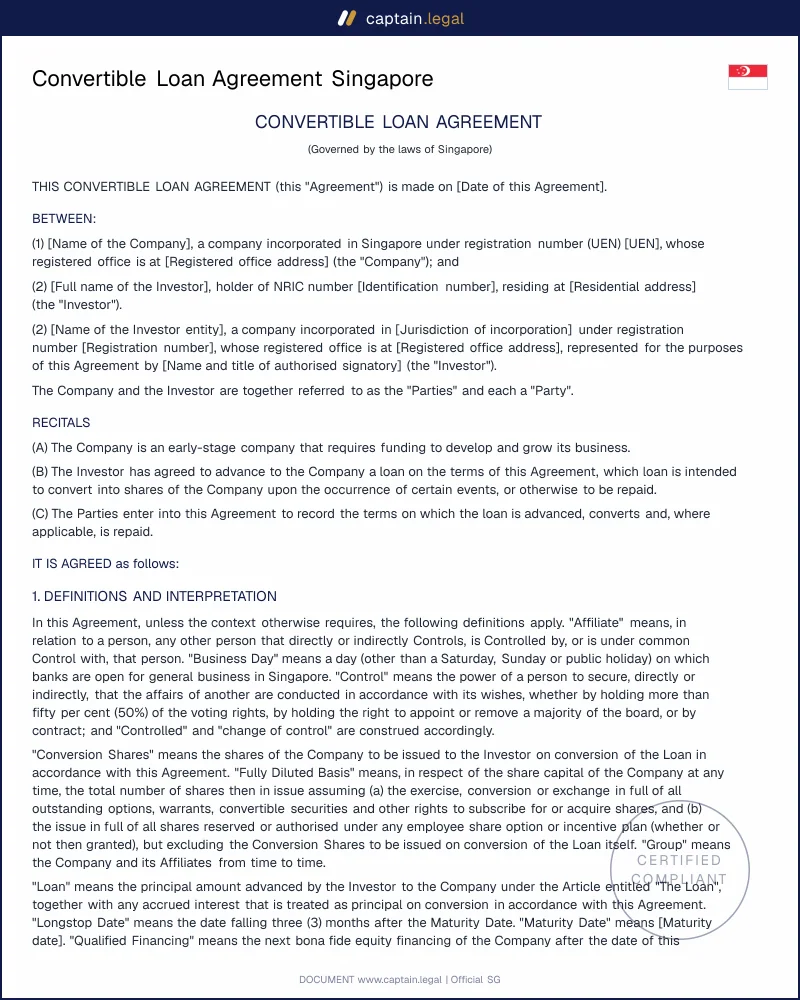
Convertible Loan Agreement Singapore | Companies Act 1967

Singapore convertible note and SAFE drafted to the Companies Act 1967 and SFA 2001, with section 161 and exemption clauses. Word and PDF.
4.8/517 reviews50 000+ downloadsInstant download
Share

Early-stage founders in Singapore raise their first outside money on paper that sets the price later, not now. A convertible loan agreement and its equity-first cousin, the SAFE (simple agreement for future equity), both let a startup take capital today and convert it into shares at the next priced round, using a valuation cap or discount to reward the early risk. This template is drafted for Singapore-incorporated private companies under the Companies Act 1967 and the Securities and Futures Act 2001, with the conversion mechanics, investor protections and prospectus-exemption language that local funds and angels expect to see. It gives founders a fundraising instrument they can send to an investor the same afternoon, in Word and PDF, without paying a firm to draft from scratch.

Compliant

2026 Legislation

50,000+ clients

trust us

Affordable

From $4.90 / doc

Secure payment

Instant download

Convertible Loan Agreement Singapore | Companies Act 1967

Secure payment

Fill in the template

What is a convertible loan agreement or SAFE in Singapore?

A convertible loan is debt. The investor lends the company a sum, the loan accrues interest and carries a maturity date, and instead of being repaid in cash it converts into shares when a qualifying financing round closes. If that round never happens, the debt sits on the balance sheet and, in principle, becomes repayable at maturity, which gives the investor real leverage. A SAFE, by contrast, is not a loan at all: it carries no interest and no maturity date, and it simply converts into equity when the trigger event occurs. The trade-off is straightforward. The note holder keeps a repayment claim as a fallback; the SAFE holder gives that up in exchange for lighter, faster paper.

Singapore founders have a third option that most global templates ignore. The CARE (Convertible Agreement Regarding Equity) is the local-law equivalent of the American SAFE, published in the VIMA model document suite by the Singapore Academy of Law and the Singapore Venture Capital and Private Equity Association. It does the same job as a SAFE but is drafted under Singapore law, so the governing-law and dispute-resolution conversation with a local investor disappears. Whichever form you choose, the economic heart is identical: money now, shares later, priced by a valuation cap or a discount to the next round. This template covers both the interest-bearing convertible note and the equity-style SAFE or CARE structure, so you can pick the instrument that matches your investor.

2

When do you need this document?

The classic trigger is the pre-seed or bridge raise, when a startup needs capital to reach the milestones that justify a priced round but neither side wants to negotiate a valuation yet. A convertible defers that fight to the Series A, when there is real data to price against. Founders reach for it again when a friendly angel or an early customer offers to put in money quickly and a full equity round would be disproportionate to the cheque size. The instrument slots neatly into the funding journey: after the founders' own capital and any grant money, and before the first priced seed or Series A.

Bridge financing between rounds is the second common scenario. A company that has raised a seed round but is a few months short of its Series A can take a top-up from existing investors on a convertible, converting alongside the incoming money at an agreed discount. A related edge case worth flagging is the down-round bridge, where the company's prospects have dipped: here the valuation cap does most of the work, and founders should model how much dilution a low cap will cause if the next round prices below expectations. Corporate or strategic investors sometimes prefer a note over a SAFE because the maturity date preserves a repayment claim, which their internal mandate may require. The one situation to avoid entirely is a broad solicitation of the public, because that is precisely what pushes the raise outside the SFA exemptions and into prospectus territory, as the Tay Chee Ming prosecution shows. When your cap table and reserved matters start to get complex, it is usually the point to graduate from convertibles to a full Singapore shareholders' agreement.

3

Key clauses included in our template

  • The conversion trigger and mechanics define the qualifying financing event, the valuation cap and the discount rate, and set out the arithmetic that turns the invested amount into a share count. This is the commercial core of the instrument, and the template drafts it so the investor receives the more favourable of the cap price and the discount price, the market-standard outcome that local investors expect.
  • The maturity and interest terms apply to the convertible note version. The template records the interest rate, whether it accrues to the principal or is paid, and what happens at maturity if no qualifying round has closed, whether the loan converts at a default valuation, extends, or becomes repayable. The SAFE and CARE version simply omits these, since neither carries interest or a maturity date.
  • The liquidity and dissolution provisions protect the investor if the company is sold or wound up before conversion. On a trade sale the investor takes the higher of their money back or the converted value; on a winding up their subscription amount ranks ahead of the ordinary shares. These safety valves are standard in the VIMA CARE and are built into the template.
  • The section 161 authority and allotment machinery ties the instrument to Singapore company law. It references the shareholder mandate the directors rely on to allot conversion shares and flags the ACRA Return of Allotment lodgement, so the paperwork on conversion day is already mapped. A Singapore directors' and shareholders' resolution pairs naturally with this to record the approvals.
  • The prospectus-exemption representations record which SFA safe harbour the raise relies on, whether the small offers cap, the private placement limit, or the accredited-investor route, and bind the investor to resale restrictions where they apply. This is the clause that keeps the raise on the right side of section 240.
4

Regional considerations

Singapore is a single unified jurisdiction, so there are no state or provincial variations to layer in, but the shape of your raise changes materially with the type of investor you approach, and that is where the real drafting decisions sit. An offer made solely to accredited investors, broadly individuals with net personal assets above S$2 million or net financial assets above S$1 million, or to institutional investors, sits within its own SFA exemption and gives you the widest runway. You still respect section 161 and lodge the allotment, but the 50-person and S$5 million ceilings of the small offers and private placement routes fall away. Most seed-stage founders raising from angels and micro-VCs live in exactly this space.

Founders raising from a broader circle of friends, customers or business contacts must instead thread the private placement needle: no more than 50 offerees in any 12-month period, no advertising, and a resale lock of six months on the securities. The critical trap, laid bare in Public Prosecutor v Tay Chee Ming, is that the small offers exemption requires a genuine personal offer, meaning the offeree must have a prior connection to the company or a prior indication of interest. Cold approaches to strangers, even below the dollar cap, do not qualify. If your convertible is structured as a note, keep the lending confined to the company itself to preserve excluded moneylender status under the Moneylenders Act 2008. And whichever exemption you rely on, remember that offers can be aggregated where they are closely related, so a series of small tranches to overlapping investors may be counted together against the ceilings. When the company is ready to formalise ownership after conversion, the Singapore Pte Ltd company constitution and the instrument of share transfer become the next documents in the sequence.

5

How to fill out this convertible loan agreement or SAFE

You start by choosing the instrument that fits your investor: an interest-bearing convertible note if they want a repayment fallback, or a SAFE or CARE-style agreement if both sides prefer clean equity paper with no maturity. From there the template asks for the company's details, the investor's details and the invested amount, then walks you through the commercial terms that do the pricing. You set the valuation cap, the discount rate and the definition of the qualifying financing round that triggers conversion, and, for a note, the interest rate and maturity date. The template then adjusts the liquidity and dissolution language to match the instrument you picked. Next you confirm which SFA exemption the raise relies on, which slots the correct representations and resale restrictions into the agreement, and you note the section 161 authority the directors will use to allot the conversion shares. Because the Electronic Transactions Act 2010 makes electronic signature valid here, both parties can sign the finished document remotely and the company can move straight to keeping the executed copy with its records ready for conversion day.

6

Common mistakes to avoid

The most damaging error is treating conversion as automatic. It is not; it is an allotment of shares that needs section 161 authority in place first, and founders who convert without a valid mandate can find the issuance void, which unravels the whole cap table at the worst possible moment. A close second is misjudging the SFA exemption. Founders routinely assume that a small raise is automatically exempt, but the Tay Chee Ming case shows that raising even modest sums from people with no genuine prior connection to the company breaches the personal-offer requirement and exposes the director to prosecution under section 240. Advertising the round, or letting it drift past 50 offerees, does the same damage.

On the commercial side, the recurring miss is a valuation cap set without modelling the dilution. A low cap looks investor-friendly on signing but can hand away far more equity than founders expect if the company grows quickly before the priced round. Leaving the note-versus-SAFE choice vague is another trap, because an interest rate and a maturity date carry consequences a SAFE simply does not, and mixing the two produces an instrument neither side fully understands. Finally, founders forget the downstream paperwork: the ACRA Return of Allotment within 14 days of conversion, the update to the register of members, and consistency with the Singapore founders' agreement already in place. Skipping these turns a clean raise into a compliance clean-up later.

Key takeaways

Instrument type

Know whether you are signing debt

A convertible loan is a loan: it carries interest and a maturity date, and if no qualifying round happens it can become repayable, giving the investor leverage. A SAFE (and Singapore’s CARE) is not debt: no interest, no maturity, and conversion happens only on the agreed trigger. Your choice changes cash-flow pressure, negotiating dynamics, and what sits on the company’s balance sheet.

Companies Act

Conversion needs section 161 authority

Conversion is not “automatic” under the Companies Act 1967. It is an allotment of new shares, and section 161 requires directors to have prior shareholder authority to allot. If you skip that mandate, the allotment is void. After shares are actually issued on conversion, the company must lodge a Return of Allotment with ACRA within 14 days, so the paperwork needs to be ready.

SFA compliance

Prospectus rules still apply to notes

Under the Securities and Futures Act 2001, a convertible instrument that will become shares is treated as an offer of securities and would generally trigger the prospectus requirement in section 240 unless an exemption applies. Common routes include the small offers exemption (S$5 million cap in any 12-month period) and private placement under section 272B (no more than 50 persons in 12 months). Get this wrong and directors face real criminal exposure.

Frequently Asked Questions

Yes. Both are ordinary contracts enforceable under Singapore's common law of contract, provided there is offer, acceptance, consideration and an intention to create legal relations, all of which a properly completed template satisfies. The convertible note is additionally a debt obligation until it converts, while the SAFE is a binding contractual promise of future equity. Signature makes them enforceable, and the Electronic Transactions Act 2010 gives electronic signatures the same validity as wet-ink ones for this type of instrument. What the template cannot do on its own is discharge the company's separate statutory duties, chiefly the section 161 shareholder authority to allot conversion shares and the relevant SFA prospectus exemption, which sit alongside the contract rather than inside it.

The difference is legal character. A convertible note is debt: it accrues interest, it has a maturity date, and if no qualifying round ever closes the company owes the money back. A SAFE is not a loan; it carries no interest and no maturity, and it converts into shares only when the trigger event happens, with no repayment claim in the ordinary course. Practically, the note gives the investor more leverage and a fallback, while the SAFE is faster, lighter paper that founders often prefer. In Singapore the CARE published in the VIMA suite is the local-law version of the SAFE, drafted so local investors recognise the governing law and boilerplate on sight.

Yes, and this catches many founders out. Conversion is an allotment of new shares, and section 161 of the Companies Act 1967 requires directors to have prior shareholder authority before they allot, whether specific to the issue or a general mandate covering convertibles. Without that authority the allotment is void. In practice founders pass a general mandate at a meeting, allot the conversion shares under it, then lodge a Return of Allotment with ACRA within 14 days and update the register of members. The instrument should record which authority the board is relying on so the conversion-day paperwork is already mapped out.

Not without a registered prospectus, and that is expensive and slow, so early-stage companies rely on exemptions instead. The small offers exemption caps the raise at S$5 million over 12 months, the private placement exemption limits it to 50 offerees over 12 months, and offers made only to accredited or institutional investors are exempt separately. The hard trap is that a small offer must be a genuine personal offer to someone with a prior connection to the company. In Public Prosecutor v Tay Chee Ming, a director who solicited strangers was convicted under section 240 of the SFA despite the modest sums, so keep the raise within your genuine network and never advertise it.

You can download the finished agreement in both Microsoft Word and PDF. The Word version lets you make final adjustments to party names, the valuation cap, the discount, or the maturity terms before signing, and hand it to your corporate secretary or lawyer for a quick review if you wish. The PDF is the clean copy for signature and for keeping with the company's records. Because Singapore recognises electronic signatures for this kind of instrument, most founders sign the PDF electronically and close the raise without meeting in person, which is what makes convertibles the fast option they are meant to be.

Far quicker than a priced round, which is the whole point of the instrument. Once you and the investor agree the invested amount, the valuation cap and the discount, the document itself can be completed in a single sitting and signed the same day electronically. There is no need to negotiate a valuation, draft a full suite of subscription and shareholder documents, or wait on extensive due diligence, which is what stretches a Series A over weeks or months. The compliance steps that follow, confirming your SFA exemption and keeping the section 161 authority ready, run in the background and only crystallise on conversion, not at signing.

Only in a narrow sense, and the template is drafted to keep you clear of them. Charging interest for repayment of a larger sum can, in principle, engage the Moneylenders Act 2008, but a lender who lends solely to corporations is an excluded moneylender and falls outside the licensing regime entirely. The instrument therefore records that the loan is advanced to the company rather than jointly to the company and its founders. There is no statutory interest-rate cap on corporate lending in Singapore, so the rate is a matter of commercial negotiation, though a genuinely convertible note usually carries a modest rate because the investor's real return comes from the equity conversion, not the coupon.

4.8/5

17 verified reviews · 50 000+ downloads

Convertible Loan Agreement Singapore | Companies Act 1967
  • Immediate access to the document
  • PDF + Word download
  • Compliant with 2026 legislation
  • Reviewed by lawyers
Fill in the template
Secure payment
Updated on July 11, 2026

You might also like

NDA Singapore Template
Company Constitution Singapore