Create my document
Login

Choose country

FranceBelgiqueEspañaUnited StatesUnited KingdomMarocDeutschlandItaliaSchweizSingapore
Business

Singapore Written Resolution: Companies Act ss 184A-184G

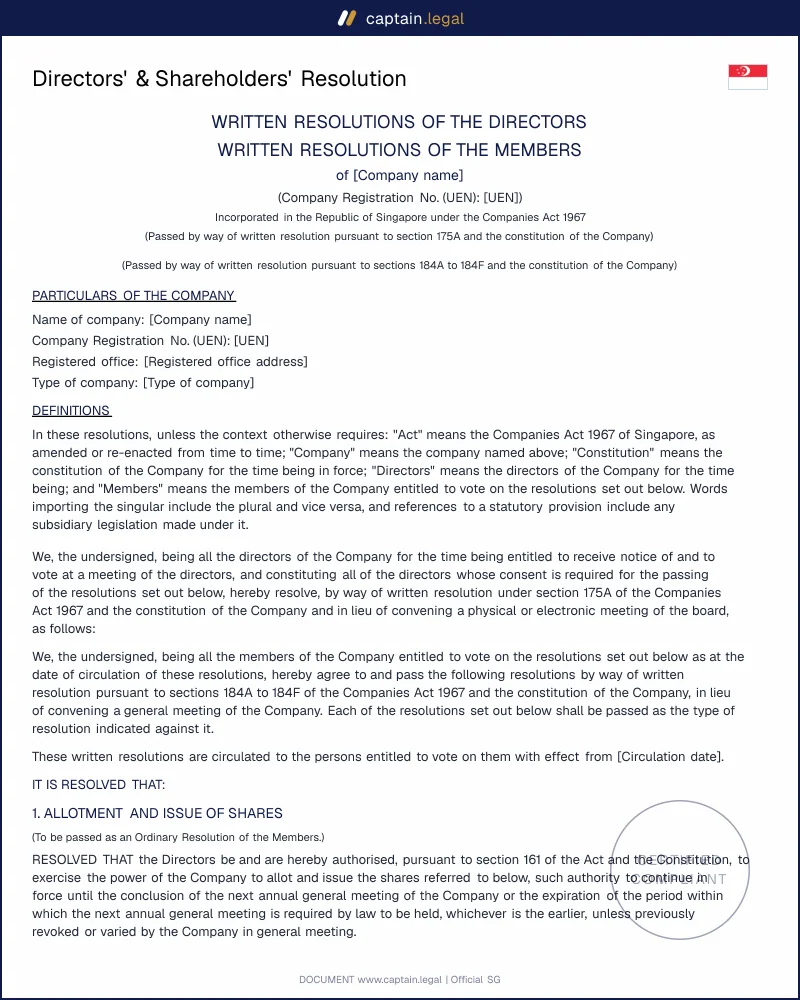
Directors' and shareholders' written resolutions drafted to sections 184A-184G of the Companies Act 1967. Minute-book ready, in Word and PDF.
4.7/521 reviews50 000+ downloadsInstant download
Share

A directors' and shareholders' resolution is the formal written record that proves a company's decisions were properly authorised, who agreed to them, and on what date. In Singapore practice it is the single most-requested governance document, because banks, ACRA and auditors all want to see the paper trail behind a share allotment, a director's appointment, a dividend or a contract approval. This template gives you a board resolution and a members' resolution drafted to the Companies Act 1967, in the written form that lets a Pte Ltd decide without convening a physical meeting. You can adapt it for routine and one-off decisions alike, and download it as editable Word and PDF.

Most private companies in Singapore pass nearly every decision in writing rather than by holding a meeting. The mechanics matter more than founders expect: a resolution signed by the wrong people, recorded on the wrong date, or missing an interest declaration is the kind of defect that surfaces months later when a bank or a buyer's lawyer reads the minute book.

Compliant

2026 Legislation

50,000+ clients

trust us

Affordable

From $4.90 / doc

Secure payment

Instant download

Singapore Written Resolution: Companies Act ss 184A-184G

Secure payment · No subscription

Fill in the template

What is a directors' and shareholders' resolution?

A directors' resolution is a formal decision adopted by the board, exercising the management powers the law and the constitution place in the directors' hands. Under section 157A of the Companies Act 1967, the business of a company is managed by, or under the direction of, the directors, so the great majority of operational decisions sit at board level. A shareholders' resolution (a members' resolution) is a decision taken by the owners on matters reserved to them, such as appointing or removing directors, approving certain capital changes, or amending the constitution.

The distinction is not cosmetic. A directors' resolution authorises the company to act, for example to open a bank account, issue new shares once allotment is approved, or sign a lease. A shareholders' resolution exercises ownership rights and clears the matters the Companies Act or the constitution keeps out of the board's reach. Ordinary members' resolutions pass by a simple majority of votes; special resolutions need at least 75% and are reserved for substantial matters like constitutional amendments, a change of name, or a capital reduction. Confusing the two layers is the most common drafting error, because a decision passed at the wrong level can be challenged as void. Where a single document records both a board decision and the members' approval that follows, the template keeps them as two clearly separated resolutions rather than blurring them into one. For the founding paperwork that sits behind these decisions, see our Pte Ltd company constitution template for Singapore.

2

When do you need this document?

The most frequent trigger is a share allotment. When a Pte Ltd issues new shares to a founder, an investor or under an employee scheme, the board resolves to allot and the members usually approve the issue, after which the company lodges the Return of Allotment with ACRA. Without the resolution on file, the share register and the ACRA record sit on no documented authority, and that gap is exactly what a buyer's due-diligence lawyer flags. The next common scenario is the appointment or resignation of a director or company secretary, where the board notes the change and the company files the relevant BizFile+ transaction within the statutory window.

Dividends are a third recurring use. Declaring a dividend requires the directors to confirm the company can pay it out of profits and remain solvent, and that confirmation is recorded in a board resolution before any payment leaves the account. Contract and banking approvals make up much of the rest: authorising a director to sign a lease, approving a supply agreement, opening or changing signatories on a corporate bank account. Banks in Singapore routinely refuse to act on instructions that are not backed by a board resolution naming the authorised signatories. One edge case worth flagging is the one-member, one-director company, where section 184G and the constitution still call for the sole decision-maker to record the resolution in writing and minute it, even though no second signature exists. Another is the interested-director transaction: where a director stands on both sides of a contract, the section 156 declaration must appear in the resolution, and the constitution often bars that director from voting. For the employment side of appointments, our Singapore employment contract templates cover the offer and appointment letters that usually accompany a director or executive hire.

3

Key clauses included in our template

  • The heading and company particulars state the full company name, the UEN, the registered office and whether the document is a directors' resolution, a members' resolution, or a combined record. This is what lets a bank or the Registrar match the resolution to the right entity without ambiguity.
  • The recitals and resolved clauses set out the background and then the operative decision in the imperative ("IT WAS RESOLVED THAT..."). Each decision is drafted as a discrete resolution so that a share allotment, an appointment and a banking authority are not tangled into a single unseverable block.
  • The written-means statement records that the resolution is passed under sections 184A to 184C without a meeting, confirms the resolution was circulated to every member entitled to vote, and identifies it as an ordinary or special resolution so the correct majority is visible on the face of the document.
  • The interest declaration captures any section 156 disclosure, names the interested director and notes whether that director abstained, which protects the decision if it is later questioned.
  • The signature and dating block provides for each director's signature on a board resolution and each consenting member's signature on a members' resolution, with a clear effective date. The resolution takes effect on the date the last required person signs, unless it states otherwise, so a blank or back-dated date is a real defect.
  • The minute-book and retention note reminds the company to file the signed original and keep it for ten years under section 184F. A property-related approval often pairs with documents from our Singapore tenancy and lease agreement templates.
4

How to fill out this resolution

You start by choosing whether the decision belongs to the directors, the shareholders, or both, because that choice sets the majority and the signatories. From there you enter the company's name, UEN and registered office, then describe the decision in plain terms: the number and class of shares to be allotted, the name and identification of an incoming director, the amount and record date of a dividend, or the counterparty and value of a contract. The template then prompts you to confirm whether you are passing the resolution at a meeting or by written means, and if by written means it inserts the section 184A language and the circulation confirmation automatically.

Next you address any conflict of interest, declaring a director's section 156 interest where one exists and recording an abstention if the constitution requires it. You then set the effective date and list every signatory: all directors for a board written resolution, and the consenting members for a members' resolution. Once complete, you download the document in Word to make final edits or in PDF to circulate for signature, and you file the signed original in the minute book. The form keeps the statutory citations consistent throughout, so you are not left guessing which section applies.

5

Common mistakes to avoid

The error we see most often is passing a decision at the wrong level, treating a reserved matter as a simple board decision or, conversely, dragging the members into an approval the board could have given alone. A share buy-back or a constitutional amendment that should carry a special resolution but is minuted as an ordinary board resolution is vulnerable to challenge, and the defect rarely shows up until a financing round or a sale forces a careful read of the minute book. Closely related is the signing failure: a directors' written resolution signed by a bare majority when the constitution demands every director's signature is simply not passed, even though it looks complete.

Dating is the other recurring trap. A resolution that is undated, or back-dated to suit a filing, undermines the whole record, because the document is meant to be contemporaneous evidence that the board acted before the company did. Founders also forget the section 156 interest declaration, which leaves an interested-director transaction exposed. Finally, many companies pass the resolution and then never file it; an unrecorded resolution breaches section 184F and gives a bank or auditor grounds to refuse to rely on it. The personal documents founders sometimes need alongside corporate filings are covered in our Singapore powers of attorney and statutory declarations.

Key takeaways

Purpose

Resolutions are your decision paper trail

A directors’ or shareholders’ written resolution is the formal record showing what was approved, by whom, and on what date. In Singapore, this is the most commonly requested governance document because banks, ACRA and auditors often ask for evidence behind a share allotment, director appointment, dividend declaration or contract approval. If the paperwork is missing, the company can struggle to prove proper authority.

Authority

Board vs members: don’t mix levels

A directors’ resolution is the board exercising management powers under section 157A of the Companies Act 1967. A members’ resolution is for matters reserved to shareholders, such as certain capital changes or amending the constitution. Ordinary resolutions pass by a simple majority, while special resolutions require at least 75%. Passing a decision at the wrong level is a common defect and can be attacked as void.

Process

Written resolutions have strict steps and records

Sections 184A to 184G of the Companies Act 1967 allow private companies to pass resolutions in writing (physical or electronic) instead of holding a general meeting. Directors must circulate the proposed resolution to every member entitled to vote (section 184C), and members must be notified once it is passed (section 184E). Keep the signed resolution in the minute book and retain it for ten years (section 184F).

Frequently Asked Questions

Yes. Sections 184A to 184G of the Companies Act 1967 expressly allow a private company to pass resolutions by written means instead of holding a general meeting, and a resolution passed this way has the same legal effect as one passed at a meeting. An ordinary members' resolution passes once a simple majority of voting members agree, and a special resolution once 75% agree. The directors must first circulate the proposed resolution to all members entitled to vote, and the company must record the passed resolution in its minute book. Provided those steps are followed and the document is properly signed and dated, the written resolution is fully binding on the company.

For a board resolution passed at a meeting, a simple majority of the directors present is usually enough, subject to the constitution. A directors' resolution in writing is stricter: the ACRA Model Constitution and most bespoke constitutions require it to be signed by all directors entitled to receive notice of a board meeting, so unanimous signature is the safe default. Some constitutions lower this to a majority, which is why you should read your own constitution before relying on a partial signing. The resolution takes effect on the date the last required director signs, unless the document states a different effective date.

An ordinary resolution passes by a simple majority, more than 50% of the votes cast by members entitled to vote, and covers most routine matters such as appointing a director or approving routine acts of the board. A special resolution requires at least 75% and is reserved for substantial matters: amending the constitution, changing the company name, reducing share capital by the non-court route, or a voluntary winding up. Drafting the resolution at the correct level matters, because a special-resolution matter recorded as an ordinary resolution can be challenged as invalid. The template labels each resolution so the required majority is clear on its face.

Yes, indirectly. Under section 184D, members holding at least 5% of the total voting rights can serve notice on the company requiring that a general meeting be convened for the resolution instead of allowing it to pass by written means. This is a deliberate minority safeguard, and it explains why the written route is best suited to decisions where the outcome is settled and uncontested. If a resolution is likely to be opposed, convening a meeting is often the cleaner path. The template can be used for either route, inserting the written-means language only when you confirm there is no meeting.

The company must record every resolution passed by written means in its minute book under section 184F, and the signed resolution should be kept for ten years from the date it is passed. These records form part of the company's statutory documents, which directors, auditors and, in some circumstances, members may inspect. Banks and due-diligence lawyers routinely ask to see them, so storing the signed original safely is not a formality. A resolution that exists only as an unsigned draft, or that was never filed, is treated as if the decision was never properly authorised.

Yes. A Pte Ltd may have one director and one shareholder, and section 184G together with the constitution still requires that decision to be recorded in writing and minuted, even though only one person signs. The discipline matters more for a sole director, not less, because there is no second decision-maker to catch an omission. The same rules on interest declarations and dating apply, and the resolution still needs to be filed in the minute book. Our template includes a single-decision-maker format for exactly this situation.

The resolution is available as an editable Word file and as a PDF. The Word version lets you adjust the recitals, add or remove resolved clauses, and tailor the signatories before printing for signature, while the PDF is the clean version most companies circulate for signing and then file in the minute book. Both versions carry the statutory citations and the written-means language, so the legal substance is identical. Many companies keep the Word file for future decisions and lodge the signed PDF as the official record.

Not every resolution is filed with ACRA, but several trigger a filing. A share allotment requires a Return of Allotment, a change of director or company secretary requires the relevant BizFile+ transaction, and certain special resolutions, such as a constitutional amendment, must be lodged within 14 days. Most internal approvals, like authorising a bank signatory or approving a routine contract, stay in the minute book and are produced only on request. The practical rule is that the resolution authorising the decision should always exist before the related ACRA filing is made, never after.

4.7/5

21 verified reviews · 50 000+ downloads

Singapore Written Resolution: Companies Act ss 184A-184G
  • Immediate access to the document
  • PDF + Word download
  • Compliant with 2026 legislation
  • Reviewed by lawyers
Fill in the template
Secure payment · No subscription
Updated on June 17, 2026

You might also like

Incorporation Pack Singapore
Founders' Agreement Singapore