Create my document
Login

Choose country

FranceBelgiqueEspañaUnited StatesUnited KingdomMarocDeutschlandItaliaSchweizSingapore
Employment & HR

Key Employment Terms Singapore: Employment Act 1968

Written KETs required under the Employment (Records, KETs and Pay Slips) Regulations 2016. Issue to employees within 14 days of starting.
4.8/528 reviews50 000+ downloadsInstant download
Share

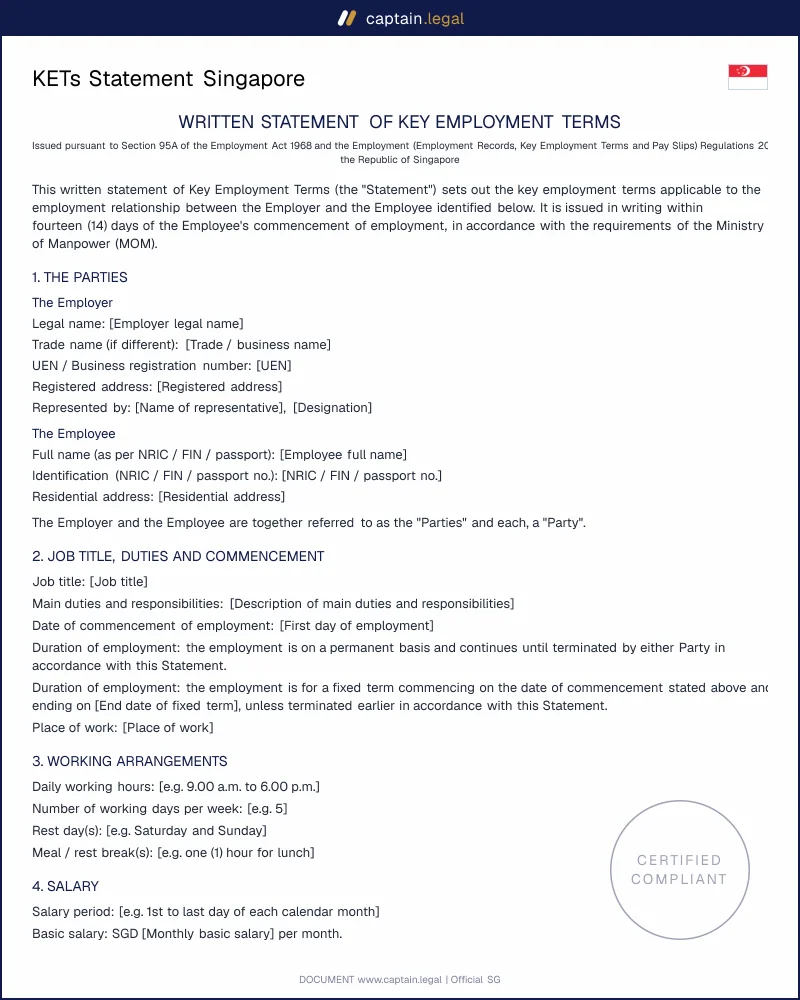
A Key Employment Terms (KETs) Statement is the written record of an employee's core working conditions that every Singapore employer must hand over under the Employment Act 1968. Since 1 April 2016 the Ministry of Manpower has required this statement for any employee covered by the Act who is engaged on a contract of fourteen days or more, and it must reach the employee within 14 days of the first day of work. The statement gathers the essentials a worker needs to understand the deal: job title and duties, salary period and components, working hours, rest days, leave, medical benefits, probation and notice. Drafted to the Employment (Employment Records, Key Employment Terms and Pay Slips) Regulations 2016, this template gives HR and small employers a compliant record they can issue, store and rely on if a dispute ever reaches the Tripartite Alliance for Dispute Management or the courts.

Compliant

2026 Legislation

50,000+ clients

trust us

Affordable

From $4.90 / doc

Secure payment

Instant download

Key Employment Terms Singapore: Employment Act 1968

Secure payment · No subscription

Fill in the template

What is a Key Employment Terms (KETs) Statement?

A Key Employment Terms Statement is a written summary of the principal terms governing an employment relationship, mandated by the Ministry of Manpower (MOM) rather than left to the parties' discretion. It is not the contract itself, though the two overlap heavily. The contract is the full agreement that binds employer and employee; the KETs are the statutory minimum set of facts the employer must record in writing so the employee is never left guessing about pay, hours or leave. If the employment contract already contains every required item, no separate KETs document is needed, which is why a well-drafted contract often doubles as the KETs record.

The distinction matters in practice. Many Singapore employers issue a short appointment letter and assume their obligation is met, then discover at a salary claim hearing that the letter omits the salary period, the overtime rate or the notice period. The KETs framework exists precisely to close those gaps. The statement can live inside the contract, sit in an electronic record, or be published on a staff portal the employee can access freely, so long as the full list of terms is captured. What it cannot do is stay verbal: the Employment Act 1968 turned the written record into a hard requirement, and an informal understanding will not satisfy MOM. Employers who want a clean standalone document, separate from a longer contract, use a dedicated KETs statement like this one.

2

When do you need this document?

The trigger is hiring. The moment an employer takes on someone covered by the Act for a contract of fourteen days or more, the clock starts and the statement must be in the employee's hands inside two weeks. New permanent hires are the obvious case, but the obligation reaches further than many employers expect. A fixed-term contractor brought in for a three-month project is covered, and so is a part-timer, because the test is the length of the contract, not the hours per week. Companies scaling up quickly, where offer letters fly out faster than HR can paper them properly, are exactly where KETs go missing.

The statement also earns its keep at the back end of the relationship. When a worker files a salary-related claim at the Tripartite Alliance for Dispute Management (TADM), the first document the mediator asks for is the written record of terms. An employer who can produce a clean KETs statement showing the agreed salary period, overtime rate and notice period is in a far stronger position than one relying on memory. The absence of a written record tends to be read against the employer, not the employee. A second common scenario is an MOM inspection or audit, where the inspector checks whether eligible staff received complete KETs and itemised payslips. One edge case worth flagging: re-hiring a former employee on fresh terms restarts the obligation, since a new contract of service means a new fourteen-day window. Businesses formalising their corporate setup at the same time often handle this alongside their Singapore company incorporation and constitution documents.

3

Key clauses included in our template

  • The employment details block captures the employer's full legal and trade name, the employee's full name as it appears on the NRIC or work pass, the job title and a real description of main duties. MOM has flagged that a bare job title such as "Sales Assistant" with no duties is a common defect, so the template prompts for a genuine description rather than a label.
  • The salary and payment terms record the salary period, the basic rate of pay, any fixed allowances and deductions, and the overtime rate and payment period where the employee is entitled to overtime. This is the section that decides most salary claims, so it is drafted to the statutory headings rather than a loose summary.
  • The working hours, rest day and leave terms set out the daily or weekly hours, the rest day arrangement and every category of leave the employee can take, from annual and sick leave to statutory entitlements under the Child Development Co-Savings Act. Medical benefits and any insurance coverage sit here too.
  • The probation and notice provisions state the length of any probation period and the notice each side must give to end the contract, the term that most often surfaces when a parting turns contentious. The notice period must match what the contract actually says.
  • The start date and contract duration record the first day of employment and, for fixed-term hires, the end date, the field that determines whether the fourteen-day eligibility threshold is even met.
4

Regional considerations

Singapore is a single unitary jurisdiction, so unlike federal countries there is no state-by-state variation in the KETs rules: the same Employment Act 1968 and the same Ministry of Manpower requirements apply island-wide, whether the workplace is in the Central Business District, Jurong or Tampines. What varies is not geography but the category of worker, and that distinction does real work.

The core protections of the Act now reach most employees, including managers and executives, but a narrower band of provisions on hours of work, rest days, overtime and public holidays applies only to workmen and to non-workmen earning 2,600 SGD a month or less. A KETs statement for a senior executive will therefore mark the hours-of-work and overtime fields differently from one issued to a rank-and-file worker, even though both are entitled to the statement. Getting this classification wrong is a frequent source of error, because an employer who copies an executive template onto a workman's statement may omit overtime terms the worker is legally owed.

Work-pass holders add a further layer. Employment Pass and S Pass employees are covered by the KETs requirement just as citizens and permanent residents are, but their statements interact with the conditions of the work pass and, for certain passes, with the Fair Consideration Framework. Employers hiring foreign staff often issue the KETs alongside a confidentiality and non-disclosure agreement under Singapore law where the role touches sensitive information, since the restraint-of-trade rules are the same regardless of nationality.

5

How to fill out this KETs Statement

You begin with the employment-details section, entering the company's registered name, the employee's full name exactly as it reads on the NRIC or work pass, the job title and a short but real description of duties. From there the template moves to the start date and, if the engagement is fixed-term, the end date, which is also where you confirm the contract runs fourteen days or longer and so triggers the obligation. The salary block comes next: you set the salary period, the basic pay, any fixed allowances or deductions, and the overtime rate where it applies, marking fields not applicable rather than leaving them empty.

The working-time section follows, capturing daily hours, the weekly rest day and the full list of leave types and medical benefits, after which you record the probation length and the notice period each side must serve. Once every field is complete, you download the statement in Word or PDF, hand it to the employee inside the fourteen-day window and keep a copy for your records. The Word version lets you fold the statement straight into a longer contract if you would rather issue a single document. Employers building out a fuller HR file often generate the statement next to their other Singapore HR and personnel documents.

6

Common mistakes to avoid

The most frequent failing is treating an offer letter or a one-line appointment note as if it discharged the KETs duty. It rarely does, because those documents almost always omit the salary period, the overtime rate or the notice period, and an incomplete statement is treated the same as no statement at all for penalty purposes. A close second is the vague job description: MOM has singled out entries that give a title with no duties, which leaves the employee, and later a mediator, unable to tell what the role actually involved. Employers also stumble on the fourteen-day window itself, assuming it runs from when the contract is signed rather than from the employee's first day of work, and miss the deadline as a result.

Two more traps recur. Employers misclassify staff, dropping the overtime and rest-day terms from a statement issued to a worker who is in fact entitled to them, usually by reusing an executive template. And many forget that the statement must be kept, not just issued: a record produced at hiring but lost before a TADM mediation is little better than none. Keep a signed acknowledgement of receipt even though the law does not force the employee to sign the KETs themselves, because proof of delivery is what protects the employer if the terms are later disputed.

Key takeaways

Deadline

Issue KETs within 14 days

For any employee covered by the Employment Act 1968 who is engaged on a contract of 14 days or more, you must give a Key Employment Terms (KETs) record in writing within 14 days from the employee’s first day of work. The obligation applies to contracts of service starting on or after 1 April 2016, under the Employment (Employment Records, Key Employment Terms and Pay Slips) Regulations 2016.

Content

Include the full mandatory term list

The KETs are a fixed checklist, not a menu. They must cover, among other items, the parties’ full names, job title and main duties, start date (and end date for fixed-term roles), working hours and rest days, salary period and components (including fixed allowances and deductions), overtime payment details, leave and medical benefits, probation, and notice for termination. If something truly does not apply, mark it as not applicable rather than leaving gaps.

Risk

Avoid penalties and dispute disadvantages

A short appointment letter often misses items like salary period, overtime rate or notice period, and that can hurt you if a salary claim arises. MOM treats KETs as a written requirement; verbal understandings do not count. If you fail to issue a complete and accurate KETs record, MOM can impose an administrative penalty of up to SGD 400 per affected employee for each breach, and the document may be scrutinised at TADM or in court.

Frequently Asked Questions

The statement is a statutory record rather than a contract on its own, but it carries real legal weight. It is the written evidence MOM and the Tripartite Alliance for Dispute Management rely on to establish what was agreed on pay, hours, leave and notice, and an employer who fails to issue a complete and accurate set faces an administrative penalty of up to 400 SGD per affected employee under the Employment Act 1968. When the KETs are embedded in a signed employment contract, they form part of a binding agreement. Issued as a standalone statement, they remain the authoritative reference for the terms, which is why accuracy matters as much as delivery.

No. The Employment Act 1968 requires the employer to issue the written record within fourteen days, but it does not require the employee to sign it. That said, MOM advises employers to obtain an acknowledgement that the employee received the KETs, and good practice is to capture a dated signature or an electronic confirmation of receipt. The point is not the employee's agreement, which the contract handles, but proof that the statutory record was actually delivered. Keeping that acknowledgement is what protects you if the employee later claims they were never told the terms.

You can download the statement in both Word and PDF. The PDF is ready to issue and store as a clean record, while the Word file lets you edit fields or fold the KETs straight into a longer employment contract. MOM expressly allows the KETs to sit inside the contract, in a separate electronic record, or on a staff portal the employee can access, so there is no need to issue a separate document if your contract already contains every mandatory term. Many employers keep the standalone statement for short engagements and use the contract route for permanent hires.

Within fourteen days of the employee's first day of work. The deadline runs from the actual start date, not from the day the contract was signed or the offer accepted, which is a distinction employers regularly get wrong. The fourteen-day eligibility threshold for whether KETs are owed at all is measured the same way: by the length of the contract, not the number of days the person happens to work. Issue the complete statement inside that window and keep a copy, because a late or missing record is what triggers the penalty and weakens your position in any later dispute.

Any employee covered by the Employment Act 1968 who enters into a contract of service on or after 1 April 2016 and is employed for fourteen days or more. The Act now covers most employees, including managers and executives, so the entitlement is broad. A small group sits outside it: domestic workers, seafarers and statutory board or government employees are governed by separate regimes. Work-pass holders, including Employment Pass and S Pass staff, are covered in the same way as citizens and permanent residents, so a foreign hire on a qualifying contract must receive the statement too.

Yes. The test is the length of the contract, not how many hours a week the person works, so a part-timer on a qualifying contract is entitled to the statement just as a full-timer is. Fixed-term hires are covered whenever the contract runs fourteen days or longer, and their statement should record the end date as well as the start date. The only practical difference is in the fields: a part-timer's hours and a fixed-term worker's contract duration are filled in to reflect the actual arrangement, with any inapplicable term marked not applicable rather than left blank.

MOM treats an incomplete or inaccurate statement the same way it treats a missing one. The employer is exposed to an administrative penalty of up to 400 SGD for each affected employee, applied per breach, and a defective record carries the same evidential weakness in a salary claim as having no record at all. The two defects MOM sees most often are a job title with no description of duties and a salary section that omits the salary period or overtime rate. Reviewing the statement against the mandatory list in the Employment (Employment Records, Key Employment Terms and Pay Slips) Regulations 2016 before issuing it is the simplest way to avoid the penalty.

4.8/5

28 verified reviews · 50 000+ downloads

Key Employment Terms Singapore: Employment Act 1968
  • Immediate access to the document
  • PDF + Word download
  • Compliant with 2026 legislation
  • Reviewed by lawyers
Fill in the template
Secure payment · No subscription
Updated on June 16, 2026

You might also like

Resignation Acceptance Letter Singapore
Employment Contract Singapore