Create my document
Login

Choose country

FranceBelgiqueEspañaUnited StatesUnited KingdomMarocDeutschlandItaliaSchweizSingapore
Employment & HR

Singapore Intern Agreement: Employment Act 1968

Internship and trainee agreement drafted for the Employment Act 1968 and MOM practice. Defines status, stipend, CPF, confidentiality and IP ownership.
4.8/520 reviews50 000+ downloadsInstant download
Share

An Internship or Trainee Agreement sets the terms on which a Singapore business engages an intern or trainee, fixing the stipend, the duration, the learning objectives, confidentiality and intellectual property ownership in one document. The single most important decision it records is status: whether the person is engaged under a contract of service (an employee covered by the Employment Act 1968) or under a training agreement (a trainee with no employment relationship). That choice drives every downstream obligation, from CPF and leave to who owns the work product. This template is drafted for Ministry of Manpower practice and downloads as Word and PDF, ready to issue or adapt.

Hiring managers, HR teams, startup founders and SMEs use it to onboard students, fresh graduates and structured trainees without copying an unsuitable full employment contract or, worse, relying on a verbal arrangement that unravels the moment a dispute over pay or ownership arises.

Compliant

2026 Legislation

50,000+ clients

trust us

Affordable

From $4.90 / doc

Secure payment

Instant download

Singapore Intern Agreement: Employment Act 1968

Secure payment · No subscription

Fill in the template

What is an internship or trainee agreement in Singapore?

An internship or trainee agreement is a written contract that defines a fixed-term, development-focused engagement. The label on the document means very little; what matters under Singapore law is the substance of the relationship. If the person does real work under your direction, on your hours, for your benefit, they are almost certainly engaged under a contract of service and therefore an employee, no matter what the heading says.

This is where most businesses confuse two distinct instruments. An intern agreement typically operates as a short-term employment contract: the intern is paid an allowance, performs productive work, and falls within the Employment Act 1968. A training agreement, by contrast, exists where the primary purpose is structured learning with no employment relationship, the classic example being a host organisation taking on a participant under a national programme such as the former SGUnited Traineeships. The Ministry of Manpower has confirmed that a participant engaged under a training agreement has no employment relationship with the host and is not covered by the Employment Act.

The practical consequence is sharp. An intern on a contract of service earns statutory entitlements including pro-rated annual leave and itemised payslips, while a genuine trainee on a training agreement does not. Our template forces you to make that call at the outset and then aligns every clause to the status you select, rather than leaving the question dangerously open. For a clean engagement of an ordinary employee instead, the Singapore employment contract templates cover the full-time relationship.

2

When do you need this document?

The most common trigger is a paid internship of three to six months, where a student or fresh graduate joins to gain industry exposure while doing productive work. Here the agreement functions as a fixed-term employment contract and must carry the KETs, the stipend and the notice mechanics. The second scenario is the structured trainee placement under a development programme, where the purpose is learning rather than output and the document is genuinely a training agreement with no employment relationship. Getting this distinction right at the engagement stage is the whole point of the document.

A third situation is the vacation or holiday internship that a company runs each year, often in cohorts, where a template that scales across multiple interns saves enormous administrative friction. A fourth is the engagement of a foreign student or intra-corporate trainee, which usually requires a Training Employment Pass; MOM treats misuse of that pass seriously, with penalties reaching twenty thousand dollars or imprisonment, so the underlying agreement should reflect the training-only purpose accurately. One edge case worth flagging is the internship that quietly converts into a full role: when the intern stays on, you need a fresh employment contract rather than letting the internship terms drift indefinitely. Another is the unpaid internship, lawful in Singapore because there is no statutory minimum allowance, but one that still benefits from a written record of scope and IP so that nobody later claims ownership of work created during the placement.

3

Key clauses included in our template

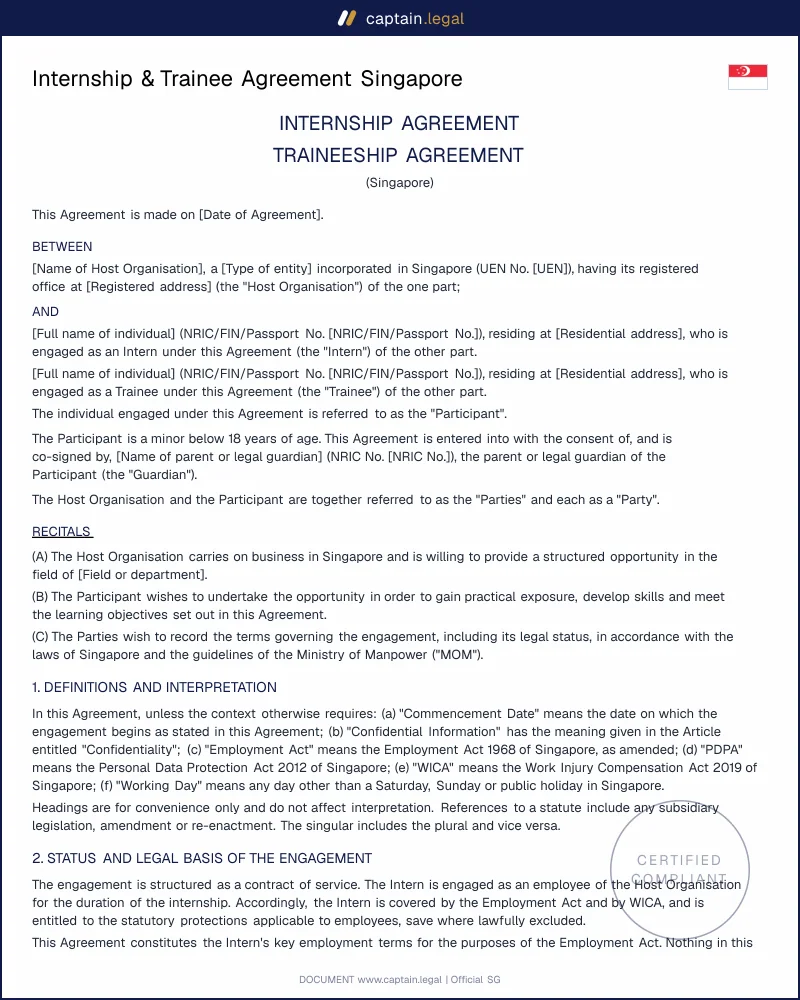
  • The status and classification clause is the spine of the document. It states expressly whether the engagement is a contract of service (intern as employee) or a training agreement (trainee, no employment relationship), and it aligns the rest of the contract to that choice so the substance and the label match.
  • The stipend and CPF clause records the monthly allowance, the payment frequency and whether CPF contributions apply. Where the CPF exemption is claimed for an MOE-linked student, the clause references the documentation the employer must retain, closing off a common audit gap.
  • The duration and probation clause fixes the start and end dates, any review point and the conversion path if the intern is offered a permanent role, so the engagement does not run on by accident.
  • The learning objectives clause sets out the structured outcomes of the placement, which is what distinguishes a genuine traineeship from disguised labour and supports the training-agreement classification where that applies.
  • The confidentiality clause protects trade secrets and aligns with the Personal Data Protection Act 2012, binding the intern not to use or disclose confidential information during or after the engagement.
  • The intellectual property clause assigns ownership of work created during the placement to the company, an essential term given that interns frequently produce code, designs or content. The Singapore NDA and confidentiality templates offer a related model where a standalone confidentiality instrument is preferred.
4

Regional and sector considerations

Singapore applies one national employment framework, so there is no state-by-state variation as in federal systems, but the practice differs by sector and by the source of the intern. In the public university and polytechnic stream, internships approved by the institution frequently qualify for the CPF exemption, and many also fall outside the Employment Act where the placement is a compulsory academic requirement. Employers drawing interns from these institutions should keep the institution's approval letter on file, because the exemption is documentary, not automatic. In private education and direct-hire internships, by contrast, the default position is that CPF is payable and the intern is treated like any part-time or temporary employee, which surprises many SMEs that assume all interns are CPF-free.

The financial services and technology sectors add a confidentiality and IP layer that the agreement must take seriously, since interns in these fields routinely touch client data and proprietary code. A robust IP assignment and a PDPA-aligned confidentiality clause are not optional extras here. For foreign trainees, the engagement is shaped by work-pass rules rather than the Employment Act, and the Training Employment Pass limits practical training to a defined, non-renewable period, so the agreement should mirror that training-only purpose and avoid language suggesting an ordinary employment relationship. Startups frequently run their internship programmes alongside founder and contractor paperwork, and the Singapore society and non-profit governance templates are a useful reference where the host is a charity or association rather than a company.

5

How to fill out this internship or trainee agreement

You begin by choosing the classification, because everything else flows from it: select contract of service if the person will do real work for a stipend, or training agreement if the engagement is genuinely development-led with no employment relationship. From there the form asks for the parties, the role title and the placement dates, then prompts you for the stipend amount and payment frequency, with a branch that captures the CPF position and, where the exemption is claimed, a reminder to retain the institution's documentation. You then set the learning objectives, which the template treats as a substantive field rather than a formality, since they support the classification you chose. The confidentiality and intellectual property clauses populate with standard protective language that you can tighten for sensitive sectors. Finally you confirm notice and termination terms and download the finished document in Word for further editing or PDF for signature. Anyone needing a broader picture of available paperwork can browse the full Singapore legal document catalogue before committing to a single template.

6

Common mistakes to avoid

The first and most expensive error is calling a working intern a "trainee" to dodge CPF and Employment Act duties. MOM looks at the substance of the relationship, not the heading, so a person doing real work under your direction is an employee whatever the document is called, and the saved contributions become a liability with interest. The second mistake is omitting the KETs: employers covered by the Act must give written Key Employment Terms within fourteen days, and a template that skips this leaves you exposed even when the rest of the agreement is sound. A close third is forgetting CPF entirely for a private-school or direct-hire intern on the mistaken belief that all interns are exempt, when the exemption is in fact narrow and documentary.

The fourth recurring problem is a weak or absent intellectual property clause. Interns build things, and without a clear assignment the company can find itself unable to prove ownership of code or designs created during the placement. The fifth is drafting a restraint of trade so wide it protects nothing, since a blanket non-compete against an intern is almost certainly unenforceable and signals overreach. Finally, many employers let a successful internship slide into a permanent role without papering it; once the placement purpose ends, you need a proper employment contract rather than an internship agreement stretched past its purpose.

Key takeaways

STATUS

Substance decides if they are employees

The headline “intern” or “trainee” is not what counts. If the person does real work under your direction, on your hours, for your benefit, it will usually be a contract of service and they fall under the Employment Act 1968. A training agreement only fits when the primary purpose is structured learning with no employment relationship (for example certain national traineeship-style arrangements).

COMPLIANCE

Employment Act duties kick in fast

Once the engagement is a contract of service, MOM practice expects the standard employee basics. You must issue written Key Employment Terms within 14 days of the start date, provide itemised payslips, and pay salary within 7 days after the end of the salary period. Statutory leave can also apply, including pro-rated annual leave (at least 7 days in year one) after 3 months’ service.

MONEY & IP

CPF, confidentiality and ownership must align

Status also drives money and ownership outcomes. CPF contributions are payable under the Central Provident Fund Act 1953 for Singapore Citizens or PRs engaged under a contract of service and earning more than $50 a month, so a mislabelled “trainee” can create back-pay exposure. Separately, put confidentiality and IP ownership in writing upfront so there is no fight later over who owns code, designs, reports or other work product.

Frequently Asked Questions

It depends on the substance of the engagement, not the title on the document. If the intern works under a contract of service, performing real work under your direction for a stipend, they are an employee covered by the Employment Act 1968 and entitled to its protections, including itemised payslips and pro-rated annual leave. The Ministry of Manpower has confirmed that only students doing an internship purely as a compulsory academic requirement fall outside the Act. A genuine trainee engaged under a training agreement, with no employment relationship, sits outside employee status. The classification clause in this agreement makes you decide that question up front.

Usually yes. CPF contributions are payable for interns who are Singapore Citizens or Permanent Residents engaged under a contract of service and earning more than fifty dollars a month. There is a specific exemption: you are not required to contribute for interns who are students enrolled in an MOE-subsidised institution or programme and employed for training approved by their educational institution. That exemption is documentary, so you must obtain and keep proof from the institution. Assuming every intern is CPF-free is one of the most common and costly classification errors.

Yes. Singapore has no statutory minimum allowance for interns, so an unpaid internship is lawful. The Ministry of Manpower nonetheless encourages employers to provide a monthly allowance to defray food and travel costs, and certain government grant schemes attach minimum allowance conditions. Even when unpaid, a written agreement remains valuable: it records the scope, the learning objectives, the confidentiality obligations and the intellectual property assignment, so the company is protected against later claims over work the intern produced during the placement.

Yes, once it is properly completed and signed by both parties it forms a binding contract under Singapore law. Its enforceability depends on accurate completion: the classification must match the real relationship, the stipend and CPF position must be correct, and any restraint clause must be reasonable in scope to hold up. The template is drafted to reflect Employment Act 1968 requirements and current Ministry of Manpower practice, but it is a self-service document rather than tailored legal advice, so engagements with unusual features such as foreign trainees on a Training Employment Pass deserve a closer review.

Most internships in Singapore run three to six months, which suits both the learning purpose and the pro-rated leave calculations that apply once an intern has served at least three months. The agreement fixes a clear start and end date, and you can add a review point or a conversion clause if you intend to offer a permanent role. Avoid open-ended internships: when the placement purpose has run its course and the person stays on, replace the internship document with a proper employment contract rather than letting the original terms drift indefinitely.

By default, ownership can be unclear, which is exactly why the intellectual property clause matters. Our template assigns ownership of work created during the placement to the company, covering the code, designs, content and other deliverables interns commonly produce. Without an express assignment, the company may struggle to prove it owns that output, a real problem in technology and creative roles. Pair the IP clause with the confidentiality terms, which align with the Personal Data Protection Act 2012, so that both ownership and the handling of sensitive information are settled in writing before the engagement begins.

The agreement is available in both Word and PDF. The Word version lets you adjust clauses for your sector, for instance tightening the confidentiality and IP terms for a fintech or software placement, while the PDF is ready for signature and filing. Both versions carry the same Singapore-specific drafting, so you can edit first in Word and then export a clean PDF for the parties to sign. Keeping a signed copy on file, together with any CPF exemption documentation from the intern's institution, completes a defensible record of the engagement.

4.8/5

20 verified reviews · 50 000+ downloads

Singapore Intern Agreement: Employment Act 1968
  • Immediate access to the document
  • PDF + Word download
  • Compliant with 2026 legislation
  • Reviewed by lawyers
Fill in the template
Secure payment · No subscription
Updated on June 16, 2026

You might also like

Termination Letter Singapore
KETs Statement Singapore