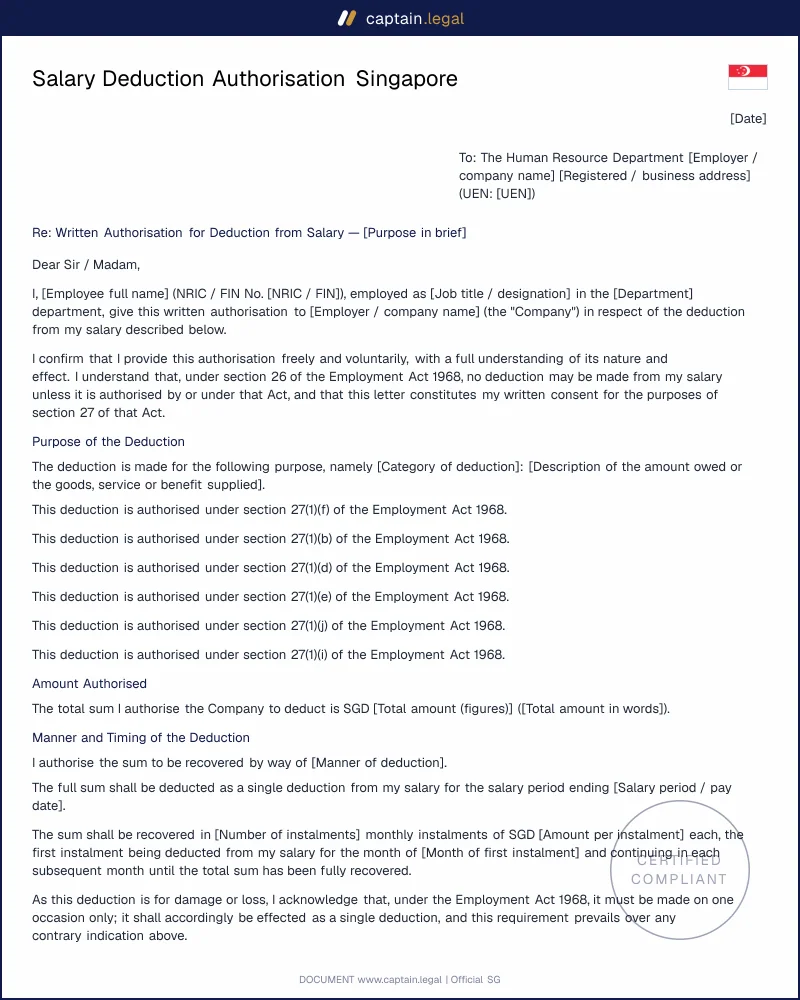
Salary deductions in Singapore are governed by Part III of the Employment Act 1968, administered by the Ministry of Manpower. The anchoring provision is section 26, which states that no employer may deduct from an employee's salary unless the deduction is authorised by the Act, ordered by a competent court or authority, or required under the Income Tax Act, Property Tax Act or Goods and Services Tax Act. Everything else flows from that prohibition. Section 27 then lists the deductions the Act permits, and sections 28 to 31 set the conditions for specific categories: absence from work, damage or loss of goods the employee was accountable for, accommodation and amenities, and the recovery of advances and loans.
Two numerical limits do most of the work in practice. Under section 32, total deductions in any one salary period cannot exceed 50% of the salary payable for that period, a cap that protects the employee's take-home pay from being wiped out by concurrent deductions. Certain items sit outside this ceiling: deductions for absence, recovery of advances or loans, income tax, and consented payments to registered co-operative societies do not count towards the 50%. Deductions for damage or loss carry their own stricter rule, capped at 25% of one month's salary, permitted only after an inquiry, and made as a single lump sum rather than instalments. Advances and loans may be recovered in instalments spread over no more than twelve months.
The rules tighten for foreign workers. An employer may not deduct from a work pass holder's salary without the employee's written consent, and must notify MOM before making a new deduction or reducing pay. Certain deductions from a foreign employee are prohibited even with consent, including costs tied to employment such as work pass renewal, security bond, medical insurance and levy payments. The authoritative starting point for any deduction question is the Ministry of Manpower guidance on allowable salary deductions, which sets out the permitted grounds and the notification steps. Where the deduction relates to the end of the relationship, the mechanics link closely to notice and final pay, so a well-drafted Singapore termination letter under the Employment Act 1968 should reflect any authorised deduction taken against the final salary.