Create my document
Login

Choose country

SingaporeSingaporeChoose country
Personal

Child Travel Consent Letter | Women's Charter s.126

Singapore child travel authorisation drafted to the Women's Charter 1961 and Guardianship of Infants Act. Lawyer-grade, both-parents format. Word and PDF.
4.8/517 reviews50 000+ downloadsInstant download
Share

A Child Travel Consent Letter is a written authorisation signed by a parent or legal guardian that permits a child under 21 to travel abroad with one parent, a relative, a friend or another appointed guardian. Singapore families reach for it whenever the travelling adult is not both legal parents at once: a mother taking the children to Kuala Lumpur for the school holidays, a grandparent flying a grandchild to London, a father escorting a teenager to a sports tournament in Australia. The letter records who consents, who travels, where they go and for how long, so that airline staff at Changi and immigration officers overseas can see at a glance that the trip is sanctioned. It is a child travel authorisation that protects the accompanying adult as much as the child.

Compliant

2026 Legislation

50,000+ clients

trust us

Affordable

From $4.90 / doc

Secure payment

Instant download

Child Travel Consent Letter | Women's Charter s.126

Secure payment · No subscription

Fill in the template
2

When do you need this document?

The everyday trigger is the one-parent holiday. A mother flying with the children to Bangkok while the father stays in Singapore is the textbook case, and although Changi rarely asks for paperwork on the way out, the return leg and the Thai entry point can. The second common scenario is travel with a relative or family friend: grandparents taking grandchildren on a cruise, an aunt escorting a niece to Perth, a family friend bringing a teenager along on a group trip. Here the accompanying adult has no automatic authority over the child, so a letter naming them and giving their relationship is what reassures both the airline and the destination's border control.

A third situation is the unaccompanied minor flying solo to meet relatives, where airlines impose their own consent and handover documentation on top of anything immigration wants. Then come the edge cases that separate a practitioner's draft from a generic one. After a divorce, a non-custodial parent who wants to take the child overseas needs the custodial parent's written consent precisely because of section 126(3), and the trip still cannot exceed one month without court leave. Sole-custody situations are trickier still: where one parent's rights have been removed or restricted by court order, the letter should attach a copy of the relevant order so the foreign officer can see the legal basis, rather than guess at it. Blended families travelling under different surnames are another quiet trap, because a mismatch between the child's passport name and the accompanying adult's name is exactly what prompts a secondary check. Our child and spousal maintenance agreement built on the Women's Charter 1961 often sits alongside these travel questions in a post-divorce file.

3

Key clauses included in our template

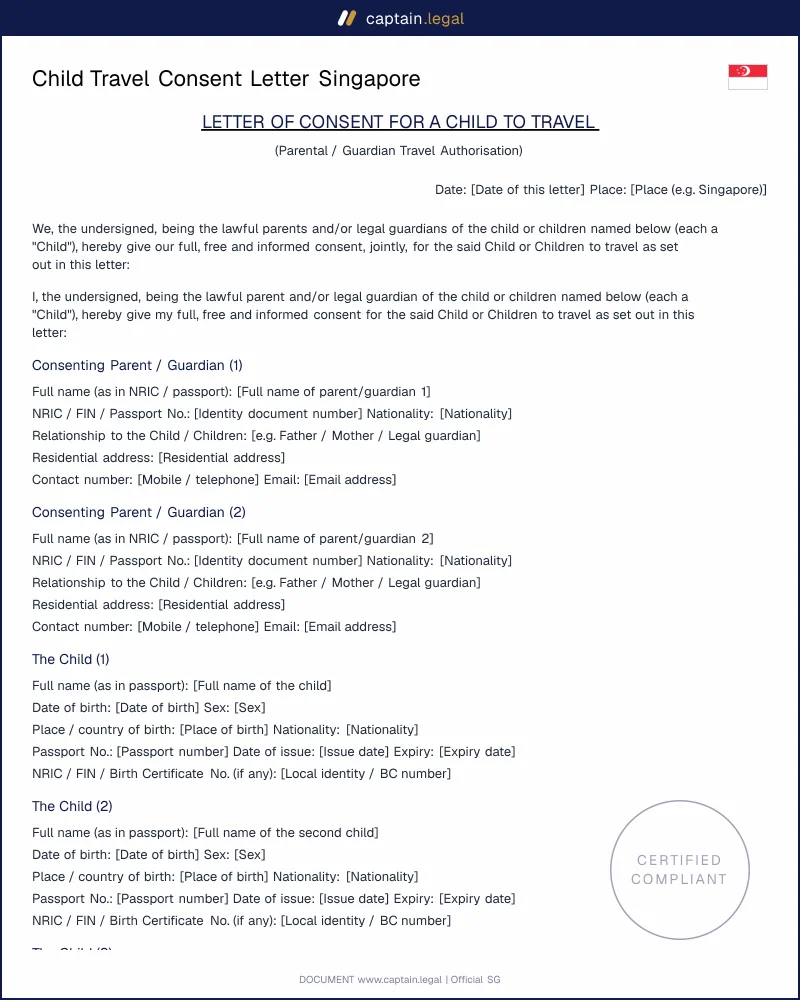
  • The identification of the child captures full name as printed in the passport, date of birth, nationality, passport number, NRIC or birth certificate number, and passport expiry. A name that does not match the travel document to the letter is the fastest route to a held-up family at a foreign counter, so the template forces an exact match rather than a casual version of the child's name.
  • The identification of the consenting parents or guardians lists each person with parental responsibility, their NRIC or passport numbers and contact details. Where both parents consent, both appear and both sign; where one parent has sole custody, the template records that fact and prompts you to attach the supporting court order.
  • The accompanying adult clause names the person travelling with the child, states their relationship, and records their identification, so a grandparent or family friend is clearly authorised rather than merely tolerated. This is the clause foreign immigration officers read first.
  • The scope of travel sets out the destination or destinations, the departure and return dates, and whether the authorisation covers a single trip or a defined series of trips within a window. Keeping the dates tight matters because section 126(3) caps cross-border removal at one month where a custody order is in force.
  • The delegated authority clause lets the consenting parent grant the accompanying adult limited power to handle emergency medical decisions and to liaise with airlines and authorities during the trip, which removes the panic when a child falls ill abroad.
  • The declaration of truth and signature block ties everything together with a dated statement, space for a witness, and an optional notarisation panel for destinations that demand a notarised letter.
4

Regional considerations

Singapore is a single jurisdiction, so the variation that matters here is not by canton or state but by destination country and airline, and a law-firm-grade letter is drafted with that in mind. For travel into the Schengen area, several member states expect a signed, sometimes notarised, consent letter from the non-travelling parent for any child crossing with only one parent, and they are far stricter than Singapore is on departure. A letter that satisfies a casual ASEAN land crossing may be waved through, while the same trip into France or Germany draws a request for notarisation and certified translation.

Malaysia and the regional land and sea crossings deserve their own thought. The Woodlands and Tuas checkpoints see enormous family traffic, and while a routine one-parent day trip rarely needs paperwork, a longer stay or travel by a non-parent is smoother with a letter in hand. Air travel through major hubs adds the airline layer: carriers running unaccompanied-minor programmes impose their own forms and handover rules that operate independently of immigration law, so the consent letter and the airline form do separate jobs and you usually need both.

For destinations that are Hague Convention contracting states, the consent letter carries extra weight because it is the documented proof that removal was not wrongful, which is precisely the question a return application would turn on. Where the trip follows a Singapore divorce, the destination's officers may also want to see the custody position, so the letter should align with the court order rather than contradict it. Parents finalising those arrangements often pair the travel letter with our Singapore divorce settlement covering HDB, CPF and maintenance so that the travel terms and the custody terms tell one consistent story.

6

Common mistakes to avoid

The mistake practitioners see most often is the single-signature letter. A parent assumes their own consent is enough, drafts a tidy note, and is then stopped abroad because the destination wanted the other parent's signature too. Where both parents share parental responsibility, the safe default is both signatures, and where only one parent signs, the letter should explain why and attach the court order that justifies it. The second frequent error is stale or imprecise dates: a letter that says "for the December holidays" rather than naming exact departure and return dates invites questions, and one that quietly allows more than a month abroad while a custody order is live runs straight into section 126(3).

Name mismatches are the next trap. Parents write the child's everyday name rather than the full name on the passport, and the small discrepancy is exactly what triggers a secondary inspection. Then there is the assumption that a consent letter overrides a court order, which it never does: if a custody arrangement restricts travel, the letter must sit within those limits, not above them. Finally, families forget that the airline and the immigration authority are two separate gatekeepers with two separate sets of rules, so they arrive with an immigration-ready letter but no airline unaccompanied-minor form, or the reverse. Carrying the child's birth certificate and, after a divorce, the custody order alongside the letter closes most of these gaps before they open.

Key takeaways

Purpose

It is a trip-specific consent, not custody

A Child Travel Consent Letter is a private written authorisation for a child under 21 to travel abroad with a named accompanying adult, on stated dates and for a stated purpose. It is not an ICA form, and it does not appoint a permanent guardian or transfer custody. Think of it as a clean, dated permission for one trip (or a defined travel window), which naturally ends when the travel dates pass.

Borders

Airlines and foreign immigration will ask

Do not assume you can “sort it out at Changi”. ICA generally does not require this letter when a child departs with one parent, but airlines, transit airports and especially destination-country immigration officers often do. When the document is missing or unclear, the practical impact is immediate: delayed check-in, extra questioning, or refusal to board. The letter works best when it clearly shows who consented, who is travelling, and where and for how long.

Women’s Charter

Divorced or separated parents face penalties

If there is a custody order or a care and control order, section 126(3) of the Women’s Charter 1961 bites: no parent may take the child out of Singapore for more than one month without the other parent’s consent or court leave. A breach can trigger section 126(5) consequences, including a fine of up to $5,000 or imprisonment up to 12 months. A properly signed consent letter is your evidence that the required consent was actually given.

Frequently Asked Questions

The letter is a genuine legal instrument: it is a signed declaration of the consent that the law requires, and where a custody order is in force it is the documented proof that the Women's Charter 1961 section 126(3) consent was given. That said, it is not a court order and it cannot grant rights the signer does not have. A parent without parental responsibility cannot consent away another parent's rights through a letter. Its binding force comes from being an accurate, dated record of lawful consent, which is why airlines and foreign immigration officers accept it. To carry full weight at strict destinations, it should be signed by every parent with parental responsibility and, where required, witnessed or notarised.

It depends on your custody position. Where there is no court order and both parents share parental responsibility, the law expects major decisions, including overseas travel, to be made jointly, so a letter signed by both parents is the safe approach and the one foreign borders prefer. Where a custody or care and control order is in force, section 126(3) of the Women's Charter 1961 is explicit: a child cannot be taken out of Singapore for more than one month without the other parent's consent or the court's leave. If you hold sole custody by court order, you can consent alone, but you should keep a copy of that order with the letter to prove it.

You download the completed letter in both Word and PDF. The Word file lets you make small adjustments later, such as updating an accompanying adult's details for a new trip or correcting a contact number, without rebuilding the document. The PDF is the clean version to print, sign and carry through Changi and the destination checkpoint. Keeping both is sensible: travel plans shift, and a fresh trip with a different accompanying adult needs its own freshly dated letter rather than a reused one.

The letter is valid for the travel window you write into it, so it is only as current as its dates. For a single holiday it covers that trip; you can also draft it to cover a defined series of trips within a stated period. There is no national expiry rule, but two limits bite. Where a custody order is in force, the trip itself cannot exceed one month under section 126(3). And whenever the accompanying adult changes, you should issue a new letter naming the new person rather than relying on an old one, because a foreign officer will read the named adult against the person actually standing there.

At the Singapore departure point, the Immigration & Checkpoints Authority does not, as a general rule, demand a consent letter for a child leaving with one parent, and there is no published ICA requirement to that effect. The real demand comes from airlines applying their own carriage rules and, far more importantly, from the destination country's immigration authorities on arrival. Treat the letter as protection for the journey rather than a Singapore exit formality. Carrying it means you are ready for the counter that does ask, instead of discovering the requirement when it is too late to fix.

Yes, and this is exactly where it earns its keep. If you have sole custody, you can consent to the travel yourself, and you should attach the court order so the basis is visible. If custody or care and control is shared or held by the other parent, you need that parent's written consent to take the child abroad, and the trip cannot run beyond one month without court leave, per section 126(3). The letter must align with the order rather than contradict it. Pairing it with a clear deed of separation under the Women's Charter 1961 keeps the travel terms consistent with the custody terms.

Singapore law does not impose notarisation on a private consent letter, but the destination often does. Strict jurisdictions, several Schengen states among them, expect a notarised signature and sometimes a certified translation, so for those trips you should notarise before a notary public. For regional travel a witnessed signature is usually enough, and a witness line strengthens any letter at little cost. The template includes both a witness block and a notarisation panel, so you can dial the formality up or down to match where the child is actually going.

A border-ready letter names the child exactly as the passport does, with date of birth and passport number, and identifies every consenting parent with their NRIC or passport details and contact information. It names the accompanying adult and their relationship to the child, states the destination and the precise departure and return dates, and carries a dated declaration with signatures. Adding emergency contact and medical authorisation, plus the child's birth certificate and any custody order as supporting documents, removes almost every reason an officer might have to hold the family up. Missing names, vague dates or a single signature where two are expected are the recurring causes of rejection.

4.8/5

17 verified reviews · 50 000+ downloads

Child Travel Consent Letter | Women's Charter s.126
  • Immediate access to the document
  • PDF + Word download
  • Compliant with 2026 legislation
  • Reviewed by lawyers
Fill in the template
Secure payment · No subscription
Updated on June 18, 2026

You might also like

Statutory Declaration Singapore
Debt Acknowledgement Template Singapore