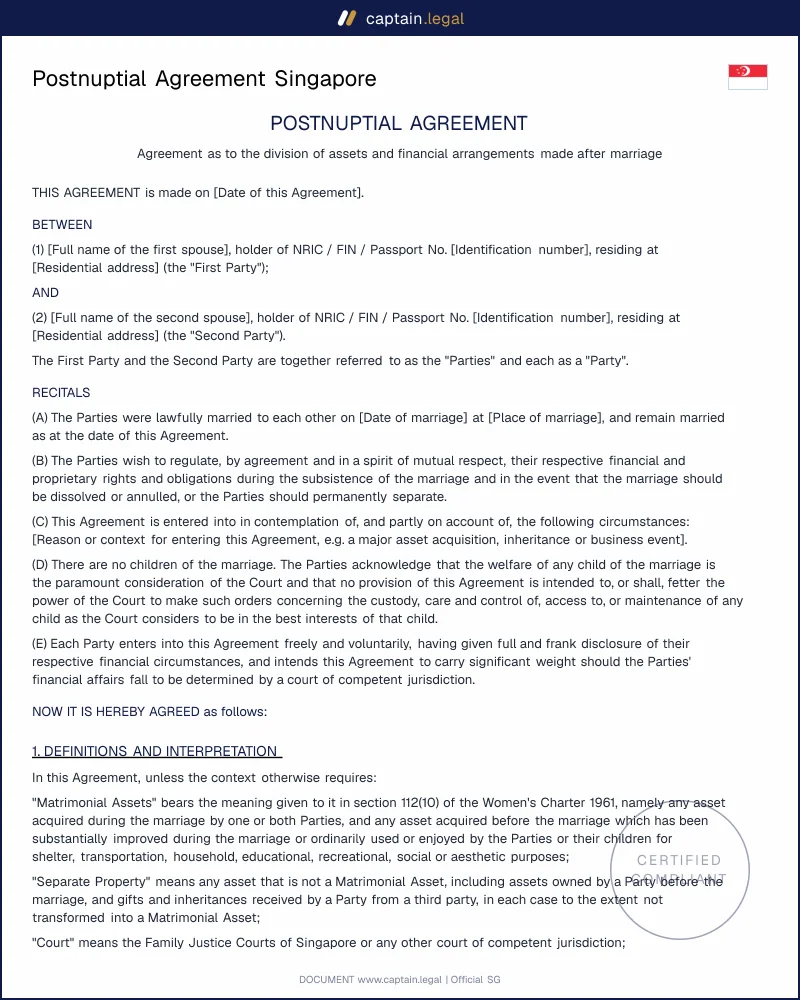
The starting point is the Women's Charter 1961 (2020 Rev Ed), the statute that governs marriage, divorce, maintenance, and the division of property in Singapore. Under section 112(1), the court has a broad discretionary power, on granting a divorce, to divide the matrimonial assets in whatever proportions it considers just and equitable. That power is the reason no marital agreement is ever automatically binding here: the court remains the ultimate arbiter, and parties cannot contract out of its jurisdiction.
What a postnuptial agreement does is feed directly into that discretion. Section 112(2) lists the factors the court must weigh, and section 112(2)(e) expressly directs the court to consider any agreement between the parties about the ownership and division of matrimonial assets made in contemplation of divorce. The Court of Appeal in TQ v TR [2009] SGCA 6 confirmed that such agreements are valid and can be persuasive evidence of the couple's intentions. Significantly, the court signalled that a postnuptial agreement may be given more weight than a prenuptial one, because it is usually made when the spouses already understand their financial reality, sometimes with a possible separation in view.
There are firm limits. Because the agreement is a contract, it must satisfy ordinary contract principles: genuine consideration, full and frank disclosure, no duress, misrepresentation, or undue influence. Any clause that tries to strip a spouse of the right to apply for maintenance under section 113 will not be enforced, and terms touching children are always read against their welfare, which the court treats as the first and paramount consideration. You can review the exact wording of the division power in the Attorney-General's Chambers text of section 112 of the Women's Charter on Singapore Statutes Online.