Create my document
Login

Choose country

FranceBelgiqueEspañaUnited StatesUnited KingdomMarocDeutschlandItaliaSchweizSingapore
Family & Divorce

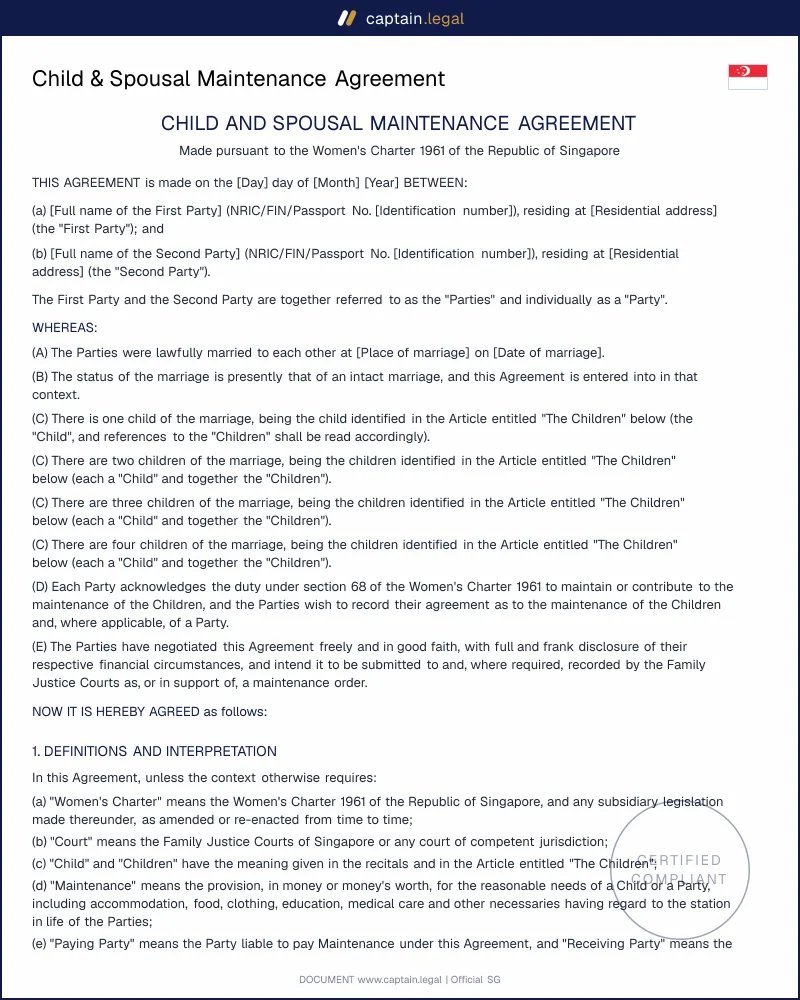
Child & Spousal Maintenance: Women's Charter 1961

Draft maintenance for children and spouse under sections 68 to 69 of the Women's Charter, structured to support a Family Justice Courts order.
4.6/512 reviews50 000+ downloadsInstant download
Share

A child and spousal maintenance agreement records, in one signed document, how much support a parent or spouse will pay, how often, by what method, and what happens when circumstances change. It is the working paper most separating couples in Singapore actually rely on, well before any judge sees the file. Drafted properly, it sets out cash maintenance for each child, any contribution toward a wife or incapacitated husband, the categories of expenses that are shared, and a clear review mechanism. It will not bind the Family Justice Courts on its own, but it gives the court a sensible starting point and can be converted into a maintenance order or consent order down the line.

Most people reach for this agreement during a separation, an uncontested divorce, or after one party simply stops contributing to the household. The aim is the same in each case: write the terms down while both parties are still talking, so the arrangement survives the moments when they are not.

Compliant

2026 Legislation

50,000+ clients

trust us

Affordable

From $4.90 / doc

Secure payment

Instant download

Child & Spousal Maintenance: Women's Charter 1961

Secure payment · No subscription

Fill in the template

What is a child and spousal maintenance agreement?

A child and spousal maintenance agreement is a private contract between two parents, or two spouses, fixing the financial support owed for the children and, where relevant, for a wife or incapacitated husband. In Singapore practice it usually combines two distinct obligations in one instrument. The first is child maintenance, the legal duty of both parents to provide reasonable food, clothing, accommodation, education and medical care. The second is spousal maintenance, which is support for a wife or an incapacitated husband and is never automatic; it depends on need, conduct and the parties' respective means.

People confuse this document with a Deed of Separation, and the two overlap, but they are not the same. A Deed of Separation covers the whole separation: living arrangements, division of assets, conduct, and often maintenance as one clause among many. A standalone maintenance agreement does one job and does it in detail, which is why couples who already have a Deed of Separation aligned with Singapore family law sometimes still want a dedicated schedule for the money. The key thing to understand is the ceiling on what private agreement can achieve. Parents are free to agree terms between themselves, but they cannot sign away the duty to maintain a child. If the agreed sum fails to meet the child's genuine needs, or is plainly unfair to one parent, the court can disregard the bargain and substitute its own order. The agreement is evidence of intention, not a final word.

2

When do you need this document?

The most common trigger is a separation where the couple wants to keep paying the bills in an orderly way while the marriage winds down. One parent has moved out, the children are still in school, and someone has to fund the household; a written agreement settles who pays what before resentment hardens into a dispute. The second frequent scenario is the run-up to an uncontested divorce, where parties record agreed maintenance terms so they can later be folded into a consent order without a fight in chambers. Since the no-fault divorce route under section 95A requires a written agreement addressing arrangements for the children and the parties' finances, a clear maintenance schedule slots neatly into that process.

Couples also reach for this document when they broadly agree but keep snagging on detail. The monthly figure is settled, but nobody has pinned down who covers orthodontics, enrichment classes, or an overseas school trip. A proper agreement forces those answers out now. It is equally useful when one party has stopped contributing and the other wants a paper record of the obligation before escalating to court, since a documented agreement strengthens a later claim that maintenance was neglected. One edge case worth flagging concerns adult children: maintenance can be agreed past 21 for a child in full-time study or with a disability, but a healthy, financially independent adult child cannot be the beneficiary of a maintenance obligation the court will enforce. Another involves incapacitated husbands, who have been eligible to claim since the 2016 amendments and are routinely overlooked in DIY drafting that still assumes only a wife can receive support.

3

Key clauses included in our template

  • The identification of the parties and children names each parent in full and lists every child with date of birth, because maintenance is calculated per child and a vague reference to "the children" invites argument later. Where the agreement is meant to support a future consent order, naming each beneficiary precisely is what lets the court translate the bargain into an enforceable instrument.
  • The quantum of child maintenance states a fixed monthly sum per child, payable by a set date each month, with the payment method spelled out (bank transfer to a named account is the norm). Pinning the date and method down matters because a missed transfer is far easier to prove than a vague claim that "he sometimes pays late".
  • The spousal maintenance clause records any agreed support for a wife or incapacitated husband, the amount, the method, and crucially the events that end it, such as remarriage, the recipient becoming self-supporting, or a fixed term expiring. Leaving the end point unstated is a classic source of conflict.
  • The shared-expenses schedule separates the base monthly figure from variable costs like school fees, insurance premiums, medical and dental bills, and enrichment activities, and states the split (often equal) plus the proof required before reimbursement. This is where most agreements are too thin, and where disputes over big-ticket items erupt.
  • The review and variation clause sets out what triggers a recalculation: job loss, a serious change in income, a child entering tertiary education, or a medical event. It should make clear that either party may apply to court if agreement on a revised figure cannot be reached.
  • The enforcement and default clause records what happens on non-payment, including the right to pursue enforcement through the Family Justice Courts and, where eligible, the Maintenance Enforcement Process, so the consequences are visible to both sides from day one.
4

Regional and practical considerations

Singapore is a single jurisdiction, so there is no canton-by-canton or state-by-state divergence to map, but several practical layers do change how a maintenance agreement should read. The first is the religion of the parties. Maintenance for Muslim marriages can fall within the Administration of Muslim Law Act 1966 and the Syariah Court's jurisdiction rather than the civil Family Justice Courts, and the drafting and the forum differ accordingly. A maintenance agreement built on the Women's Charter may not map cleanly onto a Syariah matter, so couples married under Muslim law should check which track applies before adopting a civil-law template. Parties navigating a religious dimension to their separation should also confirm whether any parenting and access arrangements for the children need to be coordinated with the maintenance terms.

The second layer is the housing and asset picture, which in Singapore almost always involves CPF and an HDB or private property. Maintenance interacts with how the matrimonial home is dealt with, and an agreement that fixes cash support while ignoring who services the mortgage tends to unravel. The third is enforcement reach. Where a payer works or holds assets overseas, a purely domestic agreement can be hard to enforce, and the Maintenance Orders (Reciprocal Enforcement) Act may be relevant for cross-border recovery. For families whose separation also touches on company shareholdings or a family business, the financial disclosure feeding the maintenance figure should be consistent with any shareholders' arrangements governed by the Companies Act 1967, since hidden or understated income is exactly what Maintenance Enforcement Officers are now empowered to investigate.

5

How to fill out this maintenance agreement

You begin by entering the full names and identification details of both parties, then add each child with a date of birth, because the template builds a separate maintenance line for every child rather than a single lumped figure. From there you set the monthly child maintenance amount per child, choose the payment date and method, and decide whether spousal maintenance applies; if it does, the form prompts you for the amount and the events that will bring it to an end. The next stage is the expenses schedule, where you tick the categories you want shared, such as school fees, medical costs and insurance, and state the split and the reimbursement proof required. You then set the review triggers and confirm how disputes will be handled, including the route to the Family Justice Courts if the parties cannot agree on a revised figure. Once the substance is settled, both parties sign and date the agreement, and you download a clean copy in Word and PDF for safekeeping. Couples who want the broader separation captured in the same exercise can pair this with a parenting plan and separation terms for Singapore families so the money and the care arrangements stay aligned.

6

Common mistakes to avoid

The error we see most often is treating a private agreement as if it can extinguish the duty to a child. It cannot. A clause that purports to release a parent from all future child maintenance is worth nothing in court, because the welfare of the child overrides the bargain and a judge can replace an inadequate figure with a fair one. The second mistake is lumping everything into a single monthly sum with no breakdown, so that when a large dental or tuition bill lands, neither party can say whether it was already covered. A clean agreement separates the base figure from variable costs and states the reimbursement proof, which is exactly the kind of detail the child maintenance recording approach for Singapore is built around.

Three further mistakes cause most of the later grief. People leave spousal maintenance open-ended, with no end event, and then fight for years about when it should have stopped. They omit a review mechanism, so a job loss or a child entering university has no agreed path to adjustment and the only option is fresh litigation. And they circulate sensitive drafts carelessly, forwarding agreements that contain children's names, addresses and school details into group chats; under the Personal Data Protection Act 2012 that is a real risk, and the practical advice is to keep distribution tight and store the signed version securely. A final, quieter mistake is forgetting that an incapacitated husband can be a legitimate recipient, which leads to templates that assume only wives claim and miss a valid entitlement.

Key takeaways

COURT WEIGHT

Private deal guides, but court decides

A child and spousal maintenance agreement helps you record the amount, frequency, payment method, shared expense categories, and a review mechanism while both parties are still communicating. It is not, by itself, binding on the Family Justice Courts. If terms are plainly unfair or do not meet a child’s genuine needs, the court can disregard the bargain and make its own maintenance or consent order.

WOMEN’S CHARTER

Two duties: child and spouse maintenance

Under the Women’s Charter 1961, child maintenance and spousal maintenance are separate obligations often combined in one document. Section 68 places a duty on both parents to provide reasonable support for a child (including illegitimate children), regardless of who the child lives with. Section 69 allows claims for a wife, former wife, or an incapacitated husband or former husband, and it is not automatic.

DURATION

Child maintenance usually runs to 21

Child maintenance generally runs until the child turns 21, so the agreement should be drafted with a clear timeline and review triggers. Section 69(5) can extend support beyond 21 where the child is serving National Service, studying full-time, or has a mental or physical disability. A practical agreement anticipates these scenarios so payments can adjust without a fresh dispute each time.

Frequently Asked Questions

A signed child and spousal maintenance agreement is a binding contract between the parties, but it does not have the force of a court order on its own, and it cannot override the Women's Charter duty to maintain a child. The Family Justice Courts retain the power to scrutinise the terms and, if the agreed maintenance fails to meet a child's needs or is unfair to one parent, to set the agreement aside and make its own order. In practice the document carries real weight as evidence of what the parties intended, and it is commonly converted into a consent order during divorce proceedings, at which point it becomes directly enforceable.

For child maintenance, the figure should reflect the child's reasonable needs measured against both parents' means, since section 68 of the Women's Charter makes maintenance a shared duty rather than a fixed tariff. For spousal maintenance, the court looks at the factors in section 114: each party's income and earning capacity, their needs and obligations, the standard of living during the marriage, its duration, and the contributions each made to the family. There is no statutory formula and no automatic percentage. A sensible agreement starts from an honest budget for the children, then allocates the cost between the parents in proportion to what each can realistically afford.

Yes. Circumstances change, and the law expects maintenance to move with them. A well-drafted agreement includes a review clause that names the triggers, typically a significant change in income, the loss of a job, a child entering tertiary education, or a serious medical event. If the parties can agree a revised figure, they simply record it in writing and sign. If they cannot, either party may apply to the Family Justice Courts to vary the arrangement, and where a maintenance order already exists the court can vary it under its statutory powers. A party cannot simply stop paying because their situation has changed; the obligation continues until it is formally varied.

You can enforce a maintenance obligation through the Family Justice Courts, and the route is now more structured following the new Maintenance Enforcement Process. Phase 1 commenced on 16 January 2025 and Phase 2 on 1 October 2025, with applications filed through the iFAMS portal. Eligible cases are referred to Maintenance Enforcement Officers who can obtain financial information from banks and public agencies to establish whether the payer genuinely cannot pay or is refusing to. The court retains older remedies as well, including an attachment of earnings order under section 71 of the Women's Charter, which diverts maintenance directly from the payer's salary.

Usually, but not always. The default is that child maintenance runs until the child turns 21. Section 69(5) of the Women's Charter extends the duty past that age in defined situations: where the child is on national service, in full-time education or training, or where a mental or physical disability prevents the child from supporting themselves. What the law will not support is maintenance for a healthy adult child who is financially independent. If you expect support to continue into university, say so expressly in the agreement, including how tertiary fees and living costs are split, because silence on the point invites a dispute exactly when the bills are largest.

Yes, in defined circumstances. Since the 2016 amendments to the Women's Charter, an incapacitated husband or incapacitated former husband can apply for maintenance under section 69, where he is unable to maintain himself because of a mental or physical disability. This is narrower than the entitlement available to a wife, but it is a real entitlement and it is frequently missed by templates that still assume only a wife can claim. If your situation involves a husband who is genuinely unable to support himself, the agreement should record his maintenance on the same footing as any other recipient, with amount, method and end events spelled out.

The maintenance agreement is available as an editable Word file and as a PDF, so you can adjust the wording to your circumstances and then produce a clean version for signing. The Word format is useful while the parties are still negotiating amounts and expense categories, since changes are easy to track. Once the terms are settled, the PDF gives you a fixed final copy suitable for signature and safekeeping, and for later submission to the Family Justice Courts if the agreement is to be turned into a consent order. Keep the signed version stored securely rather than circulated, given the sensitive personal data it contains.

4.6/5

12 verified reviews · 50 000+ downloads

Child & Spousal Maintenance: Women's Charter 1961
  • Immediate access to the document
  • PDF + Word download
  • Compliant with 2026 legislation
  • Reviewed by lawyers
Fill in the template
Secure payment · No subscription
Updated on June 17, 2026

You might also like

Deed of Separation Singapore
Divorce Settlement Agreement Singapore