Create my document
Login

Choose country

SingaporeSingaporeChoose country
Business

Service Agreement Singapore | UCTA 1977 Ready

Master Services Agreement drafted to the Unfair Contract Terms Act 1977 and GST Act. Reasonable liability cap, IP and confidentiality. Word and PDF.
4.8/5— 12 reviews50 000+ downloadsInstant download
Share

A service agreement, often styled a Master Services Agreement (MSA) when it governs a continuing commercial relationship, is the contract that fixes what one business will do for another, on what terms, and at what price. In Singapore it rests on the common law of contract rather than any single statute, which gives the parties wide freedom to structure scope, fees, GST, intellectual property and a liability cap as they see fit. This template is built for B2B use: a supplier of professional or operational services engaging a corporate customer, whether under a one-off statement of work or a rolling framework agreement. It suits consultancies, agencies, software vendors, logistics providers and any Pte Ltd that sells services and wants the commercial risk allocated in writing before the first invoice goes out.

Most disputes over service contracts in Singapore are not about whether work was done, but about scope creep, late payment and who owns what was created. A well-drafted MSA closes those gaps at the outset. The sections below walk through the legal framework, the clauses that matter most in Singapore practice, and the mistakes that turn a straightforward engagement into a debt-recovery exercise.

Compliant

2026 Legislation

50,000+ clients

trust us

Affordable

From $4.90 / doc

Secure payment

Instant download

Service Agreement Singapore | UCTA 1977 Ready

Secure payment

Fill in the template

What is a service agreement in Singapore?

A service agreement is a legally binding contract under which a service provider agrees to perform defined services for a customer in exchange for payment. The label matters less than the structure. A simple engagement letter, a full Master Services Agreement, and a set of general terms and conditions are all species of the same animal; what distinguishes an MSA is that it separates the standing commercial terms from the deliverable-specific detail, which is captured in one or more statements of work (SOWs) or service schedules that hang off the master document.

That two-tier structure is the practical reason businesses reach for an MSA rather than a fresh contract each time. The master terms fix confidentiality, IP, liability, indemnities and governing law once, and each new SOW then only needs to describe the scope, timeline and fee for that particular piece of work. Where an SOW and the master terms conflict, the agreement must say which prevails, because Singapore courts will enforce the order of precedence the parties chose rather than reading one into the contract for them. A service agreement is distinct from an employment contract: an independent contractor engaged under a service agreement falls outside the Employment Act 1968, has no statutory leave or CPF entitlement, and bears its own tax. Misclassifying an employee as a contractor to avoid those obligations is a well-known trap, and the substance of the relationship, not the label on the document, decides the point. If your arrangement is genuinely one of employment, a proper Singapore employment contract drafted to the Employment Act 1968 is the correct instrument instead.

2

When do you need this document?

The clearest trigger is the start of any ongoing services relationship where work will be delivered in tranches rather than in a single transaction. A design agency taking on a retainer client, an IT firm providing managed support, a consultancy running successive projects: each benefits from master terms signed once and SOWs added as the work evolves. The second common scenario is the reverse, a customer engaging a vendor and wanting to impose its own terms on scope, service levels and liability before committing budget. In both cases the party that puts the paper on the table usually controls the risk allocation, which is reason enough to have a template ready.

A one-off engagement of real value also warrants a proper agreement, not an email exchange. Where a single project runs into six figures, the difference between a signed MSA and a loose understanding is the difference between an enforceable claim and a quantum meruit argument in court. Cross-border work is a further trigger. When a Singapore supplier serves an overseas customer, or vice versa, the governing law and jurisdiction clauses stop being boilerplate and start determining where and under whose law a dispute will be heard. An edge case worth flagging: framework arrangements with government or large corporate customers frequently arrive with the buyer's own MSA, and the supplier's task is then to review and negotiate rather than draft. Reading the liability cap, indemnity and IP clauses of an inbound MSA with the same care you would apply to your own is where the real protection lies. Suppliers who also license the use of a brand or product alongside their services should consider whether a separate Singapore founders' agreement under the Companies Act 1967 or shareholder arrangement is needed where the relationship shades into a joint venture.

3

Key clauses included in our template

  • The scope of services and statement of work is the operative heart of the contract. Our template separates the standing master terms from a schedule that defines deliverables, milestones, acceptance criteria and exclusions, so that scope creep is met with a variation procedure rather than an argument. Vague scope is the single most litigated feature of service contracts, and the drafting here forces specificity.
  • The fees, GST and payment terms clause states the charges, the invoicing cycle, and whether amounts are exclusive or inclusive of 9% GST under the Goods and Services Tax Act 1993. It sets a payment period, late-payment interest, and a right to suspend services for non-payment, which is often more valuable than a right to sue.
  • The limitation of liability clause caps aggregate liability at a defined sum or a multiple of fees, excludes indirect and consequential loss, and is drafted to survive the UCTA reasonableness test by reference to insurance and resources. It expressly preserves liability for death and personal injury, which cannot lawfully be excluded.
  • The intellectual property clause allocates ownership of deliverables and pre-existing materials under the Copyright Act 2021, typically assigning foreground IP to the customer on full payment while the provider retains its background tools and know-how through a licence back.
  • The confidentiality and data protection clause defines confidential information, sets a survival period, and addresses each party's obligations under the Personal Data Protection Act 2012 where personal data is exchanged.
  • The termination, force majeure and dispute resolution clause covers termination for convenience and for cause, the consequences of termination, and whether disputes go to the Singapore courts or to arbitration under governing-law and jurisdiction provisions.
4

Regional and sector considerations

Singapore is a single unified jurisdiction, so there is no state-by-state variation of the kind found in federal systems; the same common law and the same statutes apply island-wide. What varies is sector and counterparty, and that is where the drafting choices bite. Regulated industries carry overlays that a general MSA does not address on its own. A supplier of financial or payment services contracts against the backdrop of Monetary Authority of Singapore licensing conditions, and a healthcare or biomedical provider against sector-specific data and licensing rules, so the base agreement should be read alongside the regulatory regime rather than treated as complete in itself.

Cross-border engagements are the most frequent complication in practice. Where the customer or supplier sits outside Singapore, the governing law and jurisdiction clauses stop being formalities. Choosing Singapore law and the Singapore courts, or alternatively arbitration seated in Singapore under the SIAC rules, determines the forum and the enforceability of any judgment or award abroad. Suppliers dealing internationally should also weigh whether GST applies at 0% as a zero-rated export of services, which turns on where the benefit of the service is received, a distinction with real cash-flow consequences.

Government and large-corporate procurement forms a third category. Public-sector and multinational buyers typically mandate their own paper, longer payment terms, and stricter service levels and audit rights, and the supplier's leverage lies in negotiating the liability cap and indemnity rather than in the scope. Where the engagement touches real property, such as facilities-management or fit-out services, the interaction with a Singapore commercial lease under the Stamp Duties Act should be checked so that the two documents do not contradict each other on responsibility for the premises.

5

How to fill out this service agreement

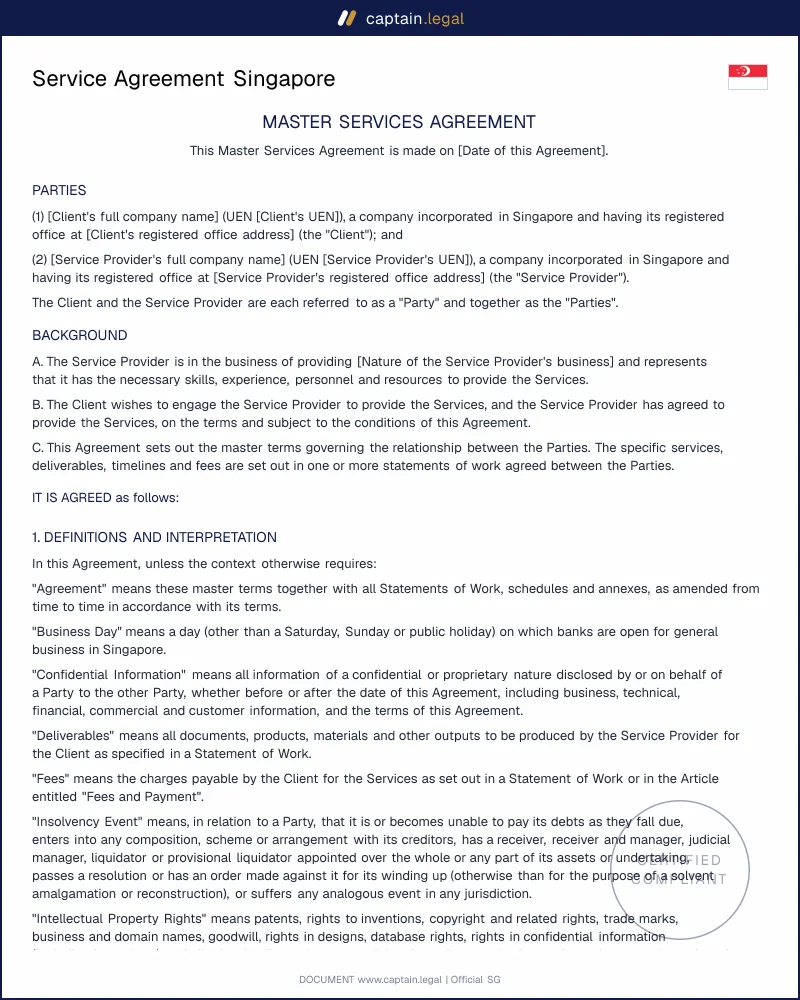
You begin by identifying the two parties, giving the full registered name and UEN of each Pte Ltd, because a contract naming a trading name rather than the legal entity is far harder to enforce. From there the template asks you to describe the services, and this is where care pays off: rather than a single line, you set out the deliverables, the timeline and any acceptance criteria in the statement of work, so that scope is a matter of record rather than recollection. You then set the commercial terms, entering the fee, the invoicing frequency and whether the figure is stated exclusive or inclusive of GST, and choosing the payment period and any late-payment interest.

The agreement next guides you through the risk clauses. You select a liability cap, expressed either as a fixed sum or as a multiple of the fees paid, and confirm the exclusions, with the template preserving the liabilities that UCTA does not allow to be excluded. You allocate intellectual property, deciding whether deliverables pass to the customer on payment and how each party's background materials are treated, and you set the confidentiality survival period. Finally you choose governing law and the forum for disputes, and both parties sign, electronically or in wet ink, under the Electronic Transactions Act 2010. Once complete, you download the finished agreement in Word and PDF. For related governance documents, a Singapore directors' and shareholders' resolution under sections 184A to 184G can record board approval of a material contract where your constitution requires it.

6

Common mistakes to avoid

The most expensive mistake is a liability cap drafted without regard to UCTA. Businesses copy a clause capping liability at a nominal figure, assume it holds, and discover in a dispute that the court has struck it out as unreasonable, leaving them exposed to the full loss. A cap must be defensible against the resources available to meet the claim and the insurance the party could reasonably have taken out; a token cap on a high-value contract rarely survives scrutiny. The second recurring error is scope defined too loosely. When the services are described in a sentence rather than a schedule, every additional request becomes a negotiation, and the provider ends up doing unpaid work or the customer ends up paying for work it did not expect. A variation procedure tied to a detailed SOW removes that friction.

Silence on GST is a smaller but common trap. An agreement that states a fee without saying whether it includes the 9% charge invites a fight the moment the first invoice lands, and the supplier often absorbs the tax to keep the client. IP is mishandled just as often. Parties assume that paying for work means owning it, but under the Copyright Act 2021 that depends on the drafting, and a provider who forgets to license back its own reusable tools can find it has assigned away its core assets. The final mistake is neglecting the interface between documents. An MSA that contradicts a linked NDA or a separate Singapore shareholders' agreement under the Companies Act 1967 on confidentiality or IP creates ambiguity that a counterparty will exploit. Keeping the suite consistent is as important as getting any single clause right.

Key takeaways

Structure

Use an MSA plus SOWs, with precedence

An MSA sets the standing terms once (confidentiality, IP, liability, governing law), while each Statement of Work (SOW) carries the job-specific scope, timeline and fees. That saves renegotiating the whole contract for every project. Do not leave conflicts to chance: the document should state clearly whether the MSA or the SOW prevails when they differ, because Singapore courts will generally apply the order the parties agreed.

Status

Do not confuse services with employment

A service agreement is for an independent contractor relationship, not employment. An independent contractor generally sits outside the Employment Act 1968 and does not receive statutory leave benefits or employer CPF contributions under an employment contract framework. If the working reality looks like employment (control, integration, exclusivity), calling it a contractor deal will not save you. Misclassification can trigger backdated obligations and a dispute over who bears tax and statutory costs.

Liability

UCTA can strike out weak caps

Liability caps and exclusions are common in B2B service agreements, but in Singapore they can be tested under the Unfair Contract Terms Act 1977 (UCTA). The key is reasonableness: if a clause fails that test, the court does not rewrite it into a nicer version; it can be struck out entirely, exposing the supplier to the full measure of loss. Draft the cap, carve-outs and risk allocation as if they might be litigated later.

Frequently Asked Questions

Yes. A service agreement is enforceable under Singapore's common law of contract once the usual elements are present: offer, acceptance, consideration and an intention to create legal relations. The template is drafted to those requirements and to the statutory overlays that matter, notably the Unfair Contract Terms Act 1977 for the liability clauses and the Goods and Services Tax Act 1993 for the fee terms. Signing it, whether electronically under the Electronic Transactions Act 2010 or in wet ink, creates a binding obligation on both parties. What makes the difference in practice is completing the schedules properly, because an agreement with a vague scope or an unreasonable liability cap can be binding yet still leave you exposed on the point you cared about most.

Yes. The Electronic Transactions Act 2010 gives electronic signatures and electronic records the same legal effect as handwritten signatures for commercial contracts of this type. A service agreement or MSA signed through an e-signature platform, or simply by exchanging signed PDFs, is fully valid and enforceable in Singapore. The Act carves out a short list of exceptions, such as wills and certain property conveyances, but ordinary B2B service contracts fall squarely within what can be signed electronically. For evidential comfort, keep the completed record and any audit trail the platform generates, since the party seeking to rely on the contract carries the burden of proving execution if it is ever questioned.

The agreement should state expressly whether the fees are exclusive or inclusive of GST. The current rate is 9% under the Goods and Services Tax Act 1993, and registration becomes compulsory once a supplier's taxable turnover crosses S$1 million in a 12-month period. If the contract is silent, a dispute is almost guaranteed the moment an invoice adds tax the customer did not expect. Our template prompts you to choose the treatment, so the position is fixed before work starts. For international engagements, services supplied to an overseas customer whose benefit is received outside Singapore may be zero-rated at 0%, but that determination turns on the specific facts and is worth confirming with your tax adviser.

There is no fixed figure. Under section 11(4) of the Unfair Contract Terms Act 1977, a cap is judged reasonable against the resources the party could expect to have available to meet the liability and how open it was to cover the risk by insurance. In practice, caps are commonly set at the total fees paid under the agreement, or a multiple such as one to two times the annual charges, with indirect and consequential loss excluded. A cap that is plainly out of proportion to the potential harm risks being struck out entirely, as happened in Holland Leedon v C&P Transport. Aligning the cap with your professional indemnity cover is a sound way to make it defensible.

That depends on what the agreement says, which is exactly why the clause matters. Under the Copyright Act 2021, ownership does not automatically pass to the paying customer simply because it commissioned the work, so an express assignment or licence is needed to achieve the intended result. Our template typically assigns the deliverables (the foreground IP) to the customer on full payment, while the provider retains its pre-existing tools, templates and know-how (the background IP) and licenses their use to the customer as needed. Getting this allocation explicit protects both sides: the customer secures what it paid for, and the provider keeps the reusable assets that let it serve other clients.

They are the same instrument at different scales. A service agreement can be a single document covering one engagement. A Master Services Agreement is a service agreement structured for a continuing relationship: the master terms fix confidentiality, IP, liability and governing law once, and each new piece of work is added through a statement of work that only needs to describe scope, timing and fee. The MSA structure saves the parties from renegotiating the same standing terms every time, and it keeps the commercial relationship consistent. Choose a simple service agreement for a one-off, and an MSA where you expect repeat or phased work.

The template is completed by working through guided fields for the parties, the scope, the commercial terms and the risk clauses, then downloaded in Word and PDF. Most users have a signature-ready draft in a few minutes, and the Word version means you can adapt any clause to a specific engagement before signing. Because it is built to Singapore law from the outset, you are editing a compliant base rather than building a contract from scratch, which is where the time and the legal risk usually accumulate. Once both parties have signed, electronically or on paper, the agreement takes effect according to its commencement terms.

4.8/5

12 verified reviews · 50 000+ downloads

Service Agreement Singapore | UCTA 1977 Ready
  • Immediate access to the document
  • PDF + Word download
  • Compliant with 2026 legislation
  • Reviewed by lawyers
Fill in the template
Secure payment
Updated on July 11, 2026

You might also like

Founders' Agreement Singapore
Director Service Agreement