Create my document
Login

Choose country

SingaporeSingaporeChoose country
Real Estate

Renovation Contract Template SG in Word and PDF

Build your renovation contract in minutes with a guided wizard, then download it in Word and PDF with retention sum and defects period included.
4.7/518 reviews50 000+ downloadsInstant download
Share

A renovation contract puts in writing what a homeowner and a contractor have actually agreed before any work begins. The scope comes from the quotation. The price is paid in stages, against work actually completed, and the completion date is fixed. This template covers renovation and addition and alteration (A&A) works for HDB flats, condominiums and landed homes in Singapore. Owners get a retention sum held until the defects liability period ends and a clean exit if the project stalls. Contractors get a firm payment timetable and a fair extension of time when a delay is not their fault.

Compliant

2026 Legislation

50,000+ clients

trust us

Affordable

From $4.90 / doc

Secure payment

Instant download

Renovation Contract Template SG in Word and PDF

Secure payment

Fill in the template

What is a renovation contract in Singapore?

A renovation contract is a works agreement between a property owner and a renovation firm. It is not the same thing as the quotation. The quotation prices the job; the contract governs it. A typical quotation goes silent on the questions that decide disputes: when payment falls due, who absorbs a three-week delay, and how long the contractor answers for cracked grouting. This agreement incorporates the quotation by reference and adds the legal machinery around it.

No single statute governs residential renovation in Singapore: the contract itself, the Building Control Act 1989 for structural work, and the rules of the body managing the property do the governing. The paperwork carries almost all the weight: most renovation cases heard at the Small Claims Tribunals turn on gaps in the paperwork rather than on the statutes. Like the other Singapore real estate and tenancy templates on this site, the agreement is drafted so that each answer you give removes one of those silences.

2

When do you need this agreement?

The classic trigger is the full renovation of a resale flat or a new BTO after key collection, where the owner pays in stages for something that does not exist yet. It matters just as much for a targeted job, a kitchen and two bathrooms, say: wet works are where permits, waterproofing and defects claims concentrate. Owners of landed homes reach for it when the project crosses into A&A territory, a new porch, an attic conversion, a rear extension, all of which bring the Building Control Act 1989 and planning permission into play.

Buyers often sign it between exercising an option to purchase for a private property and completion, so works can start the day the keys change hands. Landlords use it before re-letting a tired unit, when each week of delay costs rent. If you will keep living in the property during the works, the site obligations and a firm completion date carry extra weight; and if you supply your own materials, a late delivery from your side extends the contractor's deadline, expressly.

3

Key clauses included in our template

The agreement runs to fifteen numbered clauses when liquidated damages are included, and the wizard adapts several of them to your answers. If the renovation is a prelude to letting the place out, it pairs naturally with a tenancy agreement for HDB and condo rentals once the works are done. The load-bearing provisions are these:

  • The identification of the parties and the property captures the renovation firm's UEN together with the address and type of the property, so you know exactly who you are contracting with and for which premises.
  • The works and quotation clause incorporates your accepted quotation and states which document prevails if they conflict. The scope you negotiated becomes enforceable instead of decorative.
  • The time clause fixes a start date and a practical completion date, and allows an extension only for causes outside the contractor's control, agreed variations, or items you undertook to supply late.
  • The payment clause records the contract sum, the deposit paid on signing, and progress payments against stages actually completed, each invoice payable within seven days, less retention. The contractor may suspend works after fourteen days of non-payment.
  • The retention and defects provisions let you hold back five or ten per cent of each progress payment and of the final payment, released fourteen days after the defects liability period ends, less only amounts properly applied to notified defects. Defects must be made good within fourteen days, failing which a third party rectifies at the contractor's cost.
  • The liquidated damages clause, included unless you switch it off, fixes a daily amount for late completion, framed as a genuine pre-estimate of loss so that a court treats it as compensation.
4

HDB flat, condominium or landed home: what changes

HDB flats carry the heaviest compliance load. The contractor must hold a live registration under the Registered Renovation Contractors' Scheme, obtain the HDB renovation permit before starting any work that requires one, and respect the permitted hours for noisy works. The template's HDB variant writes each duty into the contract, alongside a field for the registration number itself. Never let hacking begin before the permit is actually issued; a contractor who starts early exposes you to HDB enforcement. Owners who renovate to let out part of the flat usually follow the project with a room rental agreement built for HDB and condominium landlords.

Condominiums shift the centre of gravity to the management corporation. Approval must be obtained before works begin where the by-laws require it, and the contractor has to comply with the by-laws and house rules: lift protection, hoisting windows, working hours, protection of common property. Most MCSTs also require a renovation deposit, and the agreement obliges the contractor to cooperate with that arrangement.

Landed properties raise the structural stakes. Where works touch structural elements, the contract requires the plans, approvals and permits under the Building Control Act 1989 to be in place before those works start, including a qualified person where the law demands one and any planning permission required from the URA.

5

How to fill out this renovation contract

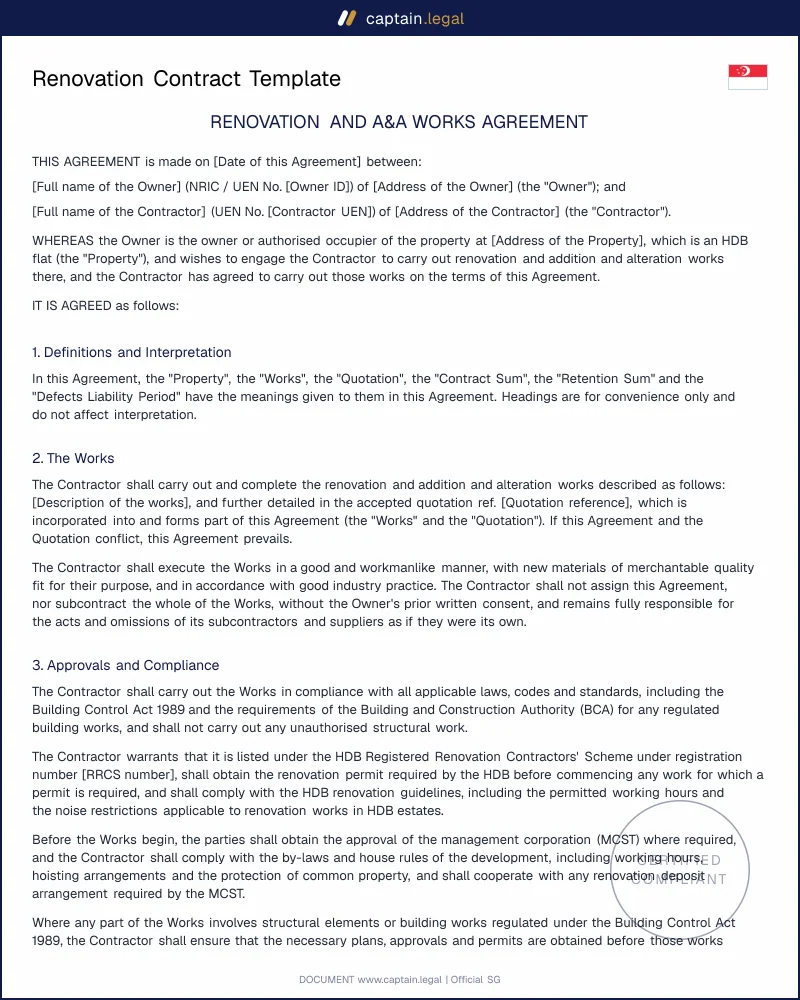
You start with the parties, then the property, and the form reshapes itself as you go. Select "HDB flat" and a field appears for the contractor's RRCS registration number; select condominium or landed and it disappears, replaced by the matching compliance clause. Next comes the scope: a plain-language summary of the works and the reference of the accepted quotation. You then set the start and completion dates, enter the contract sum and the deposit, and pick the retention rate and the defects liability period from preset options. A final switch keeps or removes the liquidated damages clause.

The preview updates beside the form as you answer, and the clause numbering adjusts itself when optional sections come in or out, so what you read is always the exact contract you will sign. Then download it and sign with the contractor before the first hammer swings. The same wizard drives the full catalogue of Singapore legal documents.

6

Common mistakes to avoid

The most expensive mistake is paying too far ahead of the work. A large upfront payment removes the contractor's incentive to finish and your leverage when defects appear; progress payments against completed stages, less retention, keep the incentives aligned to the last day. Close behind is skipping the registration check on an HDB job: an unregistered renovator saves nothing and puts the permit, and the whole project, at risk. The third classic is the oral variation, agreed at the site, priced never, disputed at handover. This agreement requires every variation to be written, signed and priced before the varied work begins, a habit that prevents more disputes than any other clause.

The quieter mistakes cost just as much. A scope described as "as per discussion" gives a tribunal nothing to hold the contractor to. A missing completion date lets the project float for months without remedy. A handover without a walk-through wastes the defects liability period: inspect and notify defects in writing while the clock runs. A firm that documents its jobs properly, from the works agreement itself to the contract templates for Singapore businesses behind its operations, spends its energy building rather than arguing from memory.

Key takeaways

SCOPE

The quotation prices it, the contract runs it

A renovation contract is not the quotation. The quotation sets the scope and price, but it often stays silent on the points that trigger disputes: when each payment is due, what counts as completion, and who bears delay. This template incorporates the quotation by reference and adds the working rules, so you are not arguing later over implied terms.

PAYMENT

Stage payments, plus retention through defects

Payment is structured in stages, tied to work actually completed, rather than a lump sum. On top of that, the owner keeps a retention sum that is only released after the defects liability period ends. This gives the contractor a predictable timetable, while giving the owner leverage if issues like cracked grouting or failed waterproofing show up after handover.

COMPLIANCE

Approvals and permits are not optional

If the works touch structural elements or cross into addition and alteration (A&A), the Building Control Act 1989 regime applies and may require plans, approvals and a qualified person before work starts. For HDB flats, the contractor must be under the HDB Registered Renovation Contractors' Scheme and many works need a renovation permit; condos must follow MCST by-laws and deposits. Unauthorised structural work can lead to rectification orders and prosecution.

Frequently Asked Questions

Yes. A renovation contract signed by the owner and the contractor is an ordinary contract under Singapore law: offer, acceptance and consideration are present, and no special form is required. What makes it enforceable in practice is precision. Because this template incorporates your accepted quotation, fixes dates and states each party's duties expressly, a tribunal can apply it without guesswork. Residential renovation disputes can be brought before the Small Claims Tribunals for claims within the Tribunals' monetary limit, where the written agreement is usually the decisive piece of evidence.

Yes, if the property is an HDB flat. Renovation works in HDB flats must be carried out by a contractor listed under the Registered Renovation Contractors' Scheme, and a renovation permit is required before many common works can lawfully begin. The template's HDB variant makes the contractor warrant its registration, records the number in the contract, and obliges the firm to obtain the permit and respect the permitted hours. If a contractor hesitates to put its RRCS number in writing, treat that as your answer.

The template offers five per cent or ten per cent of each progress payment and of the final payment. Five per cent is the common figure for straightforward residential jobs; ten per cent suits projects with heavy wet works or a history of rework. The retention is security for the owner: it is released in full fourteen days after the defects liability period ends, less only amounts properly applied to defects notified during that period. Holding it back from each progress payment as well as the final one gives the mechanism teeth.

Fourteen days from your written notice. Any defect, shrinkage or fault appearing within the defects liability period, which you set at three, six or twelve months from practical completion, must be made good by the contractor at its own cost within that window. If the contractor fails to act, you may engage a third party to rectify the defect and recover the reasonable cost, including by deduction from the retention sum. Put every defect in writing with photographs and a date; an oral complaint does not start the clock.

If you kept the liquidated damages clause, the contractor pays a fixed daily amount for every calendar day beyond the completion date, after any fair extension. The clause frames that amount as a genuine pre-estimate of your loss, the standard Singapore courts expect, so pick a figure that mirrors your real daily cost, such as alternative accommodation. You may deduct the accrued amount from any sum still owed, including the retention. Without the clause you can still claim damages for delay, but you must prove your loss item by item.

Yes, the finished contract downloads in both formats. The PDF is ready to print and sign; the Word file remains editable if the two of you agree a final adjustment before signing. Print two copies, have both parties sign each, and attach the itemised quotation to every copy. Keep the signed set with the project invoices and photographs: that file is what you would rely on if a dispute ever arises.

Whoever agreed to them, at the price fixed before the work was done. The variations clause requires every change to the scope to be agreed in writing and signed by both parties, with its price and any effect on the completion date settled before the varied work begins. A variation handled that way is payable with the progress invoice that follows its completion. A change that skips the written step is how budgets drift, so the written discipline protects both sides in equal measure.

4.7/5

18 verified reviews · 50 000+ downloads

Renovation Contract Template SG in Word and PDF
  • Immediate access to the document
  • PDF + Word download
  • Compliant with 2026 legislation
  • Reviewed by lawyers
Fill in the template
Secure payment
Updated on July 12, 2026

You might also like

Deed of Surrender of Lease Singapore
Tenancy Renewal Agreement Singapore
Renovation Contract Singapore: A&A Works Agreement