Create my document
Login

Choose country

FranceBelgiqueEspañaUnited StatesUnited KingdomMarocDeutschlandItaliaSchweizSingapore
Real Estate

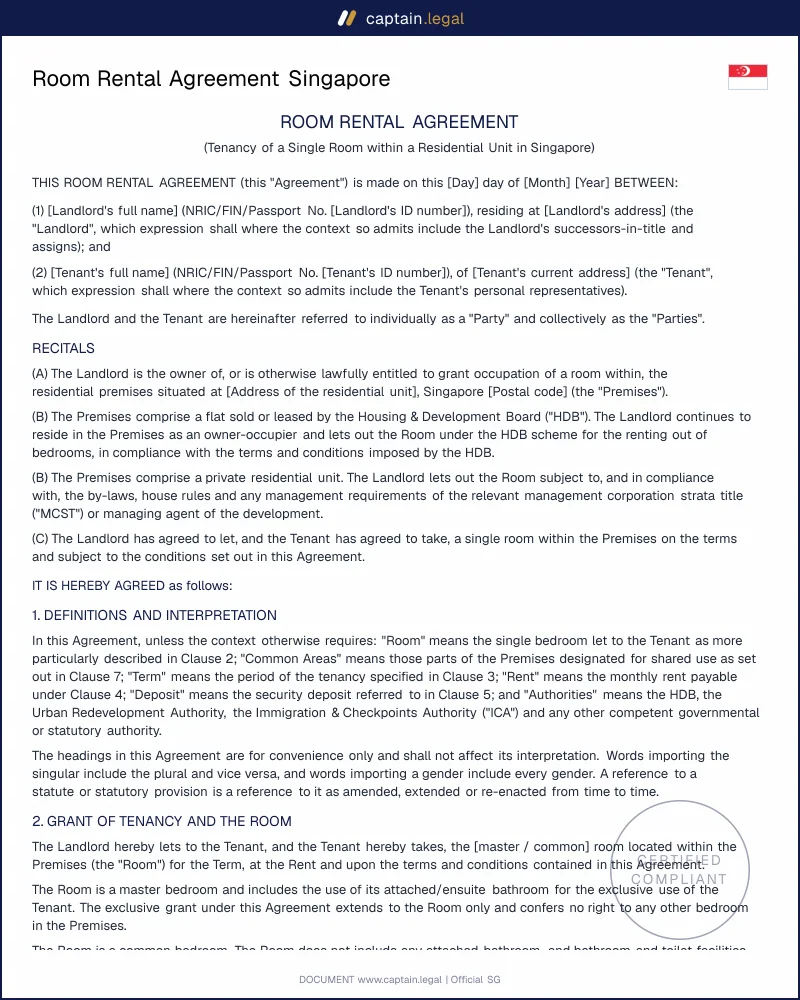
Singapore Room Rental Agreement, HDB & Stamp Duties Act

Room tenancy agreement drafted for HDB bedroom-rental rules and Stamp Duties Act stamping. Covers occupancy caps, deposit, diplomatic clause and house rules.
4.7/531 reviews50 000+ downloadsInstant download
Share

A room rental agreement is the written contract you sign when you let out a single bedroom in your HDB flat or condominium while continuing to live there yourself. It names the parties, fixes the rent and security deposit, sets the term and the house rules, and divides responsibility for shared utilities and common areas. In Singapore this document does double duty: it protects you in any later dispute, and it forms part of what HDB expects to see when you register the rental of a bedroom. Drafted properly, it keeps a room let clean and compliant from the first viewing to the final handover.

This template is built for the practical reality of room rental in Singapore, where the owner stays on the premises and a single occupant takes one room. It covers the clauses that decide most disputes, the occupancy and eligibility rules that keep the arrangement lawful, and the stamping step that gives the contract evidential weight.

Compliant

2026 Legislation

50,000+ clients

trust us

Affordable

From $4.90 / doc

Secure payment

Instant download

Singapore Room Rental Agreement, HDB & Stamp Duties Act

Secure payment · No subscription

Fill in the template

What is a room rental agreement in Singapore?

A room rental agreement is a species of tenancy agreement. It grants a tenant the exclusive use of one bedroom plus shared use of the kitchen, bathrooms and living areas, while the owner retains possession of the rest of the flat and continues to live there. That last point is the legal hinge. Renting out a room is not the same as subletting the whole flat, and the two are governed by different HDB rules, different occupancy caps and a different application path.

The distinction matters in everyday language too. People say partial rental, room let or lodger arrangement, but the operative document is still a tenancy agreement for part of the premises. Because you stay in occupation, the tenant is closer to a lodger than to a tenant of the whole unit, and the agreement should say so plainly. A whole-flat tenancy hands over the keys and the owner steps out; a room rental agreement keeps the owner in residence, sharing the front door, the meter and the corridor. Getting the characterisation right protects you on two fronts: it keeps you inside HDB's room-rental framework rather than its whole-flat framework, and it shapes the house rules, since a shared home needs clauses on visitors, quiet hours and use of common areas that a whole-flat lease never bothers with. For condominium owners the HDB rulebook does not apply, but the Urban Redevelopment Authority minimum-stay rule does, and the contract structure stays the same.

2

When do you need this document?

The classic case is the owner-occupier with a spare bedroom who wants rental income without giving up the flat. A working professional with a three-room flat lets the second bedroom to a colleague on an Employment Pass; the owner keeps the master, shares the kitchen, and the arrangement runs for a fixed year. Here the agreement does the heavy lifting on shared-space etiquette that a whole-flat lease never addresses.

A second common trigger is the condominium owner letting one room while living in another. The HDB rules do not apply to private property, but the URA minimum-stay duration of three consecutive months does, and short-stay letting of under three months remains prohibited. The contract structure is identical; only the regulatory overlay changes.

Family and lifestyle situations make up the rest. Parents whose children have moved out let a room to a student; an owner heading overseas for several months lets a room to a trusted friend on clear written terms rather than a handshake. One edge case worth flagging concerns non-citizen tenants. If your tenant is a non-Malaysian Singapore Permanent Resident or foreigner, they must hold a valid long-term pass with at least six months' validity at the date of your application, and the room must be let for a minimum of six months. The Non-Citizen Quota, by contrast, does not apply to the renting out of bedrooms, only to whole-flat rentals, a distinction owners frequently get wrong. A second edge case: never let a room for business use. Commercial activity in the flat breaches HDB's terms and can put your ownership at risk.

3

Key clauses included in our template

  • The parties and the room let are identified precisely: the owner by name and NRIC, the tenant by name and pass type, and the specific bedroom together with the shared areas the tenant may use. Naming the exact room and the shared facilities prevents the commonest argument, which is what the tenant actually paid for.
  • The rent and payment terms fix the monthly figure, the due date and the payment method, and state plainly whether utilities are included or apportioned. Where utilities are shared, the clause sets the split, a flat add-on or a metered share, so the PUB bill never becomes a monthly negotiation.
  • The security deposit is set, commonly one month's rent for a one-year term, with the conditions for its return and the grounds for deduction spelled out. A deposit clause that does not list deductible items invites a Small Claims Tribunals dispute at move-out.
  • The term and the diplomatic clause record the fixed period and, for tenants who may be posted away, an early-exit right after a minimum occupation period on stated notice. For HDB rooms the term must respect the six-month minimum tenancy.
  • The house rules govern the shared home: visitor policy, overnight guests, quiet hours, use of the kitchen and living room, cooking restrictions, and rules on pets and smoking. These are the clauses unique to a shared flat and the ones that keep the peace.
  • The HDB-approval condition and inventory make the agreement contingent on HDB's written approval where the flat is public housing, and attach a signed inventory of the room's furnishings and condition recorded with dated photos.
4

Regional considerations

Room rental in Singapore divides cleanly along one line: public housing versus private property. The rules are national, but they bite differently depending on which side of that line your home sits.

HDB flats carry the heaviest regulatory load. Only owners of three-room or larger flats may let out bedrooms, and unlike whole-flat rental this does not require the five-year Minimum Occupation Period to have been met. The owner must obtain HDB's approval before the tenancy begins and must continue to reside in the flat throughout; if the owner and all authorised occupiers move out, the registration is revoked and the let is treated as an unauthorised whole-flat rental. Total occupancy is capped by flat type, and under a temporary relaxation running to 31 December 2026, four-room and larger flats may house up to eight persons in total, counting the owner's household. Application is online through HDB's e-Service, with an administrative fee per bedroom, and the minimum tenancy is six months. Singapore Citizens and Permanent Residents alike may let out rooms.

Private condominiums and landed homes answer to the URA rather than to HDB. There is no approval step and no occupancy cap of the HDB kind, but the URA minimum-stay duration of three consecutive months applies, and letting for under three months is not permitted. Diplomatic clauses are far more common in this segment because the tenant pool skews toward expatriates on postings, so the early-exit drafting deserves close attention. The stamping obligation is identical across both segments; the Stamp Duties Act does not distinguish HDB from private property. Owners of either type should keep the full Singapore property and rental catalogue close to hand when a single room let grows into something larger.

5

How to fill out this room rental agreement

You start by telling the form whether the property is an HDB flat or a private home, because that choice drives the rules that follow. From there you enter the parties: your own name and NRIC as the resident owner, then the tenant's name and pass type, since a non-citizen tenant's pass validity feeds directly into the eligibility check. You then identify the specific bedroom and tick the shared areas the tenant may use, which fixes the scope of what is being let. Next you set the financial terms, the monthly rent, the deposit, the due date and the utilities arrangement, and the form prompts you to state expressly whether utilities are included or apportioned. You choose the term and decide whether to include a diplomatic clause, and for an HDB room the form holds you to the six-month minimum. The house-rules section lets you set visitor, guest, noise and common-area rules in plain language. Finally you attach the inventory and, for HDB flats, confirm the agreement is conditional on HDB approval. The output downloads as a Word file you can edit and a PDF you can sign and e-stamp. Owners who also run a small business from a separate office may find the Singapore business and incorporation templates useful alongside this.

6

Common mistakes to avoid

The most damaging mistake is letting a tenant move in before HDB approves the rental. Approval must precede the tenancy, and moving someone in first turns a lawful room let into an unauthorised one, with action available against the owner under the Housing and Development Act. Almost as common is forgetting to e-stamp. Owners treat the stamp as a formality and skip it, then discover at a deposit dispute that an unstamped agreement is inadmissible until the duty and a penalty are paid, with late penalties climbing to several times the original duty. A third recurring error is a vague deposit clause that names a sum but never lists what may be deducted, which all but guarantees a fight at move-out and a trip to the Small Claims Tribunals.

Owners also miscount occupancy. The cap includes the owner's own household, not just the tenants, and exceeding it risks fines and revocation. Confusing the Non-Citizen Quota with bedroom rental is another frequent slip, since that quota applies only to whole-flat lets. The last mistake is relying on a handshake or a borrowed template that ignores shared-living realities. A room let in an occupied home needs house rules a whole-flat lease never carries, and skipping them is where co-living relationships break down. For the related employment paperwork a live-in arrangement sometimes touches, the Singapore employment and HR documents cover offer and confidentiality letters.

Key takeaways

HDB rules

Room rental is not whole-flat letting

This agreement is for a single bedroom while the owner continues living in the flat. That characterisation drives compliance: HDB treats bedroom rental differently from renting out the whole unit, with different approval paths, occupancy caps and eligibility conditions under the Housing and Development Act 1959. If the owner moves out or the arrangement looks like a whole-flat tenancy, you risk falling outside HDB’s room-rental framework.

Stamp duty

E-stamp on time or disputes stall

A room tenancy is dutiable under the Stamp Duties Act 1929. For terms of four years or less, duty is 0.4% of the average annual rent, payable via IRAS e-Stamping within 14 days of signing in Singapore (30 days if signed overseas). Even where average annual rent is S$1,000 or below, stamping still helps. An unstamped agreement is not admissible in evidence until duty and any penalty are paid.

House rules

Write the shared-living rules clearly

Singapore has no general rent control, so day-to-day rights and obligations sit mainly in the contract and common law. Anything not written is hard to enforce later, especially in a shared home. Spell out rent, security deposit, term, utility-sharing and use of common areas, then add practical rules that prevent friction: visitors, quiet hours, cleaning, and what happens at handover. These clauses decide most room-rental disputes.

Frequently Asked Questions

Yes. A room rental agreement is a tenancy contract, and once both parties sign it, it binds them under common law. There is no requirement for a lawyer, a witness or notarisation for it to take effect. What gives it full evidential force is stamping: under the Stamp Duties Act, an unstamped tenancy cannot be used as evidence in court or before the Small Claims Tribunals until the duty and any penalty are paid. So the contract is binding on signature, but stamp it within 14 days to make sure you can actually rely on it if a dispute over rent or deposit arises later.

Yes, if the property is an HDB flat. You must apply for and obtain HDB's approval before the tenancy begins, and you must continue to live in the flat throughout the rental. Only owners of three-room or larger flats may let out bedrooms, though the five-year Minimum Occupation Period that applies to whole-flat rental does not apply to room rental. Application is online through HDB's e-Service with an administrative fee per bedroom. A sound agreement is drafted expressly conditional on HDB approval, so that if approval is refused the contract falls away rather than leaving you exposed.

Both. You receive an editable Word file and a ready-to-sign PDF. The Word version lets you adjust house rules, the utilities split or the diplomatic clause to fit your situation, while the PDF is the clean copy you print, sign and keep. For HDB and private property documents in this category the same dual-format approach applies, so you can stamp or adapt any of them immediately after download.

For an HDB room, the minimum tenancy is six months per application, with a maximum of three years for Singaporean and Malaysian tenants and two years where a tenant is a non-Malaysian non-citizen. For private condominiums and landed homes, the URA sets a minimum stay of three consecutive months, and anything shorter is prohibited as unlawful short-term accommodation. Build the term around these floors. A common practical choice is a fixed one-year term with a diplomatic clause allowing early exit after a stated minimum period, which suits tenants on work postings while keeping you inside the HDB or URA minimums.

Yes, within limits. A non-citizen tenant must hold a valid long-term pass, an Employment Pass, S Pass, Work Permit, Student Pass, Dependant Pass or Long-Term Visit Pass, with at least six months' validity as at the date of your application. Tourists cannot rent. Importantly, the Non-Citizen Quota of 8% at neighbourhood level and 11% at block level applies only to whole-flat rentals, not to the renting out of bedrooms, so a room let to a foreigner is not quota-restricted. You still need HDB approval and the tenant must meet the six-month minimum tenancy.

Lease duty is 0.4% of the average annual rent for terms of four years or less. If the average annual rent is 1,000 dollars or below, no duty is payable at all, which exempts many single-room lets. Where duty is due, it must be e-stamped with IRAS within 14 days of signing in Singapore. By convention the tenant pays, but both parties are jointly liable, so the agreement should state who bears it. Missing the deadline triggers penalties that escalate with delay, so treat stamping as part of signing, not an afterthought.

You risk fines and, in the worst case, revocation of your approval to rent out, after which tenants may be required to leave. The cap is set by flat type and crucially counts the owner's own household alongside the tenants. Under the temporary relaxation in force until 31 December 2026, four-room and larger flats may hold up to eight persons in total. Before you sign, add up everyone who lives in the flat, yourself and your family included, and confirm the room let keeps you under the limit. Overcrowding is one of the fastest ways to lose your rental approval.

4.7/5

31 verified reviews · 50 000+ downloads

Singapore Room Rental Agreement, HDB & Stamp Duties Act
  • Immediate access to the document
  • PDF + Word download
  • Compliant with 2026 legislation
  • Reviewed by lawyers
Fill in the template
Secure payment · No subscription
Updated on June 16, 2026

You might also like

Rent Receipt & Deposit Acknowledgement
Tenancy Agreement Singapore