Create my document
Login

Choose country

FranceBelgiqueEspañaUnited StatesUnited KingdomMarocDeutschlandItaliaSchweizSingapore
Business & Incorporation

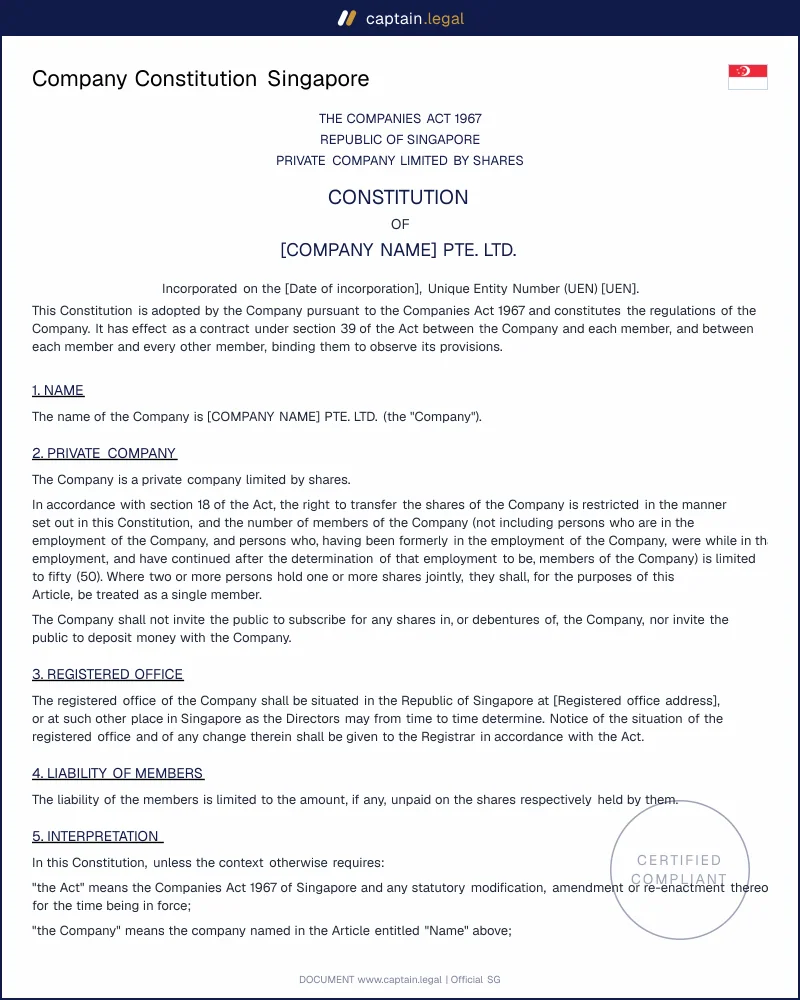
Pte Ltd Constitution Singapore: Companies Act 1967

Drafted to s.36 Companies Act 1967 and ACRA practice. Share classes, s.26A entrenching provisions, 75% thresholds, pre-emption. Word & PDF.
4.5/523 reviews50 000+ downloadsInstant download
Share

A company constitution is the binding rulebook of a Singapore private limited company (Pte Ltd), replacing the old Memorandum and Articles of Association since the 2016 reforms. It governs how shares are issued, how directors exercise their powers, what majorities decisions need, and how existing shareholders are protected when new shares or transfers come into play. This company constitution Singapore template is drafted for incorporation through ACRA's BizFile+ portal and aligned with the Companies Act 1967, with share classes, director powers, decision thresholds and pre-emption rights set out in clean, ACRA-ready language for founders, in-house counsel and corporate secretaries.

Most off-the-shelf constitutions simply copy the statutory Model Constitution and stop there. That document is a safe minimum, not a governance framework. A bespoke constitution is where founders fix the things the Model is silent on: a second class of shares for an investor, a chairman's casting vote, a pre-emption waterfall on transfers, or a quorum that protects a minority holder. Getting these right at incorporation saves an expensive special resolution amendment six months later.

Compliant

2026 Legislation

50,000+ clients

trust us

Affordable

From $4.90 / doc

Secure payment

Instant download

Pte Ltd Constitution Singapore: Companies Act 1967

Secure payment · No subscription

Fill in the template

What is a company constitution in Singapore?

A company constitution is the single document that defines the legal relationship between a Singapore company, its members and its directors. Since 3 January 2016, the Companies (Amendment) Act 2014 abolished the separate Memorandum and Articles of Association and merged them into one instrument called the constitution, lodged with ACRA on incorporation. Every company registered under the Companies Act 1967 must have one, and it binds the company and each member as though each had signed and sealed it.

There is an important distinction founders often miss. A company limited by shares may simply adopt the Model Constitution prescribed under section 36(1)(a) of the Act and set out in the First Schedule, or it may register a bespoke constitution tailored to its commercial reality. The Model Constitution is competent for a single-founder shelf company, but it assumes one class of ordinary shares, default director powers and no pre-emption mechanics beyond the basics. A Pte Ltd raising external capital, splitting equity among co-founders, or planning an investor round needs the bespoke route. The constitution should also be read alongside any shareholders agreement, because where the two conflict, drafting ambiguity becomes litigation. A well-built constitution and a clean shareholders agreement say the same thing in compatible language, with the constitution carrying the provisions that must bind third parties and the Registrar.

2

When do you need this document?

The most common trigger is incorporating a new Pte Ltd where the Model Constitution does not fit. Two co-founders splitting equity 60/40 need transfer restrictions and pre-emption rights the Model handles only loosely, and a sole founder planning to bring in a CTO on vesting shares needs the share machinery drafted before the first allotment. The second frequent scenario is a financing round, where an angel or seed investor insists on a class of preference shares carrying liquidation preference, anti-dilution protection or board appointment rights. None of that exists in the statutory default, so the constitution has to be replaced or amended by special resolution before completion.

Founder disputes drive the next category. When a shareholder relationship sours, the parties discover the constitution is the only document a court and the Registrar will treat as binding, and a vague quorum clause or a missing casting vote becomes the whole battleground. Amending an existing constitution to convert a sole-director company into a multi-director board, to create a new share class, or to insert reserved-matter vetoes also calls for a fresh instrument. One edge case worth flagging: a company applying for certain licences, or a regulated entity, may need its objects and director-power clauses drafted with specificity rather than relying on the broad statutory capacity, because the licensing authority reads the constitution as evidence of governance. A related need often arises around equity documents, so founders frequently pair the constitution with a Singapore shareholders agreement template at the same time.

3

Key clauses included in our template

  • The share capital and share classes clause defines ordinary and any preference shares, the rights attaching to each (dividend, voting, return of capital), and whether shares are redeemable. This is where an investor's liquidation preference or a founder's enhanced voting class lives, drafted to be consistent with section 64 on rights attaching to shares so that class rights are not accidentally varied.
  • The directors' powers and proceedings clause sets the management authority of the board, the quorum for board meetings, the appointment and removal mechanics, and whether the chairman holds a casting vote. A casting vote is the single most contested line in a two-director company, so the template states it expressly rather than leaving it to the statutory default.
  • The pre-emption rights on transfer clause gives existing members the first right to buy shares a departing holder wishes to sell, with a fair-value mechanism and a clear notice timetable. Without this clause, a co-founder can sell to an outsider freely, which is why it sits at the heart of every closely held Pte Ltd.
  • The decision thresholds and reserved matters clause lists the actions requiring more than a simple majority, and may attach entrenching provisions under section 26A to protect a minority holder on defined fundamental decisions.
  • The transmission, forfeiture and lien provisions handle what happens to shares on a member's death, bankruptcy or default, points the Model Constitution covers thinly and that matter enormously in family-held companies.
4

Regional considerations

Singapore is a unitary jurisdiction, so there are no state or provincial variations in company law: the Companies Act 1967 and ACRA practice apply uniformly across the Republic. The regional nuance that matters is instead about company type and registration pathway. A Pte Ltd is the right vehicle for most operating businesses, but founders sometimes confuse it with a company limited by guarantee, which is governed by section 36(1)(b) and the Second Schedule and is used for non-profits rather than profit-distributing ventures. If a non-profit structure is in fact the goal, the Singapore company limited by guarantee constitution is the correct starting point, not this template.

Foreign-owned companies face one structural requirement that shapes the constitution indirectly. Every Pte Ltd must have at least one director ordinarily resident in Singapore, and a qualified company secretary must be appointed within six months of incorporation. Where directors sit overseas, the constitution's provisions on electronic meetings, written resolutions and notice become practically important, because the board may rarely meet in one room. The Electronic Transactions Act 2010 validates electronic execution for most corporate documents, so a constitution can be adopted and amended digitally. For companies operating across the region from a Singapore base, aligning the constitution with the day-to-day commercial paperwork in our Singapore business and incorporation documents category keeps the governance and operational layers consistent.

5

How to fill out this company constitution

You start by entering the company name and confirming the company type as a private company limited by shares, which sets the statutory schedule the document follows. From there the form asks for the share capital structure: the number and class of shares, and whether you need a second class for an investor or a founder. If you select more than one class, the template opens the rights fields so you can define dividend, voting and capital entitlements for each. The next stage covers the board, where you set the minimum and maximum number of directors, the meeting quorum, and whether the chairman carries a casting vote.

The constitution then moves to transfer mechanics, where you choose the pre-emption model and the notice periods that govern a sale of shares. You can switch on reserved matters and, if a minority holder needs protection, attach an entrenching provision with a threshold above 75%. The final fields capture the registered office and the secretary details required at incorporation. Once complete, you download the document in Word and PDF, ready to lodge with ACRA through BizFile+ or to hand to your corporate secretary. Founders setting up the company in one sitting often complete the matching Singapore director consent and incorporation papers in the same session.

6

Common mistakes to avoid

The single most frequent error is adopting the Model Constitution by default and discovering, at the first financing round, that it has no preference share class, no meaningful pre-emption mechanism and no reserved matters. Founders then pay for an amendment by special resolution that should have been drafted at incorporation. A close second is letting the constitution and the shareholders agreement drift apart, so that one says the chairman has a casting vote and the other is silent, or the quorum numbers do not match. When they conflict, the dispute is no longer about business, it is about which document governs, and that is exactly the fight a clean constitution prevents.

Two technical mistakes recur. Companies frequently forget that altering a constitution requires a 75% special resolution and that a copy must be lodged with ACRA, so an "agreed" change that was never formally passed or filed is simply not effective against the Registrar. Founders also misuse entrenching provisions, either omitting them where a minority investor genuinely needs a veto, or drafting them so broadly that the company becomes ungovernable because nothing can be changed. The last common error is a missing or under-specified casting vote in a two-director company, which guarantees deadlock the moment the founders disagree, and a deadlock with no constitutional tie-breaker often ends in court.

Key takeaways

Companies Act

The constitution is the company’s rulebook

For a Singapore Pte Ltd, the constitution is the single binding document governing the relationship between the company, its members and its directors. Since 3 January 2016, it replaced the old Memorandum and Articles and is lodged with ACRA on incorporation via BizFile+. Under the Companies Act 1967, it takes effect as a statutory contract once registered.

Governance

Model is minimum; bespoke fits founders

You can adopt the Model Constitution under section 36(1)(a), but it is designed for a straightforward setup: one class of ordinary shares and default director powers. If you are splitting equity among co-founders, planning an investor round, or needing clear pre-emption mechanics on new issues or transfers, a bespoke constitution is where you hardwire those commercial terms up front.

Resolutions

Know the 75% floor and entrenchment

Decision-making hinges on statutory thresholds: ordinary resolutions pass by a simple majority, while special resolutions need at least 75% and cover big-ticket actions like amending the constitution. You cannot draft below these floors, but you can require more. Section 26A allows entrenching provisions, such as a higher threshold or a named shareholder’s consent, to protect key clauses and minority positions.

Frequently Asked Questions

Yes. Once adopted on incorporation and lodged with ACRA, the constitution takes effect under section 39 of the Companies Act 1967 as a statutory contract binding the company and every member as if each had signed it. The template is drafted to the requirements of section 22 and the broader Act, so it is enforceable on the same footing as any properly executed constitution. What gives it legal force is correct completion and lodgement, not the format, and the Electronic Transactions Act 2010 means a digitally executed and lodged constitution is as valid as a wet-ink one for a private company.

You can. Section 36 lets a company limited by shares either adopt the Model Constitution in the First Schedule or register its own bespoke document. A bespoke constitution is the normal choice for any company with more than one founder, multiple share classes, or external investors, because the Model assumes a single class of ordinary shares and default director powers. The bespoke route lets you build pre-emption rights, reserved matters and entrenching provisions into the binding rulebook from day one, rather than amending later.

Amending the constitution requires a special resolution, passed by at least 75% of the votes cast, under the Companies Act 1967. A copy of the resolution and the amended constitution must then be lodged with ACRA to take effect. If your constitution contains an entrenching provision under section 26A, the threshold for that specific clause may be higher than 75%, or subject to a named condition. An amendment that is voted through but never filed with the Registrar does not bind the company, so the lodgement step is not optional.

The template lets you define ordinary shares and one or more classes of preference shares, with distinct rights as to dividend, voting and return of capital, and shares can be made redeemable. This flexibility, anchored in section 64 on the variation of class rights, is what allows a constitution to accommodate an investor's liquidation preference or a founder's enhanced voting rights. Where you create more than one class, the constitution should also set out how class rights may be varied, so that one group of shareholders cannot dilute another's rights without the prescribed consent.

Pre-emption rights give existing members the first opportunity to buy shares that another member wants to sell or that the company proposes to issue, before they go to an outsider. The template sets out a notice procedure, a fair-value mechanism, and a timetable within which existing holders must take up their entitlement. This keeps ownership within the founding group and prevents a co-founder from selling to a competitor or stranger. The clause is one of the most valuable additions over the Model Constitution, which handles transfer control only lightly.

The constitution is available in both Word and PDF. The Word version lets your corporate secretary or solicitor make final adjustments to names, share numbers and director details before lodgement, while the PDF is suited to signing and filing. Both formats are formatted for lodgement with ACRA through the BizFile+ portal at incorporation, and electronic execution is valid under the Electronic Transactions Act 2010. If you incorporate fully online, you can complete, sign and file without ever printing the document.

The drafting itself takes minutes once you have your share structure and director details ready. Lodgement happens as part of the BizFile+ incorporation application, which ACRA typically processes within a day where no referral to another authority is required. For an existing company amending its constitution, you first pass the 75% special resolution, then lodge the amended document; the change takes effect on lodgement, not on the date of the vote. A qualified company secretary must in any event be appointed within six months of incorporation to keep the company compliant.

4.5/5

23 verified reviews · 50 000+ downloads

Pte Ltd Constitution Singapore: Companies Act 1967
  • Immediate access to the document
  • PDF + Word download
  • Compliant with 2026 legislation
  • Reviewed by lawyers
Fill in the template
Secure payment · No subscription
Updated on June 17, 2026

You might also like

Directors' & Shareholders' Resolution
Incorporation Pack Singapore