Create my document
Login

Choose country

FranceBelgiqueEspañaUnited StatesUnited KingdomMarocDeutschlandItaliaSchweizSingapore
Business

Singapore NDA Template | Common Law of Confidence

Confidentiality agreement drafted for Singapore practice and the I-Admin breach-of-confidence approach. Mutual & one-way, PDPA-aware, Word & PDF download.
4.8/525 reviews50 000+ downloadsInstant download
Share

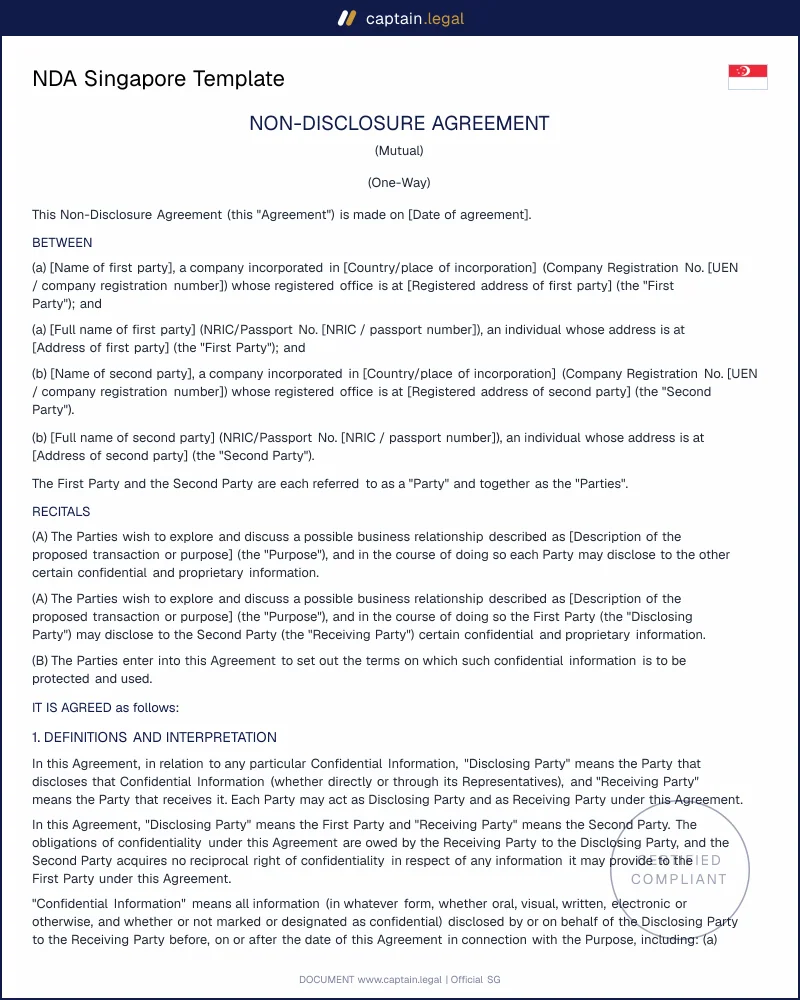
A Non-Disclosure Agreement, or NDA, is the contract that lets a Singapore business open its books, its code or its supplier list to an outsider without handing over the keys to the kingdom. It binds the receiving party to keep what they learn secret and to use it only for an agreed purpose, whether the counterparty is a venture investor running diligence, a contract manufacturer quoting on a build, or a freelance developer touching your codebase. A well-drafted confidentiality agreement does more than recite boilerplate. It pins down exactly what counts as confidential, why it was shared, how long the duty lasts, and what happens to the material when the talks end. This template gives you both the mutual and the one-way structure, drafted for Singapore practice and aware of your obligations under the Personal Data Protection Act 2012 when the secrets include personal data.

Compliant

2026 Legislation

50,000+ clients

trust us

Affordable

From $4.90 / doc

Secure payment

Instant download

Singapore NDA Template | Common Law of Confidence

Secure payment · No subscription

Fill in the template

What is a non-disclosure agreement in Singapore?

A non-disclosure agreement is a binding contract under Singapore's common law of contract by which one party (or both) promises to protect information disclosed by the other and to restrict its use to a defined permitted purpose. Singapore practitioners use two structures depending on the flow of information. A one-way NDA protects a single discloser, the natural choice when you brief a supplier on your specifications or hand a contractor your customer data. A mutual NDA protects both sides and is standard when two businesses explore a joint venture, a merger or a reseller arrangement and each expects to reveal sensitive material.

People often confuse the NDA with a confidentiality clause buried inside a larger contract. The difference matters. A standalone NDA is signed before substantive negotiations begin, so the information is protected from the very first meeting, whereas a clause in a services agreement only bites once that agreement is concluded. A discloser who waits until the master contract is signed has often already given away the very thing worth protecting. The NDA also sits apart from a restraint-of-trade or non-compete covenant: an NDA controls information, not a person's freedom to work, and Singapore courts treat the two very differently when they assess enforceability. Keep the confidentiality obligation and any restraint cleanly separated, because conflating them is one of the fastest ways to have a clause struck down.

2

When do you need this document?

The most frequent trigger is a financing conversation. Before an investor sees your cap table, revenue figures or technology, a one-way or mutual NDA lets you share the diligence pack without losing control of it. The second common scenario is supplier and manufacturing talks, where you must reveal designs, tolerances or formulations to get a realistic quote; here a one-way NDA protecting you as discloser is usually enough. A third is engaging a freelancer or agency, the developer who needs production access or the marketing contractor who sees your customer list, and this is precisely where the PDPA dimension surfaces because personal data is changing hands.

Two edge cases separate a careful drafter from a careless one. First, the employee who is leaving to start something adjacent: the I-Admin decision means you can act on the mere possession of your confidential files, but only if you can show the material was confidential and imparted under an obligation, which a signed NDA or confidentiality clause makes far easier to prove. Second, the multi-party pitch, where you present to several prospects at once. A single mutual NDA rarely fits, because you do not want disclosure to Prospect A binding Prospect B; separate one-way agreements keep the obligations clean. When confidentiality sits alongside a working relationship rather than a standalone disclosure, a tailored Singapore confidentiality clause within an employment contract is often the better instrument.

3

Key clauses included in our template

  • The definition of confidential information is drafted broadly enough to catch oral, visual and written disclosures, then narrowed by carve-outs for information that is already public, independently developed or lawfully received from a third party. A definition that is too tight leaves gaps a recipient can exploit, while one with no carve-outs is often read down by a court as unreasonable.
  • The permitted purpose clause is the engine of the agreement. It states the single reason the information may be used, evaluating a possible investment or preparing a supply quote, and forbids every other use. Without a tight purpose, a recipient can argue almost any use was within scope, which is why this clause does more work than any other.
  • The return-and-destruction obligation requires the recipient to give back or destroy all copies, including electronic and backup copies, once the discussions end or on written demand. The template includes an option to require written certification of destruction, which matters because I-Admin makes retained copies a live risk.
  • The survival period sets how long the duty of confidence outlasts the agreement. Our template lets you choose a fixed term for ordinary commercial information and a perpetual obligation for trade secrets, since the two deserve different treatment under Singapore law.
  • The PDPA compliance and no-licence provisions confirm that disclosure grants no intellectual property rights and that any personal data within the disclosure must be handled in line with the Personal Data Protection Act 2012.
4

Regional and sectoral considerations

Singapore is a single jurisdiction, so there are no state-by-state variations to manage, but the sector in which you operate changes how an NDA should read. In financial services, a recipient may already sit under MAS confidentiality and outsourcing rules, and the NDA should dovetail with those rather than contradict them; a clause that purports to override regulatory reporting duties is unenforceable. In technology and software, the most contested ground is source code and know-how, and here the survival clause should treat trade secrets as protected indefinitely while I-Admin gives real teeth to a claim built on a departing engineer's mere copying of a repository.

In the biomedical and manufacturing sectors, disclosures often involve formulations, processes and prototypes that lose all value once public, so a one-way NDA with an aggressive destruction-and-certification obligation is the norm. Cross-border dealings deserve a hard look at the PDPA Transfer Limitation Obligation: a recipient in a group with offshore servers may move personal data out of Singapore, and the agreement should require a comparable standard of protection abroad. Watch the governing-law and jurisdiction clause closely when one party sits overseas, because an NDA expressed to be governed by Singapore law but silent on the forum can land you arguing jurisdiction before you ever reach the merits. For the broader picture on entity-level confidentiality and ownership controls, our overview of Singapore business and incorporation templates shows how an NDA fits the rest of the founding paperwork.

5

How to fill out this non-disclosure agreement

You begin by choosing the structure that matches the disclosure: one-way if only you are revealing material, mutual if both sides will. From there the form asks who the parties are, capturing the full legal name and registration number of each company or the full name and identification of each individual, because a notice naming the wrong entity is one of the easier ways to weaken enforcement later. Next you set the permitted purpose in plain words, and the template prompts you to be specific rather than generic, since this single field shapes how far the protection reaches.

You then select the survival period, with the option to run trade secrets on a perpetual footing, and decide whether to require written certification of destruction at the end. If the disclosure includes personal data, you switch on the PDPA compliance wording so the recipient's data-handling duties are explicit. The form lets you confirm Singapore law and the courts of Singapore as the governing framework, then generates a clean document ready for electronic or wet-ink signature. Once finished, you download it in both Word and PDF so you can sign immediately or adjust the language for a particular counterparty. If your project also needs a Singapore service or supply agreement template to sit behind the NDA, the same flow lets you build it next.

6

Common mistakes to avoid

The error practitioners see most often is a permitted-purpose clause that is too loose, or missing entirely. When the agreement does not say why the information was shared, a recipient can argue that almost any subsequent use fell within the spirit of the deal, and the discloser is left litigating over intent rather than enforcing a clear promise. Closely related is the over-broad definition of confidential information with no carve-outs: a Singapore court asked to enforce a definition that sweeps in genuinely public knowledge will often read it down, and a clause read down is a clause weakened. The third recurring problem is treating the NDA as an afterthought, signed only after sensitive material has already crossed the table, by which point the protection arrives too late to matter.

Two further mistakes carry real cost. Forgetting the return-and-destruction obligation leaves your material sitting on a recipient's servers indefinitely, and after I-Admin that retained copy is itself a source of risk you could have closed off. Finally, businesses regularly ignore the personal-data dimension, treating an NDA as purely commercial when the disclosure includes employee or customer records; that oversight leaves the recipient's PDPA obligations unstated and can expose both parties when data is mishandled. A confidentiality regime that pairs the NDA with sound internal personal and family document practice for any individual records involved is the more defensible position.

Key takeaways

STRUCTURE

Pick mutual or one-way, then define purpose

Choose the NDA structure based on who is disclosing. A one-way NDA fits when only one party is sharing sensitive material (for example, your specs, customer list or code). A mutual NDA suits joint venture or deal discussions where both sides will reveal information. In both cases, lock down the permitted purpose so the recipient cannot repurpose what they learn.

TIMING

Sign before talks, not after

A standalone NDA is meant to be signed before substantive negotiations start, so protection applies from the first meeting, first deck and first data room upload. If you wait for a confidentiality clause inside the main services or investment agreement, you may already have disclosed the very information you needed to protect. Treat the NDA as an early gatekeeper, not a closing document.

LEGAL RISK

Copying alone can be a breach

In Singapore, an NDA is backed by contract law and the equitable obligation of confidence. After I-Admin (Singapore) Pte Ltd v Hong Ying Ting [2020] SGCA 32, once information has the quality of confidence and was shared in circumstances importing confidence, breach is presumed and the burden shifts to the recipient. Mere possession or copying can be enough, even before any profit is made. If personal data is involved, PDPA obligations also bite.

Frequently Asked Questions

Yes. The template is drafted as a contract under Singapore's common law of contract, so once both parties sign and consideration passes, it binds them like any commercial agreement. It also reflects the equitable obligation of confidence recognised in I-Admin (Singapore) Pte Ltd v Hong Ying Ting [2020] SGCA 32, which protects confidential information independently of the contract's wording. Enforceability still depends on sensible drafting, so a tight permitted purpose and a reasonable definition of confidential information matter. A court will not rewrite an agreement that is vague or oppressively broad, which is why the template guides you toward specific, defensible language rather than a catch-all clause.

It depends on who is sharing information. Choose a one-way NDA when only you disclose, for example when you brief a supplier on your specifications or give a freelancer access to your data. Choose a mutual NDA when both sides will reveal sensitive material, as in a joint-venture discussion or a merger where each party shows the other its figures and technology. A mutual agreement is not automatically safer; it simply mirrors the obligations. If only one party is genuinely disclosing, a one-way structure is cleaner and avoids creating obligations you do not need. The template lets you switch between the two before you generate the document.

You set the duration yourself in the survival clause. For ordinary commercial information a fixed term of three to five years after the agreement ends is common in Singapore practice, long enough to cover the period in which the information retains value. Trade secrets are treated differently, and the template lets you run their protection on a perpetual basis, since a genuine trade secret loses its character only when it becomes public. The duty to keep silent survives the end of the negotiations or the working relationship, and the return-or-destroy obligation is usually tied to that same end point or to written demand.

Yes, whenever the disclosure includes personal data such as names, contact details, NRIC numbers or payroll records. The receiving party then carries obligations under the Personal Data Protection Act 2012, including the Protection Obligation and purpose-limitation rules, and any transfer of that data outside Singapore engages the Transfer Limitation Obligation. The Personal Data Protection Commission can impose financial penalties for breaches, so the template includes wording that requires the recipient to comply with the Act. An NDA does not replace PDPA compliance; it sits alongside it, and the safest agreements make the recipient's data duties explicit rather than assuming them.

Yes. The Electronic Transactions Act 2010 gives electronic records and signatures the same validity as paper for commercial contracts, and an NDA falls squarely within that. A signed PDF returned by email, or a signature applied through an e-signing platform, creates a binding agreement. The narrow exceptions in the Act, such as wills and certain property instruments, do not touch NDAs. For cross-border deals it is still worth confirming that the counterparty's home jurisdiction also recognises the electronic signature, but for a Singapore-governed NDA between Singapore parties, electronic execution is straightforward and routine.

You receive the NDA in both Word and PDF. The Word file lets you make final adjustments, such as inserting a specific permitted purpose for an unusual deal or aligning defined terms with a master agreement, while the PDF is ready to circulate and sign as it stands. Most users send the PDF for electronic signature when speed matters and keep the Word version for any negotiation that requires redlining. Both versions carry the same Singapore-drafted clauses, so you lose nothing by choosing one over the other.

Trigger the return-and-destruction clause. The template requires the receiving party to return or destroy all copies of the confidential information, including electronic files and backups, once the talks conclude or on your written demand. You can also switch on a requirement for written certification that destruction has taken place. This step is more important than it looks: after the I-Admin decision, a recipient who simply retains your files can be exposed to a breach-of-confidence claim, so closing the loop with a clear destruction obligation protects both sides and removes any lingering ambiguity about what happens to the material.

No, and you should not try to make it do so. An NDA controls information, not a person's freedom to work. A clause that purports to restrain a freelancer or employee from taking on a competitor is a restraint of trade, judged by a separate and demanding test under Singapore law, and bundling it into an NDA risks weakening the whole agreement. Keep the two instruments distinct: the NDA protects what the contractor learns, while any legitimate restraint belongs in a properly drafted and reasonable covenant. The template focuses on confidentiality and deliberately leaves restraint of trade to a purpose-built clause.

4.8/5

25 verified reviews · 50 000+ downloads

Singapore NDA Template | Common Law of Confidence
  • Immediate access to the document
  • PDF + Word download
  • Compliant with 2026 legislation
  • Reviewed by lawyers
Fill in the template
Secure payment · No subscription
Updated on June 17, 2026

You might also like

First Board Resolutions Singapore
Shareholders' Agreement Singapore Template