Create my document
Login

Choose country

SingaporeSingaporeChoose country
Real Estate

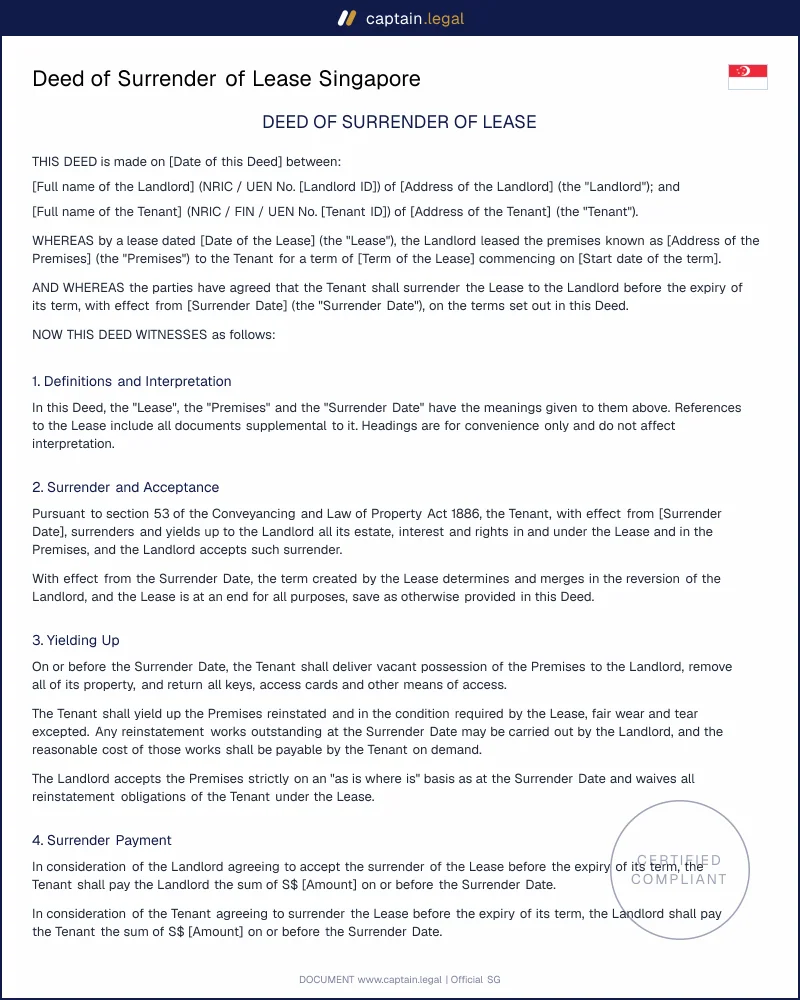
Deed of Surrender of Lease | CLPA 1886 s.53

Executed by deed under s.53 Conveyancing and Law of Property Act 1886. Merger of term, mutual release and IRAS stamp duty handled. Word and PDF.
4.8/512 reviews50 000+ downloadsInstant download
Share

A Deed of Surrender of Lease is the instrument by which a Singapore tenant hands the unexpired term of a lease back to the landlord before the contractual expiry, so that the term merges into the reversion and the tenancy ends by agreement rather than by forfeiture or effluxion. It is the clean, consensual exit that a notice to quit or a forfeiture re-entry is not. Landlords and tenants reach for it when both sides want the tenancy to stop early on agreed terms, with a mutual release from future obligations and a settled position on the security deposit. Because a surrender deals with an interest in land, Singapore law requires it to be made by deed under the Conveyancing and Law of Property Act 1886, not by a casual exchange of messages.

This template is drafted for Singapore conveyancing practice, ready to execute as a deed and to stamp with IRAS where duty arises. It suits residential and commercial premises alike.

Compliant

2026 Legislation

50,000+ clients

trust us

Affordable

From $4.90 / doc

Secure payment

Instant download

Deed of Surrender of Lease | CLPA 1886 s.53

Secure payment

Fill in the template

What is a deed of surrender of lease?

A surrender is the yielding up of a lease by the tenant to the immediate landlord, with the landlord's acceptance, so that the lesser interest (the term) is absorbed into the greater interest (the reversion) and ceases to exist. Once that merger happens, the tenant owes no further rent for the balance of the term and the landlord recovers immediate possession. This is fundamentally different from an assignment, where the tenant transfers the lease to a third party and the term survives in new hands. It also differs from a Deed of Assignment or Novation of Lease, which keeps the tenancy alive under a substituted party. A surrender extinguishes the tenancy; an assignment or novation of a Singapore lease merely moves it.

Singapore recognises two routes. A surrender by express deed is the deliberate, documented route this template provides, signed by both parties and setting out the surrender date, the deposit treatment and the release. A surrender by operation of law arises where the parties act inconsistently with the lease continuing, for example the tenant returns the keys and the landlord re-lets to someone else. The second route is unreliable and litigated after the fact. The express deed removes the guesswork by recording consent, the effective date and the financial reconciliation in writing. For a fixed exit that will hold up if a dispute later arises, the deed is the safer instrument by a wide margin.

2

When do you need this document?

The most common trigger is a tenant who must leave before the fixed term ends and whose landlord agrees to let go rather than hold him to the balance of the rent. A relocation, a business closure, a downsizing: each is a textbook case for a negotiated surrender rather than a messy default. The second frequent scenario is a landlord who wants the premises back early, perhaps to sell with vacant possession, to redevelop, or to move in a family member. Here the landlord often pays the tenant to go, which changes the stamp duty analysis and makes the written deed even more important. A commercial lease that needs an early, clean termination is a classic use case, because business tenants carry reinstatement and service-charge obligations that both sides want reconciled on the way out.

Two edge cases deserve flagging. First, a partial surrender, where only part of the demised area is handed back while the tenant keeps the rest, engages the apportionment rules and needs careful drafting of the rent that survives. Second, a tenancy under a mortgage: if the landlord's interest is mortgaged, the mortgagee's consent may be required before a surrender binds, because a surrender can prejudice the security. In both situations the standard one-page release is not enough, and the deed must spell out exactly what is being given up and what continues.

3

Key clauses included in our template

  • The parties and recitals identify the current landlord and tenant, recite the original lease by date and premises, and confirm that both parties intend an early surrender. Getting the recital of the original lease exact matters, because the deed derives its whole effect from the tenancy it is unwinding.
  • The operative surrender and acceptance is the heart of the deed. The tenant surrenders all its estate, right and interest in the premises to the landlord, and the landlord accepts, so that the term merges in the reversion from the stated effective date. Vague language here defeats the merger, so the clause is drafted to the point.
  • The mutual release discharges each party from future obligations under the surrendered lease from the effective date, while expressly preserving accrued liabilities such as rent already due, damage already caused or reinstatement already triggered. A release that is too wide can wipe out a legitimate arrears claim, so the carve-out is deliberate.
  • The security deposit clause fixes what happens to the deposit: returned in full, applied against arrears or damage, or partly withheld against agreed deductions. This is the clause that decides most surrender disputes, and it is drafted to state the figure, the deductions and the refund date plainly.
  • The reinstatement and handover terms record the condition in which the premises are returned, any agreed reinstatement works and the date vacant possession passes, so a landlord taking premises back for sale with vacant possession is not left arguing about make-good afterwards.
  • The costs, stamp duty and further assurance provisions allocate who bears the stamping cost and bind the parties to sign anything further needed to perfect the surrender on title.
4

Regional and situational considerations

Residential HDB tenancies carry their own layer. A surrender of an approved HDB flat rental should be reconciled with HDB's registration of the tenancy, and the eligibility and occupancy rules under the HDB Act mean an early exit may need to be reported so the flat's rental approval is closed out cleanly. The deed governs the private position between landlord and tenant, but it does not by itself update HDB's records, so the parties should notify HDB where a formal tenancy was registered.

Private condominium and landed tenancies are the most straightforward, operating under common law and the CLPA. The surrender deed plus, where duty arises, IRAS stamping is usually the full picture. If the tenancy was registered under the Land Titles Act 1993, the surrender of a registered co-ownership or leasehold interest should be lodged with the Singapore Land Authority to clear the encumbrance from the title.

Commercial premises raise the highest stakes because of reinstatement. Office, retail and F&B leases routinely impose make-good obligations worth tens of thousands of dollars, and a surrender that stays silent on reinstatement leaves both sides exposed. The deed should state whether make-good is done, waived or paid out. Where the landlord pays the tenant a reverse premium to surrender early, remember that IRAS characterises that payment as an assignment chargeable with BSD, so the duty must be assessed and paid within the deadline. GST may also arise on a surrender premium where the paying party is GST-registered and the surrender is a supply, a point worth checking before the figure is fixed.

5

How to fill out this deed of surrender of lease

You start by confirming the parties as they appear on the original lease, then reciting that lease accurately by its date, the premises and the term, because the deed only works if it correctly identifies the tenancy it unwinds. From there you set the effective date of surrender, the single most important field, since it fixes when the merger takes effect and when rent stops running. You then choose the deposit outcome: full refund, set-off against arrears or damage, or a stated deduction, and you enter the figures so the reconciliation is on the face of the deed. Next you record the reinstatement and handover position, stating whether make-good is complete, agreed as a payment or waived. If any consideration passes, you note who pays whom and how much, which drives the stamp duty treatment. Finally both parties execute the document as a deed, with the signatures witnessed, and where duty arises the deed is stamped through IRAS within the deadline. The guided fields walk you through each of these in order, and the output is ready as PDF and Word.

6

Common mistakes to avoid

The error we see most often is treating a surrender as an informal arrangement. Keys are handed over, a text message says "lease ended", and months later a rent claim surfaces because nothing was executed as a deed under section 53 CLPA. A surrender of a land interest that is not by deed is legally fragile, and a landlord can argue the tenancy continued. The second recurring mistake is a release that is drafted too widely, discharging "all claims" and accidentally extinguishing a legitimate claim for arrears or reinstatement that had already accrued; the release must carve out accrued liabilities explicitly. The third is silence on the security deposit, which guarantees a dispute, and the fourth is silence on reinstatement in a commercial context, where make-good costs are substantial. Sorting the deposit and the make-good position in the same tenancy document that governed the original letting saves an argument later.

The subtler error is the stamp duty trap. Parties assume a surrender is always duty-free, then the landlord pays the tenant to leave and no one realises IRAS treats that as a chargeable assignment. Missing the 14-day stamping window adds a penalty and, until it is paid, the deed cannot be produced in court. Assess duty before signing, not after.

Key takeaways

FORMALITY

A surrender must be executed by deed

Because a surrender deals with an interest in land, it must be made by deed under s.53 Conveyancing and Law of Property Act 1886, in the English language. An email chain or WhatsApp agreement is not enough, and you may end up with the original lease still binding (including rent) even if both sides thought the tenancy had ended. Use an express deed signed by both landlord and tenant.

EFFECT

Surrender ends the lease by merger

A deed of surrender extinguishes the tenancy: the unexpired term merges into the landlord’s reversion, the landlord regains immediate possession, and the tenant should not owe future rent for the balance of the term from the effective date. This is not an assignment or novation, which keeps the lease alive under a new party. The surrender date must be unambiguous because it drives liabilities and handover.

ADMIN

Settle deposit, stamping, and registration

Use the deed to lock in the practical exit terms: mutual release from future obligations, how the security deposit is treated, and the financial reconciliation on handover. Then deal with the paper trail. Where duty arises, the deed should be stamped with IRAS; treatment depends on whether any consideration is paid. If the lease is registered under the Land Titles Act 1993, record the surrender with SLA to clear title.

Frequently Asked Questions

Yes, provided it is executed as a deed. Under section 53 of the Conveyancing and Law of Property Act 1886, a surrender of an interest in land must be made by deed in the English language to be effective. A properly signed and witnessed deed binds both landlord and tenant, ends the tenant's liability for future rent from the effective date and gives the landlord immediate possession. An informal surrender, by contrast, is easy to challenge. The one caveat is that if the landlord's interest is mortgaged, the mortgagee's consent may be needed for the surrender to bind fully, so check the title position before relying on the deed alone.

It depends on who pays whom. Where the parties simply agree an early exit with no consideration, IRAS treats the surrender as a nominal or exempt instrument and no ad valorem duty is payable. If the landlord pays the tenant to accept the surrender, that payment is treated as an assignment of lease and is chargeable with Buyer's Stamp Duty under Article 12(a) of the First Schedule. A payment from tenant to landlord to buy out of the lease attracts no fixed duty for surrenders executed on or after 19 February 2011. Where duty is chargeable, stamp within 14 days of signing to avoid a penalty.

A surrender ends the tenancy: the tenant gives the unexpired term back to the landlord, the term merges into the reversion and it ceases to exist. An assignment keeps the tenancy alive but transfers it to a new tenant, who steps into the outgoing tenant's shoes for the remaining term. You surrender when you want the lease to stop; you assign when you want someone else to take it over. The stamp duty treatment and the consents required differ between the two, so the choice should be made deliberately rather than by default.

The deed is available instantly in both Word and PDF. The Word version lets you adjust the parties, the effective date, the deposit reconciliation and the reinstatement terms to match your specific tenancy before execution, while the PDF is ready to print and sign. Because a surrender must be executed as a deed with witnessed signatures, you download, complete the fields, and then have both parties sign in the presence of a witness. Where stamp duty applies, you stamp the executed deed through the IRAS e-Stamping portal.

On the effective date stated in the deed, not on the date of signing unless the two coincide. This is why the effective date field is drafted as a distinct, deliberate choice. From that date the term merges into the reversion, the tenant's obligation to pay future rent stops, and the landlord is entitled to vacant possession. Rent, service charges and other liabilities that accrued before the effective date remain payable unless the deed expressly releases them, so the parties should reconcile all outstanding sums up to that date and record the position in the deed.

Yes, a partial surrender is possible, where the tenant hands back part of the demised area and keeps the rest. This engages the apportionment rules in section 12 of the CLPA, and the deed must state clearly which part is surrendered, the reduced rent for the retained portion and how shared obligations are split. Partial surrenders are more complex than a full exit and are worth drafting with care, because ambiguity over what was given up and what continues is a common source of later dispute.

That is governed by the deed itself, which is why the deposit clause is drafted to state the outcome plainly. The deposit may be returned in full, applied against outstanding rent or damage, or partly withheld against agreed deductions. The deed should name the figure, list any deductions and set a refund date. A surrender that stays silent on the deposit is the single most common cause of post-exit disputes, so agreeing the number and recording it on the face of the document protects both sides. If deductions are contested, the accrued-liabilities carve-out in the release preserves each party's right to pursue a genuine claim.

4.8/5

12 verified reviews · 50 000+ downloads

Deed of Surrender of Lease | CLPA 1886 s.53
  • Immediate access to the document
  • PDF + Word download
  • Compliant with 2026 legislation
  • Reviewed by lawyers
Fill in the template
Secure payment
Updated on July 11, 2026

You might also like

Tenancy Diplomatic Clause Notice
Commercial Lease Agreement Singapore