Create my document
Login

Choose country

SingaporeSingaporeChoose country
Non-Profit & Associations

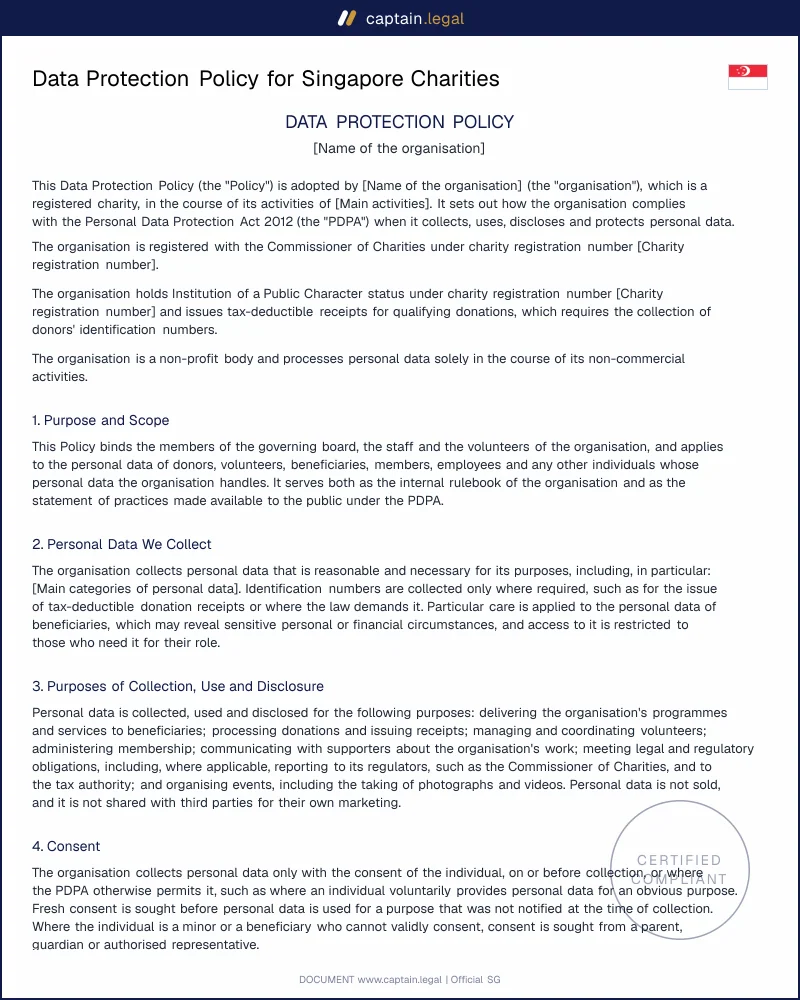
Data Protection Policy Template: PDPA Compliance Pack SG

Generate your data protection policy in minutes and download it in Word and PDF, with PDPA consent wording ready for donation and volunteer forms.
4.8/513 reviews50 000+ downloadsInstant download
Share

Every Singapore charity sits on a growing pile of personal data: donor lists, volunteer rosters, beneficiary case notes, staff files. The Personal Data Protection Act 2012 applies to all of it, and the regulator does not run a softer regime for the non-profit sector. What the law expects is easy to state and hard to improvise: a written data protection policy, a named Data Protection Officer and consent wording that actually works on your forms. This PDPA Compliance Pack gives a registered charity, an Institution of a Public Character or a society all three in a single document. You answer a short series of questions, and the policy comes out numbered and ready for your board to adopt.

Compliant

2026 Legislation

50,000+ clients

trust us

Affordable

From $4.90 / doc

Secure payment

Instant download

Data Protection Policy Template: PDPA Compliance Pack SG

Secure payment

Fill in the template

What is a PDPA data protection policy?

A data protection policy is two documents in one. Internally, it is the rulebook that tells your board members, staff and volunteers how personal data may be collected, used, disclosed and stored. Externally, it is the statement of practices that the PDPA's accountability obligation requires you to make available to the public, so that a donor or beneficiary can see how their information is handled.

This template goes further than a bare policy. It ships with a ready-made consent clause for your donation, volunteering and registration forms, a photography and video consent rule for events, and a full Data Protection Officer clause that records who holds the role and how the public can reach them. The text adapts to your structure: a registered charity states its registration with the Commissioner of Charities, an Institution of a Public Character adds the tax-receipt regime that obliges it to collect donor identification numbers, and a society or informal non-profit drops the registration language altogether. Volunteers are bound the same way as employees, which is why a written volunteer agreement template is worth signing alongside the policy.

2

When your organisation needs this policy

The trigger is rarely a regulator knocking on the door. In practice, the request comes from a grant maker running due diligence, a corporate donor's procurement team, an IPC status review, or a partner agency that shares beneficiary data with you for a joint programme. All of them now ask the same question: show us your data protection policy. Committees that have nothing in writing end up drafting one over a weekend, usually by copying a foreign privacy notice that cites the wrong statute.

There are also internal triggers. The moment volunteers start handling beneficiary records, the moment you launch a donor newsletter, or the moment you plan a street collection or phone appeal, you need written rules the whole team can follow. Browse the other non-profit and association templates for Singapore: most of them assume this policy already exists, and funding applications attach it. Adopting it early is cheaper than retrofitting it after an incident, when the regulator will ask what policies were in force on the day the data went missing.

3

Key clauses in the template

The policy runs through fourteen numbered sections, and the numbering recalculates itself when the optional fundraising section is switched off. The clauses your reviewers will look for first:

  • The purpose and scope clause binds board members, staff and volunteers alike, and covers the data of donors, members, employees and beneficiaries. It doubles as the public statement of practices the PDPA expects.
  • You describe the categories of personal data you actually collect, in your own words, and a restraint rule confines NRIC and other identification numbers to situations where the law requires them, such as tax-deductible donation receipts.
  • The clause on consent, withdrawal, access and correction carries the ready-made consent wording, the specific consent rule for event photography and the thirty-day written notice mechanism for access requests that take longer to answer.
  • Security arrangements are spelled out for electronic and paper records, retained data is reviewed on a fixed cycle, and personal data leaves Singapore only under a comparable standard of protection.
  • The data breach management clause sets the internal reporting line, the three-day notification rule for notifiable breaches and a register of every incident, whether it reaches the notification threshold or not.
  • A dedicated clause records the Data Protection Officer's identity and public contact details, and the adoption block closes the policy with the board's decision, a date and an authorised signature.

The fundraising and marketing section deserves a word of its own. It commits the organisation to checking the Do Not Call Registry before marketing or fundraising calls and texts to Singapore numbers, unless the recipient has given clear written consent, and it separates transactional messages such as donation receipts from marketing proper. That standard is deliberately stricter than the legal minimum, and it protects a campaign on the day someone adds a ticketed dinner to the appeal. If your organisation runs public appeals, pair the policy with the fund-raising permit application pack so the permit and the data behind the campaign are covered together. If you never solicit, answer no to one question and the section disappears cleanly, renumbering everything after it.

5

Common mistakes charities make

The most common error is recycling a GDPR privacy notice from a European website as the charity's data protection policy. The vocabulary looks familiar, but the deadlines, the legal bases and the regulator are all wrong, and a reviewer spots the transplant in seconds. The second is collecting NRIC numbers by default on every form; under the PDPC's advisory guidelines on NRIC numbers, identification numbers should only be collected where the law requires it or where it is genuinely necessary, such as issuing tax-deductible donation receipts.

Structural mistakes follow. Some organisations name no Data Protection Officer at all, or name one and keep the contact details private, which defeats the statutory purpose. Others treat volunteers as outsiders and never brief them, although they handle the most sensitive beneficiary data in the field. Breach registers are another blind spot: the register must record every incident, including the ones that never reach the notification threshold. And human resources data is often forgotten entirely, even though staff files fall squarely under the Act; your Singapore employment contract and this policy should point at each other, one creating the employment relationship and the other governing the data it generates.

Key takeaways

PDPA basics

Have a written policy and a named DPO

Under the Personal Data Protection Act 2012, charities and societies are not treated more lightly. You need a written data protection policy that can be shown publicly as a statement of practices, and you must designate at least one Data Protection Officer (DPO) with business contact details available to the public. This is not just paperwork; it sets the internal rules for staff and volunteers handling personal data.

Consent

Use consent wording that matches purpose

Consent remains the anchor for collecting, using and disclosing personal data. If someone gives details for an obvious purpose, deemed consent may apply, but you still need fresh consent before using the data for a new purpose they were not told about. The pack includes consent clauses for donation, volunteering and registration forms, plus photography and video consent for events, so your forms do not undercut your policy.

Deadlines

Know the breach and access timelines

The PDPA sets clear timelines that can bite during a crisis. If a data breach is likely to cause significant harm or is of significant scale, you must notify the Personal Data Protection Commission within three calendar days of determining the breach is notifiable. Individuals can also request access and corrections; if you cannot respond to an access request within 30 days, you must write back with when you will.

Frequently Asked Questions

Yes, in two directions. Once the governing board adopts it, the policy binds your staff and volunteers as an internal rule, and a breach can be treated as a disciplinary matter under the governance clause. Towards the outside world, it is the statement of practices the PDPA's accountability obligation expects you to make available, and the Personal Data Protection Commission will measure your conduct against it if a complaint or a breach is investigated. No notary or witness is needed; the adoption date and an authorised signature are enough.

Yes. When the wizard is complete you receive the document in both Word and PDF formats. Most organisations publish the PDF on their website or keep it ready to attach to grant applications, and keep the Word version for the next review cycle, since the policy commits you to revisiting it at least once a year. The Word file is fully editable, so later changes such as a new Data Protection Officer or an added activity take minutes rather than a fresh drafting exercise.

Three calendar days from the moment you determine that the breach is notifiable, meaning it is likely to cause significant harm to the individuals concerned or is of a significant scale. The assessment itself must be carried out promptly once a breach is suspected. Not every incident crosses the threshold: a misdirected email caught within minutes usually stays internal. The policy still requires a register of all breaches, notifiable or not, together with the remedial action taken, because that register is the first thing an investigator asks for.

Yes. The obligation to designate a Data Protection Officer applies to every organisation, with no exemption for size or for the non-profit sector. The role does not require a lawyer: a committee member, the general manager or a trusted volunteer can hold it, and the function can also be outsourced. What matters is that someone is formally designated, that the person understands the organisation's data flows, and that their business contact details are genuinely public, on your website or in the policy itself.

For data protection purposes, treat them exactly the same. The Act holds the organisation responsible for what is done with personal data in its name, whoever does it. This policy therefore binds volunteers alongside employees, requires them to keep data confidential, and includes them in training and briefings. Practical guides on Captain.Legal's Singapore legal blog cover the onboarding side; the short version is that every volunteer who touches donor or beneficiary records should sign an agreement acknowledging the policy.

Only where the message carries a marketing element. Under the PDPC's advisory guidelines on the Do Not Call provisions, a call or text that does nothing but ask for a donation is generally not a specified message, so the Registry duty is not triggered. Selling tickets to a gala, promoting merchandise or offering anything in return changes that immediately, and the campaign must then check Singapore numbers against the Registry unless the recipient has consented clearly and in writing. This template takes the prudent route and commits the organisation to checking before any marketing or fundraising campaign, so a volunteer never has to judge the line mid-call.

The pack includes a one-sentence consent clause, automatically completed with your organisation's name, for donation, volunteering and registration forms. It covers collection, use and disclosure for the purposes set out in the policy and reminds the signer that consent can be withdrawn at any time. Where the individual is a minor or a beneficiary who cannot validly consent, the policy directs you to a parent, guardian or authorised representative, and photographs taken at events call for their own specific consent before publication.

4.8/5

13 verified reviews · 50 000+ downloads

Data Protection Policy Template: PDPA Compliance Pack SG
  • Immediate access to the document
  • PDF + Word download
  • Compliant with 2026 legislation
  • Reviewed by lawyers
Fill in the template
Secure payment
Updated on July 12, 2026

You might also like

Board Resolution Template Singapore
Conflict of Interest Policy Singapore Charity