Create my document
Login

Choose country

FranceBelgiqueEspañaUnited StatesUnited KingdomMarocDeutschlandItaliaSchweizSingapore
Non-Profit & Associations

Charity Governance Pack: Charities Act 1994

Governance pack aligned with the Charities Act 1994 and the Code of Governance for Charities and IPCs. Board roles, conflict and reserves policies.
4.8/531 reviews50 000+ downloadsInstant download
Share

A charity governance pack is the bundle of founding and policy documents that lets a Singapore non-profit register with the Commissioner of Charities and run its board the way the regulator expects. It sits on top of your legal form, whether you are a society, a company limited by guarantee or a charitable trust, and it brings together the governing instrument, the board's terms of reference, a conflict-of-interest policy, a reserves policy and the decision-making rules that keep a committee accountable. The pack is built for organisations applying for charity status, and for existing charities tightening their governance ahead of the annual Governance Evaluation Checklist. It produces clean documents in Word and PDF, aligned with the Charities Act 1994 and the Code of Governance for Charities and IPCs.

Good governance is not a formality in Singapore. It is the first thing the Commissioner looks at when deciding whether your organisation deserves the public's trust, and the first thing donors check before they give.

Compliant

2026 Legislation

50,000+ clients

trust us

Affordable

From $4.90 / doc

Secure payment

Instant download

Charity Governance Pack: Charities Act 1994

Secure payment · No subscription

Fill in the template

What is a charity governance pack?

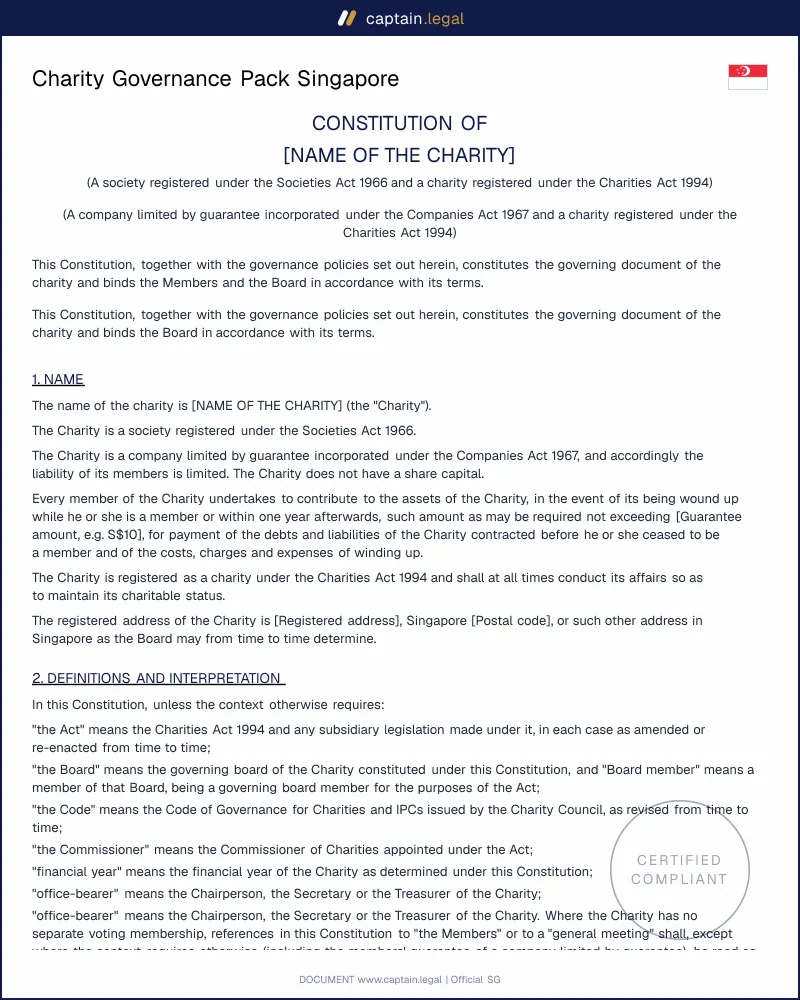
A charity governance pack is not a single contract. It is a coordinated set of constitutional and policy documents that together satisfy what the regulator calls the governing instrument and the governance framework around it. The governing instrument is your organisation's main constitutional document, the Constitution for a society, the company constitution (formerly the Memorandum and Articles of Association) for a company limited by guarantee, or the trust deed for a charitable trust. The pack supplies that core instrument plus the supporting policies that the Code of Governance expects every board to have in writing.

People often confuse a governance pack with a simple society constitution, and the two are not the same thing. A bare constitution tells the Registrar who the members are and how meetings run. A governance pack goes further: it spells out board roles and the split between governance and management, it documents how conflicts of interest are declared and managed, it sets a reserves policy, and it fixes quorum and voting rules so that decisions are defensible if anyone later challenges them. A constitution alone rarely passes a serious charity registration review on the governance limb. The Commissioner frequently asks applicants to amend their instrument or add policies before approving charity status, which is exactly the gap this pack is designed to close before you submit rather than after.

2

When do you need this document?

The most common trigger is a brand-new organisation racing the three-month clock. You have just incorporated a company limited by guarantee with ACRA, or registered a society of ten or more members under the Societies Act 1966, and you now need a governing instrument and policy set that will survive the Commissioner's review without a round of amendments. Getting the governance pack right at this stage saves weeks, because the regulator commonly bounces applications back when the instrument lacks proper objects, dissolution clauses or conflict provisions. Founders setting up a corporate non-profit usually pair this pack with the constitution and founder resolutions covered in our Singapore business and incorporation document library.

The second scenario is the existing charity preparing for its annual Governance Evaluation Checklist. A board that adopted a thin constitution years ago often discovers, the first time it answers the GEC honestly, that it has no written reserves policy and no documented conflict-of-interest procedure. Rebuilding those before the submission deadline turns a string of "no" answers into "yes". A third, increasingly frequent trigger is the move to seek Institution of a Public Character (IPC) status, which unlocks the 250% tax deduction for donors but carries the stricter Tier 1 guidelines. The governance bar rises sharply, and a pack drafted to IPC standard is the cleanest way to clear it. Finally, a governance crisis, a resignation, a donor complaint or a disputed payment forces many boards to formalise rules they had only ever treated as understood. The members and committee resolutions in our Singapore personal and family legal templates frequently sit alongside the pack when those decisions need to be minuted properly.

3

Key clauses included in our template

  • The objects clause states the organisation's purposes in language that is exclusively charitable, because anything that is not exclusively charitable can sink the registration outright. The drafting tracks the recognised charitable heads under Singapore law and the Charities (Registration of Charities) Regulations, and keeps the purposes beneficial wholly or substantially to the community in Singapore.
  • The board composition and roles clause separates governance from day-to-day management and fixes the minimum of three governing board members, at least two of whom must be Singapore citizens or permanent residents. It defines the Chairman, Secretary and Treasurer roles and reflects the Code of Governance recommendation on term limits, including the maximum consecutive years for the Treasurer position.
  • The conflict-of-interest policy requires every board member to declare interests, recuse themselves from affected decisions, and have the abstention recorded in the minutes. This is one of the policies the Commissioner most often finds missing, and its absence is a frequent reason a GEC answer reads "non-compliant".
  • The reserves policy sets out how much the charity holds in reserve, why, and when it will be reviewed, which Principle 4 of the Code expects every board to articulate rather than leave to chance.
  • The decision-making and meetings clause fixes quorum at no fewer than half the board, sets voting thresholds, and regulates how resolutions are passed in and outside meetings, so that no decision can later be attacked as procedurally invalid.
  • The dissolution clause directs any surplus assets on winding up to another charity with similar objects, never to members, which is a hard requirement for charitable status.
4

Regional considerations

Singapore is a single jurisdiction, so there is no state-by-state variation, but the regulatory route does change with your legal form and that choice shapes the whole pack. A society is registered with the Registrar of Societies under the Societies Act 1966 and is fast to set up, but a society is not a separate legal person, so committee members can carry personal exposure. A company limited by guarantee is incorporated with ACRA under the Companies Act 1967, gives the organisation separate legal personality and limited liability, and is the form most larger or higher-risk non-profits prefer. A charitable trust is governed by its trust deed. The governing instrument language differs for each, and the pack adapts the wording accordingly.

The second axis is tier. Under the Code of Governance, Tier 1 covers all IPCs and large non-IPC charities with gross annual receipts or total expenditure of ten million dollars or more, while smaller charities sit in the lighter tier. An IPC is held to the full Tier 1 guidelines, including stricter board renewal expectations and a maximum term limit for board members in large charities and IPCs, so a pack drafted for a small community group will not, on its own, satisfy an IPC. The third consideration is the Sector Administrator. Depending on your field, health, education, social service, sports, arts or community, your application may be routed through a sector administrator rather than the Commissioner directly, and each can have its own emphasis. None of this changes the core documents, but it changes which guidelines you must answer in the GEC, which is why our pack flags the tier and form before you complete it.

5

How to fill out this charity governance pack

You start by telling the form which legal structure your organisation uses, since a society, a company limited by guarantee and a charitable trust each need a different governing instrument. From there the pack adjusts the constitutional wording and the references to the Societies Act, the Companies Act 1967 or the trust deed accordingly. You then enter the organisation's name, its charitable objects, and the names and identification of your governing board members, and the form checks that you have at least three with the required Singapore citizen or permanent resident threshold. Next you set the practical governance levers: quorum, voting thresholds, term limits and the financial year. The reserves and conflict-of-interest policies populate from a short set of choices, so you are not drafting from a blank page. Finally you indicate whether you intend to apply for IPC status, which switches the pack to the stricter Tier 1 language. The output downloads in Word so your board or lawyer can refine it, and in PDF for signing and submission through the Charity Portal. Boards that also need to record the adopting resolution often pull a template from our Singapore non-profit and association document collection.

6

Common mistakes to avoid

The mistake we see most often is treating registration as optional or open-ended. The three-month duty under the Charities Act is real, and boards that drift past it because "we are not collecting much yet" are already in breach. A close second is an objects clause that is not exclusively charitable. Founders love to add a commercial or members-benefit purpose "just in case", and that single line can defeat the entire application, because anything beyond exclusively charitable purposes disqualifies the organisation. Many boards also copy a generic constitution off the internet and never add the policies the Code of Governance expects, then answer the Governance Evaluation Checklist with a row of blanks where the reserves policy and conflict-of-interest procedure should be.

The other recurring failure is governance on paper but not in practice. A conflict-of-interest policy that exists in a folder but is never invoked when a board member's company bids for a contract is worse than useless, because it shows the board knew the rule and ignored it. Declare the interest, recuse, and minute it every single time. Boards also forget that personal data triggers the Personal Data Protection Act 2012, so they collect donor and volunteer details with no consent or retention rule in sight. Finally, many committees neglect quorum and term limits until a contested decision exposes the gap, by which point the validity of past resolutions is open to question. The fix in every case is the same: write the rule down before you need it, and follow it when you do.

Key takeaways

REGISTRATION

Three-month deadline to register as charity

If your organisation is set up for exclusively charitable purposes, the governing board members must apply to register with the Commissioner of Charities within three months of establishment under section 7(8)(a) of the Charities Act 1994. Missing the window puts the board in breach of a statutory duty, even though the Commissioner may allow a longer period. The application hinges on submitting the governing instrument and required particulars.

DOCUMENTS

A constitution alone usually is not enough

A charity governance pack is a coordinated bundle, not just a society Constitution. It sits over your legal form (society, company limited by guarantee under the Companies Act 1967, or charitable trust) and brings together the governing instrument plus board terms of reference, conflict-of-interest policy, reserves policy, and decision rules like quorum and voting. This is the material reviewers look for when assessing governance readiness.

GOVERNANCE

Code of Governance drives board expectations

The Code of Governance for Charities and IPCs sits above the statute and sets what boards are expected to have in writing, including clear board roles and how governance stays separate from management. It operates on a comply or explain basis, and the April 2023 edition applies to financial years beginning on or after 1 January 2024. This feeds directly into the annual Governance Evaluation Checklist, which donors often ask about too.

Frequently Asked Questions

The documents in the pack are drafted to be legally effective once they are properly adopted and signed by your governing board members or members, as your structure requires. The governing instrument becomes binding when adopted in accordance with the Societies Act 1966, the Companies Act 1967 or your trust deed, and the policies take effect once the board resolves to adopt them. What the pack cannot do is grant charity status by itself. Status is conferred only by the Commissioner of Charities after review under the Charities Act 1994. The pack puts you in the strongest position to pass that review, but the final approval rests with the regulator, not the document.

Yes. Every document generates in both Microsoft Word and PDF. The Word version is there so your board, secretary or lawyer can fine-tune the objects clause, adjust quorum and term limits, or insert sector-specific wording before adoption. The PDF version is formatted for signing and for upload through the Charity Portal when you submit your registration. Most boards keep the Word file as their working master and archive the signed PDF as the executed record. If your governing instrument is later amended, you regenerate the Word document and produce a fresh signed PDF, which keeps your governance file clean and current for any future Governance Evaluation Checklist.

Three months. Under section 7(8)(a) of the Charities Act 1994, the governing board members of an organisation established for exclusively charitable purposes have a duty to apply for registration within three months of establishment, supplying the governing instrument and required information. The Commissioner has discretion to allow a longer period in particular cases, but you should not assume it. Because the Commissioner's own processing then takes time, the practical lesson is to have your governing instrument and governance policies ready at or before incorporation rather than scrambling afterwards. A complete pack on day one is the difference between a smooth three-month application and a rushed, incomplete one.

At least three governing board members, and at least two of them must be Singapore citizens or permanent residents. Those are the baseline conditions for registration under the Charities (Registration of Charities) Regulations. The Code of Governance layers further expectations on top, especially for larger charities and IPCs, including regular board renewal and a maximum consecutive term, and a recommended limit on how long one person holds the Treasurer role. The pack builds these thresholds into the board composition clause so you do not accidentally fall below the statutory minimum or breach the renewal guidelines you are reporting against.

A charity is an organisation registered with the Commissioner under the Charities Act for exclusively charitable purposes. An Institution of a Public Character (IPC) is a charity that has also been approved to issue tax-deductible receipts, which lets donors claim a 250% tax deduction on qualifying gifts. IPC status is more valuable for fundraising but more demanding on governance, because IPCs fall into the stricter Tier 1 of the Code of Governance. If you intend to seek IPC status, you should build your governance pack to Tier 1 from the start rather than register as an ordinary charity and rebuild later.

Yes, and arguably more so. The fact that board members are unpaid does not remove conflicts. A trustee whose own company tenders for the charity's work, or who sits on the board of a grant recipient, has a real conflict regardless of whether anyone is paid. The Code of Governance expects a written conflict-of-interest policy, declared interests, and recusal recorded in the minutes. It is one of the items the Commissioner most often finds missing, and a blank answer on the Governance Evaluation Checklist against it is a visible signal of weak governance to anyone reading your public profile.

The Code operates on a comply or explain basis rather than as hard law, so you are not automatically in breach for departing from a guideline. What you must do is explain any departure honestly in your annual Governance Evaluation Checklist, which is published on the Charity Portal for donors and the public to see. In practice the reputational cost of repeated "non-compliant" answers is high enough that most boards treat the Code as a working standard. The guidelines are tiered, so a small community group answers fewer of them than a large IPC, but every registered charity reports against the version that matches its size and status.

4.8/5

31 verified reviews · 50 000+ downloads

Charity Governance Pack: Charities Act 1994
  • Immediate access to the document
  • PDF + Word download
  • Compliant with 2026 legislation
  • Reviewed by lawyers
Fill in the template
Secure payment · No subscription
Updated on June 16, 2026

You might also like

AGM Minutes & Annual Return
Society Constitution Singapore