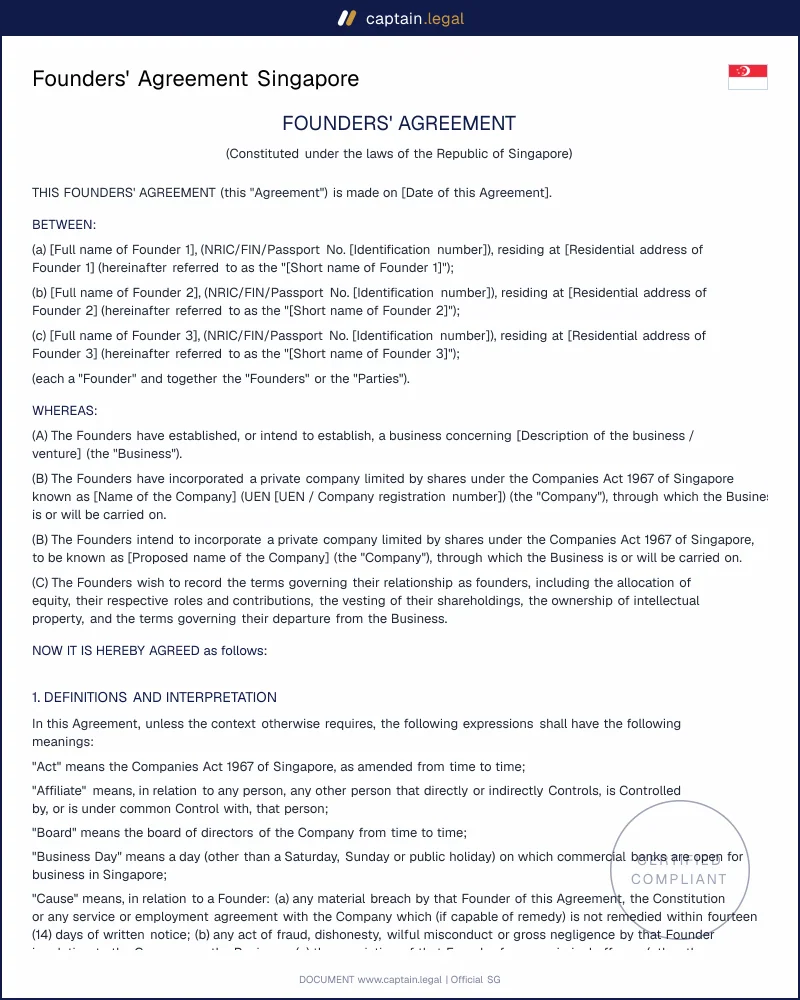
A Pte Ltd is incorporated and governed by the Companies Act 1967 (Cap. 50), administered by the Accounting and Corporate Regulatory Authority through the BizFile+ portal. The Act sets the baseline: at least one director ordinarily resident in Singapore, at least one shareholder, a registered office and a company secretary appointed within six months. What the Act does not do is dictate the private bargain between founders. It does not require a founders' agreement or an SHA, and it does not supply most of the protections co-founders need. That gap is exactly what your agreement fills, and it rests on Singapore's common law of contract: offer, acceptance, consideration and an intention to create legal relations.
The single most important point for Singapore founders concerns vesting. Singapore company law contains no automatic vesting mechanism. Give a co-founder 40 percent at incorporation and watch them leave after six months, and absent a vesting clause they keep the full 40 percent. There is no statutory claw-back. Vesting must be drafted explicitly, which is why this document earns its place.
Restraint clauses sit under a separate rule. A post-exit non-compete binding a departing founder is enforceable only if it protects a legitimate interest, such as confidential information or client connections, and is reasonable in scope, duration and geography. A blanket ban on ever competing will be struck down. Electronic signing is generally valid under the Electronic Transactions Act 2010, with narrow exceptions. You can read the statute itself on the Companies Act 1967 page at Singapore Statutes Online. For the governance papers that surround it, our Singapore board resolution template under the Companies Act 1967 handles the formal decisions that put your terms into effect.