Create my document
Login

Choose country

SingaporeSingaporeChoose country
Business

Director Service Agreement: s.157 Companies Act

Executive director contract drafted to section 157 Companies Act 1967 fiduciary duties and ACRA practice. Reviewed for Singapore. Word and PDF.
4.8/59 reviews50 000+ downloadsInstant download
Share

A Director's Service Agreement is the contract that turns a person appointed to the board into a properly engaged executive of your Singapore company, setting out remuneration, powers, obligations and the way the relationship ends. It sits alongside the appointment itself, which happens when the director signs a consent to act and the company lodges the appointment with ACRA. Where an appointment letter simply records that someone has become a director, a service agreement governs what that director actually does day to day, what they are paid, and how their fiduciary duties under section 157 of the Companies Act 1967 translate into enforceable contractual terms. Founders, boards and incoming executive directors all rely on this document to avoid the awkward gap between "you are on the board" and "here is exactly what we have agreed".

Compliant

2026 Legislation

50,000+ clients

trust us

Affordable

From $4.90 / doc

Secure payment

Instant download

Director Service Agreement: s.157 Companies Act

Secure payment

Fill in the template

What is a director's service agreement in Singapore?

A director's service agreement is a contract of employment made between a Singapore company and one of its directors who also works in the business, most often as an executive director, managing director or CEO. It differs from a plain appointment letter, which records the fact of appointment and the consent to act required under section 145, and from an ordinary staff employment contract, because the counterparty owes the company statutory and fiduciary duties that no rank-and-file employee carries. The agreement fixes the commercial terms of the engagement: salary, bonus, benefits, notice, restrictive covenants and the interaction between the person's role as an officer and their role as an employee.

The distinction matters in practice. A non-executive director who only attends board meetings is usually engaged under a short letter of appointment, not a full service agreement, because there is no employment relationship to document. An executive director who runs a function or the whole company needs the fuller instrument. Getting this wrong creates real problems later, since an executive removed as a director may still have live employment claims, and a company that never documented the remuneration finds itself arguing about what was promised. If you are also setting up the company's internal governance, the service agreement should be read together with your constitution and shareholders' arrangements so the powers granted to the director match what those documents allow. Our Singapore shareholders' agreement template is the natural companion where the director is also a shareholder.

2

When do you need this document?

The most common trigger is the appointment of an executive director who will draw a salary and run part or all of the business. A verbal understanding between founders works until the money is real; once a director is being paid, the company needs a written record of the remuneration, the role and the exit terms, and this is where our Singapore founders' agreement hands over to a proper service agreement. The second frequent scenario is a funding round or new investor coming in, when investors insist that key executives are locked in on documented terms with restrictive covenants, so that talent and intellectual property do not walk out of the door.

A change of role also calls for the document. When a senior employee is elevated to the board, their existing staff contract no longer captures the reality, because they now carry duties under section 157 that an ordinary employee never had. Bringing in an outside CEO produces the same need from the opposite direction. There are edge cases worth flagging. A director who is also a controlling shareholder should have the service agreement drafted in step with the shareholders' arrangements, or the two documents will contradict each other on reserved matters and removal. A nominee or non-executive director should generally not sign a full service agreement at all, since there is no employment to document and doing so can accidentally create obligations and liabilities the parties never intended. Getting the classification right at the outset saves an expensive unwinding later.

3

Key clauses included in our template

  • The appointment and term clause records the office held, the commencement date and whether the engagement runs for a fixed term or continues until terminated, and it cross-refers to the consent to act and the ACRA lodgement so the corporate and contractual appointments line up.
  • The duties and powers clause defines the scope of the executive's authority within the limits section 157A allows the board to delegate, and it makes clear that the director must devote proper time and attention to the role rather than treating it as a title.
  • The remuneration clause sets out salary, any performance bonus, benefits and the mechanism for review, and it distinguishes director's fees approved by the members from employment salary, a distinction that matters for both tax and company law.
  • The fiduciary and statutory duties clause restates the section 157 obligation to act honestly and with reasonable diligence and the section 156 duty to disclose conflicts, converting statutory duties into express contractual promises the company can enforce directly.
  • The confidentiality and intellectual property clause protects trade secrets and assigns work product to the company, an assignment that dovetails with your broader confidentiality documents such as the Singapore NDA template used with third parties.
  • The restrictive covenants clause addresses non-competition and non-solicitation on departure, drafted narrowly because Singapore courts enforce restraints of trade only where they protect a legitimate proprietary interest and go no further than reasonably necessary.
4

Regional considerations

Singapore is a single unified jurisdiction, so unlike a multi-state contract the service agreement does not vary by province or state. What does vary is the type of director and the type of company, and the agreement must be tuned to both.

Executive directors carry the full weight of an employment relationship layered on top of their office, so their agreements engage the Employment Act 1968 where the individual falls within its coverage, together with all the section 157 fiduciary duties. The contract here is the fullest version, with remuneration, notice, leave and restrictive covenants all documented. Non-executive and nominee directors sit at the other end. They are generally engaged under a short letter of appointment rather than a service agreement, because there is no salary or day-to-day management to govern, and a nominee director in particular must preserve independent judgment despite the wishes of an appointor.

Company type shifts the emphasis too. In a Pte Ltd with a tight shareholder base, the service agreement is usually read alongside the constitution and the members' arrangements, and the reserved-matters list in those documents constrains what the director may decide alone. The company must maintain at least one director ordinarily resident in Singapore under section 145(1), a requirement the appointment should never inadvertently breach, and it must have appointed a company secretary within six months of incorporation. Companies limited by guarantee and larger groups add further governance layers, but the drafting principle holds throughout: the director's contractual powers must match the authority the constitution actually confers. Where the wider incorporation paperwork still needs assembling, our Singapore Pte Ltd incorporation pack covers the founding filings that precede any service agreement.

5

How to fill out this director's service agreement

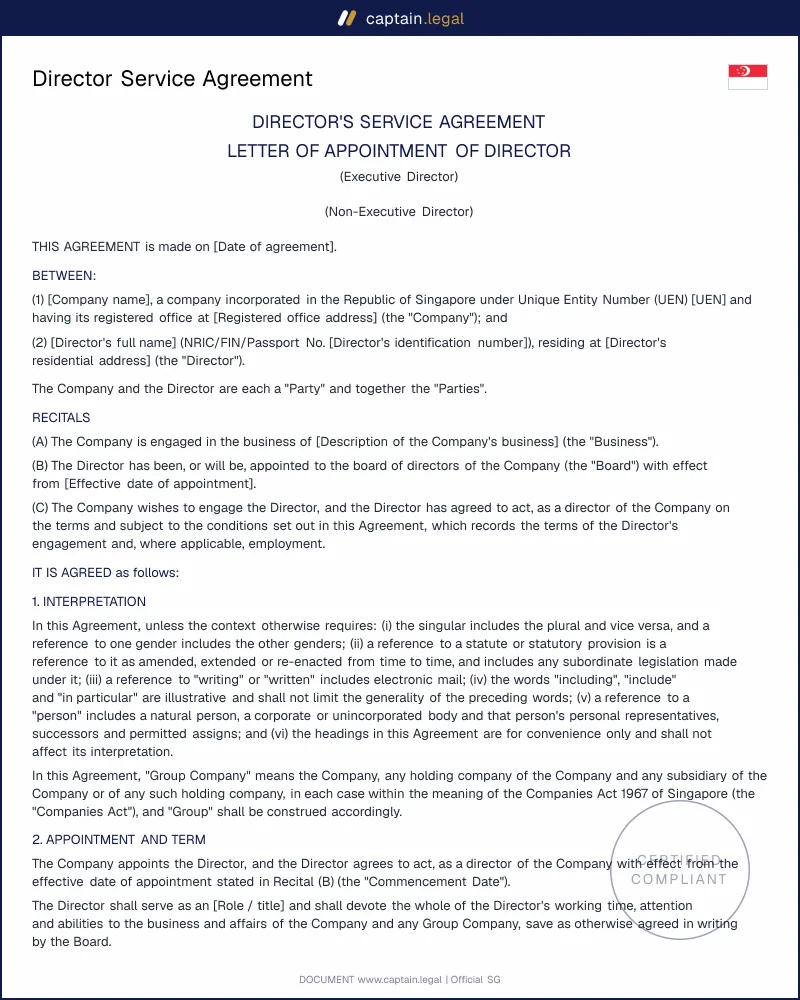
You start by identifying the company and the director, entering the company's name and Unique Entity Number and the individual's particulars as they appear on the consent to act. From there the template asks whether the engagement is executive or non-executive, and it adjusts the remuneration and duties sections accordingly, since a non-executive appointment needs a far lighter instrument. You then set the commencement date and choose between a fixed term and an open-ended engagement terminable on notice, with the notice periods filled in to sit above any Employment Act floor that applies.

The remuneration section takes your salary figure, any bonus mechanism and the benefits on offer, keeping director's fees separate from employment salary so the two are approved through the right channels. Next you calibrate the restrictive covenants, choosing the duration and geographic reach with the reminder that Singapore courts read these narrowly. The confidentiality and intellectual property terms are largely standard but can be tightened where the role touches sensitive material. A final review lets you check that the powers granted match your constitution before you download the finished agreement in Word and PDF, ready for signature and for the corresponding board resolution recorded through our Singapore directors' and shareholders' resolution template.

6

Common mistakes to avoid

The error I see most often is treating the service agreement as interchangeable with the appointment. Signing a consent to act and lodging the appointment with ACRA puts someone on the board, but it says nothing about pay, duties or exit, and companies that stop there end up arguing over terms that were never written down. The mirror-image mistake is giving a non-executive or nominee director a full executive service agreement, which manufactures an employment relationship nobody wanted and exposes the company to claims on departure. Classification should be settled before any drafting begins.

A further trap is drafting the director's powers without checking the constitution, so the contract purports to grant authority the constitution reserves to the board or the members, leaving the executive acting ultra vires. Overreaching restrictive covenants cause their own damage, since a Singapore court will strike down a restraint that is wider than the legitimate interest it protects, and a covenant struck down protects nothing at all. Finally, companies forget that the section 157 and section 156 duties are live from day one and now carry a heavier maximum fine since 6 May 2026, so a contract that stays silent on conflicts and disclosure leaves the director exposed and the company without a contractual remedy it could easily have secured.

Key takeaways

Scope

A service agreement is not appointment

A Director’s Service Agreement fills the gap after the board appointment. The appointment happens when the director signs a consent to act and the company lodges the appointment with ACRA, but that alone does not set pay, benefits, notice, duties, or restraints. Use the service agreement to define the day-to-day executive role and remuneration, instead of arguing later about what was promised.

Companies Act

Section 157 duties stay in force

The agreement should translate statutory fiduciary duties into clear contractual obligations, not water them down. Under section 157 Companies Act 1967, a director must act honestly and use reasonable diligence, and must not misuse position or information obtained as an officer. A breach is not just a contractual issue: section 157(3) makes it a criminal offence, and the company can also sue civilly for losses.

Governance

Align authority, conflicts, and board control

Authority must match what the constitution and shareholder arrangements allow. Section 157A places management in the board, so the contract should state what powers are delegated and what stays reserved to the board, reducing ambiguity for a CEO or managing director. It should also build in a conflicts process, since section 156 requires disclosure of interests in company transactions.

Frequently Asked Questions

Yes. A director's service agreement is a contract governed by Singapore's common law of contract, and once it is signed by both the company and the director with the intention to be bound, it is enforceable in the Singapore courts. Electronic signature is valid for this type of document under the Electronic Transactions Act 2010, so the agreement can be executed digitally. What gives the document real force is that it converts the director's statutory duties under section 157 of the Companies Act 1967 into express contractual promises, meaning the company can sue for breach of contract as well as rely on the statutory and fiduciary remedies. A properly completed template, adapted to your company and reviewed before signing, holds up as well as one drafted from scratch.

An appointment letter records that a person has become a director and usually accompanies the consent to act lodged with ACRA under section 145. It is short and does little more than confirm the office. A service agreement is a far fuller employment contract for an executive director, governing remuneration, duties, powers, confidentiality, restrictive covenants and how the relationship ends. A non-executive or nominee director typically needs only the appointment letter, because there is no salary or day-to-day management to document. An executive director who runs the business needs the service agreement, and giving one to a non-executive by mistake can accidentally create an employment relationship the parties never intended.

The director's service agreement is available in both Word and PDF. The Word version lets you make final adjustments to remuneration figures, notice periods and the scope of restrictive covenants before signing, which is useful because these terms are genuinely negotiated between the company and the incoming director. The PDF version gives you a clean, print-ready copy for execution and for the company's minute book. Most users complete the guided form, download the Word file to fine-tune the commercial terms, then produce the PDF for signature. Both formats reflect the same underlying drafting aligned with the Companies Act 1967 and Singapore practice.

Notice is set by the agreement itself, subject to the statutory floor in the Employment Act 1968 where the executive falls within its coverage. Contracts for senior executives commonly fix one to three months, and the figure should be entered in the agreement rather than left to default. Removal from the board is a separate question governed by the Companies Act 1967 and the constitution, and it does not automatically end the employment. This is precisely why the service agreement and the corporate removal mechanics must be read together, since a director removed by the members may still have a live employment claim if the notice and severance terms in the contract are not honoured.

It can, but only within limits. Singapore courts enforce restrictive covenants only where they protect a legitimate proprietary interest, such as trade secrets or client connections, and only to the extent reasonably necessary in duration and geographic scope. A covenant drafted too widely is not read down to a reasonable version; it is struck out entirely, leaving the company with no protection. The template therefore keeps non-competition and non-solicitation clauses narrow and tied to identifiable interests. Where confidentiality is the main concern rather than competition, a dedicated confidentiality instrument alongside the service agreement is often the stronger route.

Yes, and this is the point most first-time directors miss. The duties under section 157, requiring honesty and reasonable diligence, and under section 156, requiring disclosure of conflicts, apply by force of statute the moment a person becomes a director, whether or not any contract mentions them. A silent contract does not remove the duties; it simply deprives the company of a contractual remedy and leaves the director without a clear internal disclosure process. Since 6 May 2026 the maximum fine for a breach of director duties has risen to S$20,000, so restating these duties in the agreement is a sensible protection for both sides rather than mere legal boilerplate.

No. The service agreement is the employment contract for an executive director, combining the terms of office with the terms of employment in one instrument, which avoids the contradictions that arise when a person holds two overlapping documents. What the executive should not have is a plain staff employment contract that ignores the section 157 duties, because that document was never written for someone carrying fiduciary obligations. If a senior employee is being promoted to the board, the correct step is to replace the old staff contract with a service agreement, not to bolt a director appointment onto an employment contract designed for someone without a seat at the table.

4.8/5

9 verified reviews · 50 000+ downloads

Director Service Agreement: s.157 Companies Act
  • Immediate access to the document
  • PDF + Word download
  • Compliant with 2026 legislation
  • Reviewed by lawyers
Fill in the template
Secure payment
Updated on July 11, 2026

You might also like

Directors' & Shareholders' Resolution
First Board Resolutions Singapore