Create my document
Login

Choose country

SingaporeSingaporeChoose country
Employment & HR

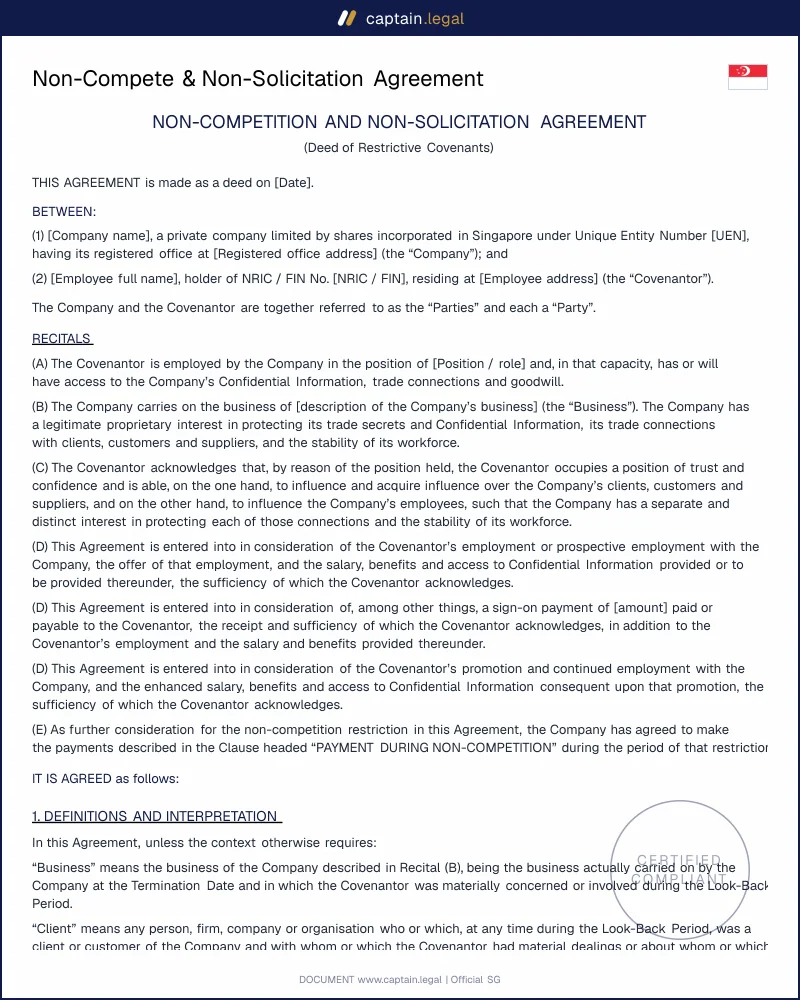
Non-Compete & Non-Solicitation Agreement (SGCA)

Restraint of trade drafted to Man Financial [2008] 1 SLR(R) 663 and recent High Court rulings. Enforceable non-solicitation scope. Word, PDF.
4.8/515 reviews50 000+ downloadsInstant download
Share

A Non-Compete and Non-Solicitation Agreement is a standalone restrictive covenant that an employer asks a departing or incoming employee to sign, restraining that person from competing against the business or poaching its clients and staff after employment ends. In Singapore it is treated as a restraint of trade, which means it starts life presumptively void and is enforced only where the employer can justify it. Drafted well, it protects genuine trade connections and confidential know-how. Drafted too widely, it protects nothing, because a Singapore court that finds a covenant unreasonable will simply refuse to enforce it. This page explains how the agreement works, the Man Financial reasonableness test that governs it, and how to scope a non-solicitation clause and a non-compete so they survive scrutiny.

Compliant

2026 Legislation

50,000+ clients

trust us

Affordable

From $4.90 / doc

Secure payment

Instant download

Non-Compete & Non-Solicitation Agreement (SGCA)

Secure payment

Fill in the template

What is a non-compete and non-solicitation agreement?

A non-compete and non-solicitation agreement bundles two distinct restraints into one instrument. The non-compete restrains a former employee from joining or setting up a competing business for a defined period within a defined area. The non-solicitation limb restrains the same person from approaching the employer's clients, suppliers or remaining staff. The two are often confused, yet the courts treat them very differently: a customer non-solicitation clause is far easier to justify than an outright ban on competing, because it targets a specific proprietary interest rather than the general freedom to earn a living.

You will meet these covenants inside a full employment contract, but a standalone deed has real advantages. It can be signed at a later stage, for example when an employee is promoted into a client-facing role or given access to sensitive pricing, and it lets you tailor the restraint to that person's actual exposure rather than relying on boilerplate buried in the original letter of appointment. Singapore has no statute fixing permitted durations or distances, unlike some jurisdictions. Everything turns on common law reasonableness, which is why the drafting of each restricted activity, each named client group and each month of the restraint period carries weight. A separate agreement also signals to a court that the parties turned their minds to the restriction, rather than treating it as a standard term nobody read.

2

When do you need this document?

The most common trigger is hiring or promoting someone into a role with real client contact. A sales lead, a relationship manager or a practice head who becomes the human face of your business to key accounts is precisely the person a trade connection restraint is meant to address. The interest is genuine, and a customer non-solicitation covenant scoped to clients that person actually dealt with stands a strong chance of holding. A second scenario is access to confidential commercial data such as pricing models, margins or supplier terms, though here you must remember that a confidentiality clause alone may already do the work, and the non-compete needs an interest beyond it.

A third situation is the departure of a senior employee whose exit threatens to unravel a team. Singapore recognises the maintenance of a stable, trained workforce as a protectable interest, so an employee non-solicitation clause preventing that person from poaching former colleagues can be justified where the staff are genuinely skilled and integral. The edge cases are where drafting earns its keep. A junior administrator with no client relationships and no access to secrets cannot lawfully be restrained; a court in Man Financial signalled that restraining such staff needs very special circumstances. Equally, restraints protecting potential rather than actual business, a market you hope to enter but do not yet serve, tend to fail, as the court held when it refused to shield an employer's aspirational Asian expansion. The safe path is a letter of authorisation style precision: name the interest, name the group, and stop there. For the surrounding contractual architecture, our Singapore employment contract drafted to the Employment Act 1968 shows how the restraint sits alongside notice and confidentiality terms.

3

Key clauses included in our template

  • The definition of the restricted activity is drafted narrowly to the business the employee actually worked in, not the whole industry. MoneySmart struck down a clause reaching every online financial-comparison business when the employee's real work concerned a single product line, so our template ties the prohibition to the specific services the employee was engaged in.
  • The customer non-solicitation covenant is limited to clients the employee personally dealt with or had confidential knowledge of during a defined look-back window, rather than the employer's entire client list. This is the covenant most likely to be enforced, because it maps directly onto the recognised trade connection interest.
  • The employee non-solicitation covenant restrains the poaching of colleagues who possess genuine skill and training, reflecting the stable-workforce interest accepted since Man Financial, while excluding purely junior staff whose restraint a court would refuse.
  • The restraint period and geographical scope are set as single, fixed figures, never as a cascade of alternatives. Because MoneySmart condemned cascading drafting for leaving the employee uncertain which limit applies, our template asks for one duration and one clearly defined area tied to where the business genuinely operates.
  • The legitimate-interest recital records, in the operative wording, the specific proprietary interest each restraint protects, and confirms the covenant guards an interest over and above any separate confidentiality clause, addressing the Stratech rule head-on.
  • The severability and consideration provisions allow an unreasonable limb to fall away without collapsing the whole deed, and record the consideration given, whether the offer of employment itself or a fresh benefit on promotion.
4

Regional considerations

Singapore is a single unified jurisdiction, so unlike a federal system there are no state or provincial variations in the restraint-of-trade doctrine. What varies instead is judicial attitude by sector and seniority, and the practitioner needs to read the covenant against the specific industry. In financial services and fintech, the MoneySmart and Man Financial line shows courts scrutinising geographical reach closely, refusing restraints that sweep in markets the employee never served. A clause binding a Singapore-facing employee across all of Southeast Asia will usually fail on geography alone, so the restricted area should match the territory where the employee actually built connections.

In technology and cybersecurity, the courts have been sceptical of activity scopes drawn at industry width. The Shopee decision confirms that where a confidentiality clause already exists, the non-compete must justify itself independently, a demanding threshold in a sector where know-how is the main asset. Employers here do better to lean on tightly drawn non-solicitation covenants than on broad non-competes. In professional services and education, the 2025 High Court decision in FirstCom Academy Pte Ltd v Oom Academy Pte Ltd [2025] SGHC 266 is a caution: the restraint failed at the very first hurdle because the employer could not prove any legitimate proprietary interest at all, so the court never reached reasonableness. The lesson across every sector is uniform. Identify the real interest before you draft the restriction, because a covenant without a proven interest behind it is worthless regardless of how modest its duration looks. Our Singapore NDA template built on the common law of confidence pairs naturally with a restraint where confidential information is the interest in play.

5

How to fill out this non-compete and non-solicitation agreement

You start by identifying the parties and the point at which the restraint is being taken, whether at the outset of employment or on a promotion, because the consideration differs in each case. From there the template asks you to name the legitimate proprietary interest you are protecting, prompting you to choose between trade connection, confidential information beyond an existing NDA, and a stable trained workforce, and to describe it in concrete terms rather than as a generic recital. You then define the restricted activity by reference to the actual services the employee worked on, and the template steers you away from industry-wide wording that the Shopee and MoneySmart courts rejected.

Next you set a single restraint period and a single geographical area, with guidance keeping you clear of cascading alternatives. For the non-solicitation limb you specify the client look-back window and confirm the covenant reaches only customers the employee personally dealt with. The document closes with severability, governing-law and signature blocks formatted for Singapore execution. Because reasonableness is judged at the moment of signing, the finished agreement should reflect the employee's role as it stands on that date. If the role later changes materially, our Singapore key employment terms statement is a useful prompt to revisit and, if needed, re-execute the restraint.

6

Common mistakes to avoid

The commonest error is reaching for width in the belief that a broader clause offers more protection. The opposite is true in Singapore. A covenant that bans all competition, covers a whole region the employee never served, or names the entire client base rather than the accounts the person actually handled, gives a court every reason to strike it down in full. The MoneySmart judgment is the cautionary tale: an activity scope drawn at the level of "any online financial-comparison business" collapsed because the employee's real work touched only one narrow product. Ambition in drafting is self-defeating when the remedy for unreasonableness is unenforceability, not judicial re-writing.

A second recurring mistake is the cascading restraint, where the drafter offers the court a menu of durations or areas hoping one will be accepted. Singapore courts dislike this because it leaves the employee unable to know what binds them, and MoneySmart treated it as a mark against enforceability. The third mistake is relying on a non-compete to protect information that a separate NDA already covers, without articulating any interest beyond it; after Shopee this is a near-automatic loss. A fourth, exposed in FirstCom Academy, is failing to prove a legitimate interest exists at all, which ends the enquiry before reasonableness is even considered. Finally, many employers forget that reasonableness is assessed at signing, so a restraint appropriate for a senior hire but signed years earlier when the person was junior may not hold. Where the interest is chiefly about client relationships, a focused restraint pairs well with the protections in our Singapore employment and HR document category.

Key takeaways

Restraint of trade

Presumptively void unless the employer justifies

In Singapore, post-employment non-competes and non-solicits start off presumptively void as a restraint of trade. The employer must earn enforcement under the Man Financial [2008] 1 SLR(R) 663 test by showing (1) a legitimate proprietary interest, (2) reasonable limits between the parties, and (3) consistency with the public interest. If any limb fails, the court can refuse enforcement entirely.

Scope drafting

Non-solicitation is easier than non-compete

Customer or staff non-solicitation is usually more defensible than a blanket ban on competing because it targets a specific trade connection or workforce stability. Drafting has to be tight: define the restricted activity, named client group or category, geography and restraint period. Singapore has no statutory caps on months or kilometres, so the clause lives or dies on reasonableness in the facts.

Litigation risk

Overbroad clauses can protect nothing

If the restraint is drafted too widely, a Singapore court may simply strike it down rather than rewrite it. A common pitfall is relying on “confidential information” where a confidentiality clause already exists; you still need to show an additional legitimate interest, or it looks like an attempt to stifle competition. Recent High Court decisions (eg Shopee [2024] SGHC 29) highlight how quickly this can unravel.

Frequently Asked Questions

It can be, but nothing about a restraint is automatic. Every post-employment covenant is presumptively void under the restraint-of-trade doctrine confirmed in Man Financial (S) Pte Ltd v Wong Bark Chuan David [2008] 1 SLR(R) 663, and it becomes binding only if the employer proves a legitimate proprietary interest and shows the restraint is reasonable in scope, duration and geography, and not contrary to the public interest. A well-scoped non-solicitation clause protecting genuine client connections is the most reliable to enforce. A broad ban on competing is the least reliable. The template is drafted to satisfy the three-limb test, but enforceability ultimately depends on the facts of the role and the accuracy with which you complete it.

A non-compete restrains the former employee from working in or running a competing business at all, within a set period and area. A non-solicitation clause is narrower: it stops the person from approaching the employer's clients, suppliers or staff, while leaving them free to work in the same field. Singapore courts enforce non-solicitation covenants far more readily because they target a specific interest, the employer's trade connection or its trained workforce, rather than restraining the general freedom to earn a living. Many restraints that would fail as non-competes survive when recast as tightly drawn non-solicitation obligations, which is why the template treats the two limbs separately.

There is no statutory maximum, because Singapore fixes no numeric limits. Duration is judged only by reasonableness against the interest protected, assessed at the date of signing. In practice, periods of six to twelve months are common for client-connection and workforce interests, and courts grow sceptical as the period lengthens without strong justification. The right duration is the shortest that genuinely protects the interest, and it should be a single fixed figure. Avoid stacking several possible periods, because the cascading drafting condemned in MoneySmart Singapore Pte Ltd v Artem Musienko [2024] SGHC 94 counts against enforceability by leaving the employee uncertain which limit applies.

Only if the non-compete protects an interest beyond the confidential information the NDA already covers. This is the Stratech rule affirmed in Man Financial and applied in Shopee Singapore Pte Ltd v Lim Teck Yong [2024] SGHC 29: where confidentiality is separately protected, the employer must show the restraint guards a legitimate proprietary interest over and above that information, or the court will treat the non-compete as a bare attempt to stifle competition and refuse to enforce it. In practice this means grounding the non-compete in trade connection or workforce stability, and drafting the recital to say so explicitly. A confidentiality obligation and a restraint should complement each other, not duplicate.

Singapore law recognises three. The first is trade secrets and confidential information. The second is the employer's trade connection with its customers, the relationships a client-facing employee builds and could carry to a competitor. The third is the maintenance of a stable and trained workforce, which supports employee non-solicitation covenants. A simple wish to avoid competition is never enough on its own; the court in Man Financial was clear that a bare desire to shield oneself from a former employee's competition will not be protected. The 2025 decision in FirstCom Academy Pte Ltd v Oom Academy Pte Ltd [2025] SGHC 266 shows the consequence of getting this wrong: with no proven interest, the restraint failed before reasonableness was even examined.

The agreement is available as an editable Word document and as a PDF. The Word version lets you adjust the restricted activity, the client look-back window, the restraint period and the geographical area to fit the specific role, which matters because reasonableness is assessed at the moment of signing and each restraint should be tailored to the individual. The PDF is ready for signature once the terms are settled. Because a restraint appropriate for one employee may be unreasonable for another, we recommend completing a fresh version for each person rather than reusing a single filled template across a team.

Yes, a restraint needs consideration like any contractual promise. Where the agreement is signed at the start of employment, the offer of the job itself supplies it. Where you introduce or tighten a restraint mid-employment, for instance on a promotion, you should provide fresh consideration, such as the new role, an increase in remuneration or another tangible benefit, and record it in the agreement. A restraint imposed on an existing employee for nothing in return is vulnerable. The template includes a consideration provision prompting you to state what was given, which strengthens the covenant and reflects that the parties genuinely bargained for the restriction rather than treating it as an afterthought.

4.8/5

15 verified reviews · 50 000+ downloads

Non-Compete & Non-Solicitation Agreement (SGCA)
  • Immediate access to the document
  • PDF + Word download
  • Compliant with 2026 legislation
  • Reviewed by lawyers
Fill in the template
Secure payment
Updated on July 11, 2026

You might also like

Internship & Trainee Agreement Singapore
Resignation Acceptance Letter Singapore
Non-Compete & Non-Solicitation Agreement Singapore